
BuddhistCatholicContemplativeEvangelicalGeneral ChristianHinduJewishLatter-day SaintMuslimNew VisionsProgressive Christian
Beliefs
- Buddhist
- Catholic
- Contemplative
- Evangelical
- General Christian
- Hindu
- Jewish
- Latter-day Saint
- More Voices
- Muslim
- New Visions
- Pagan
- Progressive Christian
Topics
- Religion News
- Food and Religion
- Sports and Religion
- Religious Art
- Religious Music and Entertainment
- Religious Events
- History and Religion
- Style and Religion
- Politics and Religion
- Women in Religion
- Recreation Outdoors and Religion
- Business Finance and Religion
- Careers Workplace and Religion
- Education and Religion
- Family Parenting and Religion
- Health Fitness and Religion
- Home and Religion
- Relationships and Religion
- Technology and Religion
- Travel and Religion
Columnists
- Buddhist Columnists
- Business Finance and Religion Columnists
- Careers Workplace and Religion Columnists
- Catholic Columnists
- Contemplative Columnists
- Education and Religion Columnists
- Evangelists Columnists
- Family Parenting and Religion Columnists
- General Christian Columnists
- Health Fitness and Religion Columnists
- Hindu Columnists
- History and Religion Columnists
- Home and Religion Columnists
- Jewish Columnists
- More Voices Columnists
- Latter Day Columnists
- Muslim Columnists
- New Visions Columnists
- Nonreligious Columnists
- Pagan Columnists
- Politics and Religion Columnists
- Progressive Columnists
- Recreation Outdoors and Religion Columnists
- Relationships and Religion Columnists
- Religion News Columnists
- Religious Art Columnists
- Religious Events Columnists
- Religious Music and Entertainment Columnists
- Sports and Religion Columnists
- Style and Religion Columnists
- Technology and Religion Columnists
- Travel and Religion Columnists
- Women in Religion Columnists
Resource Library
- 2026 Calendar
- Library of World Religions
- The 100 Most Holy Places on Earth
- Patheos Answers
- Podcasts
- Videos
- Faith Leaders Database
- Anglican Episcopalian
- Bahai
- Baptist
- Buddhism
- Christianity
- Confucianism
- Eastern Orthodoxy
- Hinduism
- Holiness and Pentecostal
- ISKCON
- Islam
- Judaism
- Lutheran
- Methodist
- The Church of Jesus Christ of Latter-day Saints
- New Age
- Paganism
- Presbytarian and Reformed
- Protestantism
- Religion Behind the Scenes
- Roman Catholic
- Scientology
- Shia Islam
- Sikhism
- Sufism
- Sunni Islam
- Taoism
- Zen
- See all religions
Research Tools
 Ad-Free & Subscriber Log-In Subscription Support
Ad-Free & Subscriber Log-In Subscription Support
Follow Patheos 

- Trending:
- Forgiveness
- |
- Marriage
- |
- Consciousness
- |
- Death Penalty
- |
- Election
- |
- Halloween

- Home
- Catholic
- Women in Religion
- A Catholic Tackles: The Question of Women’s Ordination
A Catholic Tackles: The Question of Women’s Ordination
Last updated on: September 22, 2022 at 9:03 am by Dennis Knapp
A Catholic Tackles: The Question of Women’s Ordination 2022-09-22T09:03:05-06:00 Dennis Knapp
Patheos Explore the world's faith through different perspectives on religion and spirituality! Patheos has the views of the prevalent religions and spiritualities of the world.
A Catholic tackles: the questions women’s ordination.
In conjunction with Matthew Graham at Rational Animal, The Latin Right and Rational Animal decided to tackle the same topic but through our own faith traditions. For this article, we tackle the topic of women’s ordination. I address the topic through the Roman Catholic perspective, while Matthew the Anglican. The questions Matthew and agreed to answer are:
- Does your faith tradition ordain women?
- If so, for what reason? If not, why not?
- What does this topic tell the reader about the way the faith tradition deals with doctrinal issues?
Does Your Faith Tradition Ordain Women?
The quick answer is no. Women’s ordination is not practiced in the Catholic Church. Often painted in terms of a denial of women’s access to ecclesial power, the Catholic Church sees this in a different light. I wrote about the subject of power denial before in my article The Jesus Prerogative: On Women Priests. In the article, I state:
Jesus did associate closely with women, true. However, no credible historical evidence exists of Jesus’ appointing of women Apostles, nor evidence of women bishops. If such credible evidence exists, and Jesus’ prerogative included women Apostles that in turn appointed successors through apostolic succession, the Church will honor this evidence and women priests and bishops would exist to this day. No such evidence exists, so the Church lacks the authority to overrule her Lord on the matter.
Moreover, not even the Mother of God, Mary the Theotokos, did Jesus appoint as an apostle. If anyone deserved this honor, Mary did. So, at the root of this denial to the episcopate is not power but the prerogative of Jesus. But there’s also more. This I address further in the article.
If Not Power, Then Why Not?
Per my other article, there exists no evidence of Jesus appointing women as apostles. These same apostles appointed bishops after them and no women were among them. This pattern existed throughout the history of the Catholic Church. Some may ask, “why not change now? Why cannot the Church get with the times and ordain women? Are not both men and women equal in dignity as children of God made in God’s image?” The Catholic Church’s ability to “change” doctrine has limits. These limits were fully articulated by Cardinal John Henry Newman in An Essay on the Development of Christian Doctrine. In the article, How Can the Church Change Its Views on Same-Sex Marriage?, I summarize the seven criteria of authenticity all doctrinal “changes” (development) need to meet:
- Maintains the original type.
- Cannot contradict its underlying principle.
- Maintains the overall health of the Church.
- Logically follows from past doctrines.
- Remains in accordance with the original idea when fully developed.
- Conserves and retains what came before.
- Stands the test of time.
Furthermore, failure to meet all seven tests of authenticity means a corruption occurred, not an authentic development in doctrine. When one examines the absence of historical and theological evidence, the ordination of women within the Catholic Church fails to meet a single criterion of authenticity.
In Persona Christi
The doctrine of in persona Christi Capitis teaches that through the sacrament of Holy Orders, Christ is present in His Church. The Catechism of the Catholic Church 1548 states:
In the ecclesial service of the ordained minister, it is Christ himself who is present to his Church as Head of his Body, Shepherd of his flock, high priest of the redemptive sacrifice, Teacher of Truth. This is what the Church means by saying that the priest, by virtue of the sacrament of Holy Orders, acts in persona Christi Capitis:
It is the same priest, Christ Jesus, whose sacred person his minister truly represents. Now the minister, by reason of the sacerdotal consecration which he has received, is truly made like to the high priest and possesses the authority to act in the power and place of the person of Christ himself (virtute ac persona ipsius Christi).
Christ is the source of all priesthood: the priest of the old law was a figure of Christ, and the priest of the new law acts in the person of Christ.
But where does maleness come into play? Christ became a man forever. Jesus was born of the Virgin Mary as male. This maleness was no accident of fate. Christ’s maleness was part of God’s plan. Why did God choose to become male? And how does this choice affect the priesthood?
Christ the Man. Does Maleness Matter?
Moreover, Deacon Matthew Newsome wrote an article in 2017 that makes excellent points on Christ’s maleness (and why God’s own preferred pronouns are male). In the article Women Priests and the Masculinity of Christ, he writes (forgive the extralong quote):
Jesus teaches us to call God “Father.” Jesus always refers to God as masculine. Why should this be? We know that God has no sex, as sex implies a physical body capable of reproduction. God is spirit. God is sexless for the same reason that angels are sexless. It just doesn’t apply. But even though God is not biologically male, God can still be masculine.
Let’s think about biology for a moment. The category of male makes no sense without the category of female. There are creatures that reproduce asexually and we do not classify those as male or female. Such terms have no meaning in those cases. But when we have a creature that reproduces sexually, we categorize certain members of the species as male and others as female — always both. The very idea of sex necessitates a complementary pair. One is meaningless without the other.
To be masculine implies a relationship, or at least the capacity for a relationship, with a corresponding feminine. But what determines which is which? Biologists don’t just flip a coin when they discover a new species and say, “we’ll call this one the male and that one the female.” Still speaking in biological terms, the nature of that relationship is this: the male gives seed; the female receives the seed into her body and there it grows and engenders life. At the most basic level, this is the difference between the sexes.
With all this in mind, we can return to the idea of God as masculine and look for the corresponding feminine. God can only be masculine in relationship something. What? The answer is the Church. This is why Christians have always referred to God as “he,” and the Church as “she.” The Church is feminine.
In summary, God chose Christ’s maleness because the Church is Christ’s bride and thus has femaleness. St. Paul affirms this understanding in Ephesians 5:22-33, where he uses the example of marriage to show the mystery of Christ’s relationship to His Church. Therefore, since the priest stands in persona Christi as Christ the male, we stand in persona ecclesia as the female Church.
In Conclusion… How To Deal With Doctrinal Issues
To sum up why the Catholic Church does not (and cannot) ordain women, consider the following:
- Jesus did not appoint women apostles, not even His mother, so the Church cannot now do so.
- The apostles did not appoint women bishops, so the Church cannot now do so.
- The doctrine of in persona Christi Capitis teaches that a male priest stands in the person of Christ in the Church. Women by their female nature cannot do this.
- The intentional maleness of Christ show’s God plan of salvation in that the Church stands in persona ecclesia as female and priest as in persona Christi as male.
Finally, Deacon Newsome ended his article with the following admonition that sums up the Catholic Church’s position nicely. This quote also shows how the Church deals with doctrinal issues. In short, through an adherence to the propagative of Christ. Doctrine do develop but they cannot contradict Christ’s teaching.
The Church has only that authority that was given to her by God. And what she received from God was a male priesthood. Jesus certainly entrusted women in His inner circle (the Blessed Mother and St. Mary Magdalene are two prime examples). Yet He chose only men to make up the Twelve. This is why in 1994 Pope St. John Paul II proclaimed in Ordinatio Sacerdotalis, that “the Church has no authority whatsoever to confer priestly ordination on women.” There were plenty of pagan religions in ancient times that had female priests. But this is not what Christ gave the Church.
It’s not a matter of wanting to or not wanting to. It’s a matter of being faithful to what was entrusted to the Church by God.
Now, some will ask about women deaconess in the early Church. I will address that on its own in a future article.
Like and follow me on Facebook and Twitter.

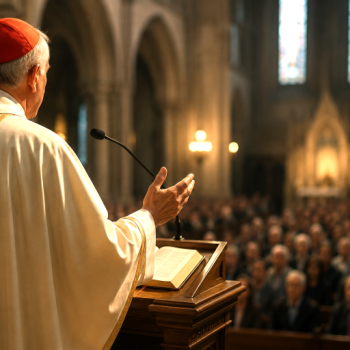
Taken from Pixabay
General Christian
Women in Religion
Politics and Religion
History and Religion
Previous Post

September 15, 2022
Lie Unto Others as You Would Have Them Lie Unto You…
Next Post
September 26, 2022 How Would You Counsel Chloe Cole About Her Gender Confusion?
Browse Our Archives
Select a Category Abortion Arius Atheists Catholic Apologetics Catholic Culture Catholic History Catholic Humor Catholic Poetry Catholic Politics Catholic Theology Dr. James White Faith Alone Joe Heschmeyer Kamala Harris Martin Luther Pope Francis Preborn Children President Biden Science and Catholicism Sola Scriptura Synod of Synodality Trinity
Select a Month October 2026 September 2026 August 2026 July 2026 June 2026 May 2026 April 2026 March 2026 February 2026 January 2026 December 2025 November 2025 October 2025 September 2025 August 2025 July 2025 June 2025 May 2025 April 2025 March 2025 February 2025 January 2025 December 2024 November 2024 October 2024 September 2024 August 2024 July 2024 June 2024 May 2024 April 2024 March 2024 February 2024 January 2024 December 2023 November 2023 October 2023 September 2023 August 2023 July 2023 June 2023 May 2023 April 2023 March 2023 February 2023 January 2023 December 2022 November 2022 October 2022 September 2022 August 2022 July 2022 June 2022 May 2022 April 2022 March 2022 February 2022 January 2022 December 2021 November 2021
Follow Us!
TAKE THE
Religious Wisdom Quiz
What is the key message of Proverbs about how to live?
Select your answer to see how you score.
Seek power Win battles Pursue wisdom Amass riches
Related posts from The Latin Right

The Poor Have Rights—and Responsibilities

Fighting Over the Rhetorical Woman

Is It Christian Nationalist to Want Christian Civilization?
When Pastoral Language Refuses to Answer
TRENDING AT PATHEOS Catholic

How to Make a Decision When You Can't...
Main point: It’s much more valuable to stay close to God so...

Archdiocese Hosts Military Marriage Retreat in Germany
RASTATT, Germany — The transient military lifestyle, with its frequent deployments and...

Nearly every morning, I make the drive to Detroit with my high-school-age...

The Real AI Story Is Adoption Without Trust
Artificial intelligence has crossed a political threshold. It is no longer a...

A new article, written by Jeff Lindsay and Gale L. Pooley,...

Swimfan: Forgotten Aughts Pleasures
This is a recovery effort. In 2002, My Big Fat Greek Wedding...
view all Catholic blogs
Ad-Free & Subscriber Log-In Subscription Support
- About Us
- 2026 Calendar
- Videos
- Podcasts
- Library of World Religions
- Faith In Media Tracker
- Advertise With Us
- Write for Us
- Privacy Policy
- Terms of Service
- Do Not Sell My Data
- Contact Us
- Radiant Digital
- Manage Newsletter Subscriptions
- Unsubscribe From Notifications
- Sitemap
Copyright 2008-2026, Patheos. All rights reserved.
Subscription Support Ad-Free & Subscriber Log-In
Follow Patheos