
BuddhistCatholicContemplativeEvangelicalGeneral ChristianHinduJewishLatter-day SaintMuslimNew VisionsProgressive Christian
Beliefs
- Buddhist
- Catholic
- Contemplative
- Evangelical
- General Christian
- Hindu
- Jewish
- Latter-day Saint
- More Voices
- Muslim
- New Visions
- Pagan
- Progressive Christian
Topics
- Religion News
- Food and Religion
- Sports and Religion
- Religious Art
- Religious Music and Entertainment
- Religious Events
- History and Religion
- Style and Religion
- Politics and Religion
- Women in Religion
- Recreation Outdoors and Religion
- Business Finance and Religion
- Careers Workplace and Religion
- Education and Religion
- Family Parenting and Religion
- Health Fitness and Religion
- Home and Religion
- Relationships and Religion
- Technology and Religion
- Travel and Religion
Columnists
- Buddhist Columnists
- Business Finance and Religion Columnists
- Careers Workplace and Religion Columnists
- Catholic Columnists
- Contemplative Columnists
- Education and Religion Columnists
- Evangelists Columnists
- Family Parenting and Religion Columnists
- General Christian Columnists
- Health Fitness and Religion Columnists
- Hindu Columnists
- History and Religion Columnists
- Home and Religion Columnists
- Jewish Columnists
- More Voices Columnists
- Latter Day Columnists
- Muslim Columnists
- New Visions Columnists
- Nonreligious Columnists
- Pagan Columnists
- Politics and Religion Columnists
- Progressive Columnists
- Recreation Outdoors and Religion Columnists
- Relationships and Religion Columnists
- Religion News Columnists
- Religious Art Columnists
- Religious Events Columnists
- Religious Music and Entertainment Columnists
- Sports and Religion Columnists
- Style and Religion Columnists
- Technology and Religion Columnists
- Travel and Religion Columnists
- Women in Religion Columnists
Resource Library
- 2026 Calendar
- Library of World Religions
- The 100 Most Holy Places on Earth
- Patheos Answers
- Podcasts
- Videos
- Faith Leaders Database
- Anglican Episcopalian
- Bahai
- Baptist
- Buddhism
- Christianity
- Confucianism
- Eastern Orthodoxy
- Hinduism
- Holiness and Pentecostal
- ISKCON
- Islam
- Judaism
- Lutheran
- Methodist
- The Church of Jesus Christ of Latter-day Saints
- New Age
- Paganism
- Presbytarian and Reformed
- Protestantism
- Religion Behind the Scenes
- Roman Catholic
- Scientology
- Shia Islam
- Sikhism
- Sufism
- Sunni Islam
- Taoism
- Zen
- See all religions
Research Tools
 Ad-Free & Subscriber Log-In Subscription Support
Ad-Free & Subscriber Log-In Subscription Support
Follow Patheos 

- Trending:
- Forgiveness
- |
- Marriage
- |
- Consciousness
- |
- Death Penalty
- |
- Election
- |
- Halloween

- Home
- Catholic
- History and Religion
- Sola Scriptura’s Refutation in the 5th Century
Sola Scriptura’s Refutation in the 5th Century
Last updated on: August 16, 2022 at 5:21 pm by Dennis Knapp
Sola Scriptura’s Refutation in the 5th Century 2022-08-16T17:21:12-06:00 Dennis Knapp
Patheos Explore the world's faith through different perspectives on religion and spirituality! Patheos has the views of the prevalent religions and spiritualities of the world.
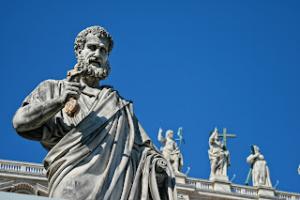 Did you know that the sixteenth century Protestant doctrine of sola scriptura was actually refuted in 431 AD by St. Vincent of Lerins? Allow to explain.
Who Should Interpret Scripture?
In the fourth chapter of his Commontorium, St. Vincent muses about who has the proper authority to interpret Scripture. His musings sound very modern. He wonders if there is a principle to properly discern between orthodoxy (right belief) and the “falsehood of heresy.”
He states:
“I have continually given the greatest pains and diligence to inquiring, from the greatest possible number of men outstanding in holiness and in doctrine, how I can secure a kind of fixed and, as it were, general and guiding principle for distinguishing the true Catholic Faith from the degraded falsehoods of heresy…?” [emphasis mine]
Many Scriptural Paths to Heresy
St. Vincent then takes up the difficulty of scriptural interpretation and how the improper use of Scripture leads many down a path toward heresy. He concluded all Scriptural interpretation must accord with that of the Catholic Church.
“Here, it may be, someone will ask, Since the canon of Scripture is complete, and is in itself abundantly sufficient, what need is there to join to it the interpretation of the Church? The answer is that because of the very depth of Scripture all men do not place one identical interpretation upon it. The statements of the same writer are explained by different men in different ways, so much so that it seems almost possible to extract from it as many opinions as there are men.
Novatian expounds in one way, Sabellius in another, Donatus in another, Arius, Eunomius and Macedonius in another, Photinus, Apollinaris and Priscillian in another, Jovinian, Pelagius and Caelestius in another, and latterly Nestorius in another. Therefore, because of the intricacies of error, which is so multiform, there is great need for the laying down of a rule for the exposition of Prophets and Apostles in accordance with the standard of the interpretation of the Church Catholic.” [emphasis mine]
Apostolic Authority, the Catholic Church, and Proper Interpretation
Finally, he then reaffirms this interpretive principle for all possible theological issues that may arise. One can turn to the Church Fathers, but even these “opinions” must be in line with, and in continuation and communion with, the Catholic Church.
“But what if some error arises regarding which nothing of this sort is to be found? Then he must do his best to compare the opinions of the Fathers and inquire their meaning, provided always that**, though they belonged to diverse times and places, they yet continued in the faith and communion of the one Catholic Church;**” [emphasis mine]
To read the full chapter, click here.
Sola Scriptura in the Ancient Church
The interpretative principle espoused by St. Vincent regarding the questions of who can properly interpret Scripture is the earliest formal warning against sola scriptura. The practice of sola scripture was not merely a 16th century innovation used to codify the divergent theological beliefs of the Reformers. On the contrary, sola scriptura IS the historical modus operandi for the justification for ALL theological beliefs that diverge from those held by the historic Church. The ONLY legitimacy both early heretics and later Protestant Reformers had for their beliefs were found in their ability to use “Scripture alone” to justify those beliefs. Without “Scriptural support,” their beliefs were merely unauthoritative opinion and held no weight.
Moreover, I do separate early heretics from Protestant Reformers. The latter’s acceptance of the Church’s Christology and Trinitology, which was the focus of early heretical beliefs, is not the Reformer’s error. Their error is of a totally different kind, even though the method to reach these errors were fundamentally the same. Martin Luther and John Calvin, for all their faults, were not foolish enough to attempt a full redefinition of Christianity. They recognized the early councils regarding the nature of Christ and the Trinity and they left those dogmas alone.
The date of St. Vincent’s Commontorium also gives it weight in this historical assessment of sola scripture. The Commontorium was written just after the Council of Ephesus (431 AD). St. Vincent lists all the major heretics of the early Church up to his own time (Nestorius). He demonstrates that the one unifying commonality amongst the variation of their beliefs is their universal reliance on, and misinterpretation of, Scripture alone. Let’s look at Arius and the Arians heresy of the 4th century to demonstrate this point.
The Arian Controversy
Arius (d. 336) was a Cyrenaic (Libyan) presbyter who taught that God the Son was the first created being and that “there was a time when He was not.” The Son was therefore a creature. As the first creature created out of nothing, God created the Son and thus became the “Father” at that point. God then used the created Son to create the world out of nothing. For further reading, click here. If Arius was alone and had no followers or adherents, his heresy would have died with him. Sadly, such was not the case. His numerous followers led Constantine to call the First Ecumenical Council of Nicaea in 325 AD.
The Arian Use of Sola Scriptura
Arius’ greatest concern, the foundation of this theological position, was his belief that pagan philosophy had infiltrated the Church. According to Arius, and those who followed after him, those who support the eventual “orthodox” position, did so by adopting words and concepts foreign to Scripture, especially in declaring that the Father and the Son shared the same “essence” or ousia (homoousia). This word, and its entire concept, Arius viewed as an innovation of bishops who stood in direct opposition to Scripture. The Arian 3rd Council of Sirmium summarizes this claim plainly:
“But since many persons are disturbed by questions concerning what is called in Latin substantia, but in Greek ousia, that is, to make it understood more exactly, as to ‘coessential,’ or what is called, ‘like-in-essence,’ there ought to be no mention of any of these at all, nor exposition of them in the Church, for this reason and for this consideration, that in divine Scripture nothing is written about them, and that they are above men’s knowledge and above men’s understanding;” [emphasis mine]
Furthermore, Arius and his followers believed theirs was the “orthodox” or “biblical” position. They supported their view by “Scripture alone,” not by an appeal to “extra-biblical” words and concepts absent from Scripture. To them, “Scripture alone” had the final say, not “extra-biblical” pagan philosophy pushed by deceived bishops.
Does this argument sound familiar?
The Use and Abuse of Scripture
The use and abuse of Scripture to propagate heresy was not an innovation of the 16th century. It is as old as the written Word (Bible) itself. Wherever there exist individuals who claim to know better, or to have “special” insight into what “the bible teaches,” there will always be the allure of authority over others that comes with sola scriptura. Whereas the interpretive principle of St. Vincent seeks to contextualize scriptural interpretation within the Catholic Church, sola scriptura seeks to “extract from it [Scripture] as many opinions as there are men.” Therefore, it is no accident that most Protestant confessions start with a support of sola scriptura. They MUST do so.
Protestant Confessions Use of Sola Scriptura:
Sixty-Seven Articles of Zwingli (1523): Opening Statement
Augsburg Confession (1530): Preface Paragraph 8
French Confession of Faith (1559): Article 2 and 3 (1 is a short confession on God’s nature)
Belgic Confession (1561): Article 2 and 3 (1 is a short confession on God’s nature)
39 Articles of Faith (1563): Article VI
The Westminster Confession of Faith (1647) Chapter 1: Of the Holy Scripture
In conclusion, the above confessions teach varying doctrines. The foundation and justification for this variety of belief is sola scriptura. Devoid of scriptural support, these “confessions” are mere group opinion documents. Therefore, they require an authority easily manipulated that offers no possibility for objection. The Scripture (Bible) has no will or ability to resist misinterpretation – and Protestants want it no other way.
Like what you read? Please check out my other writing here.
Please like and follow me on Facebook.
History and Religion
Previous Post

February 9, 2022
Anti-Racist Movement: Antithetical to the Eucharist
Next Post
February 16, 2022 Nobody Cares, and That’s a Good Thing
Browse Our Archives
Select a Category Abortion Arius Atheists Catholic Apologetics Catholic Culture Catholic History Catholic Humor Catholic Poetry Catholic Politics Catholic Theology Dr. James White Faith Alone Joe Heschmeyer Kamala Harris Martin Luther Pope Francis Preborn Children President Biden Science and Catholicism Sola Scriptura Synod of Synodality Trinity
Select a Month October 2026 September 2026 August 2026 July 2026 June 2026 May 2026 April 2026 March 2026 February 2026 January 2026 December 2025 November 2025 October 2025 September 2025 August 2025 July 2025 June 2025 May 2025 April 2025 March 2025 February 2025 January 2025 December 2024 November 2024 October 2024 September 2024 August 2024 July 2024 June 2024 May 2024 April 2024 March 2024 February 2024 January 2024 December 2023 November 2023 October 2023 September 2023 August 2023 July 2023 June 2023 May 2023 April 2023 March 2023 February 2023 January 2023 December 2022 November 2022 October 2022 September 2022 August 2022 July 2022 June 2022 May 2022 April 2022 March 2022 February 2022 January 2022 December 2021 November 2021
Follow Us!
TAKE THE
Religious Wisdom Quiz
What happened to Lot's wife as they fled Sodom?
Select your answer to see how you score.
She died by fire She turned into a pillar of salt She became blind She fell into a well
Related posts from The Latin Right

Amoris Laetitia Deserves a Better Defence

Rich Man, Poor Man: Altruism and Agency

The Order We Did Not Make: The World...

Is This “Culture War” Catholicism—or Evangelization?
TRENDING AT PATHEOS Catholic

Methodist Central Hall and Westminster Abbey
Situated on the same square is Methodist Central Hall and Westminster Abbey. ...

57th Dove Awards Honor Dolly Parton, Crown New...
On gospel music’s biggest night, the 57th annual GMA Dove Awards honored...

The First Eucharistic Controversy: Christ’s Real Presence
For Catholics, the Eucharist is the source and summit of the Christian...

What a Stop Sign Can Teach Us About...
How to Make a Decision When You Can't Hear God Main point:...

Archdiocese Hosts Military Marriage Retreat in Germany
RASTATT, Germany — The transient military lifestyle, with its frequent deployments and...

Nearly every morning, I make the drive to Detroit with my high-school-age...
view all Catholic blogs
Ad-Free & Subscriber Log-In Subscription Support
- About Us
- 2026 Calendar
- Videos
- Podcasts
- Library of World Religions
- Faith In Media Tracker
- Advertise With Us
- Write for Us
- Privacy Policy
- Terms of Service
- Do Not Sell My Data
- Contact Us
- Radiant Digital
- Manage Newsletter Subscriptions
- Unsubscribe From Notifications
- Sitemap
Copyright 2008-2026, Patheos. All rights reserved.
Subscription Support Ad-Free & Subscriber Log-In
Follow Patheos