
BuddhistCatholicContemplativeEvangelicalGeneral ChristianHinduJewishLatter-day SaintMuslimNew VisionsProgressive Christian
Beliefs
- Buddhist
- Catholic
- Contemplative
- Evangelical
- General Christian
- Hindu
- Jewish
- Latter-day Saint
- More Voices
- Muslim
- New Visions
- Pagan
- Progressive Christian
Topics
- Religion News
- Food and Religion
- Sports and Religion
- Religious Art
- Religious Music and Entertainment
- Religious Events
- History and Religion
- Style and Religion
- Politics and Religion
- Women in Religion
- Recreation Outdoors and Religion
- Business Finance and Religion
- Careers Workplace and Religion
- Education and Religion
- Family Parenting and Religion
- Health Fitness and Religion
- Home and Religion
- Relationships and Religion
- Technology and Religion
- Travel and Religion
Columnists
- Buddhist Columnists
- Business Finance and Religion Columnists
- Careers Workplace and Religion Columnists
- Catholic Columnists
- Contemplative Columnists
- Education and Religion Columnists
- Evangelists Columnists
- Family Parenting and Religion Columnists
- General Christian Columnists
- Health Fitness and Religion Columnists
- Hindu Columnists
- History and Religion Columnists
- Home and Religion Columnists
- Jewish Columnists
- More Voices Columnists
- Latter Day Columnists
- Muslim Columnists
- New Visions Columnists
- Nonreligious Columnists
- Pagan Columnists
- Politics and Religion Columnists
- Progressive Columnists
- Recreation Outdoors and Religion Columnists
- Relationships and Religion Columnists
- Religion News Columnists
- Religious Art Columnists
- Religious Events Columnists
- Religious Music and Entertainment Columnists
- Sports and Religion Columnists
- Style and Religion Columnists
- Technology and Religion Columnists
- Travel and Religion Columnists
- Women in Religion Columnists
Resource Library
- 2026 Calendar
- Library of World Religions
- The 100 Most Holy Places on Earth
- Patheos Answers
- Podcasts
- Videos
- Faith Leaders Database
- Anglican Episcopalian
- Bahai
- Baptist
- Buddhism
- Christianity
- Confucianism
- Eastern Orthodoxy
- Hinduism
- Holiness and Pentecostal
- ISKCON
- Islam
- Judaism
- Lutheran
- Methodist
- The Church of Jesus Christ of Latter-day Saints
- New Age
- Paganism
- Presbytarian and Reformed
- Protestantism
- Religion Behind the Scenes
- Roman Catholic
- Scientology
- Shia Islam
- Sikhism
- Sufism
- Sunni Islam
- Taoism
- Zen
- See all religions
Research Tools
 Ad-Free & Subscriber Log-In Subscription Support
Ad-Free & Subscriber Log-In Subscription Support
Follow Patheos 

- Trending:
- Forgiveness
- |
- Marriage
- |
- Consciousness
- |
- Death Penalty
- |
- Election
- |
- Halloween

- Home
- Catholic
- History and Religion
- By Martin Luther the Church Falls
By Martin Luther the Church Falls
Last updated on: August 16, 2022 at 5:22 pm by Dennis Knapp
By Martin Luther the Church Falls 2022-08-16T17:22:23-06:00 Dennis Knapp
Patheos Explore the world's faith through different perspectives on religion and spirituality! Patheos has the views of the prevalent religions and spiritualities of the world.
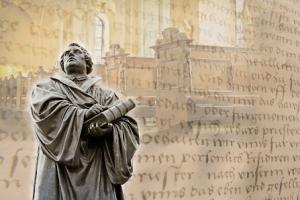 Did the Church fall in its infancy? According to German Reformer Martin Luther, it did.
In this article, I will evaluate the claim by Martin Luther that the Church stands or collapses on the understanding of faith alone as forensic justification (FAFJ).
This article will NOT demonstrate a developed Tridentine understanding of justification existed in the early Church. There existed no such understanding. A fully developed understanding of justification, like the Trinity, took time.
Furthermore, the Catholic Church nowhere states that an understanding in part constitutes the collapse of the whole. Luther makes the claim and therefore that claim we must examine. Did the Church fall?
How Did the Church Fall?
Martin Luther summed up the fulcrum by which all of Christianity stands or falls when he stated:
“quia isto articulo stante stat Ecclesia, ruente ruit Ecclesia— “Because if this article [of justification] stands, the church stands; if this article collapses, the church collapses.” (Mart WA 40/3.352.3)
The article Luther refers to is justification by faith alone or forensic justification (FAFJ).
“When we talk about justification being forensic, we mean that, in the final analysis, God justifies us when He pronounces that in His sight we are considered, deemed, or regarded as just. Forensic justification involves God’s declaration of a person being just in His sight. It is a legal declaration by which God declares a person just.” – RC Sproul
Luther’s Logical Fall
If we follow Luther’s logic and cannot show that the Church has always taught FAFJ, then we must conclude that the Church did indeed fall. Nor does Luther give us other options. He does not allow for the development of this doctrine. He does not allow FAFJ to exist in some sort of proto form at an earlier time to then develop into Luther’s full form in the 16th century. No, he states quite clearly that if this article collapses, the whole Church collapses with it. Juxtapose this with Jesus’ words in Matthew 16:18 and we see that the Church and Martin Luther have a problem.
A careful evaluation of historical Christian thought and practices shows FAFJ a theological innovation of Martin Luther in the 16th century. It was an innovation in response to the Catholic Church’s abuse of indulgences. FAFJ was unknown to early Christian writers. Conversely, if early Christian writers had a concept of FAFJ, the means by which they dealt with grave sin after baptism, especially fornication, adultery, apostasy, and sacrilege, would have been different. The way in which early Christians discussed, argued, and ultimately resolved the issue of grave sin after baptism shows a total lack of understanding of FAFJ.
Faith Alone Thought Early Church?
It is true that some early Christian writers did placed the words “faith” and “alone” together in their writings. For example:
Novatian, 200-258 AD
“God rejoices in our faith alone, in our innocence alone, in our truth alone, in our virtues alone. And these dwell not in our belly, but in our soul; and these are acquired for us by divine awe and heavenly fear, and not by earthly food.” (Novatian, On the Jewish Meats, Chapter V,)
Aristides, 2nd Century AD
“Now by the grace of God it was given me to speak wisely concerning Him. So far as I have received the faculty I will speak, yet not according to the measure of the inscrutability of His greatness shall I be able to do so, but by faith alone do I glorify and adore Him.” (The Apology of Aristides, Introduction)
Chrysostom 347-407 AD
Again, they said that he who adhered to Faith alone was cursed, but he shows that he who adhered to Faith alone, is blessed. (Chrysostom, Homilies on the First Epistle of St. Paul to Timothy, Homily IV, on 1 Tim. 1:15,)
Theodoret, 393-458 AD
“Through faith alone I look for finding some mercy in the day of the Lord’s appearing. I wish and I pray that I may follow the footprints of the holy Fathers, and I earnestly desire to keep undefiled the evangelic teaching which was in sum delivered to us by the holy Fathers assembled in council at the Bithynian Nicæa.” (Of Theodoretus, Bishop of Cyrus, to Dioscorus, Archbishop of Alexandria)
Faith Alone Properly Defined
At this point, any honest theologian or historian should ask the obvious question: did the writers just quoted understand faith alone to mean FAFJ as espoused by Martin Luther? Short answer, no, they did not. When an early Church writer placed the words “faith” and “alone” together does not mean they had Luther’s understanding of FAFJ in mind. A careful analysis of their overall writings shows this is indeed the case. In fact, the early Church did not have a clear and concise understanding of justification, but it is clear they DID NOT have in mind Luther’s innovation of FAFJ.
Exegeting Faith Alone the Church Stands
The only instance faith alone appears in scripture precedes the word “not.”
You see that a person is justified by works and not by faith alone. – James 2:24.
Those who adhere to FAFJ go to great lengths to demonstrate that the “not” before “faith alone” does not mean “not” as the plain reading of the text would suggest. “No,” they say. They then proceed to perform various exegetical gymnastics to show that James is using a different kind of faith than Paul uses in Romans and Galatians (Galatians 2:15–16 and Romans 4:2). They then conclude that, since James and Paul use “faith” in different ways, we cannot use James 2:24 to refute FAFJ. The obvious reading is off the table.
Furthermore, if this principle of exegesis, used by adherence of FAFJ for the only scripture where faith alone appear together, then this same interpretive principle also applies to the writings of early Church that use the words faith alone. All examples of faith alone in any early Church writing are now off the table.
No early Christian taught FAFJ as understood by Martin Luther. The early Church is silent on FAFJ. The way it addressed issues of sin also demonstrate this reality (I deal with this topic here). Therefore, the only logical (and historical/theological) conclusion to reach is that the Church did not fall—just as Christ promised.
Like what you read? Please check out my other writing here.
Please like and follow me on Facebook.
History and Religion
Previous Post

February 16, 2022
Nobody Cares, and That’s a Good Thing
Next Post
February 23, 2022 Baptism: Sin and Forgiveness in the Early Church
Browse Our Archives
Select a Category Abortion Arius Atheists Catholic Apologetics Catholic Culture Catholic History Catholic Humor Catholic Poetry Catholic Politics Catholic Theology Dr. James White Faith Alone Joe Heschmeyer Kamala Harris Martin Luther Pope Francis Preborn Children President Biden Science and Catholicism Sola Scriptura Synod of Synodality Trinity
Select a Month October 2026 September 2026 August 2026 July 2026 June 2026 May 2026 April 2026 March 2026 February 2026 January 2026 December 2025 November 2025 October 2025 September 2025 August 2025 July 2025 June 2025 May 2025 April 2025 March 2025 February 2025 January 2025 December 2024 November 2024 October 2024 September 2024 August 2024 July 2024 June 2024 May 2024 April 2024 March 2024 February 2024 January 2024 December 2023 November 2023 October 2023 September 2023 August 2023 July 2023 June 2023 May 2023 April 2023 March 2023 February 2023 January 2023 December 2022 November 2022 October 2022 September 2022 August 2022 July 2022 June 2022 May 2022 April 2022 March 2022 February 2022 January 2022 December 2021 November 2021
Follow Us!
TAKE THE
Religious Wisdom Quiz
Who lay on his side for over a year as a prophetic sign?
Select your answer to see how you score.
Ezekiel Daniel Hosea Micah
Related posts from The Latin Right

Amoris Laetitia Deserves a Better Defence

Rich Man, Poor Man: Altruism and Agency

The Order We Did Not Make: The World...

Is This “Culture War” Catholicism—or Evangelization?
TRENDING AT PATHEOS Catholic

Archdiocese Hosts Military Marriage Retreat in Germany
RASTATT, Germany — The transient military lifestyle, with its frequent deployments and...

Nearly every morning, I make the drive to Detroit with my high-school-age...

The Real AI Story Is Adoption Without Trust
Artificial intelligence has crossed a political threshold. It is no longer a...

A new article, written by Jeff Lindsay and Gale L. Pooley,...

Swimfan: Forgotten Aughts Pleasures
This is a recovery effort. In 2002, My Big Fat Greek Wedding...

Top Three Anti-Catholic Lies About Catholicism
This is my initial transcript for the video, "THE 3 WORST...
view all Catholic blogs
Ad-Free & Subscriber Log-In Subscription Support
- About Us
- 2026 Calendar
- Videos
- Podcasts
- Library of World Religions
- Faith In Media Tracker
- Advertise With Us
- Write for Us
- Privacy Policy
- Terms of Service
- Do Not Sell My Data
- Contact Us
- Radiant Digital
- Manage Newsletter Subscriptions
- Unsubscribe From Notifications
- Sitemap
Copyright 2008-2026, Patheos. All rights reserved.
Subscription Support Ad-Free & Subscriber Log-In
Follow Patheos