
BuddhistCatholicContemplativeEvangelicalGeneral ChristianHinduJewishLatter-day SaintMuslimNew VisionsProgressive Christian
Beliefs
- Buddhist
- Catholic
- Contemplative
- Evangelical
- General Christian
- Hindu
- Jewish
- Latter-day Saint
- More Voices
- Muslim
- New Visions
- Pagan
- Progressive Christian
Topics
- Religion News
- Food and Religion
- Sports and Religion
- Religious Art
- Religious Music and Entertainment
- Religious Events
- History and Religion
- Style and Religion
- Politics and Religion
- Women in Religion
- Recreation Outdoors and Religion
- Business Finance and Religion
- Careers Workplace and Religion
- Education and Religion
- Family Parenting and Religion
- Health Fitness and Religion
- Home and Religion
- Relationships and Religion
- Technology and Religion
- Travel and Religion
Columnists
- Buddhist Columnists
- Business Finance and Religion Columnists
- Careers Workplace and Religion Columnists
- Catholic Columnists
- Contemplative Columnists
- Education and Religion Columnists
- Evangelists Columnists
- Family Parenting and Religion Columnists
- General Christian Columnists
- Health Fitness and Religion Columnists
- Hindu Columnists
- History and Religion Columnists
- Home and Religion Columnists
- Jewish Columnists
- More Voices Columnists
- Latter Day Columnists
- Muslim Columnists
- New Visions Columnists
- Nonreligious Columnists
- Pagan Columnists
- Politics and Religion Columnists
- Progressive Columnists
- Recreation Outdoors and Religion Columnists
- Relationships and Religion Columnists
- Religion News Columnists
- Religious Art Columnists
- Religious Events Columnists
- Religious Music and Entertainment Columnists
- Sports and Religion Columnists
- Style and Religion Columnists
- Technology and Religion Columnists
- Travel and Religion Columnists
- Women in Religion Columnists
Resource Library
- 2026 Calendar
- Library of World Religions
- The 100 Most Holy Places on Earth
- Patheos Answers
- Podcasts
- Videos
- Faith Leaders Database
- Anglican Episcopalian
- Bahai
- Baptist
- Buddhism
- Christianity
- Confucianism
- Eastern Orthodoxy
- Hinduism
- Holiness and Pentecostal
- ISKCON
- Islam
- Judaism
- Lutheran
- Methodist
- The Church of Jesus Christ of Latter-day Saints
- New Age
- Paganism
- Presbytarian and Reformed
- Protestantism
- Religion Behind the Scenes
- Roman Catholic
- Scientology
- Shia Islam
- Sikhism
- Sufism
- Sunni Islam
- Taoism
- Zen
- See all religions
Research Tools
 Ad-Free & Subscriber Log-In Subscription Support
Ad-Free & Subscriber Log-In Subscription Support
Follow Patheos 

- Trending:
- Forgiveness
- |
- Marriage
- |
- Consciousness
- |
- Death Penalty
- |
- Election
- |
- Halloween
 The Lady's Quill
- Home
- Pagan
- The Lady’s Quill: To Listen
The Lady’s Quill: To Listen
Last updated on: October 8, 2015 at 4:00 pm by Laine Mardollsdottir
The Lady’s Quill: To Listen 2015-10-08T16:00:12-07:00 Laine Mardollsdottir
Patheos Explore the world's faith through different perspectives on religion and spirituality! Patheos has the views of the prevalent religions and spiritualities of the world.
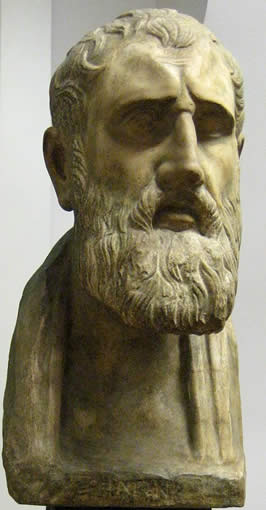
“Zeno of Citium pushkin” by user:shakko – Own work. Licensed under CC BY-SA 3.0 via Commons.

“We have two ears and one mouth, so we should listen more than we say.” Zeno of Citium
I learned the quote above as a child. I didn’t understand it, because I didn’t know how to listen. I was a motormouth and often still am; I love sharing what’s going on inside my head. I thought that I loved to communicate, but I didn’t really understand communication at the time. I just enjoyed laying a spell on others so that they might see what I saw, and was exceptionally good at it.
Communication is a multi-way street, though. I’ve always been good at compelling others to listen when I speak aloud. It took me a long time to realize that not everyone was just as talented at it and yet they had just as much to share. That’s when I started to learn about active listening; not just absorbing words but forcing your mind to work to understand what someone else is trying to convey.
Active Versus Passive Listening
Active listening is difficult. It requires a level of disengagement of ego, because to understand what is being conveyed you need to disable or at least suppress the parts of yourself that want to rise to your defense. If you fail to do that you are more likely to take something personally or feel that it is an attack when that is not the intent. Trying to assume goodwill on the part of the speaker, trying to listen to the words and pay close attention to the nonverbal cues that the person is expressing, and taking time to think about statements and questions that make you upset or uncomfortable are all powerful tools in active listening.
When we listen passively, we allow streams of words and concepts to wash over us, and only truly notice the ones that touch upon a powerful or basic need of ours. Being that we all wish to preserve ourselves, we latch on first to the words and phrases that we perceive as associated with threats.
This is unhelpful. First off, it often forces our bodies into a defensive posture and a fight-or-flight response. Heart rate increases, adrenaline pumps, and we become biologically prepared for an imminent confrontation. While adrenaline is helpful in the wild and in physical situations it’s rarely useful in social ones. Usually the person overwhelmed by their adrenaline becomes aggressively defensive and overbearing, qualities that lead to a breakdown of communication.

Francois Etienne du Plessis / Shutterstock.com
It also means that the hard work of developed nuance and the reasons behind the emotional quality of the words will be lost on the listener. Nothing exists on its own to be its own; everything must exist within context. Listening (or reading) passively strips individual parts of speech of their context which in turn strips what’s being said of its meaning.
It’s difficult, and it’s a process. To listen actively you not only need to pay attention to what’s being said, but turn it through your own mind and engage in a level of empathy. As I said before, context is vital; when I say a phrase to you it may mean something completely different from what you mean when you say the same thing to me and unless I can put myself in your shoes to some extent that context will be lost on me.
It’s especially difficult when you’re trying to build that context from the bottom up and understand an experience foreign to you. You have to work on metaphors that both of your share, often with back-and-forth discussion, while acknowledging that your shared experiences are likely mere approximations of one another. By building on this you can develop a level of understanding between the parties involved; a common language that neither spoke before. This can be invaluable in building on further communication.
We see through a pair of eyes no one else ever has, hear with ears that no one else can hear through, and think with a brain shaped by genetics and experiences that are unique to each of us. Our languages are often clumsy tools; hard to wield effectively – and we all know that a tool wielded poorly will often end up becoming an weapon accidentally.
Discomfort
Active listening is uncomfortable if you do it right; at least it starts out that way. It has to be – you can’t remain comfortable and try and work to comprehend experiences that you do not share or ideas that are new to you. Pain is always a sign of growth and change; it hurts to stretch your mind and heart as much as it can your body. That makes it hard to want to do, and we unconsciously avoid it as a result. Sometimes you don’t have the energy, sometimes you don’t have the time, sometimes you’re already emotionally off-balance and not in a good place to listen actively.
I regularly witness people close their minds when they hear a buzzword or phrase that upsets them. It’s unfortunate, because it often involves someone who is genuinely being harmed or experiencing an injustice being ignored or verbally assaulted when they try to relay the immanent reality of their experience. Often people object with, “So-and-so is just trying to make me feel bad, or feel guilty.”
Good. Feel bad. Feel guilty. It’s okay. Don’t recoil from that emotion, no matter how unpleasant it feels. Take it, hold it, embrace it, and examine it. When we want to know about a person we ask about their ancestors; do the same with that discomfort or upset. Find the origins of that feeling. Find our why you are feeling guilty, seek to understand why what is being said makes you uncomfortable. Don’t let the discomfort rule you; hold fast, examine it, learn its source and motivations.
Note that I’m not suggesting people wallow in their guilt or discomfort; that helps no one but martyrs. Instead learn it, and learn its origins. That discomfort can teach you a lot about yourself and in turn you will learn more about the person whose words or actions made you feel that way. It’s okay for your feelings to be hurt. It’s okay for your ego to be damaged. Your feelings will change once you’ve worked through them; your ego will heal over time if you nurture it.
However, that pain can interrupt the process of active listening. There are ways to avoid that, and the best way I’ve found is admitting that I may be wrong about something and stepping away. Then I can spend personal time contemplating it, discuss it with people I trust, perform divination or praying for guidance, and otherwise try to put it into perspective. Discussing something important from a place of pain can be like grocery shopping when you’re hungry; your desires and responses are magnified and you are likely to make decisions that you will regret later. Learn to take a step back, and if someone tries to pursue, set down your boundaries firmly. Let them know that you need time to process.
Active Listening and the Pagan Village
For the past many years, there have been waves of controversy and disagreement within the Pagan communities in the USA. We’ve encountered conflict over sexuality, gender identity, race, sources of information, styles of belief and practice, our collective pasts and our fractured futures. These are necessary parts of our growth and development and actually heartening as they’re patterns that have occurred and repeated in well-established, long-term religious movements. However, that growth isn’t always going to be healthy. It’s important that actively attempt to understand the experiences of others when we are confronted with these differences of experience.
These conflicts that we’re experiencing in our communities can be resolved in a healthy fashion. I’m not one who believes that unity is always for the best; if greater rifts or separation within our communities are what we need and will be healthiest then I hope that that is what will happen. In any case, we want our Pagan village to grow to be better than it is right now. We can do what humans have so often done before and listen solely to what our emotions tell us to do and react, but that won’t lead our village to greater health. To truly understand and embrace our destiny we need to do our best to instead listen to what our emotions and reactions tell us about ourselves and the people that we are reacting to.
I still say that I’m a poor listener, although people tell me otherwise. Far too often I realize that I’m not listening and trying to understand so much as waiting for my chance to speak. I try to check myself when that happens but I’m not perfect and I fail at that. Don’t think that I’m trying to tell people to do something that I myself don’t struggle with; on the contrary it’s a constant battle for me and I’ve made some admittedly terrible mistakes relating to not listening in the past.
The key is to try. Work through your own reluctance, work through your own discomfort, and try to understand the perspectives that are not your own. Listen when someone speaks about their pain. Open your mind when someone tries to relate something that you don’t believe in or don’t think that you can comprehend. The smallest voices, the least-listened-to voices, the minority voices, the quiet voices often aren’t loud for good reasons, usually because of fear of misunderstanding or frustration with having been ignored or overlooked. I’m good at advocating for my own interests because I’m a reasonably intelligent, eloquent loudmouth; not everyone is capable of being those things. Not everyone should have to be those things to be heard.
All I am asking is that you try. Try listening to the voices that you’ve ignored or that make you uncomfortable. Try examining the reasons for that discomfort and discussing them without talking over them. If you think your reasons for your discomfort are legitimate after you’ve examined them then I won’t fault you for disagreeing or turning away. If you come to realize that your pain comes from unexamined parts of yourself and try to understand it to work past it not only will I not fault you; I’ll applaud you. If you work to listen actively and take the time and expend the energy to truly understand another’s point of view (especially if it’s a voice that’s being ignored or shunned) I’ll actively celebrate you.
We may learn that some of these divisions that we see in our community need to widen; that rather than neighborhoods in the Pagan village we may have to have separate towns surrounding it.. Even if we do maintain unity, we’ll still have a long way to go to resolving these struggles and understandings about our identities and the way we treat one another. We won’t be able to make healthy decisions about these things unless we practice active listening when these dialogues get painful. Not wanting to understand someone else is the first step to dehumanizing them; conversely wanting to understand them even when its difficult is the first step to knowing them and accepting them.
If you want to learn about active listening, there are many good resources. I’d recommend Nonviolent Communication by Marshall Rosenberg and the materials of the King Institute for mundane sources. If you are looking for spiritual advisers on the subject, ask of the moon (Mani or whatever you choose to call it) as it has been watching us since the dawn of our species, ask of the stones as they have been listening and recording the history of this world. Ask the Ancestors as they do far more listening than speaking now. Among the Gods ask of Forseti who is known as a reconciler and wise judge, or Heimdall who hears and sees all from his post upon the rainbow bridge, or Frigga who knows all but says little.
May our will be strong enough to wade through the discomfort we experience to find the treasure of understanding on the other side. May our hands be open in friendship and fellowship and our differences be understood, acknowledged, accepted, and respected. May we help support the voices of those who are marginalized and ignored, and may we learn to be silent to allow others to speak and to be active in our listening to allow ourselves to understand. May our ears listen, our minds be clear, and our hearts open.


Click here to like
Patheos Pagan on Facebook.

Click here to like
the Agora on Facebook
The Lady’s Quill is published on the second and fourth Thursday of every month. You can subscribe by RSS and e-mail.
Please use the links to the right to keep on top of activities here on the Agora as well as across the entire Patheos Pagan channel.
Previous Post

September 24, 2015
Queer and Trans Identities and Pagan Mythology
Next Post
October 22, 2015 The Lady's Quill: The Three Kindreds and My Polytheist Theology
Browse Our Archives
Select a Category Columns Community Interfaith Nature Politics Ritual and Practice The Lady's Quill Theology, Ethics, Philosophy Uncategorized
Select a Month January 2017 December 2016 November 2016 October 2016 September 2016 August 2016 June 2016 March 2016 February 2016 December 2015 November 2015 October 2015 September 2015 August 2015
TAKE THE
Religious Wisdom Quiz
In 2 Peter, what did God not spare when he judged the people of Noah's Time?
Select your answer to see how you score.
Sodom and Gomorrah The ancient world Angels who sinned The wicked
Related posts from The Lady's Quill

Pagans Need To Remember The Holocaust As Well

Night Has Fallen, Light Your Torches

Greeting Freyja: A Simple Rite

TRENDING AT PATHEOS Pagan

When we talk about Greek religion, we often begin with the dodekatheion—the...

I was recently chatting with someone on Instagram. She asked me what...

While there are many people who share their results, the end of...

On July 23, I saw Christopher Nolan's The Odyssey which is Homer’s...

As I write this two big events have just finished up. One...

Restoring the Watershed of Divine Love
Perhaps cooperation is not something we manufacture through legislation, ideology, or moral...
view all Pagan blogs
Ad-Free & Subscriber Log-In Subscription Support
- About Us
- 2026 Calendar
- Videos
- Podcasts
- Library of World Religions
- Faith In Media Tracker
- Advertise With Us
- Write for Us
- Privacy Policy
- Terms of Service
- Do Not Sell My Data
- Contact Us
- Radiant Digital
- Manage Newsletter Subscriptions
- Unsubscribe From Notifications
- Sitemap
Copyright 2008-2026, Patheos. All rights reserved.
Subscription Support Ad-Free & Subscriber Log-In
Follow Patheos