
BuddhistCatholicContemplativeEvangelicalGeneral ChristianHinduJewishLatter-day SaintMuslimNew VisionsProgressive Christian
Beliefs
- Buddhist
- Catholic
- Contemplative
- Evangelical
- General Christian
- Hindu
- Jewish
- Latter-day Saint
- More Voices
- Muslim
- New Visions
- Pagan
- Progressive Christian
Topics
- Religion News
- Food and Religion
- Sports and Religion
- Religious Art
- Religious Music and Entertainment
- Religious Events
- History and Religion
- Style and Religion
- Politics and Religion
- Women in Religion
- Recreation Outdoors and Religion
- Business Finance and Religion
- Careers Workplace and Religion
- Education and Religion
- Family Parenting and Religion
- Health Fitness and Religion
- Home and Religion
- Relationships and Religion
- Technology and Religion
- Travel and Religion
Columnists
- Buddhist Columnists
- Business Finance and Religion Columnists
- Careers Workplace and Religion Columnists
- Catholic Columnists
- Contemplative Columnists
- Education and Religion Columnists
- Evangelists Columnists
- Family Parenting and Religion Columnists
- General Christian Columnists
- Health Fitness and Religion Columnists
- Hindu Columnists
- History and Religion Columnists
- Home and Religion Columnists
- Jewish Columnists
- More Voices Columnists
- Latter Day Columnists
- Muslim Columnists
- New Visions Columnists
- Nonreligious Columnists
- Pagan Columnists
- Politics and Religion Columnists
- Progressive Columnists
- Recreation Outdoors and Religion Columnists
- Relationships and Religion Columnists
- Religion News Columnists
- Religious Art Columnists
- Religious Events Columnists
- Religious Music and Entertainment Columnists
- Sports and Religion Columnists
- Style and Religion Columnists
- Technology and Religion Columnists
- Travel and Religion Columnists
- Women in Religion Columnists
Resource Library
- 2026 Calendar
- Library of World Religions
- The 100 Most Holy Places on Earth
- Patheos Answers
- Podcasts
- Videos
- Faith Leaders Database
- Anglican Episcopalian
- Bahai
- Baptist
- Buddhism
- Christianity
- Confucianism
- Eastern Orthodoxy
- Hinduism
- Holiness and Pentecostal
- ISKCON
- Islam
- Judaism
- Lutheran
- Methodist
- The Church of Jesus Christ of Latter-day Saints
- New Age
- Paganism
- Presbytarian and Reformed
- Protestantism
- Religion Behind the Scenes
- Roman Catholic
- Scientology
- Shia Islam
- Sikhism
- Sufism
- Sunni Islam
- Taoism
- Zen
- See all religions
Research Tools
 Ad-Free & Subscriber Log-In Subscription Support
Ad-Free & Subscriber Log-In Subscription Support
Follow Patheos 

- Trending:
- Forgiveness
- |
- Marriage
- |
- Consciousness
- |
- Death Penalty
- |
- Election
- |
- Halloween
 The Jesuit Post
-
About TJP on Patheos
- Home
- Catholic
- Radicalizing Reconciliation
Radicalizing Reconciliation
Last updated on: February 12, 2015 at 12:45 pm by Eric Hanna, SJ
Radicalizing Reconciliation 2015-02-12T12:45:31-08:00 Eric Hanna, SJ
Patheos Explore the world's faith through different perspectives on religion and spirituality! Patheos has the views of the prevalent religions and spiritualities of the world.
The movie Romero had a profound effect on me. It’s the true story of archbishop Oscar Romero, who was killed for speaking out against injustice in El Salvador. One scene in the film is based on a radio broadcast of Romero speaking at the funeral of his friend, who was assassinated by a government hit squad. Romero is devastated, unable to believe the senseless violence. Knowing that the funeral mass is being broadcast, Romero says he has a message for the people who killed his friend. “To you, murderous bretheren, I say this: that we love you. And we ask for repentance in your hearts.”
Forgiveness is a radical act. Often, however, we trivialize forgiveness as a sort of kindness reserved for friends. Do you have your own little enemies list? Think about the people you are quietly carrying a grudge against right now, people who slighted you, people who rub you the wrong way. Perhaps it feels unfair to give up your legitimate grievance against someone for the sake of charitability. That’s because it is unfair. In fact, such an act is wrong. Forgiveness is not about giving up on justice. It is part of a radical process of restoring justice which the Christian tradition has come to call reconciliation.
Our culture tends to view conflicts in terms of rights and infringements. This makes it easy for us to forgive little things. “I’m sorry I was late for your meeting!” This acknowledges that one has minorly infringed upon the other. The other replies, “don’t worry about it.” The other gives up the claim to a grievance. In fact, the amount it would cost for the one to make it up to the other is so minor that the other can magnanimously waive it The situation gets sticky when the stakes get higher.
Jaques Derrida remarked that forgiveness in its truest form is only ever of things for which no amends can be made. Forgiveness of this kind, seen from a purely materialist lens, is impossible or at least paradoxical. For a murderer, no amount of remorse can restore the life of the one murdered. And yet, how can justice be served? We have a choice as humans either to continue to exact as much punishment as we can or to tearfully walk up to the hard road of reconciliation.
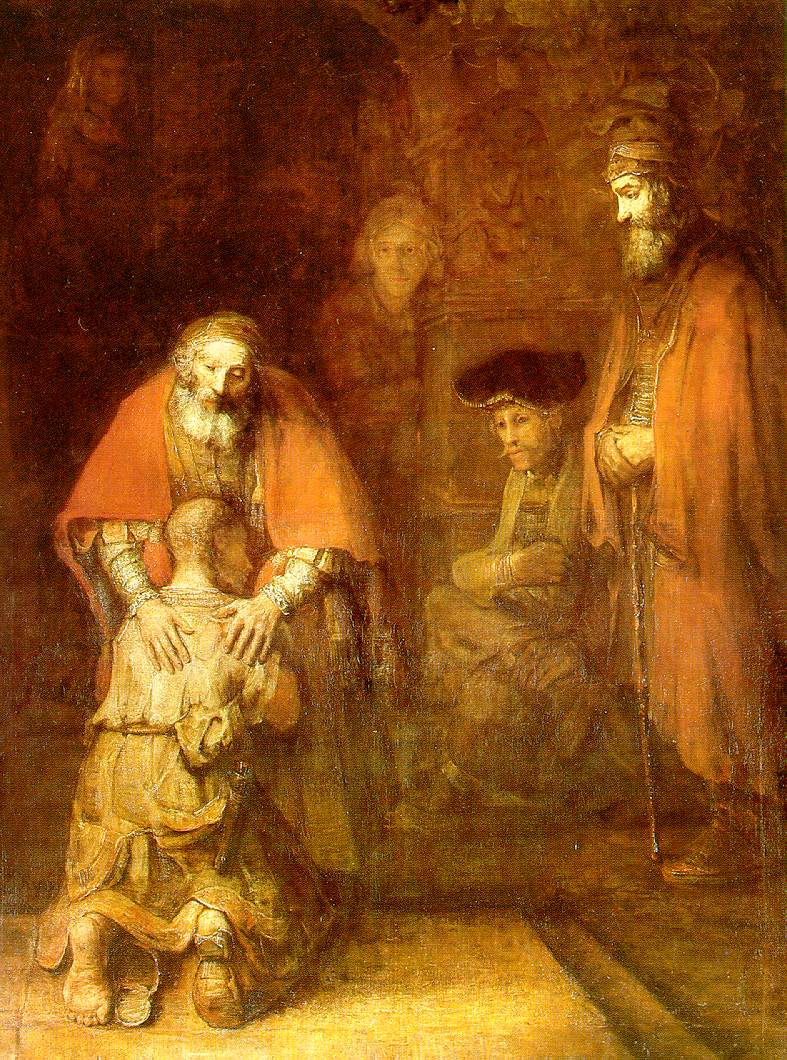
Rembrandt, The Return of the Prodigal Son
The face-to-face encounter is vital to the process of reconciliation. What keeps people our enemies is the fact that we do not know them and do not wish to know them. We falsely believe that to understand the other is to condone the wrong they have done. Far from it, the more we understand someone the more we will reject any wrongdoing in their actions. Through understanding, we come to see the person as more than their actions. We come to see them as a place of possibility where choices for the good can still be made. We can call that person to live justly.
Calling someone else to live justly supersedes the cost of the amends we think we are owed. We turn together, side by side as human beings, and agree that we are both accountable to justice itself. This creates the possibility for reconciliation between us.
In the wake of tragedies, our culture tends to follow a doctrine of uniting against our enemies, to unify in our condemnation the wrongdoer. But even the wrongdoer has the possibility to join us in condemning the wrong done. Condemning in itself is not a resolution; it is a first step. The next step is the exercise of our human freedom to seek to understand what is going on, to promote a face-to-face encounter between those who see each other only as enemies and not as people. This is the hard part.
Jesus was falsely accused. He was sentenced to be executed unjustly. We can often overlook his radical act of reconciliation on the cross: “forgive them, Lord, they know not what they do,” as a sheep-like act of kindness or as the largesse of a powerful God masquerading as a human. Neither of these are true. Jesus’ radical act of forgiveness is the true model for all forgiveness.
Even as we acknowledge the deep wrong that has been done, even as we find no remorse in the enemy, even when there is no hope that amends can me made, we can love. We can choose to be human and call others to be the same by seeing and truly responding to their humanity.
Previous Post

February 5, 2015
The New Evangelization of FOCUS
Next Post
February 16, 2015 A Preferential Option for LGBTQ Persons?
Browse Our Archives
Select a Category About the Blog TJP Book Excerpt TJP Excerpt Uncategorized Weekly Post
Select a Month June 2015 May 2015 April 2015 March 2015 February 2015 January 2015 December 2014 November 2014 October 2014 September 2014 August 2014 July 2014 June 2014 May 2014 April 2014 March 2014 February 2014 January 2014
Follow Us!
TAKE THE
Religious Wisdom Quiz
Who was the king of Israel known for his wisdom?
Select your answer to see how you score.
David Hezekiah Saul Solomon
Related posts from The Jesuit Post

Rosario Rodriguez on forgiving her attackers

Leah Darrow: From America's Next Top Model to...

What could a celibate know about dating?

The Genius of Compassion: Big Hero Six
TRENDING AT PATHEOS Catholic

Rejecting Doom: Christian Hope And Human Action
Christianity is a religion of hope. We are to have hope and...

It’s What Comes From Within Which Matters
One of the most difficult things for us to understand is why...

Why I Choose the Eucharist Over the Sermon
Choose the Eucharist, Not the Sermon What are we supposed to get...

5 Design Elements Found in Spiritually Rooted Homes
Putting Spirituality Into Home Decor Our homes are more than our living...

Credo: A Story of God Told with the...
About 10 years ago, I began to imagine a personal "Credo" that...

The Anatomy of Divine Revelation in Catholic Thought
The claim that God has made Himself known to human beings is...
view all Catholic blogs
Ad-Free & Subscriber Log-In Subscription Support
- About Us
- 2026 Calendar
- Videos
- Podcasts
- Library of World Religions
- Faith In Media Tracker
- Advertise With Us
- Write for Us
- Privacy Policy
- Terms of Service
- Do Not Sell My Data
- Contact Us
- Radiant Digital
- Manage Newsletter Subscriptions
- Unsubscribe From Notifications
- Sitemap
Copyright 2008-2026, Patheos. All rights reserved.
Subscription Support Ad-Free & Subscriber Log-In
Follow Patheos