
BuddhistCatholicContemplativeEvangelicalGeneral ChristianHinduJewishLatter-day SaintMuslimNew VisionsProgressive Christian
Beliefs
- Buddhist
- Catholic
- Contemplative
- Evangelical
- General Christian
- Hindu
- Jewish
- Latter-day Saint
- More Voices
- Muslim
- New Visions
- Pagan
- Progressive Christian
Topics
- Religion News
- Food and Religion
- Sports and Religion
- Religious Art
- Religious Music and Entertainment
- Religious Events
- History and Religion
- Style and Religion
- Politics and Religion
- Women in Religion
- Recreation Outdoors and Religion
- Business Finance and Religion
- Careers Workplace and Religion
- Education and Religion
- Family Parenting and Religion
- Health Fitness and Religion
- Home and Religion
- Relationships and Religion
- Technology and Religion
- Travel and Religion
Columnists
- Buddhist Columnists
- Business Finance and Religion Columnists
- Careers Workplace and Religion Columnists
- Catholic Columnists
- Contemplative Columnists
- Education and Religion Columnists
- Evangelists Columnists
- Family Parenting and Religion Columnists
- General Christian Columnists
- Health Fitness and Religion Columnists
- Hindu Columnists
- History and Religion Columnists
- Home and Religion Columnists
- Jewish Columnists
- More Voices Columnists
- Latter Day Columnists
- Muslim Columnists
- New Visions Columnists
- Nonreligious Columnists
- Pagan Columnists
- Politics and Religion Columnists
- Progressive Columnists
- Recreation Outdoors and Religion Columnists
- Relationships and Religion Columnists
- Religion News Columnists
- Religious Art Columnists
- Religious Events Columnists
- Religious Music and Entertainment Columnists
- Sports and Religion Columnists
- Style and Religion Columnists
- Technology and Religion Columnists
- Travel and Religion Columnists
- Women in Religion Columnists
Resource Library
- 2026 Calendar
- Library of World Religions
- The 100 Most Holy Places on Earth
- Patheos Answers
- Podcasts
- Videos
- Faith Leaders Database
- Anglican Episcopalian
- Bahai
- Baptist
- Buddhism
- Christianity
- Confucianism
- Eastern Orthodoxy
- Hinduism
- Holiness and Pentecostal
- ISKCON
- Islam
- Judaism
- Lutheran
- Methodist
- The Church of Jesus Christ of Latter-day Saints
- New Age
- Paganism
- Presbytarian and Reformed
- Protestantism
- Religion Behind the Scenes
- Roman Catholic
- Scientology
- Shia Islam
- Sikhism
- Sufism
- Sunni Islam
- Taoism
- Zen
- See all religions
Research Tools
 Ad-Free & Subscriber Log-In Subscription Support
Ad-Free & Subscriber Log-In Subscription Support
Follow Patheos 

- Trending:
- Forgiveness
- |
- Marriage
- |
- Consciousness
- |
- Death Penalty
- |
- Election
- |
- Halloween
 The Jesuit Post
-
About TJP on Patheos
- Home
- Catholic
- A Preferential Option for LGBTQ Persons?
A Preferential Option for LGBTQ Persons?
Last updated on: February 28, 2015 at 9:05 am by Eric Hanna, SJ
A Preferential Option for LGBTQ Persons? 2015-02-28T09:05:32-08:00 Eric Hanna, SJ
Patheos Explore the world's faith through different perspectives on religion and spirituality! Patheos has the views of the prevalent religions and spiritualities of the world.
Ever since Vatican II we as a church have been unpacking what it means to have a preferential option for the poor and vulnerable. How might this option apply to people in the LGBTQ community?
Pope Francis has made comments in recent years that indicate a loving, pastoral approach to LGBTQ persons in the church and in the world. God loves and approves of the human person without condition or exception. There are several factors that hinder this loving response and several elements of church teaching that might help it. And help we must: many of God’s children are suffering, rejected, and de-humanized. Pope Francis’ comments deepen our desire to love and care for people, many of whom have been deeply hurt and marginalized. How can we respond thoughtfully and compassionately to the cries for help around us?
Many Catholics are not knowledgeable about the struggles faced by LGBTQ persons. They may also be unaware of the church’s teachings on this topic. This lack of knowledge makes us tentative, fearful both of stepping outside the bounds of church teaching and also of giving offence in a sensitive context. Rather than address individual other people, we retreat to generalities, criticizing society in general for permissiveness and excess. These criticisms can hamper genuine dialogue with our actual neighbours, the people we meet. In order to step forward towards being affected and moved be a face-to-face recognition of other people, we need greater knowledge.
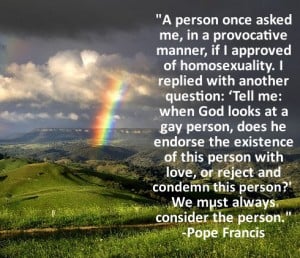
The first kind of knowledge we as a church can seek is that which comes from friendship with marginalized people. LGBTQ persons are waiting to hear that we as a church are interested in making our parishes, schools, and homes safe space: where each person’s dignity is upheld as sacred.
Jesus created this space around himself wherever he went. How many times does Jesus stand face-to-face with those who are excluded from society? And even during times of prayer and solitude, he allows himself to be interrupted and surprised by encounters with others. He allows himself to be moved with compassion.
A friend and colleague of mine, a priest who has been a friend to LGBTQ persons in a parish context for two decades, recently reminded me that the church does in fact offer us great guidance. The official guidelines that explicitly speak about diversity of orientation and gender identity are somewhat minimal, though they do emphasize a loving, pastoral response. The guidelines assure us that having a homosexual orientation is not a sin. But the particular guidelines are discussion-openers, not discussion-closers. We need not limit ourselves to solely these documents. Our response is also guided by the whole social teaching of the church. These social teachings call us to respond to persons in pain, who are un-loved by their neighbours. These church documents give us methods for developing our ability to be moved with compassion.
For example, consider this passage from, Evangelium Vitae (Par 101), which Pope St. John-Paul II sends to all people of goodwill, especially believers:
“A society lacks solid foundations when, on the one hand, it asserts values such as the dignity of the person, justice and peace, but then, on the other hand, radically acts to the contrary by allowing or tolerating a variety of ways in which human life is devalued and violated, especially where it is weak or marginalized.”
It is a grim reality that LGBTQ persons face hatred, denigration, lack of access to employment, and finally injury or even death. But even when this is not the case, we are still called to love those whom others refuse to love. As church communities we are being called to educate ourselves and one another on the need for justice for the LGBTQ community.
I construe this education of ourselves in LGBTQ matters as a point of personal spiritual growth. This education might begin in confluence with other educational initiatives like those combating racism, sexism, and forms of economic injustice.
To grow spiritually, we look to the concrete, real-life experiences of our neighbours. We seek to encounter the marginalized and rejected and be friends to them, listening to their stories. This personal growth may bear fruit in many subtle ways. It may be as grand as a stranger who feels accepted by a church they’d thought rejected them, or it may be as small as a colleague who notes your use of inclusive language. In either case, you are showing that you are a person of love.
On the most basic, human level, we’re called to say “I love you,” over and over again. Policies and analysis and criticism can come later. First we look our neighbour in the eye and acknowledge their humanity. We cry with their hurts. And we tell them that God holds them in a loving embrace. This is not something we are merely “allowed” to do. This is something we must do. It is one of the deepest longings of our hearts.
Previous Post

February 12, 2015
Radicalizing Reconciliation
Next Post

February 18, 2015 Now is the Time: Show me love
Browse Our Archives
Select a Category About the Blog TJP Book Excerpt TJP Excerpt Uncategorized Weekly Post
Select a Month June 2015 May 2015 April 2015 March 2015 February 2015 January 2015 December 2014 November 2014 October 2014 September 2014 August 2014 July 2014 June 2014 May 2014 April 2014 March 2014 February 2014 January 2014
Follow Us!
TAKE THE
Religious Wisdom Quiz
Which language is the official language of the Roman Catholic Mass worldwide since Vatican II?
Select your answer to see how you score.
French Local vernacular Latin Greek
Related posts from The Jesuit Post

What could a celibate know about dating?

The Genius of Compassion: Big Hero Six
America interviews TJP editor Michael Rossmann, SJ
TRENDING AT PATHEOS Catholic

Rejecting Doom: Christian Hope And Human Action
Christianity is a religion of hope. We are to have hope and...

It’s What Comes From Within Which Matters
One of the most difficult things for us to understand is why...

Why I Choose the Eucharist Over the Sermon
Choose the Eucharist, Not the Sermon What are we supposed to get...

5 Design Elements Found in Spiritually Rooted Homes
Putting Spirituality Into Home Decor Our homes are more than our living...

Credo: A Story of God Told with the...
About 10 years ago, I began to imagine a personal "Credo" that...

The Anatomy of Divine Revelation in Catholic Thought
The claim that God has made Himself known to human beings is...
view all Catholic blogs
Ad-Free & Subscriber Log-In Subscription Support
- About Us
- 2026 Calendar
- Videos
- Podcasts
- Library of World Religions
- Faith In Media Tracker
- Advertise With Us
- Write for Us
- Privacy Policy
- Terms of Service
- Do Not Sell My Data
- Contact Us
- Radiant Digital
- Manage Newsletter Subscriptions
- Unsubscribe From Notifications
- Sitemap
Copyright 2008-2026, Patheos. All rights reserved.
Subscription Support Ad-Free & Subscriber Log-In
Follow Patheos