
BuddhistCatholicContemplativeEvangelicalGeneral ChristianHinduJewishLatter-day SaintMuslimNew VisionsProgressive Christian
Beliefs
- Buddhist
- Catholic
- Contemplative
- Evangelical
- General Christian
- Hindu
- Jewish
- Latter-day Saint
- More Voices
- Muslim
- New Visions
- Pagan
- Progressive Christian
Topics
- Religion News
- Food and Religion
- Sports and Religion
- Religious Art
- Religious Music and Entertainment
- Religious Events
- History and Religion
- Style and Religion
- Politics and Religion
- Women in Religion
- Recreation Outdoors and Religion
- Business Finance and Religion
- Careers Workplace and Religion
- Education and Religion
- Family Parenting and Religion
- Health Fitness and Religion
- Home and Religion
- Relationships and Religion
- Technology and Religion
- Travel and Religion
Columnists
- Buddhist Columnists
- Business Finance and Religion Columnists
- Careers Workplace and Religion Columnists
- Catholic Columnists
- Contemplative Columnists
- Education and Religion Columnists
- Evangelists Columnists
- Family Parenting and Religion Columnists
- General Christian Columnists
- Health Fitness and Religion Columnists
- Hindu Columnists
- History and Religion Columnists
- Home and Religion Columnists
- Jewish Columnists
- More Voices Columnists
- Latter Day Columnists
- Muslim Columnists
- New Visions Columnists
- Nonreligious Columnists
- Pagan Columnists
- Politics and Religion Columnists
- Progressive Columnists
- Recreation Outdoors and Religion Columnists
- Relationships and Religion Columnists
- Religion News Columnists
- Religious Art Columnists
- Religious Events Columnists
- Religious Music and Entertainment Columnists
- Sports and Religion Columnists
- Style and Religion Columnists
- Technology and Religion Columnists
- Travel and Religion Columnists
- Women in Religion Columnists
Resource Library
- 2026 Calendar
- Library of World Religions
- The 100 Most Holy Places on Earth
- Patheos Answers
- Podcasts
- Videos
- Faith Leaders Database
- Anglican Episcopalian
- Bahai
- Baptist
- Buddhism
- Christianity
- Confucianism
- Eastern Orthodoxy
- Hinduism
- Holiness and Pentecostal
- ISKCON
- Islam
- Judaism
- Lutheran
- Methodist
- The Church of Jesus Christ of Latter-day Saints
- New Age
- Paganism
- Presbytarian and Reformed
- Protestantism
- Religion Behind the Scenes
- Roman Catholic
- Scientology
- Shia Islam
- Sikhism
- Sufism
- Sunni Islam
- Taoism
- Zen
- See all religions
Research Tools
 Ad-Free & Subscriber Log-In Subscription Support
Ad-Free & Subscriber Log-In Subscription Support
Follow Patheos 

- Trending:
- Forgiveness
- |
- Marriage
- |
- Consciousness
- |
- Death Penalty
- |
- Election
- |
- Halloween
 The Jesuit Post
-
About TJP on Patheos
- Home
- Catholic
- On Not Bumping Into the Furniture: The Immaculate Conception and Cooperation with Grace
On Not Bumping Into the Furniture: The Immaculate Conception and Cooperation with Grace
Last updated on: December 8, 2014 at 4:11 am by Nathan W. O'Halloran, SJ
On Not Bumping Into the Furniture: The Immaculate Conception and Cooperation with Grace 2014-12-08T04:11:22-08:00 Nathan W. O'Halloran, SJ
Patheos Explore the world's faith through different perspectives on religion and spirituality! Patheos has the views of the prevalent religions and spiritualities of the world.
The late great Avery Cardinal Dulles is reported by Schuyler Brown, a former student of his, to have once declared the doctrine of original sin “closed for repairs,” and there seem to be a whole lot of good reasons for that. The doctrine of original sin has been attacked over the past couple centuries for a variety of reasons, too numerous to get into. What matters is that the result has been a total obfuscation of the meaning of the doctrine itself. I would not be surprised if most Catholics, if asked, wouldn’t respond in the same way they might about Purgatory: “We still believe in that?”
Which only makes it harder to understand the meaning of today’s feast of the Immaculate Conception, that Mary was preserved from original sin from the moment of conception, or, in the official language: “The Blessed Virgin Mary, from the first moment of her conception, by a singular grace and privilege of almighty God, and in view of the merits of Jesus Christ, Savior of the human race, was preserved free from every stain of original sin.” Great. And what does that mean? Seriously: What does it mean to say that Mary had no “stain of original sin?” What is the “stain” of original sin?
This is made even more confusing by the fact that the Catechism of the Catholic Church, following Anselm over Augustine, defines original sin as a privation, as a lack of something that should be had. As CCC 404 and 405 puts it:
By yielding to the tempter, Adam and Eve committed a personal sin, but this sin affected the human nature that they would then transmit in a fallen state. It is a sin which will be transmitted by propagation to all mankind, that is, by the transmission of a human nature deprived of original holiness and justice… It is a deprivation of original holiness and justice.
And so the “stain” that Mary is born without really doesn’t refer to a something at all but a lack that everyone has, but that she doesn’t have. Everyone else is born without “original justice,” or basically, God’s special gracious help. Adam and Eve rejected this help from God, and rejected it also on behalf of their ancestors. And so we’re all born with this lack. Tough luck for us? Well, that’s how history works. Decisions made in the past affect those who come after. If a parent wastes all of his or her child’s college fund on gambling or alcohol, then there is no money for college. That’s not unfair on God’s part; it’s just how human beings living in historical relationships work.
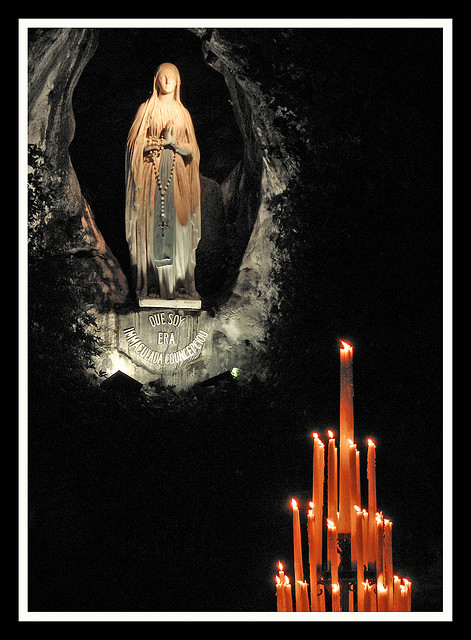
From the grotto at Lourdes
Image: Fr. Lawrence Lew, OP / Flickr (Creative Commons)
Therein lies the rub for Mary and the problem with the dogma: Is it actually possible to be born into the human race otherwise than historically affected by one’s ancestors? In other words, whether or not, according to Scotus, Mary was “preserved by the grace of the Mediator” so that she could be born without the deficiency of original sin, is such a preservative redemption, a redemption in anticipation, actually possible? Isn’t her nature still a human nature, with all of the biological and cultural inheritance that comes with such a nature? Mary’s parents don’t have to be drug addicts to make this hard to swallow; simply being human is enough. We’ve all seen babies misbehave, and that misbehaving eventually turns into sin at a ripe young age. Presumably Mary was born as the same kind of baby, and so presumably “preservative redemption” for Mary does not mean that she was born without all of the usual biological and cultural baggage of human nature. Mary, and Jesus too, both experienced all the defects of human nature. The only difference was that they did not sin. In other words, they experienced the whole ontological deficiency of our human nature, but they never sinned as a result.
So, if there was no “something” that Mary was preserved from, then what exactly makes her different? If she experienced all of the effects of original sin, and original sin itself is not some “thing,” then what is she preserved from? Can you be preserved from a lack, but then still experience the lack? Because that’s what we seem to be saying about Mary. What sense does it make to be preserved from the lack of sight (original sin) but then still be stuck in the dark (effects of original sin)? You may not have congenital blindness, but if you still can’t see, then you’ll still bump into things.
What I would argue is that both Mary had a fallen nature in the sense that she inherited the same human nature that her parents had, warts and all, but that precisely what she did not receive was the inevitability of sinning. Since this inevitability comes precisely from our biological and cultural inheritance, the only way to “preserve” her from it would be by means of relationship. Mary’s own self would have to be offered special assistance by the Holy Spirit, from the moment of her conception, to never actualize her fallen nature in a sinful way, i.e., never live in a way that was not entirely dependent upon grace. Mary was born with the effects of original sin – she couldn’t see – but she was preserved from the “stain” of original sin – the inevitability of bumping into things. The language of “stain” here that the Church maintains refers not to the effects of original sin, but to the inevitability of acting in a sinful way as a result of the ontological deficiency of original sin. The only way such a thing could happen is if Someone held her hand from the first moments of her conception such that she, choosing to cooperate with the help she was offered, was able to navigate safely through the minefield of life. That is the meaning of preservative redemption and the Immaculate Conception.
For us, it means that, as a result of our baptism, a similar graced freedom, a freedom not dominated by the inevitability of sinning, is available to us. Just as Mary was given special help from the moment of her conception by the Holy Spirit, as a result of the redemption wrought by Christ, so that she could live in cooperation with grace even while experiencing the effects of a fallen nature, so we too, from the moment of our baptism, are given a similar help. What makes Mary a model and exemplar for us is that she consistently chose fidelity to the grace God gave her. Just because Someone was holding her hand doesn’t mean she had to follow. But she did. We have had the same help since baptism, and yet time and again we insist on striking out on our own — and quickly walk into the furniture. The doctrine of the Immaculate Conception takes nothing away from Mary; on the contrary, it amplifies the strength of her character and goads us on to imitate her resolve and trust in God.
Next Post

December 9, 2014 In the Kingdom of the Enemy: Reading the Torture Report
Browse Our Archives
Select a Category About the Blog TJP Book Excerpt TJP Excerpt Uncategorized Weekly Post
Select a Month June 2015 May 2015 April 2015 March 2015 February 2015 January 2015 December 2014 November 2014 October 2014 September 2014 August 2014 July 2014 June 2014 May 2014 April 2014 March 2014 February 2014 January 2014
Follow Us!
TAKE THE
Religious Wisdom Quiz
Who sat at the Beautiful Gate begging before Peter healed him?
Select your answer to see how you score.
A Roman centurion A rich ruler A blind man A lame man
Related posts from The Jesuit Post
America interviews TJP editor Michael Rossmann, SJ

Rosario Rodriguez on forgiving her attackers
Leah Darrow: From America's Next Top Model to...
TRENDING AT PATHEOS Catholic

Creation, Preservation, and Teleology in Catholic Theology
As I write this, it is very early Monday morning. Like millions...

The Parable Of The Sower And The Word...
One of Christ’s most famous parables is that of the sower who...

Rejecting Doom: Christian Hope And Human Action
Christianity is a religion of hope. We are to have hope and...

Why I Choose the Eucharist Over the Sermon
Choose the Eucharist, Not the Sermon What are we supposed to get...

5 Design Elements Found in Spiritually Rooted Homes
Putting Spirituality Into Home Decor Our homes are more than our living...

Credo: A Story of God Told with the...
About 10 years ago, I began to imagine a personal "Credo" that...
view all Catholic blogs
Ad-Free & Subscriber Log-In Subscription Support
- About Us
- 2026 Calendar
- Videos
- Podcasts
- Library of World Religions
- Faith In Media Tracker
- Advertise With Us
- Write for Us
- Privacy Policy
- Terms of Service
- Do Not Sell My Data
- Contact Us
- Radiant Digital
- Manage Newsletter Subscriptions
- Unsubscribe From Notifications
- Sitemap
Copyright 2008-2026, Patheos. All rights reserved.
Subscription Support Ad-Free & Subscriber Log-In
Follow Patheos