
BuddhistCatholicContemplativeEvangelicalGeneral ChristianHinduJewishLatter-day SaintMuslimNew VisionsProgressive Christian
Beliefs
- Buddhist
- Catholic
- Contemplative
- Evangelical
- General Christian
- Hindu
- Jewish
- Latter-day Saint
- More Voices
- Muslim
- New Visions
- Pagan
- Progressive Christian
Topics
- Religion News
- Food and Religion
- Sports and Religion
- Religious Art
- Religious Music and Entertainment
- Religious Events
- History and Religion
- Style and Religion
- Politics and Religion
- Women in Religion
- Recreation Outdoors and Religion
- Business Finance and Religion
- Careers Workplace and Religion
- Education and Religion
- Family Parenting and Religion
- Health Fitness and Religion
- Home and Religion
- Relationships and Religion
- Technology and Religion
- Travel and Religion
Columnists
- Buddhist Columnists
- Business Finance and Religion Columnists
- Careers Workplace and Religion Columnists
- Catholic Columnists
- Contemplative Columnists
- Education and Religion Columnists
- Evangelists Columnists
- Family Parenting and Religion Columnists
- General Christian Columnists
- Health Fitness and Religion Columnists
- Hindu Columnists
- History and Religion Columnists
- Home and Religion Columnists
- Jewish Columnists
- More Voices Columnists
- Latter Day Columnists
- Muslim Columnists
- New Visions Columnists
- Nonreligious Columnists
- Pagan Columnists
- Politics and Religion Columnists
- Progressive Columnists
- Recreation Outdoors and Religion Columnists
- Relationships and Religion Columnists
- Religion News Columnists
- Religious Art Columnists
- Religious Events Columnists
- Religious Music and Entertainment Columnists
- Sports and Religion Columnists
- Style and Religion Columnists
- Technology and Religion Columnists
- Travel and Religion Columnists
- Women in Religion Columnists
Resource Library
- 2026 Calendar
- Library of World Religions
- The 100 Most Holy Places on Earth
- Patheos Answers
- Podcasts
- Videos
- Faith Leaders Database
- Anglican Episcopalian
- Bahai
- Baptist
- Buddhism
- Christianity
- Confucianism
- Eastern Orthodoxy
- Hinduism
- Holiness and Pentecostal
- ISKCON
- Islam
- Judaism
- Lutheran
- Methodist
- The Church of Jesus Christ of Latter-day Saints
- New Age
- Paganism
- Presbytarian and Reformed
- Protestantism
- Religion Behind the Scenes
- Roman Catholic
- Scientology
- Shia Islam
- Sikhism
- Sufism
- Sunni Islam
- Taoism
- Zen
- See all religions
Research Tools
 Ad-Free & Subscriber Log-In Subscription Support
Ad-Free & Subscriber Log-In Subscription Support
Follow Patheos 

- Trending:
- Forgiveness
- |
- Marriage
- |
- Consciousness
- |
- Death Penalty
- |
- Election
- |
- Halloween
 The Jesuit Post
-
About TJP on Patheos
- Home
- Catholic
- Our Transfiguration, and His
Our Transfiguration, and His
Last updated on: August 6, 2014 at 2:10 pm by Paddy Gilger, SJ
Our Transfiguration, and His 2014-08-06T14:10:52-08:00 Paddy Gilger, SJ
Patheos Explore the world's faith through different perspectives on religion and spirituality! Patheos has the views of the prevalent religions and spiritualities of the world.
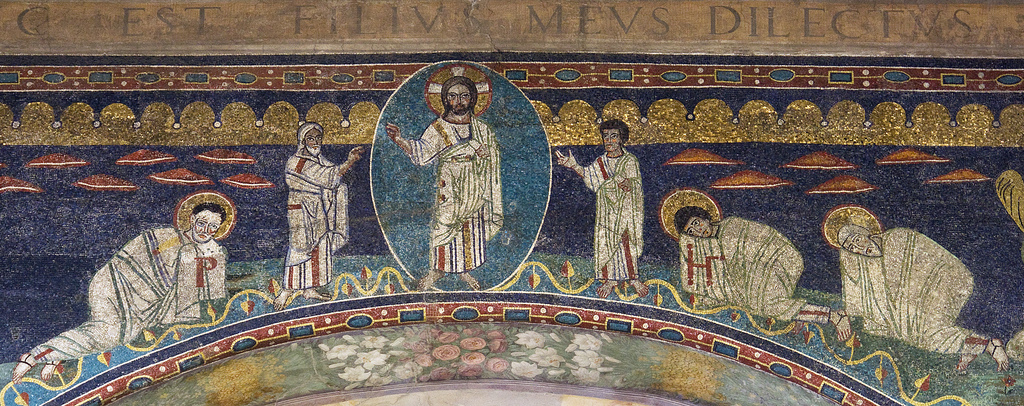
Transfiguration in the basilica of Santi Nereo ed Archilleo in Rome.
Jesus took Peter, James, and his brother, John,
and led them up a high mountain by themselves.
And he was transfigured before them;
his face shone like the sun
and his clothes became white as light.
And behold, Moses and Elijah appeared to them,
conversing with him.
– Mt 17:1-3
I write, on a gray-skied working Wednesday, of what the Greek-Catholic Dominican priest Jean Corbon called “the historical and literary center of the Gospel,” the transfiguration of Christ. It’s Fr. Corbon – and more particularly his toweringly great book on the sacred liturgy, The Wellspring of Worship – who has put me up to unpacking such an audacious claim.
Corbon’s aims in the book go farther can be summarized here, but one of the themes he returns to over and again is divination – which involves, to paraphrase Athanasius, recognizing that God became human so that humans might become divine. The transfiguration, which according to Corbon is the center of the Gospel, is the event that reveals that divination is possible. In other words, what we celebrate on the feast of the transfiguration is not an “impossible unveiling” of Jesus as Christ to the disciples, but a “moment of intensity” in which the always-already-existing unity of the Father and Son (into which we are all invited) is made visible (p93). Corbon writes:
“The transfiguration of the Word gives a glimpse of the fullness of what the Word inaugurated in his Incarnation and manifested after his baptism by his miracles: namely, the truth that the body of the Lord Jesus is the sacrament that gives the life of God to men. When our humanity consents without reserve to be united to the humanity of Jesus, it will share the divine nature (2 Pet 1:4); it will be divinized” (p95).
All of which raises, for me, a question: who is it that is being transfigured on this feast day, in this reading? Corbon is clear in his answer: it is not Jesus. Nothing has changed for him. Instead, it is the disciples who are changed; us. St. John of Damascus agrees. Christ, he says, “was transfigured, not by acquiring what he was not but by manifesting to his disciples what he in fact was; he opened their eyes and gave these blind men sight.” In other words, in the transfiguration we are given a glimpse of the telos of humanity: union with God.
The thing is that this ongoing transfiguration, this unity that God so desires to accomplish with us, requires our consent. “When our humanity consents without reserve to be united to the humanity of Jesus, it will share the divine nature,” Corbon writes. Which means that the transfiguration is the revelation of what will happen to us when we approach, as closely as we can, the constant consent that is Jesus’ relationship to the Father. It is because it is consent that is required that it cannot be coerced from us.
Remembering that, along with Elijah, it was Moses who stood next to Jesus on the mountaintop, Corbon turns his attention to consent as well, remembering the fire that does not consume the burning bush. Neither does Jesus, who is that same divine fire, burn away our humanity or consume our freedom as we are made more divine. Instead, the “Holy One does not destroy but penetrates… everything that is.” Instead, “the flame that burns us without consuming… reveals itself by giving itself and become known by being received. It is not our flesh that stands in the way of our seeing, as the ancient dualisms claim, but our lack of selfless generosity and love or, in other words, our death” (p88). This is what the vision of the transfiguration we are given asks us to relinquish: not our humanity, not our freedom, but our ego.
As we are well aware, this is an endless task.
***
For me one of the regular temptations that accompanies the task (which is also the greatest of gifts) of celebrating mass daily, is to turn my prayer into homily preparation. One of the best things about learning from Fr. Corbon is the recession of this temptation. How, after all, could my heart not be opened to the God of my life when reading – study – enacts the mysterious, divinizing union that God desires not just on the feast of the transfiguration, but everyday. Reading, I mean, words such as these:
“If, then, Jesus is transfigured, the reason is that the Father causes his own joy to flame out in him. The radiance of the light in the suffering body of Jesus is, as it were, the thrill experienced by the Father in response to the total self-giving of his only Son. This explains the voice that pierces through the cloud: ‘This is my Son, the Beloved; he enjoys my favor. Listen to him” (p93).
Joy. Radiance. Suffering. Thrill. Pierce. Beloved. Listen. Be transfigured. Amen.
Previous Post

August 2, 2014
Must Read: Bishop Caggiano Interview on "Church Reform from Below"
Next Post
August 15, 2014 Remembering Archbishop Oscar Romero at 97
Browse Our Archives
Select a Category About the Blog TJP Book Excerpt TJP Excerpt Uncategorized Weekly Post
Select a Month June 2015 May 2015 April 2015 March 2015 February 2015 January 2015 December 2014 November 2014 October 2014 September 2014 August 2014 July 2014 June 2014 May 2014 April 2014 March 2014 February 2014 January 2014
Follow Us!
TAKE THE
Religious Wisdom Quiz
According to Philippians, what should we think about?
Select your answer to see how you score.
The needs of others The word of God day and night Whatever is true, noble, right, pure, lovely, and admirable The suffering of Christ
Related posts from The Jesuit Post
America interviews TJP editor Michael Rossmann, SJ

Rosario Rodriguez on forgiving her attackers

Leah Darrow: From America's Next Top Model to...
TRENDING AT PATHEOS Catholic

Creation, Preservation, and Teleology in Catholic Theology
As I write this, it is very early Monday morning. Like millions...

The Parable Of The Sower And The Word...
One of Christ’s most famous parables is that of the sower who...

Rejecting Doom: Christian Hope And Human Action
Christianity is a religion of hope. We are to have hope and...

Why I Choose the Eucharist Over the Sermon
Choose the Eucharist, Not the Sermon What are we supposed to get...

5 Design Elements Found in Spiritually Rooted Homes
Putting Spirituality Into Home Decor Our homes are more than our living...

Credo: A Story of God Told with the...
About 10 years ago, I began to imagine a personal "Credo" that...
view all Catholic blogs
Ad-Free & Subscriber Log-In Subscription Support
- About Us
- 2026 Calendar
- Videos
- Podcasts
- Library of World Religions
- Faith In Media Tracker
- Advertise With Us
- Write for Us
- Privacy Policy
- Terms of Service
- Do Not Sell My Data
- Contact Us
- Radiant Digital
- Manage Newsletter Subscriptions
- Unsubscribe From Notifications
- Sitemap
Copyright 2008-2026, Patheos. All rights reserved.
Subscription Support Ad-Free & Subscriber Log-In
Follow Patheos