
BuddhistCatholicContemplativeEvangelicalGeneral ChristianHinduJewishLatter-day SaintMuslimNew VisionsProgressive Christian
Beliefs
- Buddhist
- Catholic
- Contemplative
- Evangelical
- General Christian
- Hindu
- Jewish
- Latter-day Saint
- More Voices
- Muslim
- New Visions
- Pagan
- Progressive Christian
Topics
- Religion News
- Food and Religion
- Sports and Religion
- Religious Art
- Religious Music and Entertainment
- Religious Events
- History and Religion
- Style and Religion
- Politics and Religion
- Women in Religion
- Recreation Outdoors and Religion
- Business Finance and Religion
- Careers Workplace and Religion
- Education and Religion
- Family Parenting and Religion
- Health Fitness and Religion
- Home and Religion
- Relationships and Religion
- Technology and Religion
- Travel and Religion
Columnists
- Buddhist Columnists
- Business Finance and Religion Columnists
- Careers Workplace and Religion Columnists
- Catholic Columnists
- Contemplative Columnists
- Education and Religion Columnists
- Evangelists Columnists
- Family Parenting and Religion Columnists
- General Christian Columnists
- Health Fitness and Religion Columnists
- Hindu Columnists
- History and Religion Columnists
- Home and Religion Columnists
- Jewish Columnists
- More Voices Columnists
- Latter Day Columnists
- Muslim Columnists
- New Visions Columnists
- Nonreligious Columnists
- Pagan Columnists
- Politics and Religion Columnists
- Progressive Columnists
- Recreation Outdoors and Religion Columnists
- Relationships and Religion Columnists
- Religion News Columnists
- Religious Art Columnists
- Religious Events Columnists
- Religious Music and Entertainment Columnists
- Sports and Religion Columnists
- Style and Religion Columnists
- Technology and Religion Columnists
- Travel and Religion Columnists
- Women in Religion Columnists
Resource Library
- 2026 Calendar
- Library of World Religions
- The 100 Most Holy Places on Earth
- Patheos Answers
- Podcasts
- Videos
- Faith Leaders Database
- Anglican Episcopalian
- Bahai
- Baptist
- Buddhism
- Christianity
- Confucianism
- Eastern Orthodoxy
- Hinduism
- Holiness and Pentecostal
- ISKCON
- Islam
- Judaism
- Lutheran
- Methodist
- The Church of Jesus Christ of Latter-day Saints
- New Age
- Paganism
- Presbytarian and Reformed
- Protestantism
- Religion Behind the Scenes
- Roman Catholic
- Scientology
- Shia Islam
- Sikhism
- Sufism
- Sunni Islam
- Taoism
- Zen
- See all religions
Research Tools
 Ad-Free & Subscriber Log-In Subscription Support
Ad-Free & Subscriber Log-In Subscription Support
Follow Patheos 

- Trending:
- Forgiveness
- |
- Marriage
- |
- Consciousness
- |
- Death Penalty
- |
- Election
- |
- Halloween
 The Jesuit Post
-
About TJP on Patheos
- Home
- Catholic
- Becoming Peter, on Betrayal and Faith
Becoming Peter, on Betrayal and Faith
Last updated on: April 19, 2014 at 10:48 am by Paddy Gilger, SJ
Becoming Peter, on Betrayal and Faith 2014-04-19T10:48:53-08:00 Paddy Gilger, SJ
Patheos Explore the world's faith through different perspectives on religion and spirituality! Patheos has the views of the prevalent religions and spiritualities of the world.
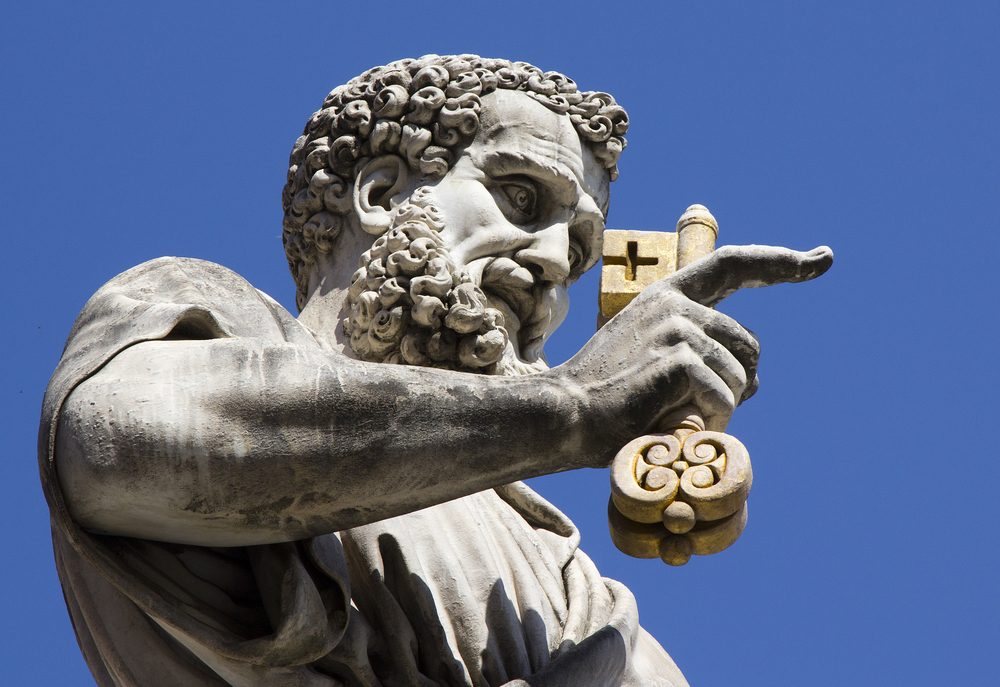
Shutterstock / ilozavr
In an aptly-sad, darkly-hopeful, meditation of an essay over at On Faith, Tim O’Brien confesses his sympathy for Judas. “Yes, that Judas,” he writes, “Judas Iscariot. The betrayer. The Lost One. The bad guy who rivals only Satan in the collective Christian imagination.”
Confession made he turns quickly to the main question: just what is the difference between Judas and Peter?
He’s right to ask. These Holy Week readings place precisely that question – and a number of others as well – right in our faces. We can hardly look around them though we try. They talk about both Judas’ betrayal with a kiss in the garden and Peter’s betrayal with a word in the courtyard. Both travelled with him, presumably loved him, and both turned their back on him in the hour of deep need.
O’Brien’s answer is, for me, a surprising one. It’s faith. Not the faith that means belief in X proposition or Y creedal formulation. No, the faith that believes that Jesus is a certain kind of person, that Jesus (and therefore His Father – He is, after all, the Messiah) is the kind of person who forgives. It’s faith, writes O’Brien, in forgiveness.
As a young priest who consistently finds himself surprising people by saying that hearing confessions is the best part of being a priest, let me just say: this is a difference I can get behind. But he doesn’t leave it there.
To support and deepen this thesis O’Brien looks to another account of the Holy Thursday narrative, the one that comes from the Gospel of Luke, in which Jesus responds to Peter’s insistence that he will remain faithful by saying: “Simon, Simon, behold Satan has demanded to sift all of you like wheat, but I have prayed that your own faith may not fail; and once you have turned back, you must strengthen your brothers.” Peter said to him, “Lord, I am prepared to go to prison and to die with you.” But Jesus replied, “I tell you, Peter, before the cock crows this day, you will deny three times that you know me.”
O’Brien unpacks the paradox of Jesus’ words as follows: “On the one hand,” he writes,
Jesus prays that Peter’s faith will not fail, even as he accurately predicts the upcoming denial. So what is this faith that Jesus prays will not fail?
Faith in forgiveness. Jesus isn’t praying that Peter won’t deny him; he knows that will happen. Jesus is praying that Peter not lose faith that he can truly “turn back”: that he can repent, rejoin the community, and even strengthen his brothers and sisters. It is faith in the love and mercy of God, which is to say faith in the ministry of Jesus that Peter had witnessed first hand.
It’s just this faith, faith in forgiveness, that Judas lacked. O’Brien:
To my mind, these [Mt 27:3-5] are among the saddest words in Christianity. Though repentant, Judas has no faith in forgiveness – whether forgiveness of himself, forgiveness from the community, or forgiveness from God. We know he never returned. …
He is who we are, we who also betray in ways small and spectacular, secret and public. And he is who we might mistakenly become, when our faith in forgiveness falters.
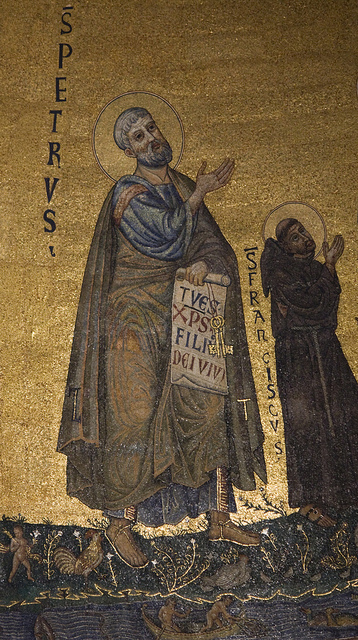
St. Peter by Fr. Lawrence O.P. at Flickr
We – spiritual descendents of the Twelve that we are – hold within ourselves the potential to be either Peter or Judas. And this difference is not faith in a thing, but faith that we can be forgiven, about this O’Brien is surely right.
***
A short personal postscript:
I remain, despite twelve years of trying to do so, unconvinced of my ability to articulate how well O’Brien’s words summarize what it is to be a priest today. Nearly perfectly well.
When it really comes down to it I find his words so moving for the same reason I find my experience in the confessional so moving: because it’s where I most often witness people refusing to be Judas; becoming St. Peter. And celebrating then. Celebrating like St. Peter when he heard the words of his friend – “It is the Lord!” – and looked up from his fishing. Looked up to see the most familiar of forms, leaning over the hot coals, cooking the fish, waiting for him.
St. Peter’s faith, as Jesus had prayed, did not fail. And he spent the rest of his life knowing both that he was unworthy of being forgiven (he was crucified, so our tradition says, up side down for Christ’s sake) and knowing that he had been anyway, and celebrating.
Previous Post
April 14, 2014
What Martyrdom Means
Next Post

April 22, 2014 Mass Exodus: Why Young People are Leaving Church and Rethinking Faith
Browse Our Archives
Select a Category About the Blog TJP Book Excerpt TJP Excerpt Uncategorized Weekly Post
Select a Month June 2015 May 2015 April 2015 March 2015 February 2015 January 2015 December 2014 November 2014 October 2014 September 2014 August 2014 July 2014 June 2014 May 2014 April 2014 March 2014 February 2014 January 2014
Follow Us!
TAKE THE
Religious Wisdom Quiz
Who miraculously made an iron axe head float?
Select your answer to see how you score.
Jonah Elisha Elijah Hosea
Related posts from The Jesuit Post
America interviews TJP editor Michael Rossmann, SJ

Rosario Rodriguez on forgiving her attackers

Leah Darrow: From America's Next Top Model to...
TRENDING AT PATHEOS Catholic

Creation, Preservation, and Teleology in Catholic Theology
As I write this, it is very early Monday morning. Like millions...

The Parable Of The Sower And The Word...
One of Christ’s most famous parables is that of the sower who...

Rejecting Doom: Christian Hope And Human Action
Christianity is a religion of hope. We are to have hope and...

Why I Choose the Eucharist Over the Sermon
Choose the Eucharist, Not the Sermon What are we supposed to get...

5 Design Elements Found in Spiritually Rooted Homes
Putting Spirituality Into Home Decor Our homes are more than our living...

Credo: A Story of God Told with the...
About 10 years ago, I began to imagine a personal "Credo" that...
view all Catholic blogs
Ad-Free & Subscriber Log-In Subscription Support
- About Us
- 2026 Calendar
- Videos
- Podcasts
- Library of World Religions
- Faith In Media Tracker
- Advertise With Us
- Write for Us
- Privacy Policy
- Terms of Service
- Do Not Sell My Data
- Contact Us
- Radiant Digital
- Manage Newsletter Subscriptions
- Unsubscribe From Notifications
- Sitemap
Copyright 2008-2026, Patheos. All rights reserved.
Subscription Support Ad-Free & Subscriber Log-In
Follow Patheos