
BuddhistCatholicContemplativeEvangelicalGeneral ChristianHinduJewishLatter-day SaintMuslimNew VisionsProgressive Christian
Beliefs
- Buddhist
- Catholic
- Contemplative
- Evangelical
- General Christian
- Hindu
- Jewish
- Latter-day Saint
- More Voices
- Muslim
- New Visions
- Pagan
- Progressive Christian
Topics
- Religion News
- Food and Religion
- Sports and Religion
- Religious Art
- Religious Music and Entertainment
- Religious Events
- History and Religion
- Style and Religion
- Politics and Religion
- Women in Religion
- Recreation Outdoors and Religion
- Business Finance and Religion
- Careers Workplace and Religion
- Education and Religion
- Family Parenting and Religion
- Health Fitness and Religion
- Home and Religion
- Relationships and Religion
- Technology and Religion
- Travel and Religion
Columnists
- Buddhist Columnists
- Business Finance and Religion Columnists
- Careers Workplace and Religion Columnists
- Catholic Columnists
- Contemplative Columnists
- Education and Religion Columnists
- Evangelists Columnists
- Family Parenting and Religion Columnists
- General Christian Columnists
- Health Fitness and Religion Columnists
- Hindu Columnists
- History and Religion Columnists
- Home and Religion Columnists
- Jewish Columnists
- More Voices Columnists
- Latter Day Columnists
- Muslim Columnists
- New Visions Columnists
- Nonreligious Columnists
- Pagan Columnists
- Politics and Religion Columnists
- Progressive Columnists
- Recreation Outdoors and Religion Columnists
- Relationships and Religion Columnists
- Religion News Columnists
- Religious Art Columnists
- Religious Events Columnists
- Religious Music and Entertainment Columnists
- Sports and Religion Columnists
- Style and Religion Columnists
- Technology and Religion Columnists
- Travel and Religion Columnists
- Women in Religion Columnists
Resource Library
- 2026 Calendar
- Library of World Religions
- The 100 Most Holy Places on Earth
- Patheos Answers
- Podcasts
- Videos
- Faith Leaders Database
- Anglican Episcopalian
- Bahai
- Baptist
- Buddhism
- Christianity
- Confucianism
- Eastern Orthodoxy
- Hinduism
- Holiness and Pentecostal
- ISKCON
- Islam
- Judaism
- Lutheran
- Methodist
- The Church of Jesus Christ of Latter-day Saints
- New Age
- Paganism
- Presbytarian and Reformed
- Protestantism
- Religion Behind the Scenes
- Roman Catholic
- Scientology
- Shia Islam
- Sikhism
- Sufism
- Sunni Islam
- Taoism
- Zen
- See all religions
Research Tools
 Ad-Free & Subscriber Log-In Subscription Support
Ad-Free & Subscriber Log-In Subscription Support
Follow Patheos 

- Trending:
- Forgiveness
- |
- Marriage
- |
- Consciousness
- |
- Death Penalty
- |
- Election
- |
- Halloween
 The Jesuit Post
-
About TJP on Patheos
- Home
- Catholic
- Speed and the Meaning of Reading
Speed and the Meaning of Reading
Last updated on: March 6, 2014 at 11:13 pm by Paddy Gilger, SJ
Speed and the Meaning of Reading 2014-03-06T23:13:34-08:00 Paddy Gilger, SJ
Patheos Explore the world's faith through different perspectives on religion and spirituality! Patheos has the views of the prevalent religions and spiritualities of the world.

Garsya / Shutterstock
Over the past few days more than a few friends of mine have been passing around a link to an article with the following link-baity title: “This Insane New App Will Allow You To Read Novels In Under 90 Minutes.” My ability to ignore such links[1. While letting out only the tiniest of sighs at the gauche-ness of the world.] is high, but there are limits to the number of times one can scroll by something an increasing percentage of one’s friends are interested in.
Once I gave in (trusted?) my attention was more than a little grabbed. The aforementioned insane new reading app is called Spritz, and it aims to double, triple – even quadruple! he says in his best infomercial voice – the number of words we can read per minute (WPM). The weird thing is… well, it seems like it works. On their site, Spritz describes test subjects who are now reading at 900 WPM. For some perspective, that’s a rate which would allow one to complete Harry Potter and the Sorcerer’s Stone in about 80 minutes. To the surprise of no one I have some thoughts about this, but first take a look at Spritz in action:


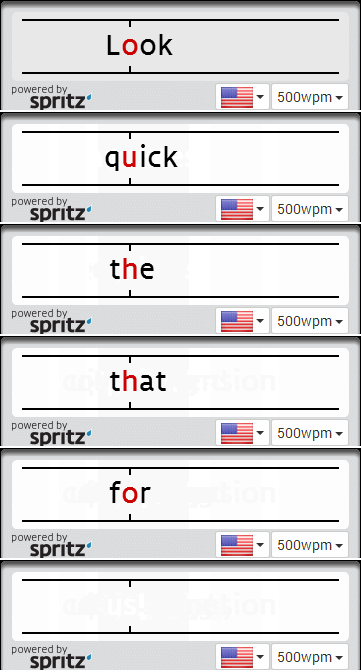
Pretty wild, right? And not uncool either (read: I am sorry for doubting you, friends), especially when it seems like comprehension isn’t declining as speed increases.
But the relative coolness of apps like Spritz (Spreeder is another one) isn’t really what’s in question. The more fundamental – and more interesting – question that apps like this provoke is: What does it mean to read? How are these speed reading apps changing the meaning of reading? And will changing the meaning of reading also change us?
Those might be strange questions because what’s happening here is that, rather than fundamentally transforming reading, Spritz and Spreeder are limiting it, narrowing it, constraining it. Yes, words are still linked together and processed, information is still communicated. But these apps are taking the formerly pluriform experience of reading and turn it exclusively into to what previously been only one of its many aspects: The rapid accumulation of knowledge.
***
Which is not to say that there are no benefits. Two have jumped out. First, they’re actually helping people sustain attention. Blogger Jim Pagel over at Slate wrote a helpful, concise piece to this effect just the other day. “Spreeder,” he writes,
has completely transformed the way I read. Prior to using it, I would almost always lose focus during long articles, and at the end of each day, I’d have dozens of unread tabs to bookmark for later reading. Since I started using Spreeder, though, not only have I never run a daily reading deficit, I’ve actually run a surplus, starting to chip away at the mountain of bookmarked reading debt I’ve accumulated over the years.
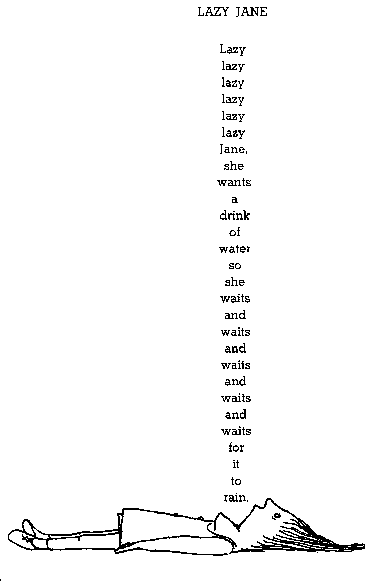
Shel Silverstein – Lazy Jane
And second, early results are showing that Spritz and Spreeder are helpful for people with dyslexia, which is very cool.[2. From the Spritz website: “One of the keys of helping people with dyslexia and other reading issues is related to delimiting the content that is viewable to the reader to improve readability and comprehension – exactly what Spritz does. A Spritz-enabled application can be slowed down to accommodate any speed that a developer would like. Here is a direct quote from a dyslexic user: ‘Your product is AWESOME, for a dyslexic person as me, this feels VERY liberating!’ – Andreas from Sweden”]
But considering reading as primarily a mountain to be chipped away to gravel, a task to be accomplished, comes with a cost. One of the more self-evident costs, given the visual structuring of Spritz wherein one word follows another, is that there is no chance to use structure to shape meaning. Take Shel Silversteen’s “Lazy Jane” as a simple example. We know this already, but the place poets choose to break their lines itself shapes the meanings poems can convey.
Probing a bit more deeply returns us to the problem that speed reading itself tends to limit the purpose of reading to knowledge accumulation. What does this reduction of reading to knowledge do to works that refuse to be reduced to data-fication? What does this do to works that were never intended merely to be acquired as knowledge?
All to say that reading via Spritz or Spreeder is something done as a task-to-be-accomplished. It means that Spritz reading is something you do in order to be done with it, to have completed it. Which is not a bad thing in and of itself, but it is accompanied by a temptation to forget that there is more to reading than simply a mountain of knowledge.
***
Aside from such cost/benefit analysis, however, technologies like this impose structural costs as well: They demand that we be ever more engaged in deciding what is good for us and what isn’t. To use a sociological term, they demand that we be ever more reflexive, ever more aware that we have to actively decide how we will allow things — and which things we will allow — to affect us.
If consuming information at 900 WPM becomes the norm, what kind of heroic effort will be required of us to read, say, Rilke’s Book of Hours? Or to avoid reading the latest link-bait piece to cross a Twitter feed (after all, it will only take 30 seconds)? Real freedom, freedom from limitations we are not readily aware of, requires the cultivation of habits. As we’re habituated into reading as knowledge accumulation will we still have the freedom to read in other ways? Even more, will we be able to summon the effort – not to mention the time and distance and self-knowledge – to read without technological crutches even when it means reading so much less?
We are limited creatures. YouTube adds 72 hours of video each minute – more than it will ever be possible to watch. The same, no matter how fast we read, goes for reading. Not only are we limited creatures, but we are limited creatures who are increasingly being asked to discerningly choose the habits we will cultivate, habits that directly affect the ways we normally treat the things with which we interact each day. When I open David Foster Wallace’s Consider the Lobster, how will I let it reach me? What would it even mean to “read” Psalm 139 at 900 WPM?
Yes, Spritz and Spreeder and whatever app in the future will allow us to watch video at 400x the speed will help us get through more of it. But they only forestall the real problem: Our coming to terms with the reality of our finitude. This is a problem peculiar to our age, one in which we are asked what we will choose now that there are more goods to choose from than we can possibly consume.
This problem can make us, as many of us know, enormously anxious. It used to be that our options were limited and we wanted more of them. Now, when the avalanche of information threatens to overtake us, the default response our culture provides is more and more reflexivity, saying, in effect: You choose. You deal with it. You sort it out. Your problem.
Alternatively, we can take these tools as a challenge to discernment: To the spiritually mature choice between multiple goods. If we use them discerningly, to increase our freedom instead of simply increasing the amount of knowledge we can consume, we can use technology to humanize the time we are given.
None of this is meant to condemn speed reading, it’s only to show it for what it is, a tool, not a savior. What these tools can’t do is save us from the question of what to read by attempting to answer: “All of it.”
— — // — —
Next Post

March 9, 2014 Well Worth Reading: CNN's Belief Blog on Finding the "Francis Effect"
Browse Our Archives
Select a Category About the Blog TJP Book Excerpt TJP Excerpt Uncategorized Weekly Post
Select a Month June 2015 May 2015 April 2015 March 2015 February 2015 January 2015 December 2014 November 2014 October 2014 September 2014 August 2014 July 2014 June 2014 May 2014 April 2014 March 2014 February 2014 January 2014
Follow Us!
TAKE THE
Religious Wisdom Quiz
Who said, "Behold the Lamb of God, who takes away the sin of the world"?
Select your answer to see how you score.
Peter Mary Paul John the Baptist
Related posts from The Jesuit Post

America interviews TJP editor Michael Rossmann, SJ


Rosario Rodriguez on forgiving her attackers

Leah Darrow: From America's Next Top Model to...
TRENDING AT PATHEOS Catholic

The Parable Of The Sower And The Word...
One of Christ’s most famous parables is that of the sower who...

Rejecting Doom: Christian Hope And Human Action
Christianity is a religion of hope. We are to have hope and...

Why I Choose the Eucharist Over the Sermon
Choose the Eucharist, Not the Sermon What are we supposed to get...

5 Design Elements Found in Spiritually Rooted Homes
Putting Spirituality Into Home Decor Our homes are more than our living...

Credo: A Story of God Told with the...
About 10 years ago, I began to imagine a personal "Credo" that...

The Anatomy of Divine Revelation in Catholic Thought
The claim that God has made Himself known to human beings is...
view all Catholic blogs
Ad-Free & Subscriber Log-In Subscription Support
- About Us
- 2026 Calendar
- Videos
- Podcasts
- Library of World Religions
- Faith In Media Tracker
- Advertise With Us
- Write for Us
- Privacy Policy
- Terms of Service
- Do Not Sell My Data
- Contact Us
- Radiant Digital
- Manage Newsletter Subscriptions
- Unsubscribe From Notifications
- Sitemap
Copyright 2008-2026, Patheos. All rights reserved.
Subscription Support Ad-Free & Subscriber Log-In
Follow Patheos