
BuddhistCatholicContemplativeEvangelicalGeneral ChristianHinduJewishLatter-day SaintMuslimNew VisionsProgressive Christian
Beliefs
- Buddhist
- Catholic
- Contemplative
- Evangelical
- General Christian
- Hindu
- Jewish
- Latter-day Saint
- More Voices
- Muslim
- New Visions
- Pagan
- Progressive Christian
Topics
- Religion News
- Food and Religion
- Sports and Religion
- Religious Art
- Religious Music and Entertainment
- Religious Events
- History and Religion
- Style and Religion
- Politics and Religion
- Women in Religion
- Recreation Outdoors and Religion
- Business Finance and Religion
- Careers Workplace and Religion
- Education and Religion
- Family Parenting and Religion
- Health Fitness and Religion
- Home and Religion
- Relationships and Religion
- Technology and Religion
- Travel and Religion
Columnists
- Buddhist Columnists
- Business Finance and Religion Columnists
- Careers Workplace and Religion Columnists
- Catholic Columnists
- Contemplative Columnists
- Education and Religion Columnists
- Evangelists Columnists
- Family Parenting and Religion Columnists
- General Christian Columnists
- Health Fitness and Religion Columnists
- Hindu Columnists
- History and Religion Columnists
- Home and Religion Columnists
- Jewish Columnists
- More Voices Columnists
- Latter Day Columnists
- Muslim Columnists
- New Visions Columnists
- Nonreligious Columnists
- Pagan Columnists
- Politics and Religion Columnists
- Progressive Columnists
- Recreation Outdoors and Religion Columnists
- Relationships and Religion Columnists
- Religion News Columnists
- Religious Art Columnists
- Religious Events Columnists
- Religious Music and Entertainment Columnists
- Sports and Religion Columnists
- Style and Religion Columnists
- Technology and Religion Columnists
- Travel and Religion Columnists
- Women in Religion Columnists
Resource Library
- 2026 Calendar
- Library of World Religions
- The 100 Most Holy Places on Earth
- Patheos Answers
- Podcasts
- Videos
- Faith Leaders Database
- Anglican Episcopalian
- Bahai
- Baptist
- Buddhism
- Christianity
- Confucianism
- Eastern Orthodoxy
- Hinduism
- Holiness and Pentecostal
- ISKCON
- Islam
- Judaism
- Lutheran
- Methodist
- The Church of Jesus Christ of Latter-day Saints
- New Age
- Paganism
- Presbytarian and Reformed
- Protestantism
- Religion Behind the Scenes
- Roman Catholic
- Scientology
- Shia Islam
- Sikhism
- Sufism
- Sunni Islam
- Taoism
- Zen
- See all religions
Research Tools
 Ad-Free & Subscriber Log-In Subscription Support
Follow Patheos 

- Trending:
- Advent
- |
- Forgiveness
- |
- Thanksgiving
- |
- Election
- |
- Seasonal Holidays
- |
- Marriage
 The Jesuit Post
-
About TJP on Patheos
- Home
- Catholic
- The (Rolling) Stone That the Builders Rejected
The (Rolling) Stone That the Builders Rejected
Last updated on: January 30, 2014 at 7:37 pm by Sam Sawyer, SJ
The (Rolling) Stone That the Builders Rejected 2014-01-30T19:37:00-08:00 Sam Sawyer, SJ
Patheos Explore the world's faith through different perspectives on religion and spirituality! Patheos has the views of the prevalent religions and spiritualities of the world.
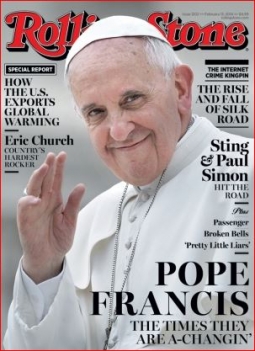 I started out yawning at the Pope Francis cover at Rolling Stone. Then I read it, and was frustrated and saddened. But after a day of trying to ignore it, and hoping that I wouldn’t have to bother writing about it (and with a helpful challenge from another Patheos blogger), I think it might deserve more than just a dismissal.
So here’s how that worked out, in order.
1. Yawn …
Rolling Stone is late to the party with this piece. We’ve already had tons of Pope Francis coverage, and doing the compare/contrast routine with Benedict is likewise old news. So too is looking at how Francis is changing the style of the papacy and speculation about changes to come in the Curia — and the piece adds nothing new to these discussions.
So the only real story here is the story itself: the Pope’s on the cover of Rolling Stone! But Time beat them to the punch on making a story out of a secular publication celebrating Francis, and even if they hadn’t, the Advocate managed to be more shocking and surprising. (Covers for two out of three of “sex, drugs, and rock ‘n roll” for a septuagenarian celibate ain’t bad. Should we be on the lookout for High Times to devote a cover to Francis as well?)
Anyway: the main thing that’s newsworthy about this story is that Rolling Stone ran it, and even that’s not all that interesting anymore.
2. “What a pity.”
That’s what Fr. Federico Lombardi, SJ, the Vatican spokesman, had to say about the piece, calling it “superficial journalism.” He made clear that it misunderstands the new pope as much as the old one: “This is not the way to do a good service even to Pope Francis, who knows very well what the Church owes to his predecessor.”
Yes, what a pity that our cultural imagination finds the easiest way to praise someone is by contrasting them with someone we’re supposed to despise. What a pity that the new example of leadership Francis is giving — both for the Church and for the world — keeps getting illustrated by contrast with Benedict. We’d all do well to remember that the “Francis effect” is only possible because, by resigning, Benedict did something thoroughly more radical with the papacy than any of the changes Francis has made or is likely to make.
And what a pity, as Leah Libresco has commented over at Unequally Yoked, that the piece praises Francis’s joy without wondering more about where it is sourced. (Though there may be a small glimmer of hope there. Leah points out that Francis “makes joy and charity look normal, until the most surprising thing is that we ever came to believe this spirit wasn’t our natural inheritance.” My favorite line from the Rolling Stone profile was a quote from Elisabetta Piqué, an Argentine journalist who’s known Francis for years, saying his election represents a “scandal of normality.” Amen to that; three words to capture why Francis has captured our imaginations.)
3. What can we learn here?
I was ready to leave the Rolling Stone piece behind, and leave my own response unwritten — neither the yawn nor the pity seeming compelling enough to bother with — until I read Elizabeth Duffy’s challenge (hat-tip to the Deacon’s Bench for that) to cast a wider net.
She points out that
Catholics are so used to pope bashing that we become skeptical when the media loves him or any part of our faith. It’s tempting to think these are apocalyptic times. The seed must be falling on rocky ground, and eventually the media is going to wake up and realize that the Pope is still Catholic (or as some conspiracy theorists fear, maybe the Church will wake up and discover that the Pope no longer is).
And she wonders if “it’s possible that our culture has been silently longing to see the Gospel truly lived and willing to engage with the world as it is.” If I may paraphrase: perhaps it’s possible that our world, so thoroughly coarsened that it seems unshockable, is now waiting to be scandalized by the “normality” of joy, hope, and faith.
After all, I’d just finished writing an intro piece for TJP on Patheos about our hope to pursue reconciliation in this new space, to help people to talk to each other, and to be open to the possibility that God is at work in people we might disagree with to change us as much as them. Physician, heal thyself.
What do I have to learn from the Rolling Stone piece, once I get past my impulse to correct everything it got wrong? Once I get past being bored by or despairing over another instance of “the world” not getting “the Church”?
Here are a few suggestions.
First, the world is fascinated by the Church. Often that fascination is expressed in negative critique: what’s this hidebound, archaic, repressive institution still doing here? But it remains fascination, and I think much of that is due to the fact that the Church is one of the few institutions that still can be imagined as “larger” than a purely human project. We still think that “belonging” has a significance that is more than merely functional; we still feel committed to the Church even when it doesn’t appear to satisfy our desires. And so the appearance of a new pope who helps the world see some of what we already know and love in the Church increases that fascination. And insofar as fascination may lead to wonder and wonder may lead to love … maybe, just maybe, this is all part of grace at work.
Second, even what’s expressed as criticism can be born from hope. Let’s try to discern where it comes from before we leap to correct it. Yes, I am as sick as anyone else at seeing Benedict XVI maligned and his name dragged through the mud. Yes, I wish people who write about the Church bothered to be more than minimally acquainted with basic theology.
Nonetheless, there’s a basic hopefulness behind a lot of it: people who didn’t think they could like a pope now do, and are trying to understand why; exploring the contrast is an obvious way to do that. While he by no means deserves to suffer it, Benedict’s legacy will survive a poorly researched drive-by smear in Rolling Stone. Perhaps we ought to be more concerned with helping people explore why Francis’s focus on the poor or his personal simplicity seem so compelling rather than making sure they know they’re wrong in their assumptions about Benedict, or have all their theological i’s dotted and t’s crossed.
Third, it’s Francis’s celebrity — but it’s our mission. It’s easy to get caught up in the flood of positive attention being directed at the Church these days, even if we’re a little skeptical about it. It feels good to be liked, after all, and particularly for those of us who work in evangelization and communication, there’s a tremendous opportunity. People are finally interested in what we’re saying! (Believe me: we know the papal coverage temptation well at The Jesuit Post).
But if all we’re doing is enjoying the moment of papal sunshine cast our way, we’re missing the point. It’s easy to take it as affirmation for what we’ve already been doing. It’s easy to count the pope’s likeability as success. However, as Francis warned us in Evangelii Gaudium, that way lies the peril of the “spiritual worldliness” which seeks our own interests rather than Christ’s, which leads us to “look on from above and afar, [to] reject the prophecy of their brothers and sisters, [to] discredit those who raise questions, [to] constantly point out the mistakes of others and [to be] obsessed by appearances” (§97).
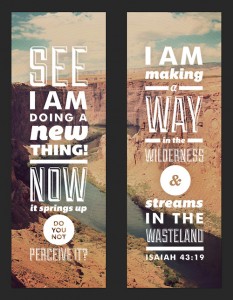 “See, I am doing something new!” (Isaiah 43:19)
A pope on the cover of Rolling Stone — surely a new thing. What are we going to do with it? How are we going to take this moment of openness, this possible moment of grace, and cooperate with it?
This flood of attention being paid to the Church ought to be a challenge to us to use it as an opportunity to preach the Gospel — and perhaps more importantly, to learn from it how to preach the Gospel more effectively in the world today.
The “scandal of normality,” the surprisingly credible witness of joy, the desire for someone to speak out on behalf of the poor — there is much for us to learn here. And that is by no means an exhaustive list.
I don’t expect Rolling Stone to start preaching the Gospel (though God has done stranger things). But it would be ungrateful, not to mention unimaginative, to think that we can’t learn something about the Gospel from Rolling Stone.
Previous Post

January 30, 2014
Catholic Writers - Who's on YOUR Shelf?
Next Post

February 4, 2014 The Catholic "More Than"
Browse Our Archives
Select a Category About the Blog TJP Book Excerpt TJP Excerpt Uncategorized Weekly Post
Select a Month June 2015 May 2015 April 2015 March 2015 February 2015 January 2015 December 2014 November 2014 October 2014 September 2014 August 2014 July 2014 June 2014 May 2014 April 2014 March 2014 February 2014 January 2014
Follow Us!
TAKE THE
Religious Wisdom Quiz
According to Titus, what did God do when his kindness and love appeared?
Select your answer to see how you score.
He saved us through the washing of rebirth and renewal by the Holy Spirit He destroyed his enemies He established his church He sent his Son
Related posts from The Jesuit Post
America interviews TJP editor Michael Rossmann, SJ

Rosario Rodriguez on forgiving her attackers

Leah Darrow: From America's Next Top Model to...
TRENDING AT PATHEOS Catholic

Bad Survey Questions Distort Eucharistic Theology
It seems to be the newest thing: someone conducts a bad survey...

If Baptism Washes Away Sin, Why Do Catholics...
The seven sacraments stand as the foundation of Catholic ecclesial life. The...

Far from promoting indifference, inaction, or quietism, Paul consistently tells us to...

The Power of Setting a Good Example
Remember last August when the Chicago White Sox hosted a "Pope Hat...

A Catholic Critique of Biblical Unitarianism
If the statistics are to be believed, Unitarianism is rising worldwide. Although...

How Grandma Tourism Helps Grandparents Live Their Vocation
Grandma, The New Travel Influencer What started as a nostalgia-inspired social media...
view all Catholic blogs
Ad-Free & Subscriber Log-In Subscription Support
- About Us
- 2026 Calendar
- Videos
- Podcasts
- Library of World Religions
- Faith In Media Tracker
- Advertise With Us
- Write for Us
- Privacy Policy
- Terms of Service
- Do Not Sell My Data
- Contact Us
- Radiant Digital
- Manage Newsletter Subscriptions
- Unsubscribe From Notifications
- Sitemap
Copyright 2008-2026, Patheos, part of the Radiant Digital network of media brands. All rights reserved.
Subscription Support Ad-Free & Subscriber Log-In
Follow Patheos