
BuddhistCatholicContemplativeEvangelicalGeneral ChristianHinduJewishLatter-day SaintMuslimNew VisionsProgressive Christian
Beliefs
- Buddhist
- Catholic
- Contemplative
- Evangelical
- General Christian
- Hindu
- Jewish
- Latter-day Saint
- More Voices
- Muslim
- New Visions
- Pagan
- Progressive Christian
Topics
- Religion News
- Food and Religion
- Sports and Religion
- Religious Art
- Religious Music and Entertainment
- Religious Events
- History and Religion
- Style and Religion
- Politics and Religion
- Women in Religion
- Recreation Outdoors and Religion
- Business Finance and Religion
- Careers Workplace and Religion
- Education and Religion
- Family Parenting and Religion
- Health Fitness and Religion
- Home and Religion
- Relationships and Religion
- Technology and Religion
- Travel and Religion
Columnists
- Buddhist Columnists
- Business Finance and Religion Columnists
- Careers Workplace and Religion Columnists
- Catholic Columnists
- Contemplative Columnists
- Education and Religion Columnists
- Evangelists Columnists
- Family Parenting and Religion Columnists
- General Christian Columnists
- Health Fitness and Religion Columnists
- Hindu Columnists
- History and Religion Columnists
- Home and Religion Columnists
- Jewish Columnists
- More Voices Columnists
- Latter Day Columnists
- Muslim Columnists
- New Visions Columnists
- Nonreligious Columnists
- Pagan Columnists
- Politics and Religion Columnists
- Progressive Columnists
- Recreation Outdoors and Religion Columnists
- Relationships and Religion Columnists
- Religion News Columnists
- Religious Art Columnists
- Religious Events Columnists
- Religious Music and Entertainment Columnists
- Sports and Religion Columnists
- Style and Religion Columnists
- Technology and Religion Columnists
- Travel and Religion Columnists
- Women in Religion Columnists
Resource Library
- 2026 Calendar
- Library of World Religions
- The 100 Most Holy Places on Earth
- Patheos Answers
- Podcasts
- Videos
- Faith Leaders Database
- Anglican Episcopalian
- Bahai
- Baptist
- Buddhism
- Christianity
- Confucianism
- Eastern Orthodoxy
- Hinduism
- Holiness and Pentecostal
- ISKCON
- Islam
- Judaism
- Lutheran
- Methodist
- The Church of Jesus Christ of Latter-day Saints
- New Age
- Paganism
- Presbytarian and Reformed
- Protestantism
- Religion Behind the Scenes
- Roman Catholic
- Scientology
- Shia Islam
- Sikhism
- Sufism
- Sunni Islam
- Taoism
- Zen
- See all religions
Research Tools
 Ad-Free & Subscriber Log-In Subscription Support
Ad-Free & Subscriber Log-In Subscription Support
Follow Patheos 

- Trending:
- Forgiveness
- |
- Marriage
- |
- Consciousness
- |
- Death Penalty
- |
- Election
- |
- Halloween

- Home
- Progressive Christian
- Health, Fitness and Religion
- OCD in a Religious Context: Scruples
OCD in a Religious Context: Scruples
Last updated on: August 16, 2023 at 3:31 pm by Christine Schmertz Navarro
OCD in a Religious Context: Scruples 2023-08-16T15:31:48-07:00 Christine Schmertz Navarro
Patheos Explore the world's faith through different perspectives on religion and spirituality! Patheos has the views of the prevalent religions and spiritualities of the world.
When people experience Obsessive Compulsive Disorder (OCD) related to Christianity, it can manifest itself as scruples. OCD is a painful and debilitating mental illness as are scruples.
What are Scruples?
The words “scrupulous” and “scruples,” according to Merriam-Webster, originate from a Latin noun for a small sharp stone. While a sharp stone in a shoe distracts a walker attempting to go somewhere, a scruple is a concern that nags at a person’s mind. Perhaps you want a scrupulous surgeon who carefully checks that all is well before sewing you up. Maybe a scrupulous accountant will check your taxes twice before sending them to the IRS. (Apparently, Scruples is also a line of hair products as well as a television series based on a Judith Krantz novel. Interesting.)
Scruples were more common prior to Vatican II in Catholic circles when the faithful lined up for Confession Saturday evenings to prepare to receive the Eucharist the next day. Religious scruples are recurring fearful thoughts that a person has gravely sinned, is going to hell, or will otherwise receive punishment for sinful thoughts or actions.
My Own Experience
When I was in middle school, I attended an Opus Dei school that catechized via the Baltimore Catechism. We discussed sin on a regular basis in religion class, listened to weekly formation talks, and had Confession afterward. One conversation that I remember concerned whether a person would go to hell if he or she died on the way to confess a mortal sin. The teaching that probably caused me the most trouble was that a person could sin mortally by thinking about committing a mortal sin without doing anything concrete.
Perhaps this last teaching is the reason that stealing and coveting are in the Ten Commandments. A desire to hurt someone can be so powerful that it becomes a sin even if no action is ever taken. In my own case, my brain started thinking about all sorts of sins that I had no intention of ever committing. Fearing hell, I would second-guess myself repeatedly. As a scrupulous Catholic, I frequented the confessional. I did not want to confess to the Opus Dei priests. I tried to resist going to confession at my parish but wound up heading there often so that I could have some peace of mind.
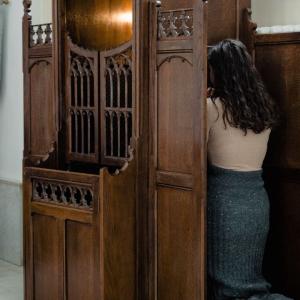
Persons with scruples may spend more time in the confessional. Thanks to Mart Production
Recovery from Scruples
Time passed and I attended a different high school. A priest’s advice, however, stuck with me. He said that I would absolutely know if I committed a mortal sin. I did not have much trouble with the scruples after that.
Mental health professionals can help people work on scruples as well as on other manifestations of OCD. Mark Shea, in his article, “Bullying the Scrupulous,” says that “diseased religion” can contribute to scruples. I think a focus on sin, penance, and hell for middle school-aged kids is a bit much. Students with fragile psyches are more vulenerable. I do not know how the other girls in my class responded to the teachings we received. They did not seem to react negatively. Since I never talked about what I was going through, others might have suffered similarly.
A Balanced Approach to Goodness and Sin
Discussion about sin without similar treatment of God’s creation, including human beings, as good, can be diseased. We are made in God’s image and likeness. We clearly can sin, but what parent just looks at what their child does wrong without understanding his or her innate goodness? If human parents can do that, God surely must.
I received a peek into the pre-Vatican II Catholic Church in the United States and am relieved that scruples are not as common as they once were. A healthy balance between people’s goodness and capacity to sin is much holier. Unfortunately, scruples are not completely a thing of the past. A scrupulous person cannot simply “get over it,” though their fears may be strange to others. They really need support to overcome them.
Catholic
Health, Fitness and Religion
Education and Religion
Previous Post

August 14, 2023
The Bible is Radical
Next Post

August 29, 2023 Why Do Some Americans Believe that Climate Change is Not Urgent?
Recent Comments
Browse Our Archives
Select a Category Bible Call and Vocation Cars and Religion Christian Behavior Christmas Generosity Family and Religion Law and Religion Money and Religion Moral Leadership Music and Religion Nature and Religion Politics and Religion Religion and Athletics Religion and Generalizations Religion and justice Ritual and Religion Uncategorized
Select a Month June 2026 April 2026 June 2025 February 2025 January 2025 November 2024 October 2024 September 2024 August 2024 April 2024 March 2024 February 2024 January 2024 December 2023 November 2023 October 2023 September 2023 August 2023 July 2023
Follow Us!
TAKE THE
Religious Wisdom Quiz
What disciple walked on water toward Jesus?
Select your answer to see how you score.
John James Matthew Peter
Related posts from The Intersection of Faith and Life
Will the U.S. Warehouse People with Disabilities?
The Intersection of Faith and Life
The Intersection of Faith and Life

Cruelty Toward Immigrants is Not Christian
The Intersection of Faith and Life

Peter Hegseth's Religious Beliefs Harm Americans
The Intersection of Faith and Life
TRENDING AT PATHEOS Progressive Christian

What Being a Modern-Day Apostle Means to Me
In my last column, I discussed the ins and outs of modern-day...

Did Ancient China Once Worship the God of...
Across human history, a common thread weaves through the origins of the...

Love Your Neighbor – Including Earth-Kin: Lev. 19,...
God’s command to love your neighbor means acting in an ethical and...

Lead a Church Study of “Jesus and Lao...
Guest writer Jack Thomas (The Irreverent Reverend) reflects on leading his church...

Pastoral Wisdom for Responding to Sermon Pushback
Getting sermon pushback on your social justice sermon? Learn practical, Proverbs-based strategies...

Principles for Understanding the Apostolic Ministry Today
Whenever people discover that my formal ministry title is "apostle," as in...
view all Progressive Christian blogs
Ad-Free & Subscriber Log-In Subscription Support
- About Us
- 2026 Calendar
- Videos
- Podcasts
- Library of World Religions
- Faith In Media Tracker
- Advertise With Us
- Write for Us
- Privacy Policy
- Terms of Service
- Do Not Sell My Data
- Contact Us
- Radiant Digital
- Manage Newsletter Subscriptions
- Unsubscribe From Notifications
- Sitemap
Copyright 2008-2026, Patheos. All rights reserved.
Subscription Support Ad-Free & Subscriber Log-In
Follow Patheos