
BuddhistCatholicContemplativeEvangelicalGeneral ChristianHinduJewishLatter-day SaintMuslimNew VisionsProgressive Christian
Beliefs
- Buddhist
- Catholic
- Contemplative
- Evangelical
- General Christian
- Hindu
- Jewish
- Latter-day Saint
- More Voices
- Muslim
- New Visions
- Pagan
- Progressive Christian
Topics
- Religion News
- Food and Religion
- Sports and Religion
- Religious Art
- Religious Music and Entertainment
- Religious Events
- History and Religion
- Style and Religion
- Politics and Religion
- Women in Religion
- Recreation Outdoors and Religion
- Business Finance and Religion
- Careers Workplace and Religion
- Education and Religion
- Family Parenting and Religion
- Health Fitness and Religion
- Home and Religion
- Relationships and Religion
- Technology and Religion
- Travel and Religion
Columnists
- Buddhist Columnists
- Business Finance and Religion Columnists
- Careers Workplace and Religion Columnists
- Catholic Columnists
- Contemplative Columnists
- Education and Religion Columnists
- Evangelists Columnists
- Family Parenting and Religion Columnists
- General Christian Columnists
- Health Fitness and Religion Columnists
- Hindu Columnists
- History and Religion Columnists
- Home and Religion Columnists
- Jewish Columnists
- More Voices Columnists
- Latter Day Columnists
- Muslim Columnists
- New Visions Columnists
- Nonreligious Columnists
- Pagan Columnists
- Politics and Religion Columnists
- Progressive Columnists
- Recreation Outdoors and Religion Columnists
- Relationships and Religion Columnists
- Religion News Columnists
- Religious Art Columnists
- Religious Events Columnists
- Religious Music and Entertainment Columnists
- Sports and Religion Columnists
- Style and Religion Columnists
- Technology and Religion Columnists
- Travel and Religion Columnists
- Women in Religion Columnists
Resource Library
- 2026 Calendar
- Library of World Religions
- The 100 Most Holy Places on Earth
- Patheos Answers
- Podcasts
- Videos
- Faith Leaders Database
- Anglican Episcopalian
- Bahai
- Baptist
- Buddhism
- Christianity
- Confucianism
- Eastern Orthodoxy
- Hinduism
- Holiness and Pentecostal
- ISKCON
- Islam
- Judaism
- Lutheran
- Methodist
- The Church of Jesus Christ of Latter-day Saints
- New Age
- Paganism
- Presbytarian and Reformed
- Protestantism
- Religion Behind the Scenes
- Roman Catholic
- Scientology
- Shia Islam
- Sikhism
- Sufism
- Sunni Islam
- Taoism
- Zen
- See all religions
Research Tools
 Ad-Free & Subscriber Log-In Subscription Support
Ad-Free & Subscriber Log-In Subscription Support
Follow Patheos 

- Trending:
- Forgiveness
- |
- Marriage
- |
- Consciousness
- |
- Death Penalty
- |
- Election
- |
- Halloween

- Home
- Progressive Christian
- Women in Religion
- Can Christian Women Relate Better to Mary of Nazareth?
Can Christian Women Relate Better to Mary of Nazareth?
Last updated on: August 21, 2023 at 2:56 pm by Christine Schmertz Navarro
Can Christian Women Relate Better to Mary of Nazareth? 2023-08-21T14:56:57-07:00 Christine Schmertz Navarro
Patheos Explore the world's faith through different perspectives on religion and spirituality! Patheos has the views of the prevalent religions and spiritualities of the world.
Can thinking about Jesus’ mother, Mary of Nazareth, help women relate more closely to her? I was leaving Mass on Mothers’ Day when I overheard a woman saying that she had never been able to relate to Mary, Jesus’ mother. I started thinking about the many statues of Mary I have seen over the years. Mary is serious, draped in blue and possibly holding a cherubic Jesus in her arms. In some paintings, she looks mercifully down at “us.” She is perfect. Because she is without sin and looks perfect, it is difficult to imagine her dealing with a toddler, with conflict, or with much of daily life in her day and ours.
I think of these perfect images as “Mary, Queen of Heaven.” We direct prayers for the intercession of Mary, Queen of Heaven, when we recite the rosary. We honor this Mary when we pray the “Hail, Mary”.
In my own mind, Mary of Nazareth is Mary, Queen of Heaven, during her earthly life. She faced innumerable challenges and could only have achieved her later status in heaven by being strong, believing in herself, trusting in God, and responding creatively to various obstacles.
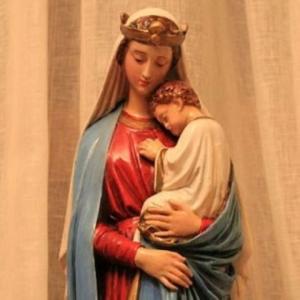
Mary holds Jesus. Davie Bicker, Pixabay
Mary in the Gospels
We first meet Mary of Nazareth in the gospels of Matthew and Luke, chapters 1 and 2. Recall that the Gospels or “good news” originally were oral announcements. Jesus’ followers preached about his great works, his death, miraculous resurrection and ascension, and his forgiveness of sins. Early believers thought that Jesus’ second coming was imminent, so initially they did not worry about recording this information in writing.
As time passed, however, the followers realized that they needed to create permanent written accounts of Jesus’ life, death, resurrection, and ascension. While the gospels are likely longer narratives of these events, they were never intended to be biographies. We only have short accounts of Mary’s life and actions here and there and gaps about which we have unanswered questions.
Mary of Nazareth’s Pregnancy and Experiences in Bethlehem
Scholars believe that Nazareth was a small town in the days of Jesus, Mary, and Joseph. We know from Scripture that Mary conceived Jesus by the Holy Spirit (Luke 1:31). The rest of Nazareth was not aware, however, of her pregnancy’s divine origin. I imagine that she was the subject of gossip because she had either conceived the baby with Joseph prior to their marriage or she had had an affair with another man. Saying that God was the father of her child probably would have gone over as well as it would today. An unusual pregnancy at the age of twelve would have been overwhelming, but gossip may have increased the stress. Most women can identify with being the subject of gossip. How would Mary have responded?
The census described in Luke, chapter 2, means that Joseph and Mary traveled from Nazareth in Galilee to Bethlehem in Judea (Luke 2:4). Bethlehem is significant because the heir to King David was to be born there. The couple traveled about sixty miles to arrive in Bethlehem. Though artists often portray Mary riding on a donkey, this detail cannot be found in Luke. Given that Mary gives birth soon after her arrival, she may have walked the entire distance in her ninth month, which would have taken great physical and emotional strength!
According to the Gospel of Matthew, the Magi visited Jesus, Mary, and Joseph. Luke tells that shepherds did as well. In dreams, God told the Magi not to tell King Herod where the child was and explained to Joseph that he, Mary, and the baby must flee to Egypt.
Joseph and Mary of Nazareth Fled King Herod
Mary and Joseph may have walked to Egypt with Jesus (Matthew 2: 13-15) at which point Joseph needed to find a livelihood. Had he brought the tools he used for carpentry? Mary and Joseph would have found other people with whom to associate. They had no place to live and shared many of the concerns of modern refugees. Mary would have needed to use all her skills to manage day-to-day life in another culture.
Would Mary have heard of Herod’s decision to massacre the boys in Bethlehem while they were in Egypt (Matthew 2:16-18)? If so, she surely did upon their return. Imagine processing the reality that so many parents had lost sons while Herod was seeking her own son. Living with this truth would also have required trust in God and emotional strength. Upon returning to Galilee, Mary, Joseph, and Jesus settled in Nazareth where they needed to start all over again.
Jesus Remained in His Father’s House
The Scriptures tell us that Jesus stayed in the Jerusalem Temple rather than rejoining his parents after their Passover journey to the city (Luke 2:41-52). Luke says that initially, his parents thought Jesus was among their family and friends. Subsequently, Joseph and Mary returned to Jerusalem and found Jesus in “his Father’s house” after three days of looking. What did their friends and family think about this unusual turn of events? Mary and Joseph do not seem like the type of couple who would lie and say that he was lost. Luckily upon returning, Jesus obeyed his parents.
We do not hear more about Joseph after the Passover Temple story. Did he die while Jesus was in his teens? Was he alive throughout Jesus’ life? We do not know. If Mary had to live as a widow, however, she was put in a difficult spot. Joseph’s work as a carpenter suggested that he might not inherit any land from his forbearers. If Joseph was to inherit land, however, it could have come to Mary through Jesus. If not, she was dependent on other people’s generosity to sustain herself and Jesus. Again, this would have been challenging.
Jesus Came to Nazareth and was Rejected
Luke tells the story of Jesus’ visit to the synagogue in Nazareth (Luke 4: 16-30). Jesus read a passage from Isaiah that refers to the prophet who would receive God’s spirit and anointing. He then said, “Today this scripture passage is fulfilled in your hearing.” At first, those listening were amazed, but then they noted that this was Joseph’s son and asked him to perform the works he had done elsewhere. He said that prophets are not welcome in their native place and made other references to great prophets of the Scriptures. He clearly associated himself with these other prophets which angered the Jews present. They consequently drove Jesus out of Nazareth.
I can imagine that as soon as Jesus was gone, all the anger and questions would have been directed at Mary (and Joseph if he was still alive). “Who is your son that he can speak as if he is one of the great prophets? Did you teach him to think this way? Do you think he is a prophet?” Mary likely faced mixed reactions from neighbors as Jesus traveled and did and said various unexpected things throughout his ministry.
Mary of Nazareth, Queen of Heaven
When I think of Mary of Nazareth, I imagine a resourceful, strong, loving woman who likely faced many challenges yet trusted in God: a miraculous pregnancy; the long trip to Bethlehem, Egypt and back; and the need to defend Jesus’ unusual behavior; the worry and sorrow of his life and death; and possibly the status of a widow. If she was able to make it through all of these things as well as the stresses of daily life, her life was much more like our own than we might think, despite the centuries in between. I think that the “Mary of Nazareth, Queen of Heaven” statue would have a wrinkled face; weathered skin; loving, compassionate eyes; and simpler clothing. She would be the type of person many of us would like to befriend, consult with and ask for help.
I believe in both the portraits of Mary of Nazareth and Mary, Queen of Heaven. After serving God so faithfully, God brought her up to heaven and gave her an exalted place. I think that many of us can relate more easily to Mary of Nazareth because we are on our own earthly journeys. We pray that we can join Mary someday in Heaven.
General Christian
Catholic
Women in Religion
Family, Parenting and Religion
Previous Post

July 28, 2023
Approaching Darkness with Light: Curiosity About a Supreme Court Case
Next Post

August 4, 2023 Does the United States Appear Highly Religious?
Recent Comments
Browse Our Archives
Select a Category Bible Call and Vocation Cars and Religion Christian Behavior Christmas Generosity Family and Religion Law and Religion Money and Religion Moral Leadership Music and Religion Nature and Religion Politics and Religion Religion and Athletics Religion and Generalizations Religion and justice Ritual and Religion Uncategorized
Select a Month June 2026 April 2026 June 2025 February 2025 January 2025 November 2024 October 2024 September 2024 August 2024 April 2024 March 2024 February 2024 January 2024 December 2023 November 2023 October 2023 September 2023 August 2023 July 2023
Follow Us!
TAKE THE
Religious Wisdom Quiz
With only 300 men, torches, and clay jars, I defeated an army as numerous as locusts. Who am I?
Select your answer to see how you score.
Barak Jephthah Gideon Samson
Related posts from The Intersection of Faith and Life

Will the U.S. Warehouse People with Disabilities?
The Intersection of Faith and Life
The Intersection of Faith and Life
Cruelty Toward Immigrants is Not Christian
The Intersection of Faith and Life
Peter Hegseth's Religious Beliefs Harm Americans
The Intersection of Faith and Life
TRENDING AT PATHEOS Progressive Christian

Why Christians Have a Sacred Duty to Vote:...
The Bible offers strong support for the sacred duty to vote. Here...

What Being a Modern-Day Apostle Means to Me
In my last column, I discussed the ins and outs of modern-day...

Did Ancient China Once Worship the God of...
Across human history, a common thread weaves through the origins of the...

Love Your Neighbor – Including Earth-Kin: Lev. 19,...
God’s command to love your neighbor means acting in an ethical and...

Lead a Church Study of “Jesus and Lao...
Guest writer Jack Thomas (The Irreverent Reverend) reflects on leading his church...

Principles for Understanding the Apostolic Ministry Today
Whenever people discover that my formal ministry title is "apostle," as in...
view all Progressive Christian blogs
Ad-Free & Subscriber Log-In Subscription Support
- About Us
- 2026 Calendar
- Videos
- Podcasts
- Library of World Religions
- Faith In Media Tracker
- Advertise With Us
- Write for Us
- Privacy Policy
- Terms of Service
- Do Not Sell My Data
- Contact Us
- Radiant Digital
- Manage Newsletter Subscriptions
- Unsubscribe From Notifications
- Sitemap
Copyright 2008-2026, Patheos. All rights reserved.
Subscription Support Ad-Free & Subscriber Log-In
Follow Patheos