
BuddhistCatholicContemplativeEvangelicalGeneral ChristianHinduJewishLatter-day SaintMuslimNew VisionsProgressive Christian
Beliefs
- Buddhist
- Catholic
- Contemplative
- Evangelical
- General Christian
- Hindu
- Jewish
- Latter-day Saint
- More Voices
- Muslim
- New Visions
- Pagan
- Progressive Christian
Topics
- Religion News
- Food and Religion
- Sports and Religion
- Religious Art
- Religious Music and Entertainment
- Religious Events
- History and Religion
- Style and Religion
- Politics and Religion
- Women in Religion
- Recreation Outdoors and Religion
- Business Finance and Religion
- Careers Workplace and Religion
- Education and Religion
- Family Parenting and Religion
- Health Fitness and Religion
- Home and Religion
- Relationships and Religion
- Technology and Religion
- Travel and Religion
Columnists
- Buddhist Columnists
- Business Finance and Religion Columnists
- Careers Workplace and Religion Columnists
- Catholic Columnists
- Contemplative Columnists
- Education and Religion Columnists
- Evangelists Columnists
- Family Parenting and Religion Columnists
- General Christian Columnists
- Health Fitness and Religion Columnists
- Hindu Columnists
- History and Religion Columnists
- Home and Religion Columnists
- Jewish Columnists
- More Voices Columnists
- Latter Day Columnists
- Muslim Columnists
- New Visions Columnists
- Nonreligious Columnists
- Pagan Columnists
- Politics and Religion Columnists
- Progressive Columnists
- Recreation Outdoors and Religion Columnists
- Relationships and Religion Columnists
- Religion News Columnists
- Religious Art Columnists
- Religious Events Columnists
- Religious Music and Entertainment Columnists
- Sports and Religion Columnists
- Style and Religion Columnists
- Technology and Religion Columnists
- Travel and Religion Columnists
- Women in Religion Columnists
Resource Library
- 2026 Calendar
- Library of World Religions
- The 100 Most Holy Places on Earth
- Patheos Answers
- Podcasts
- Videos
- Faith Leaders Database
- Anglican Episcopalian
- Bahai
- Baptist
- Buddhism
- Christianity
- Confucianism
- Eastern Orthodoxy
- Hinduism
- Holiness and Pentecostal
- ISKCON
- Islam
- Judaism
- Lutheran
- Methodist
- The Church of Jesus Christ of Latter-day Saints
- New Age
- Paganism
- Presbytarian and Reformed
- Protestantism
- Religion Behind the Scenes
- Roman Catholic
- Scientology
- Shia Islam
- Sikhism
- Sufism
- Sunni Islam
- Taoism
- Zen
- See all religions
Research Tools
 Ad-Free & Subscriber Log-In Subscription Support
Ad-Free & Subscriber Log-In Subscription Support
Follow Patheos 

- Trending:
- Forgiveness
- |
- Marriage
- |
- Consciousness
- |
- Death Penalty
- |
- Election
- |
- Halloween
 The Inner Room
- Home
- Catholic
- Uselessness: Where Suffering and Beauty Meet
Uselessness: Where Suffering and Beauty Meet
Last updated on: February 10, 2017 at 8:39 pm by Karl Persson
Uselessness: Where Suffering and Beauty Meet 2017-02-10T20:39:24-04:00 Karl Persson
Patheos Explore the world's faith through different perspectives on religion and spirituality! Patheos has the views of the prevalent religions and spiritualities of the world.
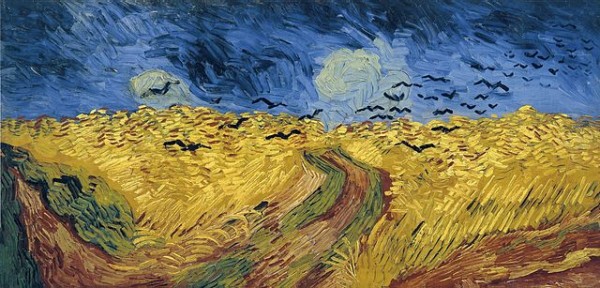
Wheatfield With Crows, 1890, Vincent van Gogh, Van Gogh Museum, Amsterdam, via Wikimedia Commons
I’ve never been good at beauty. Yes, of course I can in some sense understand beauty – for instance could tell you the parts of a piece of literature that make it beautiful. But I usually don’t permit beauty to draw me out of myself – maybe because I’ve been pushed and pulled and pinned and boxed in so many times by mental illness that I experience my own passibility as fear – the drawing out effected by beauty is of a good kind, but that’s hard to accept when the stirrings of it feel like violence. Further of course, I know my own heart and wonder whether, if I permitted my heart to move, it would move appropriately. There is always the possibility of lust for the beautiful thing or person, of envy of beauty’s seemingly peaceful state, or a deep irrational destroying frustration with something or someone so lucky as to have escaped pain – or at the very least to have somehow transcended it.
Conversely, what attracts me to people, things, and art alike are the haunted places, the places where there is yearning, tenderness, fear, pain, loneliness, and finally love. The love I am drawn to in hope – hope that it can be me someday. Likewise the tenderness. But the rest are a mirror of myself, and I seek them out as spaces where I can hear and be heard, where the darkness unnamable is not perhaps named, but at least felt – or felt to be felt – mutually. Of course, to affirm that we can simply feel each other’s pain apart from the mediation of Christ’s body is a dangerous mistake, a disregard of the particularity of others’ wounds; “I know how you feel” is a deadly phrase whenever detached from the metaphysics of the suffering Christ, whose suffering is known to us, yet also more unknown than known. Still, all this being said, sufferers can sit in the apophatic darkness and converse – and hold each others’ hands – and discover that they are somehow not alone, even if they will never fully know the depth of the other’s pain. It is this that I seek from most of my encounters, and since beauty, or at least the usual type of beauty, is not often participant in this sometimes horrific conversation, it is something I reckon little with.
And yet recently I have begun to be drawn to beauty through what I can only call a kind of empathy, and this by reading Josef Pieper’s Leisure: The Basis of Culture. Now this book of course is primarily about leisure, but as Pieper works out his argument, his definition of leisure is not so much fixed as it is fluid, a space apart from the utilitarian world of work that is the backdrop against which our world evaluates most things. Primarily marked by the evocation of wonder, this space is the sphere proper to various human experiences including worship and beauty and contemplation and the liberal arts, where what is encountered is marked by a particular kind of givenness rather than by a utilitarian justification. Yet in the workaday world, many of these truly free and freeing pursuits will be maligned and discarded as useless. And it is in this way that a certain kind of empathetic approach to beauty has been growing in me – because I know too well what it is to be useless when measured by usual utilitarian standards.
I know, that is, the uselessness effected by mental illness. I know some will quibble with my assertion of myself as such, and I know there are some who have it a lot worse off than I – I at least have the opportunity and wherewithal to teach in my field part time. Still, there is a deep pain when I see my peers making exciting contributions in their fields and generally doing amazing things while I watch myself spend most of my energy trying to survive or bury any spark of an idea I have under self-hatred, self-doubt, fear of rejection, perfectionism, or obsession, and fail over and over again to get things done, even when I have promised them to others. By any reckoning based on a utilitarian model – the model increasingly dominating the academic world as the university abandons the idea of a liberal arts education and adopts the value sets associated with what Pieper calls servile work – I am at the bottom of things, a failure. But even so there is still it seems a space left to me, the space of leisure Pieper has carved out of the workaday world. For this space is not based on utility and completion time, but a particular kind of openness to reality – and this space indeed is what I am forced many times to inhabit given my circumstances as a mentally ill academic. I am forced to sit and watch – receive – as the world I work on and think about passes me by, and only sometimes I am given the grace to actually articulate what I see and to be useful academically. Still, I cannot always predict when that will be, so mostly I just have to be content with this safe but frustratingly useless haven of grace beyond work, where I can receive and am received, no strings attached. And realizing this caused me to think about the fragile vulnerability of beauty.
By this I mean that the beautiful thing, insofar as it is maligned and hated and deemed useless, occupies in many ways the same space occupied by wounded and broken things, things that are of no use to the servile world – for both must occupy in their passivity the extra-servile space of Sabbath. To be sure, it is for different reasons – beauty occupies this space because it is by definition extra-utilitarian, while the wounded occupy this space and keep the Sabbath precisely because they can’t work – but it is interesting thinking about the ways they share the same space, the way the tears of the broken water the feet of the beautiful. There are ways perhaps it makes me even pity beauty – feel for it as a creature similarly alienated from work and its merits, but for that very reason also, like me, the recipient of grace. For pity too is a form of grace.
Of course, all that I am saying here has been much more elegantly caught up in a single image, and that from a particular Anglo-Saxon poem, The Dream of the Rood. In it, the poem’s speaker encounters a cross that seems to be constantly changing its outward appearance, now adorned with gold and gems, now effectively exhibiting stigmata and the other tortures of Christ. Later we learn that the cross is a sign, a beacon that leads one to heaven, and it is perhaps precisely for the reason explored in this post, the close proximity of the beauty and the suffering – one outside the aegis of the sæculum because receptive of extra-worldly grace, and the other outside because what is wounded and dying has no choice but to be reliant on given grace. The constantly changing cross is a hinge, drawing the wounded up into its extra-worldly wounds fused immediately with all that is beatific – the bush burns, but the flame does not devour; beauty and suffering kiss where the fire and the rose are one.
Previous Post

February 8, 2017
A Poetic Hope
Browse Our Archives
Select a Category Advent Awe Hope Lent listening Pentecost Prayer Reflection Silence Solitude Space Uncategorized wonder
Select a Month February 2017 January 2017 November 2016 September 2016 August 2016 July 2016 June 2016 May 2016 April 2016 March 2016 February 2016 January 2016 December 2015
Follow Us!
TAKE THE
Religious Wisdom Quiz
What type of insect is known from the plagues of Egypt?
Select your answer to see how you score.
Butterflies Flies Bees Locusts
Related posts from The Inner Room

Rescuing Small and Huddling Things from Adversarial Protectiveness

St. Maria Goretti and the Forgiveness of Rapists
Curing the Hungry, Feeding the Sick: Caring For...
How to Offer Spiritual Care to Your Mentally...
TRENDING AT PATHEOS Catholic

Rejecting Doom: Christian Hope And Human Action
Christianity is a religion of hope. We are to have hope and...

It’s What Comes From Within Which Matters
One of the most difficult things for us to understand is why...

Why I Choose the Eucharist Over the Sermon
Choose the Eucharist, Not the Sermon What are we supposed to get...

5 Design Elements Found in Spiritually Rooted Homes
Putting Spirituality Into Home Decor Our homes are more than our living...

Credo: A Story of God Told with the...
About 10 years ago, I began to imagine a personal "Credo" that...

The Anatomy of Divine Revelation in Catholic Thought
The claim that God has made Himself known to human beings is...
view all Catholic blogs
Ad-Free & Subscriber Log-In Subscription Support
- About Us
- 2026 Calendar
- Videos
- Podcasts
- Library of World Religions
- Faith In Media Tracker
- Advertise With Us
- Write for Us
- Privacy Policy
- Terms of Service
- Do Not Sell My Data
- Contact Us
- Radiant Digital
- Manage Newsletter Subscriptions
- Unsubscribe From Notifications
- Sitemap
Copyright 2008-2026, Patheos. All rights reserved.
Subscription Support Ad-Free & Subscriber Log-In
Follow Patheos