
BuddhistCatholicContemplativeEvangelicalGeneral ChristianHinduJewishLatter-day SaintMuslimNew VisionsProgressive Christian
Beliefs
- Buddhist
- Catholic
- Contemplative
- Evangelical
- General Christian
- Hindu
- Jewish
- Latter-day Saint
- More Voices
- Muslim
- New Visions
- Pagan
- Progressive Christian
Topics
- Religion News
- Food and Religion
- Sports and Religion
- Religious Art
- Religious Music and Entertainment
- Religious Events
- History and Religion
- Style and Religion
- Politics and Religion
- Women in Religion
- Recreation Outdoors and Religion
- Business Finance and Religion
- Careers Workplace and Religion
- Education and Religion
- Family Parenting and Religion
- Health Fitness and Religion
- Home and Religion
- Relationships and Religion
- Technology and Religion
- Travel and Religion
Columnists
- Buddhist Columnists
- Business Finance and Religion Columnists
- Careers Workplace and Religion Columnists
- Catholic Columnists
- Contemplative Columnists
- Education and Religion Columnists
- Evangelists Columnists
- Family Parenting and Religion Columnists
- General Christian Columnists
- Health Fitness and Religion Columnists
- Hindu Columnists
- History and Religion Columnists
- Home and Religion Columnists
- Jewish Columnists
- More Voices Columnists
- Latter Day Columnists
- Muslim Columnists
- New Visions Columnists
- Nonreligious Columnists
- Pagan Columnists
- Politics and Religion Columnists
- Progressive Columnists
- Recreation Outdoors and Religion Columnists
- Relationships and Religion Columnists
- Religion News Columnists
- Religious Art Columnists
- Religious Events Columnists
- Religious Music and Entertainment Columnists
- Sports and Religion Columnists
- Style and Religion Columnists
- Technology and Religion Columnists
- Travel and Religion Columnists
- Women in Religion Columnists
Resource Library
- 2026 Calendar
- Library of World Religions
- The 100 Most Holy Places on Earth
- Patheos Answers
- Podcasts
- Videos
- Faith Leaders Database
- Anglican Episcopalian
- Bahai
- Baptist
- Buddhism
- Christianity
- Confucianism
- Eastern Orthodoxy
- Hinduism
- Holiness and Pentecostal
- ISKCON
- Islam
- Judaism
- Lutheran
- Methodist
- The Church of Jesus Christ of Latter-day Saints
- New Age
- Paganism
- Presbytarian and Reformed
- Protestantism
- Religion Behind the Scenes
- Roman Catholic
- Scientology
- Shia Islam
- Sikhism
- Sufism
- Sunni Islam
- Taoism
- Zen
- See all religions
Research Tools
 Ad-Free & Subscriber Log-In Subscription Support
Ad-Free & Subscriber Log-In Subscription Support
Follow Patheos 

- Trending:
- Forgiveness
- |
- Marriage
- |
- Consciousness
- |
- Death Penalty
- |
- Election
- |
- Halloween
 The Inner Room
- Home
- Catholic
- Discovering Humanity Through Whispered Poetry in an Age of Rhetorical Explosives
Discovering Humanity Through Whispered Poetry in an Age of Rhetorical Explosives
Last updated on: September 8, 2016 at 7:00 am by Karl Persson
Discovering Humanity Through Whispered Poetry in an Age of Rhetorical Explosives 2016-09-08T07:00:47-04:00 Karl Persson
Patheos Explore the world's faith through different perspectives on religion and spirituality! Patheos has the views of the prevalent religions and spiritualities of the world.
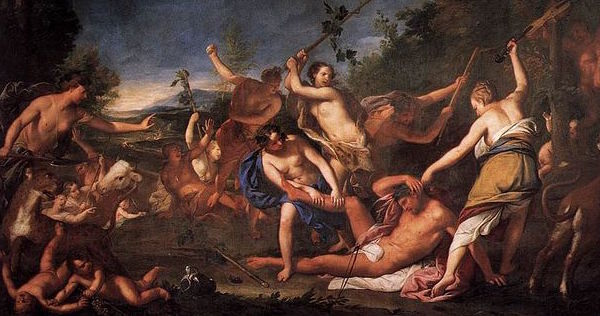
Orpheus and the Bacchantes by Gregorio Lazzarini, Public Domain via Wikimedia Commons
Flannery O’Connor once said in justification of her fiction that, in a deaf culture, one has to shout and draw large figures. And this is true of a particular kind of cultural deafness. Where violence and rot is covered up by a certain kind of respectability, such shouting and grotesqueness can be an invaluable wake-up call.
However, in my recent experience, there are other kinds of deafness amidst which shouting and grotesque figures simply don’t help. This is the deafness caused not by cover-up-respectability, but by exposure to too much shouting and noise. If one is deaf daily due to the noises and explosions of existence in an active construction zone, a few more shouts are just going to add to the noise rather than get anyone to listen.
And I feel like this is the rhetorical climate we live in. Shouts and grotesqueness work where there is politeness and respectability. They don’t work where there is simply noise, where each party is simply trying to out-yell the other. Extreme satire doesn’t work when history itself starts reading like a satirist’s script. Parody doesn’t work because we have ourselves become incarnate parodies. In a deaf culture that is respectable, one shouts and draws large grotesque figures. But in a culture where regular communication is undertaken with shouting and grotesqueness, there must be something else. Which is why I am turning increasingly away from the give and take of public argumentation and toward poetry. And this because I think we need to excavate once more the form of the human buried underneath the debris that marks its grave.
You see, like it or not, the human form is one of the things everyone wants, whether left or right, religious or non-religious. But in the current rhetorical climate, our attempts are a little like those of a demolition company trying to do restorative archeology. We can blast away at things with dynamite and shake them to bits with pneumatic drills. But this just destroys everything – there are no relics left. Sometimes I suspect that, in the most secret places of their hearts, those most responsible for the shouting and dynamiting on either side really do want the same thing – apocalypse and death. At the end of the day there is not really so much difference between the religious fundamentalist who wants civilization reduced to dust as a punishment against the godless heathen, and the progressive who secretly wants such apocalyptic destruction because those awful bigoted fundamentalists really are asking for it. Right and left, we pray to the same god: Nihilism.
And so I have turned to poetry. Not because poetry will be heard. But because it is right that there should be more complicated pictures of the human form than the ones we encounter daily in our news and Facebook feeds. It is right that the details of what a human is – in all its complexity and ambiguity and sin and grace and glory – should be traced. It is right that that form of which God said, “It is good” – marred by sin though it is – should be remembered.
We are blasting to pieces things that should be handled with gloves and brushes. The destruction of ancient art and architecture by organizations like ISIS is really only the physical manifestation of something we’ve been doing ideologically for a while. At the end of the day, is the cynical deconstruction of a piece of literature which we in our superiority have transcended really so much different in spirit from the destruction of ancient churches or temples? Like the students in Hitchcock’s classic film, Rope, fundamentalists may in fact simply be the most astute students of progressives. The world means nothing, you say? We are post-human, you say? Fine, we’ll act that way. Did you think we wouldn’t take you seriously? Flannery O’Connor in more than one place suggests that the great joke on Nietzsche is that the “new man” he prophesied isn’t the great and glorious thing he imagined, but rather the ad-man. And the business of ad-men is to reduce complex beauty to shoutable sound bytes that succeed by inundation and nagging. All publicity is good publicity.
And so I turn to poetry, one art that at least retains, if not categorically, then at least potentially, the capacity to participate in the careful excavation of the human form, the division of soul and spirit and joint and marrow that is the business of the Word of God and those who follow Him. Sometimes in deaf cultures you have to shout and make large grotesque figures. But other times, when the shouting and grotesqueness get too loud and obnoxious and everything is exploding around you, you have to whisper. Not because anyone will hear you. But because what you are whispering is truth in all its beautiful, complicated glory.
Stay in touch! Like The Inner Room on Facebook:
Previous Post
August 27, 2016
Seeking Identity
Next Post

September 6, 2016 The Voice of the Heart
Browse Our Archives
Select a Category Advent Awe Hope Lent listening Pentecost Prayer Reflection Silence Solitude Space Uncategorized wonder
Select a Month February 2017 January 2017 November 2016 September 2016 August 2016 July 2016 June 2016 May 2016 April 2016 March 2016 February 2016 January 2016 December 2015
Follow Us!
TAKE THE
Religious Wisdom Quiz
What did Jesus say about judging people?
Select your answer to see how you score.
Judge fairly Judge not Judge justly Judge yourself only
Related posts from The Inner Room


St. Maria Goretti and the Forgiveness of Rapists

On the Solemnity of Mary, Mother of God

TRENDING AT PATHEOS Catholic

Creation, Preservation, and Teleology in Catholic Theology
As I write this, it is very early Monday morning. Like millions...

The Parable Of The Sower And The Word...
One of Christ’s most famous parables is that of the sower who...

Rejecting Doom: Christian Hope And Human Action
Christianity is a religion of hope. We are to have hope and...

Why I Choose the Eucharist Over the Sermon
Choose the Eucharist, Not the Sermon What are we supposed to get...

5 Design Elements Found in Spiritually Rooted Homes
Putting Spirituality Into Home Decor Our homes are more than our living...

Credo: A Story of God Told with the...
About 10 years ago, I began to imagine a personal "Credo" that...
view all Catholic blogs
Ad-Free & Subscriber Log-In Subscription Support
- About Us
- 2026 Calendar
- Videos
- Podcasts
- Library of World Religions
- Faith In Media Tracker
- Advertise With Us
- Write for Us
- Privacy Policy
- Terms of Service
- Do Not Sell My Data
- Contact Us
- Radiant Digital
- Manage Newsletter Subscriptions
- Unsubscribe From Notifications
- Sitemap
Copyright 2008-2026, Patheos. All rights reserved.
Subscription Support Ad-Free & Subscriber Log-In
Follow Patheos