
BuddhistCatholicContemplativeEvangelicalGeneral ChristianHinduJewishLatter-day SaintMuslimNew VisionsProgressive Christian
Beliefs
- Buddhist
- Catholic
- Contemplative
- Evangelical
- General Christian
- Hindu
- Jewish
- Latter-day Saint
- More Voices
- Muslim
- New Visions
- Pagan
- Progressive Christian
Topics
- Religion News
- Food and Religion
- Sports and Religion
- Religious Art
- Religious Music and Entertainment
- Religious Events
- History and Religion
- Style and Religion
- Politics and Religion
- Women in Religion
- Recreation Outdoors and Religion
- Business Finance and Religion
- Careers Workplace and Religion
- Education and Religion
- Family Parenting and Religion
- Health Fitness and Religion
- Home and Religion
- Relationships and Religion
- Technology and Religion
- Travel and Religion
Columnists
- Buddhist Columnists
- Business Finance and Religion Columnists
- Careers Workplace and Religion Columnists
- Catholic Columnists
- Contemplative Columnists
- Education and Religion Columnists
- Evangelists Columnists
- Family Parenting and Religion Columnists
- General Christian Columnists
- Health Fitness and Religion Columnists
- Hindu Columnists
- History and Religion Columnists
- Home and Religion Columnists
- Jewish Columnists
- More Voices Columnists
- Latter Day Columnists
- Muslim Columnists
- New Visions Columnists
- Nonreligious Columnists
- Pagan Columnists
- Politics and Religion Columnists
- Progressive Columnists
- Recreation Outdoors and Religion Columnists
- Relationships and Religion Columnists
- Religion News Columnists
- Religious Art Columnists
- Religious Events Columnists
- Religious Music and Entertainment Columnists
- Sports and Religion Columnists
- Style and Religion Columnists
- Technology and Religion Columnists
- Travel and Religion Columnists
- Women in Religion Columnists
Resource Library
- 2026 Calendar
- Library of World Religions
- The 100 Most Holy Places on Earth
- Patheos Answers
- Podcasts
- Videos
- Faith Leaders Database
- Anglican Episcopalian
- Bahai
- Baptist
- Buddhism
- Christianity
- Confucianism
- Eastern Orthodoxy
- Hinduism
- Holiness and Pentecostal
- ISKCON
- Islam
- Judaism
- Lutheran
- Methodist
- The Church of Jesus Christ of Latter-day Saints
- New Age
- Paganism
- Presbytarian and Reformed
- Protestantism
- Religion Behind the Scenes
- Roman Catholic
- Scientology
- Shia Islam
- Sikhism
- Sufism
- Sunni Islam
- Taoism
- Zen
- See all religions
Research Tools
 Ad-Free & Subscriber Log-In Subscription Support
Ad-Free & Subscriber Log-In Subscription Support
Follow Patheos 

- Trending:
- Forgiveness
- |
- Marriage
- |
- Consciousness
- |
- Death Penalty
- |
- Election
- |
- Halloween
 The Inner Room
- Home
- Catholic
- Why I Need Contemplative Spirituality
Why I Need Contemplative Spirituality
Last updated on: April 11, 2016 at 9:45 am by Karl Persson
Why I Need Contemplative Spirituality 2016-04-11T09:45:02-04:00 Karl Persson
Patheos Explore the world's faith through different perspectives on religion and spirituality! Patheos has the views of the prevalent religions and spiritualities of the world.
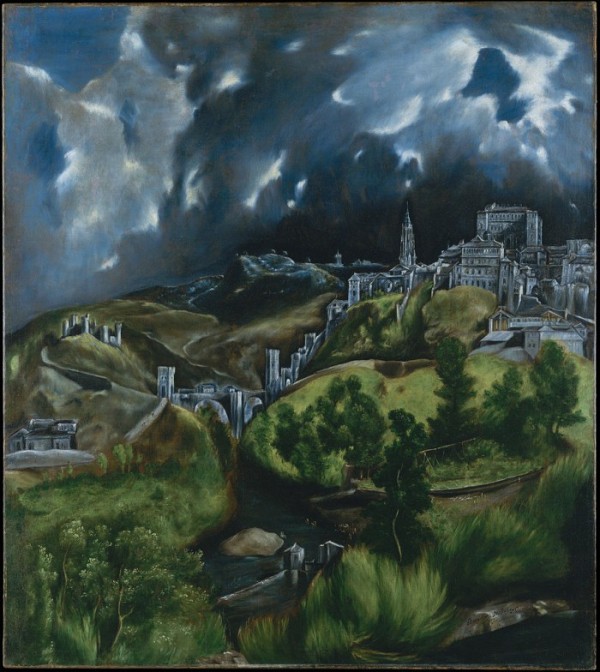
View of Toledo, El Greco [Public Domain}, via Wikimedia Commons
In his eminently affable and uncontroversial way, theologian Stanley Hauerwas once suggested he’s a pacifist because he’s a violent son of a bitch. I feel roughly similar about my own commitment to contemplative spirituality. I’m not a peaceful, well-balanced person. I’m not, as they say, zen. I’m not the guy on the inspirational poster. My mind is neurotic and frenetic, humming with noise. And these are all the reasons the Christian contemplative tradition is precisely what I need. Hauerwas recognized the monster he could potentially become without the strict tether of a pacifist commitment; similarly, I see as often as I look into the mirror the spiritual chaos my life runs the risk of becoming, and indeed too often becomes. All this to say that I am not good at contemplative spirituality; it doesn’t come to me naturally. And so you might rightly ask – as I sometimes do – why I am here writing on contemplative spirituality at all.
And yet there is a part of me that knows why too. It’s because I know there are others for whom contemplative spirituality and mysticism are not matters of comfort and natural inclination, but of life and death. It will not mean the difference between a good relationship with a God and a better one; rather, it will be the difference between relationship and death. And I write in part in the hope that some of those who have given up on spirituality on account of “not being good at it” might reconsider. When one is drowning in the ocean, one doesn’t need to “be good at” clinging to the life buoy. One simply clings to it.
You see, as someone with depression and OCD, I always lacked those things that effectively functioned as affective sacraments in the Evangelical culture I grew up in. “I wanna’ be in the light/as you are in the light” we would sing with DC Talk while the darkness of depression welled within me. And assurance of salvation. It’s fun to talk about that when your OCD keeps you from even the basic assurance you have locked the door at night. And so I was blind. I was blind in places where I saw other people seeing. Unsettled in places where I saw other people certain. Emotionally dead where I saw others feeling. And I tried. God knows how I tried. But it was a bit like being made to dance with a group who have practiced their choreography inside and out – and expected to perform with them without knowing the choreography at all. Where other hearts went right, mine went left. Where people were lifting their hands in praise, I was bowing my head in sorrow. Where others were alive, I felt dead.
Which is curious, because somehow I stayed. Not Evangelical – and I hope fellow Evangelicals can forgive me for that and try to understand – but at least Christian. I am still in love with Him. And conversely there are many who had the experiences – those glowing vibrant holy grails of faith – and then walked away. I often wonder whether, if I had been more honest about my own insecurities, it might have helped them. Maybe they too were pretending and needed to talk. Or not. The freedom of the will is a factor in these matters too.
But to return from idle speculations, I’m convinced it was, has been, and is a kind of contemplative sensibility that has kept me. Somehow along with the doubt and darkness, I also knew that my relationship with Christ in his apparent absence was intimate in a different way. Though I am increasingly reluctant to name or define it as a concept, there is a part of me that seems to have always known what St. John of the Cross describes as the dark night, even before I had words with which to know it – mixed to be sure with all kinds of other complicated experiences and mental illnesses, and hardly pure, but there nonetheless. God’s absence was the wedding band that bound our hearts together.
And so it was – has been – a dance. A dance wherein the worst moments have been when I try to mimic the moves of others – the ones I am “supposed to” do – and fail. But a dance too where I have occasionally been able to pull off moves that look remarkable and daring and wise to others, but only because those others fail to realize that these are simply a means of survival. It is not as though without contemplative spirituality I would be less of a Christian. Rather, without such spiritualities of darkness, I could not be a Christian. I’m a deeply unspiritual son of a bitch. And that’s why I need contemplative spirituality.

Next Post

April 14, 2016 Teach Us To Pray...But Be Gentle: Prayer and Mental Illness
Browse Our Archives
Select a Category Advent Awe Hope Lent listening Pentecost Prayer Reflection Silence Solitude Space Uncategorized wonder
Select a Month February 2017 January 2017 November 2016 September 2016 August 2016 July 2016 June 2016 May 2016 April 2016 March 2016 February 2016 January 2016 December 2015
Follow Us!
TAKE THE
Religious Wisdom Quiz
True or False: Cornelius was a Roman centurion who was the first Gentile convert.
Select your answer to see how you score.
TRUE FALSE
Related posts from The Inner Room




TRENDING AT PATHEOS Catholic

Rejecting Doom: Christian Hope And Human Action
Christianity is a religion of hope. We are to have hope and...

It’s What Comes From Within Which Matters
One of the most difficult things for us to understand is why...

Why I Choose the Eucharist Over the Sermon
Choose the Eucharist, Not the Sermon What are we supposed to get...

5 Design Elements Found in Spiritually Rooted Homes
Putting Spirituality Into Home Decor Our homes are more than our living...

Credo: A Story of God Told with the...
About 10 years ago, I began to imagine a personal "Credo" that...

The Anatomy of Divine Revelation in Catholic Thought
The claim that God has made Himself known to human beings is...
view all Catholic blogs
Ad-Free & Subscriber Log-In Subscription Support
- About Us
- 2026 Calendar
- Videos
- Podcasts
- Library of World Religions
- Faith In Media Tracker
- Advertise With Us
- Write for Us
- Privacy Policy
- Terms of Service
- Do Not Sell My Data
- Contact Us
- Radiant Digital
- Manage Newsletter Subscriptions
- Unsubscribe From Notifications
- Sitemap
Copyright 2008-2026, Patheos. All rights reserved.
Subscription Support Ad-Free & Subscriber Log-In
Follow Patheos