
BuddhistCatholicContemplativeEvangelicalGeneral ChristianHinduJewishLatter-day SaintMuslimNew VisionsProgressive Christian
Beliefs
- Buddhist
- Catholic
- Contemplative
- Evangelical
- General Christian
- Hindu
- Jewish
- Latter-day Saint
- More Voices
- Muslim
- New Visions
- Pagan
- Progressive Christian
Topics
- Religion News
- Food and Religion
- Sports and Religion
- Religious Art
- Religious Music and Entertainment
- Religious Events
- History and Religion
- Style and Religion
- Politics and Religion
- Women in Religion
- Recreation Outdoors and Religion
- Business Finance and Religion
- Careers Workplace and Religion
- Education and Religion
- Family Parenting and Religion
- Health Fitness and Religion
- Home and Religion
- Relationships and Religion
- Technology and Religion
- Travel and Religion
Columnists
- Buddhist Columnists
- Business Finance and Religion Columnists
- Careers Workplace and Religion Columnists
- Catholic Columnists
- Contemplative Columnists
- Education and Religion Columnists
- Evangelists Columnists
- Family Parenting and Religion Columnists
- General Christian Columnists
- Health Fitness and Religion Columnists
- Hindu Columnists
- History and Religion Columnists
- Home and Religion Columnists
- Jewish Columnists
- More Voices Columnists
- Latter Day Columnists
- Muslim Columnists
- New Visions Columnists
- Nonreligious Columnists
- Pagan Columnists
- Politics and Religion Columnists
- Progressive Columnists
- Recreation Outdoors and Religion Columnists
- Relationships and Religion Columnists
- Religion News Columnists
- Religious Art Columnists
- Religious Events Columnists
- Religious Music and Entertainment Columnists
- Sports and Religion Columnists
- Style and Religion Columnists
- Technology and Religion Columnists
- Travel and Religion Columnists
- Women in Religion Columnists
Resource Library
- 2026 Calendar
- Library of World Religions
- The 100 Most Holy Places on Earth
- Patheos Answers
- Podcasts
- Videos
- Faith Leaders Database
- Anglican Episcopalian
- Bahai
- Baptist
- Buddhism
- Christianity
- Confucianism
- Eastern Orthodoxy
- Hinduism
- Holiness and Pentecostal
- ISKCON
- Islam
- Judaism
- Lutheran
- Methodist
- The Church of Jesus Christ of Latter-day Saints
- New Age
- Paganism
- Presbytarian and Reformed
- Protestantism
- Religion Behind the Scenes
- Roman Catholic
- Scientology
- Shia Islam
- Sikhism
- Sufism
- Sunni Islam
- Taoism
- Zen
- See all religions
Research Tools
 Ad-Free & Subscriber Log-In Subscription Support
Ad-Free & Subscriber Log-In Subscription Support
Follow Patheos 

- Trending:
- Forgiveness
- |
- Marriage
- |
- Consciousness
- |
- Death Penalty
- |
- Election
- |
- Halloween
 The Inner Room
- Home
- Catholic
- Tuesday Lenten Reflection II: Living With Others in Pain
Tuesday Lenten Reflection II: Living With Others in Pain
Last updated on: February 23, 2016 at 3:25 am by Karl Persson
Tuesday Lenten Reflection II: Living With Others in Pain 2016-02-23T03:25:48-04:00 Karl Persson
Patheos Explore the world's faith through different perspectives on religion and spirituality! Patheos has the views of the prevalent religions and spiritualities of the world.
 In my prior Lenten post, I discussed Nouwen’s idea that the way to deal with loneliness is not to run from it or desperately try to drown it out, but rather to enter into it and let our desperation transform into a calm and positive solitude, a place in our hearts set apart and protected yet also open to entertaining strangers. In this post, I would like to delve a bit more into one aspect of this, the way that solitude can help open us to the pain of others. Nouwen puts it better than I could, so I shall begin with his words:
When we think about the people who have given us hope and have increased the strength of our soul, we might discover that they were not the advice givers, warners or moralists, but the few who were able to articulate in words and actions the human condition in which we participate and who encouraged us to face the realities of life. Preachers who reduce mysteries to problems and offer Band-Aid-type solutions are depressing because they avoid the compassionate solidarity out of which healing comes forth…Those who do not run away from our pains but touch them with compassion bring healing and new strength. The paradox indeed is that the beginning of healing is in the solidarity with the pain. In our solution-oriented society it is more important than ever to realize that wanting to alleviate pain without sharing it is like wanting to save a child from a burning house without the risk of being hurt. It is in solitude that this compassionate solidarity takes place. (Henri Nouwen, Reaching Out, Chapter 3, Solidarity in Pain)
To begin discussion, let me suggest that if you don’t feel the immediate palpable danger in this prospect, you should probably leave the passage and come back to it at another time, for your own good and for the good of others. Pain is a powerful thing, and sharing it with others is an intimate, vulnerable, and powerful experience – and not recognizing this can be deadly. I have seen it become the prey of ever so many warring savior complexes. And I can think of a number of instances where pain has been opened up in community, has paraded its awkward self around the room, and has then been put away more lonely and isolated than before. Like the house swept clean till the demon returns with seven more wicked spirits, the final condition feels worse and more hopeless than the first.
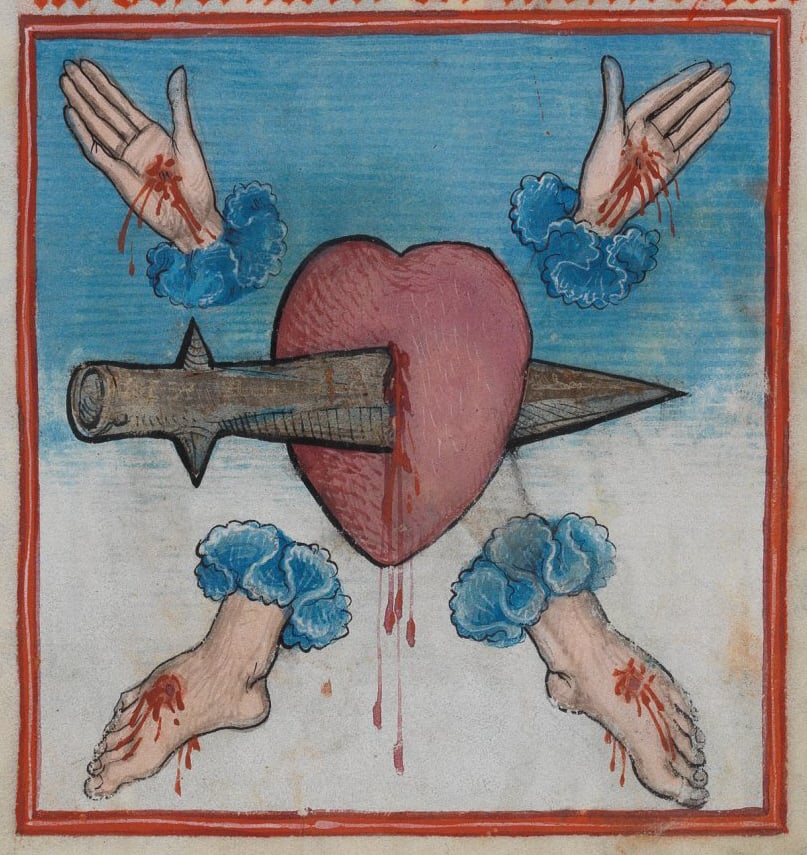
But if you hear this with fear and trembling – whether you are the one seeking to open your wounds to someone else, or the one seeking to gently tend the wounds of another – know that there is another way, a way that we encounter every time we attend the Mass. This is the way of the corpus on the cross, the body and blood in the tabernacle. For in these we discover the pain of ourselves and others held together in Christ’s body, and held in such a way that they are public and common, neither a spectacle to be mocked nor a shame to be hidden away; they are the means of participation in the pain of our neighbours. And though many of the wounds will have been inflicted by us – perhaps even as a result of good intentions and a caring spirit – the miracle is that we may still approach alongside one another as the corpus calls our hearts again and again to a particular kind of rawness and vulnerability handled with all the reverence due to the Host – for these too are His wounds in His body, the Church. If you do not yet know the deep and profound danger of sharing pain with others, I encourage you this Lent to continue making your home in the loneliness until it has become solitude. But to the degree that you are alive to the reality of wounds – your own, those of others, and the awful way they are caught up in Christ’s body – I encourage you to ask yourself even more particularly than usual this Lent where you might touch the wounds of Christ in others. And further, even when we have nothing to give, let us be open to letting others touch His wounds in us – for we trust with Saints Thomas and Longinus in the power of these wounds to convert and heal.
Previous Post

February 18, 2016
Solitude of Heart
Next Post

February 29, 2016 Hospitality and Mount Saint Mary's University
Browse Our Archives
Select a Category Advent Awe Hope Lent listening Pentecost Prayer Reflection Silence Solitude Space Uncategorized wonder
Select a Month February 2017 January 2017 November 2016 September 2016 August 2016 July 2016 June 2016 May 2016 April 2016 March 2016 February 2016 January 2016 December 2015
Follow Us!
TAKE THE
Religious Wisdom Quiz
I am twelve stones taken from a riverbed and set up as a memorial to a miraculous crossing. What am I?
Select your answer to see how you score.
Altar stones The memorial stones The Stones of remembrance Bethel
Related posts from The Inner Room
Uselessness: Where Suffering and Beauty Meet


Rescuing Small and Huddling Things from Adversarial Protectiveness
TRENDING AT PATHEOS Catholic

The Parable Of The Sower And The Word...
One of Christ’s most famous parables is that of the sower who...

Rejecting Doom: Christian Hope And Human Action
Christianity is a religion of hope. We are to have hope and...

Why I Choose the Eucharist Over the Sermon
Choose the Eucharist, Not the Sermon What are we supposed to get...

5 Design Elements Found in Spiritually Rooted Homes
Putting Spirituality Into Home Decor Our homes are more than our living...

Credo: A Story of God Told with the...
About 10 years ago, I began to imagine a personal "Credo" that...

The Anatomy of Divine Revelation in Catholic Thought
The claim that God has made Himself known to human beings is...
view all Catholic blogs
Ad-Free & Subscriber Log-In Subscription Support
- About Us
- 2026 Calendar
- Videos
- Podcasts
- Library of World Religions
- Faith In Media Tracker
- Advertise With Us
- Write for Us
- Privacy Policy
- Terms of Service
- Do Not Sell My Data
- Contact Us
- Radiant Digital
- Manage Newsletter Subscriptions
- Unsubscribe From Notifications
- Sitemap
Copyright 2008-2026, Patheos. All rights reserved.
Subscription Support Ad-Free & Subscriber Log-In
Follow Patheos