
BuddhistCatholicContemplativeEvangelicalGeneral ChristianHinduJewishLatter-day SaintMuslimNew VisionsProgressive Christian
Beliefs
- Buddhist
- Catholic
- Contemplative
- Evangelical
- General Christian
- Hindu
- Jewish
- Latter-day Saint
- More Voices
- Muslim
- New Visions
- Pagan
- Progressive Christian
Topics
- Religion News
- Food and Religion
- Sports and Religion
- Religious Art
- Religious Music and Entertainment
- Religious Events
- History and Religion
- Style and Religion
- Politics and Religion
- Women in Religion
- Recreation Outdoors and Religion
- Business Finance and Religion
- Careers Workplace and Religion
- Education and Religion
- Family Parenting and Religion
- Health Fitness and Religion
- Home and Religion
- Relationships and Religion
- Technology and Religion
- Travel and Religion
Columnists
- Buddhist Columnists
- Business Finance and Religion Columnists
- Careers Workplace and Religion Columnists
- Catholic Columnists
- Contemplative Columnists
- Education and Religion Columnists
- Evangelists Columnists
- Family Parenting and Religion Columnists
- General Christian Columnists
- Health Fitness and Religion Columnists
- Hindu Columnists
- History and Religion Columnists
- Home and Religion Columnists
- Jewish Columnists
- More Voices Columnists
- Latter Day Columnists
- Muslim Columnists
- New Visions Columnists
- Nonreligious Columnists
- Pagan Columnists
- Politics and Religion Columnists
- Progressive Columnists
- Recreation Outdoors and Religion Columnists
- Relationships and Religion Columnists
- Religion News Columnists
- Religious Art Columnists
- Religious Events Columnists
- Religious Music and Entertainment Columnists
- Sports and Religion Columnists
- Style and Religion Columnists
- Technology and Religion Columnists
- Travel and Religion Columnists
- Women in Religion Columnists
Resource Library
- 2026 Calendar
- Library of World Religions
- The 100 Most Holy Places on Earth
- Patheos Answers
- Podcasts
- Videos
- Faith Leaders Database
- Anglican Episcopalian
- Bahai
- Baptist
- Buddhism
- Christianity
- Confucianism
- Eastern Orthodoxy
- Hinduism
- Holiness and Pentecostal
- ISKCON
- Islam
- Judaism
- Lutheran
- Methodist
- The Church of Jesus Christ of Latter-day Saints
- New Age
- Paganism
- Presbytarian and Reformed
- Protestantism
- Religion Behind the Scenes
- Roman Catholic
- Scientology
- Shia Islam
- Sikhism
- Sufism
- Sunni Islam
- Taoism
- Zen
- See all religions
Research Tools
 Ad-Free & Subscriber Log-In Subscription Support
Ad-Free & Subscriber Log-In Subscription Support
Follow Patheos 

- Trending:
- Forgiveness
- |
- Marriage
- |
- Consciousness
- |
- Death Penalty
- |
- Election
- |
- Halloween
 The Inner Room
- Home
- Catholic
- Reaching Out Amidst OCD and Depression: Tuesday Lenten Reflection I
Reaching Out Amidst OCD and Depression: Tuesday Lenten Reflection I
Last updated on: February 16, 2016 at 9:55 pm by Karl Persson
Reaching Out Amidst OCD and Depression: Tuesday Lenten Reflection I 2016-02-16T21:55:46-04:00 Karl Persson
Patheos Explore the world's faith through different perspectives on religion and spirituality! Patheos has the views of the prevalent religions and spiritualities of the world.
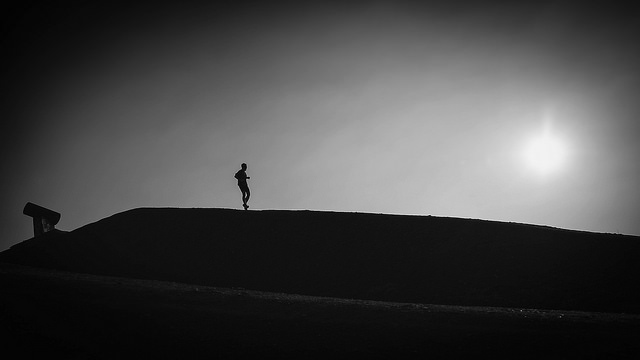
Photo Credit: The Valley Runner, Georgie Pauwels (Creative Commons License)
I have comorbid depression and obssessive compulsive disorder. I write this, not as a bid for particular sympathy – everyone has crosses – but to help give an idea of the loneliness that Henri Nouwen’s book, Reaching Out, can speak to. Of course – and very fortunately – most won’t know these experiences with such intensity as I. But I am convinced that the kind of things I experience with these issues is different from the experience of others in degree rather than kind. Even the healthiest of people know times when anxiety and sadness detach them from others – we can expect no less in a fallen world. But I shall leave applicability and analogue to the discernment of each reader. For now, my purpose is to outline my experience with the inner ache that is loneliness, and to explain how Nouwen’s text has helped address that.
But what have these disorders to do with loneliness? Well, to begin, depression is more a matter of feeling internally dead than feeling internally sad – sadness implies the hope of movement – and so one in the depth of the deepest depression has all the affable interpersonal skills of a corpse. Do you know what the corpse most recently buried in your local graveyard is thinking? No, because it is dead. This, if not exactly the ontological reality of the person in depression, is precisely how the depressed person feels, and it is intensely lonely. If some of us seem overly drawn to the darker and more gothic parts of the world, it is at least in part because of the prospect that the medieval dance of death is not in fact categorically morbid, but rather the expression of a hope born of loneliness – that someday perhaps even the death we know so intimately will experience the miracle of being able to join in the community of dance, alive.
This loneliness is further amplified by my experience of OCD, which deals in obsessions and compulsions. Compulsions are what we do to neutralize the anxiety of obssessions, irrational fears that some part of us recognizes as irrational, but that another part cannot stop worrying about. The key to fighting it is finding ways not to give in to the cycle of obsessions and compulsions, whether this involves medication, cognitive behavioural therapy, exposure therapy, or some combination of these – and it is an intensely lonely prospect.
When asked how we are doing or what we are thinking, the answer is complicated. Generally it is easiest to gloss over the problem and not mention it, but even when one does, well-meaning people often try to fix the thing we are irrationally worrying about, or reassure us that it is not something to worry about – seeking reassurance from others can in fact become a neutralizing compulsion. How does one tell someone that it is not the what we are worrying about that matters, but the how – the tortuous cycle – and moreover that for proper care it needs to be acknowledged even while entanglement in it must be avoided? Like others, and sometimes even more than others, we have the deep desire to connect with friends, family, and lovers in the depth of our being – but this is a difficult and often unattempted enterprise when it can be so difficult to tell the difference between one’s inner self and the OCD that fogs it.
Further, relationally inflected OCD often involves deep fear of hurting the people one most loves and values, and so one symptom can be avoidance of and distancing oneself from precisely those people; whereas such behaviour is usually interpreted as an expression of dislike or rejection in typical society, it can be an attempt to protect the ones we love from an imaginary predator in our minds – an explanation perhaps of why I feel some of the most pastorally meaningful texts I have encountered have been written by Joss Whedon. Though the creatures in my head are imaginary, and though part of me knows that, I know experientially the constant fear of slipping that is the essence of vampire love. And it is a lonely dance, one in which we pay so much attention to the potential disasters we may be to others that we forget we are in fact dancing with others – or, when we are reminded, we shut them out as a means of protecting them. And thus is the stage set for my crucial encounter with Nouwen’s Reaching Out last year.
As someone in these situations, I know altogether too well the experience that Nouwen so accurately describes, of an interior loneliness so suffocating that one seeks external distraction from it as much as available energy will allow, and, even in those rare moments when one begins to be at home in oneself, keeps it at arm’s length in a hermetically sealed safe in one’s chest. But what really struck me was Nouwen’s counterintuitive approach to dealing with it. Rather than treating it as a mere symptom to be simply fixed by bravery in reaching out, Nouwen suggests that loneliness is within all of us, and it will not go away this side of heaven – and the attempt to fill it with other things and persons merely ends in misuse of these things, and unhealthy relationships with these people. So Nouwen suggests that, far from fleeing this loneliness, ignoring it, or eliminating it, our first business is walking directly into it and making our homes there. Much as the desert fathers made it their business to fight their own demons and proclivities by proceeding into the desert, so our business must be to proceed into the loneliness of our heart and make it our home – Nouwen describes this as transforming loneliness into solitude, and suggests it not only as a personal matter, but one affecting entire communities. According to Nouwen, the dynamics of relationships depend on an inner solitude kept apart in one’s heart that can then paradoxically be a space of hospitality to share with others. Violating the sanctity of this inner space or letting it remain mere loneliness and running from it merely exacerbates the loneliness rather than transforming it into a positive haven of solitude that allows us to share authentically in community. To cultivate community, we must live within and from out of our own solitude.
No, I of course can’t say that when I encountered this idea of Nouwen’s I was suddenly changed and found a way out of depression and OCD – those unfortunately are companions likely to share my journey for life. What I can say though is that the discovery of this marked me, and I consider awareness of the transformation of loneliness into solitude a particularly effective tool for recognizing and making room for grace within the loneliness that every fibre of my body wants to shun. When I walk through the valley of the shadow of my heart, there are the distracting demons of OCD and the death that is depression. But also, with the desert mothers and fathers and the help of thinkers like Nouwen, I know that this place even with all its terrors belongs to God before it belongs to the devils; and their alienating wiles merely skid across the surface of a loneliness that is but the husk of a deep, abiding solitude blessed by God.
Stay in touch! Like The Inner Room on Facebook:
Previous Post

February 9, 2016
Reaching Out With Henri Nouwen: A Lenten Journey
Next Post

February 18, 2016 Solitude of Heart
Browse Our Archives
Select a Category Advent Awe Hope Lent listening Pentecost Prayer Reflection Silence Solitude Space Uncategorized wonder
Select a Month February 2017 January 2017 November 2016 September 2016 August 2016 July 2016 June 2016 May 2016 April 2016 March 2016 February 2016 January 2016 December 2015
Follow Us!
TAKE THE
Religious Wisdom Quiz
What do the Shoes of the Gospel of Peace allow believers to do?
Select your answer to see how you score.
Stand firm Dance Walk in darkness Run into battle
Related posts from The Inner Room




TRENDING AT PATHEOS Catholic

Rejecting Doom: Christian Hope And Human Action
Christianity is a religion of hope. We are to have hope and...

It’s What Comes From Within Which Matters
One of the most difficult things for us to understand is why...

Why I Choose the Eucharist Over the Sermon
Choose the Eucharist, Not the Sermon What are we supposed to get...

5 Design Elements Found in Spiritually Rooted Homes
Putting Spirituality Into Home Decor Our homes are more than our living...

Credo: A Story of God Told with the...
About 10 years ago, I began to imagine a personal "Credo" that...

The Anatomy of Divine Revelation in Catholic Thought
The claim that God has made Himself known to human beings is...
view all Catholic blogs
Ad-Free & Subscriber Log-In Subscription Support
- About Us
- 2026 Calendar
- Videos
- Podcasts
- Library of World Religions
- Faith In Media Tracker
- Advertise With Us
- Write for Us
- Privacy Policy
- Terms of Service
- Do Not Sell My Data
- Contact Us
- Radiant Digital
- Manage Newsletter Subscriptions
- Unsubscribe From Notifications
- Sitemap
Copyright 2008-2026, Patheos. All rights reserved.
Subscription Support Ad-Free & Subscriber Log-In
Follow Patheos