
BuddhistCatholicContemplativeEvangelicalGeneral ChristianHinduJewishLatter-day SaintMuslimNew VisionsProgressive Christian
Beliefs
- Buddhist
- Catholic
- Contemplative
- Evangelical
- General Christian
- Hindu
- Jewish
- Latter-day Saint
- More Voices
- Muslim
- New Visions
- Pagan
- Progressive Christian
Topics
- Religion News
- Food and Religion
- Sports and Religion
- Religious Art
- Religious Music and Entertainment
- Religious Events
- History and Religion
- Style and Religion
- Politics and Religion
- Women in Religion
- Recreation Outdoors and Religion
- Business Finance and Religion
- Careers Workplace and Religion
- Education and Religion
- Family Parenting and Religion
- Health Fitness and Religion
- Home and Religion
- Relationships and Religion
- Technology and Religion
- Travel and Religion
Columnists
- Buddhist Columnists
- Business Finance and Religion Columnists
- Careers Workplace and Religion Columnists
- Catholic Columnists
- Contemplative Columnists
- Education and Religion Columnists
- Evangelists Columnists
- Family Parenting and Religion Columnists
- General Christian Columnists
- Health Fitness and Religion Columnists
- Hindu Columnists
- History and Religion Columnists
- Home and Religion Columnists
- Jewish Columnists
- More Voices Columnists
- Latter Day Columnists
- Muslim Columnists
- New Visions Columnists
- Nonreligious Columnists
- Pagan Columnists
- Politics and Religion Columnists
- Progressive Columnists
- Recreation Outdoors and Religion Columnists
- Relationships and Religion Columnists
- Religion News Columnists
- Religious Art Columnists
- Religious Events Columnists
- Religious Music and Entertainment Columnists
- Sports and Religion Columnists
- Style and Religion Columnists
- Technology and Religion Columnists
- Travel and Religion Columnists
- Women in Religion Columnists
Resource Library
- 2026 Calendar
- Library of World Religions
- The 100 Most Holy Places on Earth
- Patheos Answers
- Podcasts
- Videos
- Faith Leaders Database
- Anglican Episcopalian
- Bahai
- Baptist
- Buddhism
- Christianity
- Confucianism
- Eastern Orthodoxy
- Hinduism
- Holiness and Pentecostal
- ISKCON
- Islam
- Judaism
- Lutheran
- Methodist
- The Church of Jesus Christ of Latter-day Saints
- New Age
- Paganism
- Presbytarian and Reformed
- Protestantism
- Religion Behind the Scenes
- Roman Catholic
- Scientology
- Shia Islam
- Sikhism
- Sufism
- Sunni Islam
- Taoism
- Zen
- See all religions
Research Tools
 Ad-Free & Subscriber Log-In Subscription Support
Ad-Free & Subscriber Log-In Subscription Support
Follow Patheos 

- Trending:
- Forgiveness
- |
- Marriage
- |
- Consciousness
- |
- Death Penalty
- |
- Election
- |
- Halloween
 The Infinity of Divinity
- Home
- Pagan
- Education and Religion
- 6 Religious Icons as Halloween Monsters
6 Religious Icons as Halloween Monsters
Last updated on: October 31, 2023 at 9:32 am by Jared Woods
6 Religious Icons as Halloween Monsters 2023-10-31T09:32:32+00:00 Jared Woods
Patheos Explore the world's faith through different perspectives on religion and spirituality! Patheos has the views of the prevalent religions and spiritualities of the world.
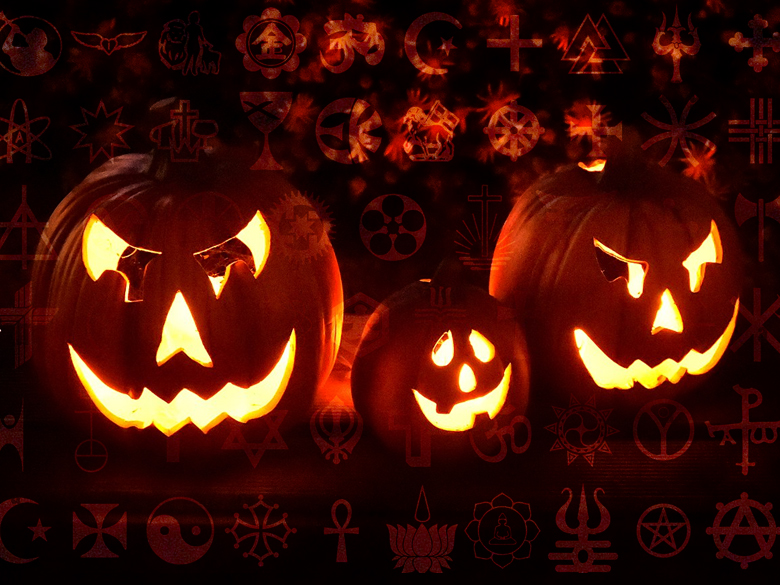
Halloween and Religion have been buddies forever. Image credit: Creative Commons, CC BY-SA 4.0 DEED.
Due to the harvest period transitioning into winter, the 31st of October marks a significant position in our planet’s rotation. With origins in paganistic Gaelic traditions, it was said that this seasonal shift thinned the walls between the spirit reality and our land of the living, allowing spooky entities to crossover. Meanwhile, November 1st marked the Christian feast of All Saints’ Day, otherwise known as All Hallows’ Day. The night before, All Hallows’ Eve, eventually evolved into the holiday name we enjoy today.
But no matter the faith, Halloween is embraced by cultures across the globe, from Abrahamics to atheists to Satanists and beyond. Every year, children honour this bizarre custom by dressing up in their creepiest costumes in hopes of hoarding candy riches. So, to celebrate the weirdness, let’s take a look at some religious deities and prophets, theorising which monsters they’d best represent.
1. Anubis as a Werewolf
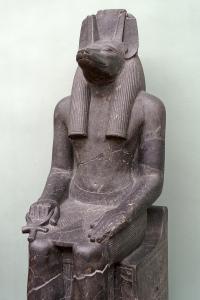
The Ancient Egyptian Anubis looks like a werewolf. Image credit: Creative Commons (CC BY-SA 4.0 DEED)
Werewolves run wild throughout religious folklore, from the Ancient Greek lycanthrope to India’s Yapum. The standard definition is an individual who has been bitten or cursed by a similar creature, transforming into a savage wolf-human hybrid whenever the full moon beckons it. This personified amalgamation of human-meets-nature has proven itself to be one of the most popular monsters in history.
Anubis is of Ancient Egyptian origin, and his responsibilities revolve around death, such as protecting graves and guiding spirits to the underworld. His Canidae head on top of a human’s body encapsulates the werewolf concept perfectly, even though there is some debate about what animal he represents. Is it a jackal? A dog? Whatever, close enough!
2. Chhinnamasta as a Vampire
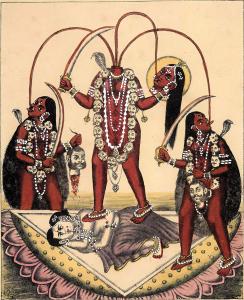
Hindu goddess Chinnamasta is like a vampire. Image credit: Creative Commons, Public Domain.
You’d struggle to find a horror creature as widely cherished as the vampire. From Buffy to Twilight, Let the Right One In to Interview with the Vampire, decades have passed without cultural interest waning. The persistent love for this monster is no secret, as its characteristics are original and unforgettable. The immortality. The aversions to the sun and garlic. And, most importantly, its thirst for the blood of the living.
Drinking blood can be found throughout many theologies (hello, Christians), but no example is as daunting as the Hindu goddess Chhinnamasta. Like the vampire, she represents both death and regeneration, along with sexual restraint and energy. And how does she illustrate these powers? By decapitating herself, of course! Chhinnamasta proudly holds her severed head in her hand as a fountain of blood spurts from her exposed neck tubes, caught in the mouths of her two associates. If this isn’t enough of an absurd scene, Chhinnamasta is also depicted standing upon the divine couple, mid-copulation. Carry on, then!
3. Jesus Christ as a Zombie
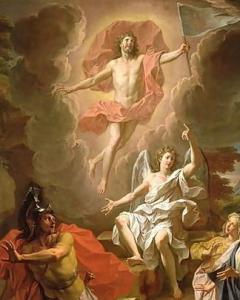
La résurrection du Christ by Noël Coypel: Français. Image credit: Creative Commons, Public Domain.
Originating from Haitian folklore, we define a zombie as a deceased human reanimated into a mobile corpse, hungry for brains. While we are yet to come across any confirmed cases of such a monster, there is an additional sense of authenticity to the zombie apocalypse concept, as the backstories usually concern the spread of a highly infectious virus. Because of this, popular culture has gobbled them up, found as central characters in literature, film, TV, video games, and even the most famous music ever made, Michael Jackson’s Thriller.
However, when discussing the resurrection of the dead, no incident is as historically significant as Jesus Christ. As the messianic leader of the biggest religion in the world, perhaps the most crucial part of his story came at the end. After being found guilty of blasphemy, Judaea crucified the man, nailing him to the cross and watching until he died. Of course, it’d take more than that to kill the so-called “only Son of God”, and three days later, he rose again. Jesus appeared to his disciples, forgave humanity for their sins, and then flew off to Heaven, leaving millennia of chaos in his wake as everyone fought over what it was he taught exactly.
4. The Dragons of Hebrew Mythology
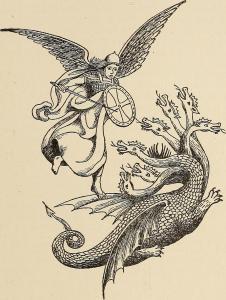
Dragon from The Book of Revelation. Image credit: Flickr, Public Domain.
Just watch Lord of the Rings or Game of Thrones, and you’ll get the message that dragons are not mythological creatures that you should mess with. Even scarier is that we find these serpentine beasts in any direction, from the flying, fire-breathing monsters in the Western Middle Ages to the wise, wingless variations in Eastern fables. Either way, scholars believe dragons to originate from exaggerated tales of crocodiles. However, some more eccentric ideas (such as those proposed by Helena Blavatsky’s religion Theosophy) draw connections between these giant reptiles and the dinosaurs.
Legends of dragons are so prevalent that even the best-selling publication of all time, The Bible, mentions them. The Old Testament (based on the Hebrew Bible) puts forward several dragon-related passages. Some of those include:
“Speak, and say, Thus saith the Lord God; Behold, I am against thee, Pharaoh king of Egypt, the great dragon that lieth in the midst of his rivers, which hath said, My river is mine own, and I have made it for myself.” – Ezekiel 29:3
“Thou didst divide the sea by thy strength: thou brakest the heads of the dragons in the waters.” – Psalm 74:13
“And thorns shall come up in her palaces, nettles and brambles in the fortresses thereof: and it shall be an habitation of dragons, and a court for owls.” – Isaiah 34:13
Not to be outdone, the Christian New Testament’s Book of Revelation also calls for dragons in its hellish apocalyptic conclusions.
“And there appeared another wonder in heaven; and behold a great red dragon, having seven heads and ten horns, and seven crowns upon his heads. And his tail drew the third part of the stars of heaven, and did cast them to the earth: and the dragon stood before the woman which was ready to be delivered, for to devour her child as soon as it was born.” – Revelation 12:3-4
“And there was war in heaven: Michael and his angels fought against the dragon; and the dragon fought and his angels.” – Revelation 12:7
5. Allan Kardec as a Ghost

Allan Kardec, founder of Spiritism. Image credit: Creative Commons, Public Domain.
If religion and Halloween have anything in common, it’s a worrying obsession with life after death. And it is upon the line between the living and the dead that the ghostly folklore thrives best. The basic narrative tells that the troubled soul of the deceased is unable to crossover and instead lives out their eternity as an invisible earthly entity, bumping things around the house while you’re trying to sleep. It makes for a wonderfully spooky story, especially when 18% of Americans claim they have seen a ghost before.
When it comes to theology, almost every sacred scripture mentions ghost activity. Especially in the ancestor worship of indigenous cultures, the entire practice of shamanism depends on it. However, no account is quite as convincing as that of Allan Kardec. As a respected educator, translator, and author, Kardec spent much of his career as a fierce sceptic against séances, and much of his studies were an attempt to disprove so-called mediums. But as his quest continued, the man was more convinced of the procedure and eventually founded the highly influential new religious movement named Spiritism. This doctrine is more popular than ever, boasting around 13 million followers, while its philosophy is fundamental to the Vietnamese folk religion Caodaism.
As we all do, Allan Kardec ultimately died. Therefore, by his logic, he is now one with the ghost world himself.
6. Doreen Valiente as a Witch

Doreen Valiente, the Mother of Witchcraft. Image Credit: Flickr, CC BY-NC-SA 2.0 DEED.
In the Halloween context, the witch archetype conjures visions of an elderly female figure, cackling as she stirs her smoky cauldron, perhaps getting ready to feast on the meat of little children. Due to this reputation, the witch label has been historically exploited to target individuals, accusing them of devil-worshipping sorcery, giving the community reason to burn them at the stake.
These days, we no longer deem witchcraft as such an evil tradition, and now witches can be generally open about their beliefs. The majority of adherents subscribe to the Wicca branch of occultist esotericism, which is considered a new religious movement. When discussing individuals who popularised the creed, most turn to Gerald Gardner. He was a male witch who wrote numerous Contemporary Pagan texts that boosted public interest in the faith. However, high priestess Doreen Valiente is the unsung heroine of Gardnerian Wicca as she helped Gerald write many of his scriptures while penning plenty of her own.
Because of her contributions, Wicca followers refer to her as “the Mother of Modern Witchcraft”. And unlike the other entries on this list, there is no hypothesis to her Halloween equivalent. She was a legit witch, through and through.
Pagan
General Christian
Religious Events

About Jared Woods
Born in South Africa and now homeless as a nomadic something or other, Jared Woods does whatever he wants. He has authored numerous books, including the spiritual philosophy texts known as the "Janthopoyism Bible". Follow Jared on Facebook, Instagram, and Twitter @legotrip You can read more about the author here.



Next Post

December 12, 2023 From Korn To Christian: Where is Brian Welch Now?
Recent Comments
Browse Our Archives
Select a Category Abrahamic Faiths Afterlife Ancient Egypt Ancient Greek Ancient Religion Artifacts Aztec Bible Bible Studies Buddhism Chicken Church Christian History Christianity Church Comparative Religion Conversion Creation Stories cults Dalai Lama Deconstruction Doorkijkkerk Easter esoteric feminism Folklore Gaza Gospels Halloween Hermetic Philosophy Hinduism Holy Week Humor Indian Philosophy Israel Jerusalem Jesus Christ Kanye West magick Meditation Mental Health mysticism Mythology new religious movement New Thought Occult Palestine pantheism Pilgrimage Pop Culture quantum mysticism Ramadan Reincarnation relationships Religion and Art Religion and Music Religious Symbolism Religious Tourism Sacred Texts Scientology Sikhism The Beatles The British Museum The Kybalion Uncategorized Vipassana witchcraft Zionism
Select a Month November 2024 January 2024 December 2023 October 2023 September 2023 August 2023 July 2023 June 2023 May 2023 April 2023
Follow Us!
TAKE THE
Religious Wisdom Quiz
Which book of the Bible records Paul’s shipwreck?
Select your answer to see how you score.
2 Timothy 1 Corinthians Romans Acts
Related posts from The Infinity of Divinity

Patheos Portals
Visiting Israel/Palestine During the War

Patheos Portals
10 Most Popular Occult Books for Secret Mystical...

Patheos Portals
Losing My Mindfulness: A Travel Story of Mental...
Patheos Portals
Undeniable Proof That God Exists
TRENDING AT PATHEOS Education and Religion

Revelation's Jesus Isn't the Lamb — He's the...
In the first article in this series of three articles, "One Jesus,...
How Paul Turned a Dead Messiah Into Christianity's...
This is a continuation of our investigation into the New Testament theologies...

Christian Nationalism: Political Tool And Biased Reporting
Christian Nationalism - An Artificial Category to Label MAGA Supporters Could "Christian...

There is no Clear Definition for "Christian Nationalism"
In the first article of this series I presented a definition of...
"Play or Pray? Exploring Faith and Choice in...
September 25, 2017. The date may not stand out to most....

Bizzle Be Better: Critiquing the Christian Rapper Bizzle
Few Christian Hip Hop artists can connect the lyrical poetics of both...
view all Education and Religion blogs
Ad-Free & Subscriber Log-In Subscription Support
- About Us
- 2026 Calendar
- Videos
- Podcasts
- Library of World Religions
- Faith In Media Tracker
- Advertise With Us
- Write for Us
- Privacy Policy
- Terms of Service
- Do Not Sell My Data
- Contact Us
- Radiant Digital
- Manage Newsletter Subscriptions
- Unsubscribe From Notifications
- Sitemap
Copyright 2008-2026, Patheos. All rights reserved.
Subscription Support Ad-Free & Subscriber Log-In
Follow Patheos