
BuddhistCatholicContemplativeEvangelicalGeneral ChristianHinduJewishLatter-day SaintMuslimNew VisionsProgressive Christian
Beliefs
- Buddhist
- Catholic
- Contemplative
- Evangelical
- General Christian
- Hindu
- Jewish
- Latter-day Saint
- More Voices
- Muslim
- New Visions
- Pagan
- Progressive Christian
Topics
- Religion News
- Food and Religion
- Sports and Religion
- Religious Art
- Religious Music and Entertainment
- Religious Events
- History and Religion
- Style and Religion
- Politics and Religion
- Women in Religion
- Recreation Outdoors and Religion
- Business Finance and Religion
- Careers Workplace and Religion
- Education and Religion
- Family Parenting and Religion
- Health Fitness and Religion
- Home and Religion
- Relationships and Religion
- Technology and Religion
- Travel and Religion
Columnists
- Buddhist Columnists
- Business Finance and Religion Columnists
- Careers Workplace and Religion Columnists
- Catholic Columnists
- Contemplative Columnists
- Education and Religion Columnists
- Evangelists Columnists
- Family Parenting and Religion Columnists
- General Christian Columnists
- Health Fitness and Religion Columnists
- Hindu Columnists
- History and Religion Columnists
- Home and Religion Columnists
- Jewish Columnists
- More Voices Columnists
- Latter Day Columnists
- Muslim Columnists
- New Visions Columnists
- Nonreligious Columnists
- Pagan Columnists
- Politics and Religion Columnists
- Progressive Columnists
- Recreation Outdoors and Religion Columnists
- Relationships and Religion Columnists
- Religion News Columnists
- Religious Art Columnists
- Religious Events Columnists
- Religious Music and Entertainment Columnists
- Sports and Religion Columnists
- Style and Religion Columnists
- Technology and Religion Columnists
- Travel and Religion Columnists
- Women in Religion Columnists
Resource Library
- 2026 Calendar
- Library of World Religions
- The 100 Most Holy Places on Earth
- Patheos Answers
- Podcasts
- Videos
- Faith Leaders Database
- Anglican Episcopalian
- Bahai
- Baptist
- Buddhism
- Christianity
- Confucianism
- Eastern Orthodoxy
- Hinduism
- Holiness and Pentecostal
- ISKCON
- Islam
- Judaism
- Lutheran
- Methodist
- The Church of Jesus Christ of Latter-day Saints
- New Age
- Paganism
- Presbytarian and Reformed
- Protestantism
- Religion Behind the Scenes
- Roman Catholic
- Scientology
- Shia Islam
- Sikhism
- Sufism
- Sunni Islam
- Taoism
- Zen
- See all religions
Research Tools
 Ad-Free & Subscriber Log-In Subscription Support
Ad-Free & Subscriber Log-In Subscription Support
Follow Patheos 

- Trending:
- Forgiveness
- |
- Marriage
- |
- Consciousness
- |
- Death Penalty
- |
- Election
- |
- Halloween
 The Infinity of Divinity
- Home
- General Christian
- Education and Religion
- The Jefferson Bible: Why Even Atheists Should Love Jesus
The Jefferson Bible: Why Even Atheists Should Love Jesus
Last updated on: July 16, 2023 at 6:20 pm by Jared Woods
The Jefferson Bible: Why Even Atheists Should Love Jesus 2023-07-16T18:20:38+01:00 Jared Woods
Patheos Explore the world's faith through different perspectives on religion and spirituality! Patheos has the views of the prevalent religions and spiritualities of the world.

Irrespective of subsequent religions, Jesus was a cool guy. (The Ascension by John Singleton Copley, Public Domain)
The Problem with Jesus and Christianity
I once heard a joke that said, “Someone should make a religion based on the teachings of Jesus”. As the classic adage goes, it’s funny because it’s true. But perhaps the most admirable attempt to accomplish such a daunting feat can be found in the Jefferson Bible.
Now, I consider myself a Christian but only in the appreciation of Christ manner. I also consider myself a Beatlemaniac, a Swiftie, and a Guinness connoisseur. These terms do not exclusively bind me to any one product, but rather, I can recognise superiority when I come across it. And Jesus is at the top of the top, which is not a statement of preference, but a statistical fact.
Jesus Christ existed. There is not a reputable historian or religious scholar who denies this reality. But, of course, it’s the details of who this man was and what he did that understandably comes under fierce scrutiny. Two thousand years of translated stories tend to lose their steering, and even the source material was not impervious to exaggerations. For critical thinkers, these unknowns become immensely frustrating because something huge definitely happened, changing the channel of the globe as we know it. Yet so much of it defied modern logic, drawing a thick hazy line between verifiable truths and questionable mythology.
Enter Thomas Jefferson
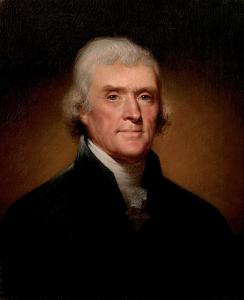
Thomas Jefferson by Rembrandt Peale (Public Domain)
Thomas Jefferson clearly understood this. As a Founding Father and the third president of the United States (1801 to 1809), there was a ton of pressure to lead his country with Christian ethics. However, Jefferson was a stubborn intellectual who perpetually pushed for scientific explanations, and his rational scepticism conflicted with his traditional faith.
To address his issues, Jefferson compiled a manuscript called The Life and Morals of Jesus of Nazareth, now more famously known as the Jefferson Bible. His approach was to take the Plantin Polyglot Bible and the King James Bible and strip them down to Jesus’ core message. The Old Testament? Gone. The Epistles of Paul? Gone. The Book of Revelation? Gone, gone, gone. Eventually, he was left with nothing but the Four Gospels According to Matthew, Mark, Luke, and John. From there, he took a razor and glue, and merged these sections into a single narrative whilst carefully avoiding anything science could dispute as supernatural. There are no miracles in this text. And when Jesus is crucified, the story ends without resurrection.
“I am Christian, in the only sense in which [Jesus] wished anyone to be.”
— Thomas Jefferson (Letter to Benjamin Rush, 1803)
The Life and Morals of Jesus of Nazareth

The Baptism of Christ by José Ferraz de Almeida Júnior (Public Domain)
The resulting book is, in some ways, a stronger argument for Christianity than the debatable divinity emphasised throughout the original Bible. It’s a simplified adaptation that focuses on Jesus’ journey and philosophies, no more, no less. Hence, by reading this, you earn a basic familiarity of a man so enlightened that even the most anti-religious atheist would struggle to fight against him.
Jesus was a preacher unlike any that had come before. He taught us that social hierarchy was irrelevant: you must show love and compassion to every person, rich or poor, best friend or dead enemy. To reach his version of salvation was through forgiveness, no matter what wrong landed upon you. And when performing good deeds, such as worship or charity, one must do so in secret, never for boasting points, even if you’re an Instagram influencer.
These fundamental schoolings of Jesus Christ appear so common now but were in radical opposition to the era’s religious and political norms. He was the ultimate rebel, walking around and disrupting the status quo under the self-proclaimed authority of God. And his anti-establishment message continually snowballed in popularity until he was recognised as a threat. That’s why they tortured and brutally murdered the guy.
Even Atheists Should Love Jesus
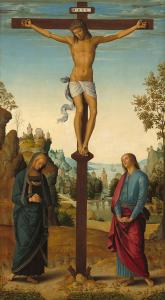
The Crucifixion with the Virgin, Saint John, Saint Jerome, and Saint Mary Magdalene by Pietro Perugino (Public Domain)
One should never judge a religion by its followers. Judge it by its prophet. Trusting the Old Testament or the quills of the disciples is a matter of faith. But Jesus’ education was of a different breed. What Jefferson has compiled is a refreshing look whereby even the apostles’ testimonies were stripped down to their raw bones. And therein lies the genuine scripture of Christ. No other recorded documentation presented ideas this revolutionary, and consequently, history itself shot off in a contrasting direction.
Global spirituality still runs on that trajectory today. With over two billion devotees, Christianity stands as the most popular theology in the world. With just under two billion, Islam comes in second, and their holy Quran mentions Jesus over 180 times.
So, if you oppose Jesus, I urge you to read the Jefferson Bible. And when you do, sincerely ask yourself what it is you dislike about this man. I am willing to bet that you will find no substantial reasoning whatsoever. Instead, you’ll realise that your prejudices are based on those who bastardised his word much later, while standalone Jesus remains a pretty awesome dude.
Because if nothing else, never forget that you’ve eaten a lot of chocolate on Easter and received ample gifts on Christmas Day. At least give him some respect for that.
General Christian
Contemplative
History and Religion

About Jared Woods
Born in South Africa and now homeless as a nomadic something or other, Jared Woods does whatever he wants. He has authored numerous books, including the spiritual philosophy texts known as the "Janthopoyism Bible". Follow Jared on Facebook, Instagram, and Twitter @legotrip You can read more about the author here.
Previous Post

July 7, 2023
The Beatles, The Bible, and Charles Manson
Next Post

August 10, 2023 The 10 Creepiest Places in Milan, Italy
Recent Comments
Browse Our Archives
Select a Category Abrahamic Faiths Afterlife Ancient Egypt Ancient Greek Ancient Religion Artifacts Aztec Bible Bible Studies Buddhism Chicken Church Christian History Christianity Church Comparative Religion Conversion Creation Stories cults Dalai Lama Deconstruction Doorkijkkerk Easter esoteric feminism Folklore Gaza Gospels Halloween Hermetic Philosophy Hinduism Holy Week Humor Indian Philosophy Israel Jerusalem Jesus Christ Kanye West magick Meditation Mental Health mysticism Mythology new religious movement New Thought Occult Palestine pantheism Pilgrimage Pop Culture quantum mysticism Ramadan Reincarnation relationships Religion and Art Religion and Music Religious Symbolism Religious Tourism Sacred Texts Scientology Sikhism The Beatles The British Museum The Kybalion Uncategorized Vipassana witchcraft Zionism
Select a Month November 2024 January 2024 December 2023 October 2023 September 2023 August 2023 July 2023 June 2023 May 2023 April 2023
Follow Us!
TAKE THE
Religious Wisdom Quiz
Who said, "Can anything good come from Nazareth?"
Select your answer to see how you score.
Nathanael Peter John the Baptist Pilate
Related posts from The Infinity of Divinity

Patheos Portals
Visiting Israel/Palestine During the War

Patheos Portals
From Korn To Christian: Where is Brian Welch...

Patheos Portals
Undeniable Proof That God Exists

Patheos Portals
The 10 Creepiest Places in Milan, Italy
TRENDING AT PATHEOS Education and Religion

Revelation's Jesus Isn't the Lamb — He's the...
In the first article in this series of three articles, "One Jesus,...

How Paul Turned a Dead Messiah Into Christianity's...
This is a continuation of our investigation into the New Testament theologies...

Christian Nationalism: Political Tool And Biased Reporting
Christian Nationalism - An Artificial Category to Label MAGA Supporters Could "Christian...

There is no Clear Definition for "Christian Nationalism"
In the first article of this series I presented a definition of...

"Play or Pray? Exploring Faith and Choice in...
September 25, 2017. The date may not stand out to most....

Bizzle Be Better: Critiquing the Christian Rapper Bizzle
Few Christian Hip Hop artists can connect the lyrical poetics of both...
view all Education and Religion blogs
Ad-Free & Subscriber Log-In Subscription Support
- About Us
- 2026 Calendar
- Videos
- Podcasts
- Library of World Religions
- Faith In Media Tracker
- Advertise With Us
- Write for Us
- Privacy Policy
- Terms of Service
- Do Not Sell My Data
- Contact Us
- Radiant Digital
- Manage Newsletter Subscriptions
- Unsubscribe From Notifications
- Sitemap
Copyright 2008-2026, Patheos. All rights reserved.
Subscription Support Ad-Free & Subscriber Log-In
Follow Patheos