
BuddhistCatholicContemplativeEvangelicalGeneral ChristianHinduJewishLatter-day SaintMuslimNew VisionsProgressive Christian
Beliefs
- Buddhist
- Catholic
- Contemplative
- Evangelical
- General Christian
- Hindu
- Jewish
- Latter-day Saint
- More Voices
- Muslim
- New Visions
- Pagan
- Progressive Christian
Topics
- Religion News
- Food and Religion
- Sports and Religion
- Religious Art
- Religious Music and Entertainment
- Religious Events
- History and Religion
- Style and Religion
- Politics and Religion
- Women in Religion
- Recreation Outdoors and Religion
- Business Finance and Religion
- Careers Workplace and Religion
- Education and Religion
- Family Parenting and Religion
- Health Fitness and Religion
- Home and Religion
- Relationships and Religion
- Technology and Religion
- Travel and Religion
Columnists
- Buddhist Columnists
- Business Finance and Religion Columnists
- Careers Workplace and Religion Columnists
- Catholic Columnists
- Contemplative Columnists
- Education and Religion Columnists
- Evangelists Columnists
- Family Parenting and Religion Columnists
- General Christian Columnists
- Health Fitness and Religion Columnists
- Hindu Columnists
- History and Religion Columnists
- Home and Religion Columnists
- Jewish Columnists
- More Voices Columnists
- Latter Day Columnists
- Muslim Columnists
- New Visions Columnists
- Nonreligious Columnists
- Pagan Columnists
- Politics and Religion Columnists
- Progressive Columnists
- Recreation Outdoors and Religion Columnists
- Relationships and Religion Columnists
- Religion News Columnists
- Religious Art Columnists
- Religious Events Columnists
- Religious Music and Entertainment Columnists
- Sports and Religion Columnists
- Style and Religion Columnists
- Technology and Religion Columnists
- Travel and Religion Columnists
- Women in Religion Columnists
Resource Library
- 2026 Calendar
- Library of World Religions
- The 100 Most Holy Places on Earth
- Patheos Answers
- Podcasts
- Videos
- Faith Leaders Database
- Anglican Episcopalian
- Bahai
- Baptist
- Buddhism
- Christianity
- Confucianism
- Eastern Orthodoxy
- Hinduism
- Holiness and Pentecostal
- ISKCON
- Islam
- Judaism
- Lutheran
- Methodist
- The Church of Jesus Christ of Latter-day Saints
- New Age
- Paganism
- Presbytarian and Reformed
- Protestantism
- Religion Behind the Scenes
- Roman Catholic
- Scientology
- Shia Islam
- Sikhism
- Sufism
- Sunni Islam
- Taoism
- Zen
- See all religions
Research Tools
 Ad-Free & Subscriber Log-In Subscription Support
Follow Patheos 

- Trending:
- Advent
- |
- Forgiveness
- |
- Thanksgiving
- |
- Election
- |
- Seasonal Holidays
- |
- Marriage
 The Infinity of Divinity
- Home
- Progressive Christian
- Education and Religion
- Does Christianity Really Believe in One True God? (Spoiler: It Doesn’t)
Does Christianity Really Believe in One True God? (Spoiler: It Doesn’t)
Last updated on: June 23, 2023 at 12:25 am by Jared Woods
Does Christianity Really Believe in One True God? (Spoiler: It Doesn’t) 2023-06-23T00:25:12+01:00 Jared Woods
Patheos Explore the world's faith through different perspectives on religion and spirituality! Patheos has the views of the prevalent religions and spiritualities of the world.
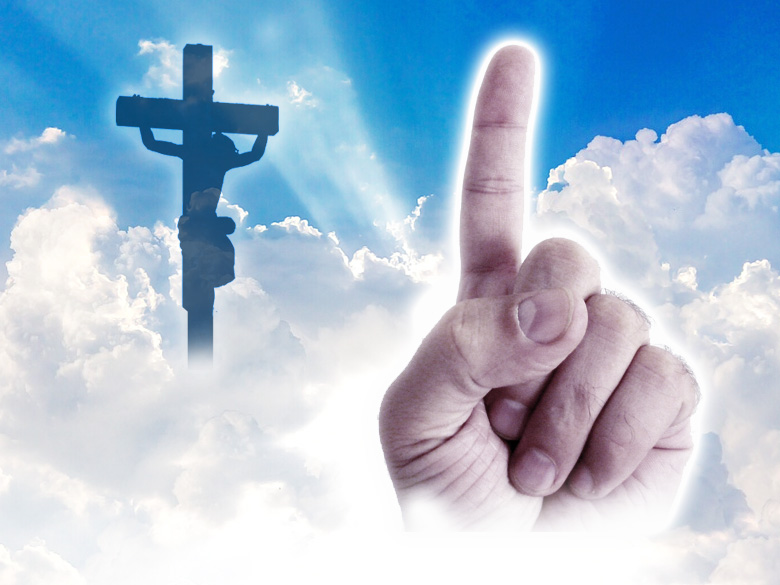
Is Christianity Really Monotheistic, Though? Like, Really Really? (Creative Commons/Pixabay)
No matter which Christian link you click, someone will have defined it as a monotheistic faith. What this means is that the world’s most popular religion believes in One All-Supreme Being who reigns over everything else. This standpoint applies to each notch on the Abrahamic belt, be it Judaism, Islam, Rastafari, Baháʼí Faith, or any of the other numerous off-shoots. However, when investigating the depths of the Biblical doctrine, is it as clear-cut as we make it out to be?
Truthfully, there is a multitude of evidence against this One God theory in relation to Christianity, at least in the stricter sense. So let us respectfully explore this delicate topic from the very beginning of what it means to be monotheistic.
Authentic Monotheism
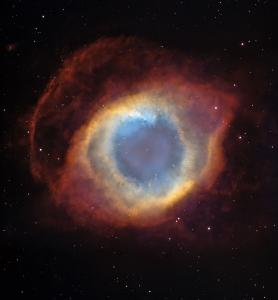
Helix Nebula (“Eye of God”). Public Domain (NASA).
To reiterate, monotheism is the belief that one exclusive deity exists. Following that inflexible characterisation, authentic monotheism is not as common as people think. Curiously, some overlooked theologies comply with the most rigid definition of the category, such as certain sects of Hinduism. This proposal may appear strange, for Hinduism boasts one of history’s widest canons of multi-gods (polytheistic). However, these deities are merely extensions of a larger force, namely Brahman (not to be confused with Brahma), the Highest Universal Principle and the Ultimate Reality.
The only reason we don’t recognise Hinduism in the monotheistic group is its fluidity. When picking this religion apart, an array of labels can apply to the faith, which includes pantheism (or panentheism at stretch). These philosophies state that the Universe itself is divinity, as it is the collection of the All as the One True God. You’ll find this understanding spread thick across the Eastern/Occult spiritual board, accepted by Taoism, Hermeticism, Neoplatonism, Neopaganism, Kabbalah and Theosophy (to name very few).
Within so many religious applications, this is the purest form of monotheism, as it removes the opportunity for any competitor gods to exist within our reality. Sadly, we often lose this connection due to pantheism’s independent terminology.
The History of “Monotheistic Religions”
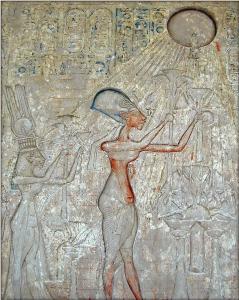
Aten was the First Monotheistic God. Public Domain.
Monotheism is said to have originated with three religions. In chronological order, they were Atenism, Zoroastrianism, and Judaism. And the similar patterns in how these singular-God theories evolved are fascinating and borderline suspicious.
Around the 14th century BCE in Ancient Egypt, the people worshipped many gods. Aten was just another deity portrayed as an aspect of Ra. But Aten spoke directly to Pharaoh Akhenaten, claiming he was the One Supreme God, and Atenism was born (dying shortly after).
Around the 6th century BCE in Iranian Mythology, the people worshipped many gods. Ahura Mazda was just another deity, noted as the creator. But Ahura Mazda spoke directly to priest Zoroaster, claiming he was the One Supreme God, and Zoroastrianism (or Mazdayasna) was born, still practised by small groups today.
Finally, around the 6th century BCE in Israel, the people worshipped many gods. Yahweh was just another deity, considered a divine warrior. But Yahweh spoke directly to the prophet Isaiah, claiming he was the One Supreme God, and Judaism’s monotheism was confirmed, still with millions of followers worldwide.
Let’s break this down. Please observe how every example features:
- A polytheistic (multiple) canon of gods;
- A lone person who receives a revelation from one of those established gods;
- This deity claiming itself as the exclusive True God, instructing us to praise him alone;
- A religion developing from those foundations.
Many centuries later, Islam was founded. It followed this identical narrative too.
In the Old Testament, God Was Not Alone
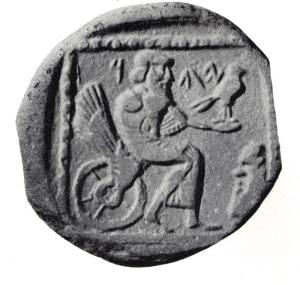
Yahweh Before He Became Famous. Public Domain.
As seen above, Judaism’s Yahweh was just one character in a wider Canaanite polytheistic belief system that historians have retroactively titled Yahwism. Additional gods and goddesses in this pantheon included Baal, Shamash, Yarikh, Mot, and Astarte, who each had their own cult followers. This faith even included Yahweh’s wife, Asherah.
Yahweh’s upgrade as the Only God is the basis for the Torah. In turn, Christianity adopted this Jewish holy book as the Old Testament. But throughout this scripture, we find an abundance of information clearly stating that Yahweh was not alone in his celestial realm. Consider the very first line of the Bible as evidence:
“In the beginning, Elohim created heaven and earth.”
– Genesis 1:1 (Names of God Bible Version)
Elohim is not technically Yahweh, nor arguably even a god. Many scholars have noted that Elohim means “gods” in Hebrew, plural. However, the singular form, Eloah (abbreviated to El), was a completely different Semitic deity to Yahweh and was considered far more powerful at the time. Point proved by the final syllable of Israel, which comes from El’s name.
Throughout the Old Testament, El is discussed in various forms. These include El Shadday (Exodus 6:3), Adonay (Psalm 90:1), El Elyon (Genesis 14.18–19), El-Roi (Genesis 16:13), and Ish (Hosea 2:16). Are these simply honorary titles that God bestowed upon himself? Or are they separate gods? The two schools of thought will never be resolved.
Either way, Judaism did a decent job of cleaning up its tracks. It eventually claimed that Eloah and Yahweh were one and the same all along and even merged mentions of wife Asherah into that godly pool. But they missed a few spots, like when Eloah refers to himself as “us” in Genesis 3:22:
“And the LORD God said, Behold, the man is become as one of us, to know good and evil: and now, lest he put forth his hand, and take also of the tree of life, and eat, and live forever.”
– Genesis 3:22 (King James Version)
Or how about the Biblical mention of a divine council of gods twice in Psalms?
“God standeth in the congregation of the mighty; he judgeth among the gods.”
– Psalm 82:1 (King James Version)“The heavens will praise your wonders, Yahweh; Your faithfulness also in the assembly of the holy ones. For who in the skies can be compared to Yahweh? Who among the sons of the heavenly beings is like Yahweh, a very awesome God in the council of the holy ones, To be feared above all those who are around him? Yahweh, God of hosts, who is a mighty one like you? Yah, your faithfulness is around you.”
– Psalm 89:5-8 (World English Translation)
As light as the sunshine, the Bible itself documents gods as a plural creating the Universe. Furthermore, we have an “assembly of the holy ones” that is “in the skies” as “heavenly beings”. And don’t forget the First Commandment, “Thou shalt have no other gods before Me”, another admission of alternative divine beings in circulation. This information indicates that, even if Yahweh was the King of the Gods, he was still just one of the gods, comparable to Zeus’ Olympians or Odin to his Norse equivalent. Yet these latter examples are considered polytheistic beliefs? Why, then, is Yahweh and his gang of deities not treated the same?
There are better-suited terms than monotheism that could apply, like “henotheism” or “monolatry“. These ideas acknowledge the existence of alternate gods but worship only one. At the very least, we should recognise that those philosophies are more appropriate to the Biblical understanding of God.
Christianity Does Not Worship One God
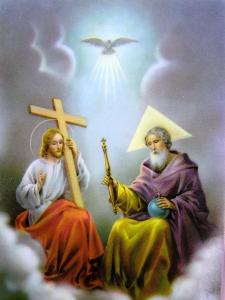
The Holy Trinity. Creative Commons.

For argument’s sake, let’s say that Yahweh was the exclusive god mentioned in the Bible (even if he’s not). In that scenario, we could still pick Christianity apart further. Unlike its surrounding Abrahamic sandwich of Judaism and Islam, Christianity splits its Supreme Being into a Powerhouse Trinity: The Father, the Son, and the Holy Spirit.
The Father would be how we understand Yahweh as the Top God. The Son would be Jesus Christ, the Messiah of Christianity that separated its path from Judaism. These are two distinct entities, yet are each worshipped, which is in direct language violation of monotheism’s etymology as an absolute indivisible One God. The argument that Jesus was an extension of God’s essence is problematic because we could refocus this perspective towards any theology with a creator god emanating lower deities from itself.
The Holy Spirit is an even wilder Uno Reverse Card, as one can interpret this force as the collective life energy existing through all things. Again, this is no different to pantheistic notions presented by Dharmic or Daoist philosophies which predate the Bible by thousands of years. The defined lines between philosophies continue to blur.
Christianity Worships an Array of Pagan Deities

Oh, When the Saints Go Marching In. Pixabay License.
When surveying the vast field of ancient polytheistic gods around the globe, we effortlessly register that us humans were channelling our worship into similarly segregated compartments. Each culture had idols for luck, fertility, war, finances, and disease. Of course, after monotheism took over, these focal points were absorbed into the greater God, correct?
Nope. Instead of doing away with these pockets of specifics, Christianity simply slid the tasks onto separate saints, praying to these celestial figures exactly as a Pagan would to their deities. Nothing but the names have changed!
So next time you talk about how your God is the One True God, remember that the devil lies in the details, and the details tell a considerably contradictory story.
This article was based on the Janthopoyism Bible, Chapter X.1.3. The Curious Transition into Monotheism. It’s available on Amazon now.
Progressive Christian
Contemplative
History and Religion

About Jared Woods
Born in South Africa and now homeless as a nomadic something or other, Jared Woods does whatever he wants. He has authored numerous books, including the spiritual philosophy texts known as the "Janthopoyism Bible". Follow Jared on Facebook, Instagram, and Twitter @legotrip You can read more about the author here.
Previous Post

June 16, 2023
The 10 Most Disturbing Creation Stories Across Mythologies
Next Post

June 25, 2023 Occult Book Review: The Kybalion (Hermeticism)
Recent Comments
Browse Our Archives
Select a Category Abrahamic Faiths Afterlife Ancient Egypt Ancient Greek Ancient Religion Artifacts Aztec Bible Bible Studies Buddhism Chicken Church Christian History Christianity Church Comparative Religion Conversion Creation Stories cults Dalai Lama Deconstruction Doorkijkkerk Easter esoteric feminism Folklore Gaza Gospels Halloween Hermetic Philosophy Hinduism Holy Week Humor Indian Philosophy Israel Jerusalem Jesus Christ Kanye West magick Meditation Mental Health mysticism Mythology new religious movement New Thought Occult Palestine pantheism Pilgrimage Pop Culture quantum mysticism Ramadan Reincarnation relationships Religion and Art Religion and Music Religious Symbolism Religious Tourism Sacred Texts Scientology Sikhism The Beatles The British Museum The Kybalion Uncategorized Vipassana witchcraft Zionism
Select a Month November 2024 January 2024 December 2023 October 2023 September 2023 August 2023 July 2023 June 2023 May 2023 April 2023
Follow Us!
TAKE THE
Religious Wisdom Quiz
What is the Jewish festival celebrating the giving of the Law at Sinai?
Select your answer to see how you score.
Purim Shavuot (Pentecost) Yom Kippur Tabernacles
Related posts from The Infinity of Divinity

Patheos Portals
Visiting Israel/Palestine During the War

Patheos Portals
10 Most Popular Occult Books for Secret Mystical...

Patheos Portals
From Korn To Christian: Where is Brian Welch...

Patheos Portals
6 Religious Icons as Halloween Monsters
TRENDING AT PATHEOS Education and Religion

Revelation's Jesus Isn't the Lamb — He's the...
In the first article in this series of three articles, "One Jesus,...

How Paul Turned a Dead Messiah Into Christianity's...
This is a continuation of our investigation into the New Testament theologies...

Christian Nationalism: Political Tool And Biased Reporting
Christian Nationalism - An Artificial Category to Label MAGA Supporters Could "Christian...

There is no Clear Definition for "Christian Nationalism"
In the first article of this series I presented a definition of...

"Play or Pray? Exploring Faith and Choice in...
September 25, 2017. The date may not stand out to most....

Bizzle Be Better: Critiquing the Christian Rapper Bizzle
Few Christian Hip Hop artists can connect the lyrical poetics of both...
view all Education and Religion blogs
Ad-Free & Subscriber Log-In Subscription Support
- About Us
- 2026 Calendar
- Videos
- Podcasts
- Library of World Religions
- Faith In Media Tracker
- Advertise With Us
- Write for Us
- Privacy Policy
- Terms of Service
- Do Not Sell My Data
- Contact Us
- Radiant Digital
- Manage Newsletter Subscriptions
- Unsubscribe From Notifications
- Sitemap
Copyright 2008-2026, Patheos, part of the Radiant Digital network of media brands. All rights reserved.
Subscription Support Ad-Free & Subscriber Log-In
Follow Patheos