
BuddhistCatholicContemplativeEvangelicalGeneral ChristianHinduJewishLatter-day SaintMuslimNew VisionsProgressive Christian
Beliefs
- Buddhist
- Catholic
- Contemplative
- Evangelical
- General Christian
- Hindu
- Jewish
- Latter-day Saint
- More Voices
- Muslim
- New Visions
- Pagan
- Progressive Christian
Topics
- Religion News
- Food and Religion
- Sports and Religion
- Religious Art
- Religious Music and Entertainment
- Religious Events
- History and Religion
- Style and Religion
- Politics and Religion
- Women in Religion
- Recreation Outdoors and Religion
- Business Finance and Religion
- Careers Workplace and Religion
- Education and Religion
- Family Parenting and Religion
- Health Fitness and Religion
- Home and Religion
- Relationships and Religion
- Technology and Religion
- Travel and Religion
Columnists
- Buddhist Columnists
- Business Finance and Religion Columnists
- Careers Workplace and Religion Columnists
- Catholic Columnists
- Contemplative Columnists
- Education and Religion Columnists
- Evangelists Columnists
- Family Parenting and Religion Columnists
- General Christian Columnists
- Health Fitness and Religion Columnists
- Hindu Columnists
- History and Religion Columnists
- Home and Religion Columnists
- Jewish Columnists
- More Voices Columnists
- Latter Day Columnists
- Muslim Columnists
- New Visions Columnists
- Nonreligious Columnists
- Pagan Columnists
- Politics and Religion Columnists
- Progressive Columnists
- Recreation Outdoors and Religion Columnists
- Relationships and Religion Columnists
- Religion News Columnists
- Religious Art Columnists
- Religious Events Columnists
- Religious Music and Entertainment Columnists
- Sports and Religion Columnists
- Style and Religion Columnists
- Technology and Religion Columnists
- Travel and Religion Columnists
- Women in Religion Columnists
Resource Library
- 2026 Calendar
- Library of World Religions
- The 100 Most Holy Places on Earth
- Patheos Answers
- Podcasts
- Videos
- Faith Leaders Database
- Anglican Episcopalian
- Bahai
- Baptist
- Buddhism
- Christianity
- Confucianism
- Eastern Orthodoxy
- Hinduism
- Holiness and Pentecostal
- ISKCON
- Islam
- Judaism
- Lutheran
- Methodist
- The Church of Jesus Christ of Latter-day Saints
- New Age
- Paganism
- Presbytarian and Reformed
- Protestantism
- Religion Behind the Scenes
- Roman Catholic
- Scientology
- Shia Islam
- Sikhism
- Sufism
- Sunni Islam
- Taoism
- Zen
- See all religions
Research Tools
 Ad-Free & Subscriber Log-In Subscription Support
Follow Patheos 

- Trending:
- Advent
- |
- Forgiveness
- |
- Thanksgiving
- |
- Election
- |
- Seasonal Holidays
- |
- Marriage

- Home
- Evangelical
- Religious Art
- Don’t Miss the Parents: A Creative Christmas Meditation
Don’t Miss the Parents: A Creative Christmas Meditation
Last updated on: November 24, 2026 at 9:25 am by David Weiss
Don’t Miss the Parents: A Creative Christmas Meditation 2026-11-24T09:25:03-05:00 David Weiss
Patheos Explore the world's faith through different perspectives on religion and spirituality! Patheos has the views of the prevalent religions and spiritualities of the world.
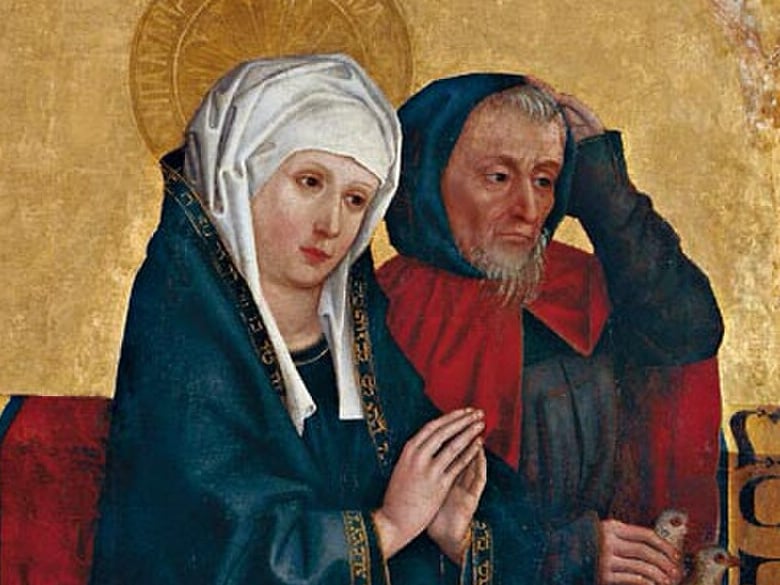
Detail of an Icon of Mary and Joseph by Hans Pleydenwurff from Wikimedia Commons
As we enter the Advent Season, I see a lot of people trying to explain away the mystery. We do that at our peril, so today, I want to get back to the basics. Let’s start with Mary and Joseph, Jesus’ earthly parents.
Let’s Start with Mary
Mary can be a somewhat controversial figure in the Church as a whole, so I want to start with a statement. I believe some in the church give her too much credit. There, I said it. I don’t believe she is divine. I don’t believe that prayers should be made to her, and that Jesus Himself is, among many other things our intermediary, and intercessor, and I believe the Bible supports that. Surely some will disagree with me, and I still love you, we just disagree. That being said, I don’t think the rest of us in the Church give her anywhere near enough credit.
Don’t Miss This…
One of the dangers of the Christmas story is that it has become so familiar that we might take it for granted and miss things. It could argued that God’s Messianic plan began in the heart of an all knowing God in eternity past. The promise of the Messiah was made to King David somewhere around 1000 BC. From that time forward, at least, people had anticipated His coming. 700 years or so before His coming, Isaiah prophesied, “Therefore the Lord himself will give you a sign. Behold, the virgin shall conceive and bear a son, and shall call his name Immanuel.” (Isaiah 7:14) People had been looking for Him for 1000 years.
Favored
Now consider the angel’s announcement to Mary. And he came to her and said, “Greetings, O favored one, the Lord is with you!” But she was greatly troubled at the saying, and tried to discern what sort of greeting this might be. And the angel said to her, “Do not be afraid, Mary, for you have found favor with God.” Again she might not have been divine, but of all the women born since the beginning of time, she was the one selected to be the mother of God. That is no small thing.
This likely young girl, she could have been in her mid teens, had somehow found favor with God. She had enough favor to be entrusted with raising and caring for God incarnate. That makes her sound pretty special. This young woman from the backwoods of Israel, somehow found favor with God. Sounds like God saw something in her.
The Line of Judah
One of the things skeptics call out about the Bible are the alleged contradictions. One of those might be the differing lineages of Jesus in Matthew and Luke. It’s not a contradiction. The lineage found in Luke 3 is likely the lineage of Mary. Luke 3:23 says Jesus, when he began his ministry, was about thirty years of age, being the son (as was supposed) of Joseph, the son of Heli. According to GotQuestions.org, This comment affirms the truth of Jesus’ virgin birth. Joseph was a “son” of Heli by virtue of his marriage to Mary, who would have been the daughter of Heli (Matthew 1:16 lists Joseph’s biological father as Jacob).
The Virgin Birth
Of course another reason why Mary’s lineage to Judah is important was because the Messiah was to come from the tribe of Judah. Matthew shows us the lineage of Joseph as being from Judah, but Joseph was not Jesus’ biological father. The other thing that sometimes comes into question is the virgin birth itself. People will say that the Greek word for Virgin can also mean young girl. Now I am not a Greek scholar by any stretch of the imagination, but it seems to me simple English context clues render this argument null and void.
How Will This Be?
Consider Luke 1:34. After receiving this amazing proclamation from an angel of the Lord, Mary had only one question. “And Mary said to the angel, “How will this be, since I am a virgin?” Now if virgin here simply meant young girl, that would be an easy answer. “The same way everyone else conceives and gives birth.” That was not the answer. Instead the angel told her exactly how it would happen in Luke 1:35. And the angel answered her, “The Holy Spirit will come upon you, and the power of the Most High will overshadow you; therefore the child to be born will be called holy—the Son of God.” Sure sounds like a virgin birth to me.
And what was Mary’s response to this announcement? With her one question answered, she said, “Behold, I am the servant of the Lord; let it be to me according to your word.”
What About Joseph?
We don’t really hear a lot about Joseph, but what we hear is pretty compelling. He was betrothed to Mary, which is kind of like being engaged, but it’s legally binding. This is part of what makes Mary’s agreement to the angel’s announcement so amazing. Were she to be found unfaithful to her betrothed, and that would be how it would have seemed, the penalty was death. Deuteronomy 22:21 demands that an unfaithful betrothed woman be stoned to death in the doorway of her father’s house. Joseph could have demanded this when he found out about Mary’s pregnancy. That was not Joseph’s way. Matthew 1:19 tells us, “Joseph, being a just man and unwilling to put her to shame, resolved to divorce her quietly.” He was simply going to walk away quietly.
Dreams
What came next, I think, reveals why Joseph was chosen. Matthew 1:20 and 21 tell us, “But as he considered these things, behold, an angel of the Lord appeared to him in a dream, saying, “Joseph, son of David, do not fear to take Mary as your wife, for that which is conceived in her is from the Holy Spirit. She will bear a son, and you shall call his name Jesus, for he will save his people from their sins.” His response? Matthew 1:24-25 “When Joseph woke from sleep, he did as the angel of the Lord commanded him: he took his wife, but knew her not until she had given birth to a son. And he called his name Jesus.” Joseph was a man who was willing to uproot his whole life, and trust God based on a dream, and he did that twice.
Filling In the Blanks
We don’t hear a lot more about Joseph in Scripture, but that hasn’t stopped some people from trying to fill in the blanks. Some have said he may have been much older than Mary. I’m not sure that’s relevant or why it matters. Some believe he was not merely a carpenter, but a wealthy building contractor. It’s almost as if they can’t see Jesus being raised in humble circumstances—the same kinds of circumstances he faced the rest of his life. If you’ve heard that, I believe I can debunk it, by going no further than Luke 2 after the birth of Jesus.
Offering
Luke 2:22-24 And when the time came for their purification according to the Law of Moses, they brought him up to Jerusalem to present him to the Lord (as it is written in the Law of the Lord, “Every male who first opens the womb shall be called holy to the Lord”) and to offer a sacrifice according to what is said in the Law of the Lord, “a pair of turtledoves, or two young pigeons.” Mary and Joseph went to the temple in obedience and did what the law required, They made a sacrifice, but was it the right sacrifice? Leviticus 12 tells us what the offering should be. “A lamb a year old for a burnt offering, and a pigeon or a turtledove for a sin offering…”
What Happened to the Lamb?
The offering for the birth of a child, was to include a lamb, but Leviticus 12 also tells us, “And if she cannot afford a lamb, then she shall take two turtledoves or two pigeons…” The offering Mary and Joseph made was the offering of someone who couldn’t afford a lamb. This leads us to one of two conclusions. Either Jesus was born to people of humble means or God picked a man to raise His Son, who would skimp on his offering. I’m betting on the former.
Miss the Parents, Miss the Point
Looking at the parents God selected to bear His Son tells us a lot. These were people who were willing to risk it all to follow God. Mary and Joseph were humble people, probably of very humble means, who were entrusted with the care and protection of God’s One and Only Son. They were used to bring the Savior of the world into the world. Joseph was entrusted with teaching the Son of God, to an extent, how to be a man. The virgin birth was a story many wouldn’t believe, and people still try to explain it away, because it doesn’t work in the natural world. Isn’t that the whole point? This is not a natural story. It’s supernatural. It’s a plan to defeat our sinful nature, and make us better than that nature. Jesus humbled Himself to become one of us, to show us how we could become like Him.
His parents trusted God to keep His promises, and God used them to keep His greatest promise, Salvation by grace through faith. And that plan was brought about at least in part, by two young people who were willing to take everything on faith. Don’t try to explain the miracles of the story away. Take them on faith.

About Dave Weiss
Dave Weiss is a pastor and a traveling speaker. He has written and/or illustrated many self-published books and has his MDIV and DMIN, both with a concentration in Creative Arts Ministry. He is married to his wife Dawn and has two adult sons and a grandson named David. You can read more about the author here.
Previous Post

November 17, 2026
Making Stones Into Bread: Choosing the “Right” Work
Browse Our Archives
Select a Category Creative Arts Ministry Leadership Uncategorized Worship
Select a Month November 2026 October 2026 September 2026 August 2026 July 2026 June 2026 May 2026 January 2026 December 2025 November 2025 October 2025 September 2025 July 2025 June 2025 May 2025 April 2025 March 2025 February 2025 June 2024 May 2024 April 2024 March 2024 February 2024
Follow Us!
TAKE THE
Religious Wisdom Quiz
What is the number of the beast in Revelation?
Select your answer to see how you score.
777 1000 666 144
Related posts from The Imaginative Church

Making Stones Into Bread: Choosing the “Right” Work

Write Your Story: A Great Way to Find...

He’s Making A List… A Great Way to...

To Halloween or Not to Halloween… That Is...
TRENDING AT PATHEOS Evangelical
Making Stones Into Bread: Choosing the “Right” Work
I was on my online arts ministry Zoom meeting with the International...

Ukraine’s exhausted Christians face fifth winter of war
By Julian Lukins The full-scale war in Ukraine is taking “a serious...

Russell Brand's Conviction is not anti-Christian Persecution
How do we shed the reputation that the Church is OK with...

Have you ever caught yourself saying, “I’ll do it tomorrow,” or “Now...

Write Your Story: A Great Way to Find...
A few month’s back, my son was scrolling around Facebook and saw...

Throughout history, people have pursued pleasure, possessions, relationships, and success in an...
view all Evangelical blogs
Ad-Free & Subscriber Log-In Subscription Support
- About Us
- 2026 Calendar
- Videos
- Podcasts
- Library of World Religions
- Faith In Media Tracker
- Advertise With Us
- Write for Us
- Privacy Policy
- Terms of Service
- Do Not Sell My Data
- Contact Us
- Radiant Digital
- Manage Newsletter Subscriptions
- Unsubscribe From Notifications
- Sitemap
Copyright 2008-2026, Patheos, part of the Radiant Digital network of media brands. All rights reserved.
Subscription Support Ad-Free & Subscriber Log-In
Follow Patheos