
BuddhistCatholicContemplativeEvangelicalGeneral ChristianHinduJewishLatter-day SaintMuslimNew VisionsProgressive Christian
Beliefs
- Buddhist
- Catholic
- Contemplative
- Evangelical
- General Christian
- Hindu
- Jewish
- Latter-day Saint
- More Voices
- Muslim
- New Visions
- Pagan
- Progressive Christian
Topics
- Religion News
- Food and Religion
- Sports and Religion
- Religious Art
- Religious Music and Entertainment
- Religious Events
- History and Religion
- Style and Religion
- Politics and Religion
- Women in Religion
- Recreation Outdoors and Religion
- Business Finance and Religion
- Careers Workplace and Religion
- Education and Religion
- Family Parenting and Religion
- Health Fitness and Religion
- Home and Religion
- Relationships and Religion
- Technology and Religion
- Travel and Religion
Columnists
- Buddhist Columnists
- Business Finance and Religion Columnists
- Careers Workplace and Religion Columnists
- Catholic Columnists
- Contemplative Columnists
- Education and Religion Columnists
- Evangelists Columnists
- Family Parenting and Religion Columnists
- General Christian Columnists
- Health Fitness and Religion Columnists
- Hindu Columnists
- History and Religion Columnists
- Home and Religion Columnists
- Jewish Columnists
- More Voices Columnists
- Latter Day Columnists
- Muslim Columnists
- New Visions Columnists
- Nonreligious Columnists
- Pagan Columnists
- Politics and Religion Columnists
- Progressive Columnists
- Recreation Outdoors and Religion Columnists
- Relationships and Religion Columnists
- Religion News Columnists
- Religious Art Columnists
- Religious Events Columnists
- Religious Music and Entertainment Columnists
- Sports and Religion Columnists
- Style and Religion Columnists
- Technology and Religion Columnists
- Travel and Religion Columnists
- Women in Religion Columnists
Resource Library
- 2026 Calendar
- Library of World Religions
- The 100 Most Holy Places on Earth
- Patheos Answers
- Podcasts
- Videos
- Faith Leaders Database
- Anglican Episcopalian
- Bahai
- Baptist
- Buddhism
- Christianity
- Confucianism
- Eastern Orthodoxy
- Hinduism
- Holiness and Pentecostal
- ISKCON
- Islam
- Judaism
- Lutheran
- Methodist
- The Church of Jesus Christ of Latter-day Saints
- New Age
- Paganism
- Presbytarian and Reformed
- Protestantism
- Religion Behind the Scenes
- Roman Catholic
- Scientology
- Shia Islam
- Sikhism
- Sufism
- Sunni Islam
- Taoism
- Zen
- See all religions
Research Tools
 Ad-Free & Subscriber Log-In Subscription Support
Ad-Free & Subscriber Log-In Subscription Support
Follow Patheos 

- Trending:
- Forgiveness
- |
- Marriage
- |
- Consciousness
- |
- Death Penalty
- |
- Election
- |
- Halloween
 The High Calling
- Home
- Careers, Workplace and Religion
- The Integrity Test
The Integrity Test
Last updated on: March 17, 2015 at 9:02 am by The High Calling
The Integrity Test 2015-03-17T09:02:56-06:00 The High Calling
Patheos Explore the world's faith through different perspectives on religion and spirituality! Patheos has the views of the prevalent religions and spiritualities of the world.
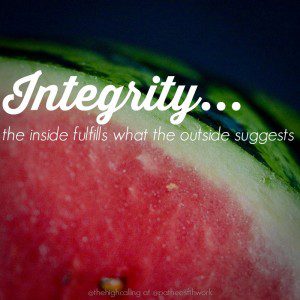 by Robb Redman
I once watched pastor and author Erwin McManus use a banana and a watermelon to demonstrate how integrity works. Peeling the banana and slicing open the watermelon, Pastor McManus explained that in fruit, the inside fulfills what the outside suggests. Fruit displays integrity. In people, on the other hand, the inside-outside consistency is blocked by sin. The inside often fails to live up to the outside, and integrity, or lack of it, is less obvious.
One integrity indicator shows up in the decisions we make—in particular the decisions for which the Bible gives no clear guidance. God blesses us with remarkable freedom: freedom from sin’s bondage, freedom in the Holy Spirit to experience the abundant life that Christ promises. . . . We are also free to make choices, large and small, that affect our relationship with God and others. In learning to make good and God-honoring choices, our faith and character grow and our insides more clearly live up to our outsides.
The apostle Paul provides four tests to help guide us in the tough choices that make us feel alone in our final decisions:
- The authority test. Will the result of my choice put me under its power? 1 Cor. 6:12 (NIV): “Everything is permissible for me”—but I will not be mastered by anything.”
- The sanctification test. Will the result of my choice make me more godly? In 1 Cor. 10:23 (NIV), Paul writes: “Everything is permissible”—but not everything is beneficial. “Everything is permissible”—but not everything is constructive.
- The edification test. Will the result of my choice benefit others? “Let us therefore make every effort to do what leads to peace and to mutual edification. Do not destroy the work of God for the sake of food. All food is clean, but it is wrong for a man to eat anything that causes someone else to stumble. It is better not to eat meat or drink wine or to do anything else that will cause your brother to fall” (Rom. 14:19-21 NIV).
- The conscience test. Will the result of my choice make my conscience uneasy? “So whatever you believe about these things keep between yourself and God. Blessed is the man who does not condemn himself by what he approves. But the man who has doubts is condemned if he eats, because his eating is not from faith; and everything that does not come from faith is sin” (Rom. 14:22-23 NIV).
The good news is that we’re not left on our own to guess which choice will most please God. Paul writes that “we have the mind of Christ” (1 Cor. 2:16). When we come to Christ, He fills us with His Spirit in such a way that we begin to see and hear as He does. His thoughts become our thoughts. His wholeness and integrity heal our brokenness and inconsistency. And His character begins to shine through the choices we make.
This post by Robb Redman was originally published at TheHighCalling.org. Photo by poppet with a camera, used via Creative Commons on Flickr. Photo design by Dan King of Fistbump Media.
Previous Post
March 16, 2015
Trapped: The Church Vocation Issue We Don't Talk About
Next Post

March 19, 2015 Abundance in a World of Choices
Browse Our Archives
Select a Category Current Events Interviews Reflections Uncategorized Video Posts Vocation Work Practices
Select a Month August 2015 July 2015 June 2015 May 2015 April 2015 March 2015 February 2015 January 2015 December 2014 November 2014 October 2014 September 2014 August 2014 July 2014 June 2014 May 2014 April 2014 March 2014 February 2014 December 2013
Follow Us!
TAKE THE
Religious Wisdom Quiz
Who did Jesus call out of the tomb after four days?
Select your answer to see how you score.
Mary Lazarus Bartimaeus Jairus
Related posts from The High Calling


Tomorrow's Legacy Today: What Will the Children Remember?


Figuring Out Success With the Amish
TRENDING AT PATHEOS Careers, Workplace and Religion

St. Francis by Bill Droel Pope Leo XIV declares 2026 as “Year...

Catholics are schooled in the faith by memorizing dogmatic points and lots...

The Good News of Our Human Limitations -...
After another day of trying to meet deadlines and working on projects,...

Quiet Holy Attentiveness (podcast) with Sarah Clarkson
We know that quiet is an essential aspect of the spiritual life,...

Every Vocation Everywhere All At Once
What is a vocation? How does it endure through the years? Can...

I promise this is not going to become a Taylor Swift Studies...
view all Careers, Workplace and Religion blogs
Ad-Free & Subscriber Log-In Subscription Support
- About Us
- 2026 Calendar
- Videos
- Podcasts
- Library of World Religions
- Faith In Media Tracker
- Advertise With Us
- Write for Us
- Privacy Policy
- Terms of Service
- Do Not Sell My Data
- Contact Us
- Radiant Digital
- Manage Newsletter Subscriptions
- Unsubscribe From Notifications
- Sitemap
Copyright 2008-2026, Patheos. All rights reserved.
Subscription Support Ad-Free & Subscriber Log-In
Follow Patheos