
BuddhistCatholicContemplativeEvangelicalGeneral ChristianHinduJewishLatter-day SaintMuslimNew VisionsProgressive Christian
Beliefs
- Buddhist
- Catholic
- Contemplative
- Evangelical
- General Christian
- Hindu
- Jewish
- Latter-day Saint
- More Voices
- Muslim
- New Visions
- Pagan
- Progressive Christian
Topics
- Religion News
- Food and Religion
- Sports and Religion
- Religious Art
- Religious Music and Entertainment
- Religious Events
- History and Religion
- Style and Religion
- Politics and Religion
- Women in Religion
- Recreation Outdoors and Religion
- Business Finance and Religion
- Careers Workplace and Religion
- Education and Religion
- Family Parenting and Religion
- Health Fitness and Religion
- Home and Religion
- Relationships and Religion
- Technology and Religion
- Travel and Religion
Columnists
- Buddhist Columnists
- Business Finance and Religion Columnists
- Careers Workplace and Religion Columnists
- Catholic Columnists
- Contemplative Columnists
- Education and Religion Columnists
- Evangelists Columnists
- Family Parenting and Religion Columnists
- General Christian Columnists
- Health Fitness and Religion Columnists
- Hindu Columnists
- History and Religion Columnists
- Home and Religion Columnists
- Jewish Columnists
- More Voices Columnists
- Latter Day Columnists
- Muslim Columnists
- New Visions Columnists
- Nonreligious Columnists
- Pagan Columnists
- Politics and Religion Columnists
- Progressive Columnists
- Recreation Outdoors and Religion Columnists
- Relationships and Religion Columnists
- Religion News Columnists
- Religious Art Columnists
- Religious Events Columnists
- Religious Music and Entertainment Columnists
- Sports and Religion Columnists
- Style and Religion Columnists
- Technology and Religion Columnists
- Travel and Religion Columnists
- Women in Religion Columnists
Resource Library
- 2026 Calendar
- Library of World Religions
- The 100 Most Holy Places on Earth
- Patheos Answers
- Podcasts
- Videos
- Faith Leaders Database
- Anglican Episcopalian
- Bahai
- Baptist
- Buddhism
- Christianity
- Confucianism
- Eastern Orthodoxy
- Hinduism
- Holiness and Pentecostal
- ISKCON
- Islam
- Judaism
- Lutheran
- Methodist
- The Church of Jesus Christ of Latter-day Saints
- New Age
- Paganism
- Presbytarian and Reformed
- Protestantism
- Religion Behind the Scenes
- Roman Catholic
- Scientology
- Shia Islam
- Sikhism
- Sufism
- Sunni Islam
- Taoism
- Zen
- See all religions
Research Tools
 Ad-Free & Subscriber Log-In Subscription Support
Ad-Free & Subscriber Log-In Subscription Support
Follow Patheos 

- Trending:
- Forgiveness
- |
- Marriage
- |
- Consciousness
- |
- Death Penalty
- |
- Election
- |
- Halloween
 The High Calling
- Home
- Careers, Workplace and Religion
- Challenges and Crises in Seminary and University Education
Challenges and Crises in Seminary and University Education
Last updated on: October 25, 2014 at 3:27 pm by The High Calling
Challenges and Crises in Seminary and University Education 2014-10-25T15:27:05-06:00 The High Calling
Patheos Explore the world's faith through different perspectives on religion and spirituality! Patheos has the views of the prevalent religions and spiritualities of the world.
by Bob Robinson
How well do our educational institutions support and promote living out our faith in our work?
Not very well, according to two experts who addressed those attending the Faith@Work Summit in Boston this weekend.
 Paul Williams of Regent College addressed some major problems that he sees in North American seminary education.
In spite of all the decades of teaching on faith/work integration, why do so many Christians still struggle with a sacred/secular divide in their lives? Why are they still unable to connect their faith with their work?
Williams stated that it is because most Christians have an anemic theology of work, vocation and mission. While many people have four to eight years of complex higher education for their vocations, they have the equivalent of a ninth or tenth grade education in theology. They have not been equipped with the depth that they need to live a holistic Christian life in which their faith impacts every aspect of their lives, including that which they spend most of their time and energy doing, their careers.
Williams quoted Mark Greene of The London Institute for Contemporary Christianity, when he stated that churches see their primary mission as, “to recruit the people of God to use some of their leisure time to join the missionary initiatives of church-paid workers.”
Williams blames our seminaries for this faulty view of the church’s mission. And he said, “Our seminaries’ education strategy is just not going to cut it” because it is based on a “Clerical and Scholastic” model that will not meet the challenges of our day. By this Williams means that, as a vestige of the age of Christendom, we train our people for a careers as pastors funded primarily by the tithe and give them an education in theology and Bible and think that they will be effective. But what this often leads to is an intellectual insecurity when it comes to real-world marketplace issues.
As a result, many of our pastors do not make it a priority to understand and engage the members of their congregation in the matters of their work.
He suggests that seminaries begin training people in a way that joins scholars with practitioners. Pastors should be required to experience what it is like to work in the secular world as part of their training. Practical discipleship for those seeking ordination must be done in the context of community, with real-life experiences.
But in an age where there are seminaries (which have increased by 7%), these schools are experiencing lower enrollment (down 12%) and increased cost (up 20%). There is oversupply and under-demand. This is a crisis in seminary education that must be met, but the temptation for schools may be to make seminary education less robust for the sake of keeping their doors open.
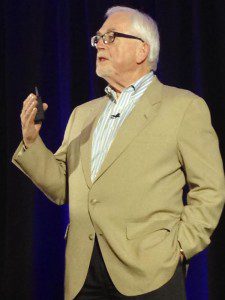 Al Erisman echoed this concern. Erisman is Executive in Residence, Seattle Pacific University for their School of Business & Economics. Showing a chart that showed the cost of tuition at an average university over the past decade, the annual cost had increased from $4,000 to over $10,000. That’s a factor of 2-1/2 times, which if continues would mean that annual college tuition at this school will be $1.6 Million in 2090. This is clearly not sustainable.
Along with the crisis of cost, according to Erisman, there are also crises in the educational content and the lack of character development in today’s universities.
For over three decades Erisman was at The Boeing Company, where he ultimately served as Director of Technology R&D and Senior Technical Fellow. While there, he fought against the prevailing ideas of economist Milton Friedman who famously advocated in 1970 that a company should only be concerned with maximizing shareholder value. According to the Friedman School of Economics, there is no real reason for business people to have a sense of social responsibility.
Erisman believes that too many university graduates still seem to believe that the main reason for business is to make profits.
Contrary to Freidman’s philosophy, Erisman spoke of Daniel Kahneman, another Nobel-Prize winning economist and the author of Thinking, Fast and Slow. Kahneman’s research, which combined psychology with economics, proved that business leaders’ behavior often is not merely in their self-interest. They often do indeed act in the interest of others. Erisman wants universities to embrace a servant-leadership paradigm for business leaders.
How can we address the challenges facing university and seminary education? The Faith@Work Summit was not about having experts espouse solutions to all these issues, but to create a conversation among overlapping networks of faith-at-work sectors for finding collaborative solutions.
What do you have to offer the conversation?
Bob Robinson is a writer, speaker, mistake repeater, forgetful husband, silly father, and depender on God’s grace and mercy. He consults with (re)integrate, he ministers with CCO, and he edits with The High Calling. Read more of his work at www.re-integrate.org/magazine. Follow his tweets @Bob_Robinson_re.
Images by Bob Robinson. Used with permission.
Previous Post

October 25, 2014
Turning the Workplace, Classroom, and Marketplace Into Sanctuaries
Next Post

October 27, 2014 Serving God in the Business of Death
Browse Our Archives
Select a Category Current Events Interviews Reflections Uncategorized Video Posts Vocation Work Practices
Select a Month August 2015 July 2015 June 2015 May 2015 April 2015 March 2015 February 2015 January 2015 December 2014 November 2014 October 2014 September 2014 August 2014 July 2014 June 2014 May 2014 April 2014 March 2014 February 2014 December 2013
Follow Us!
TAKE THE
Religious Wisdom Quiz
Who said: "See to it that no one takes you captive through hollow and deceptive philosophy"?
Select your answer to see how you score.
John James Peter Paul
Related posts from The High Calling


The Five Biggest Career Mistakes Christians Make

Trapped: The Church Vocation Issue We Don't Talk...
Talking with VeggieTales Founder Phil Vischer
TRENDING AT PATHEOS Careers, Workplace and Religion

St. Francis by Bill Droel Pope Leo XIV declares 2026 as “Year...

Catholics are schooled in the faith by memorizing dogmatic points and lots...

The Good News of Our Human Limitations -...
After another day of trying to meet deadlines and working on projects,...

Quiet Holy Attentiveness (podcast) with Sarah Clarkson
We know that quiet is an essential aspect of the spiritual life,...

Every Vocation Everywhere All At Once
What is a vocation? How does it endure through the years? Can...

I promise this is not going to become a Taylor Swift Studies...
view all Careers, Workplace and Religion blogs
Ad-Free & Subscriber Log-In Subscription Support
- About Us
- 2026 Calendar
- Videos
- Podcasts
- Library of World Religions
- Faith In Media Tracker
- Advertise With Us
- Write for Us
- Privacy Policy
- Terms of Service
- Do Not Sell My Data
- Contact Us
- Radiant Digital
- Manage Newsletter Subscriptions
- Unsubscribe From Notifications
- Sitemap
Copyright 2008-2026, Patheos. All rights reserved.
Subscription Support Ad-Free & Subscriber Log-In
Follow Patheos