
BuddhistCatholicContemplativeEvangelicalGeneral ChristianHinduJewishLatter-day SaintMuslimNew VisionsProgressive Christian
Beliefs
- Buddhist
- Catholic
- Contemplative
- Evangelical
- General Christian
- Hindu
- Jewish
- Latter-day Saint
- More Voices
- Muslim
- New Visions
- Pagan
- Progressive Christian
Topics
- Religion News
- Food and Religion
- Sports and Religion
- Religious Art
- Religious Music and Entertainment
- Religious Events
- History and Religion
- Style and Religion
- Politics and Religion
- Women in Religion
- Recreation Outdoors and Religion
- Business Finance and Religion
- Careers Workplace and Religion
- Education and Religion
- Family Parenting and Religion
- Health Fitness and Religion
- Home and Religion
- Relationships and Religion
- Technology and Religion
- Travel and Religion
Columnists
- Buddhist Columnists
- Business Finance and Religion Columnists
- Careers Workplace and Religion Columnists
- Catholic Columnists
- Contemplative Columnists
- Education and Religion Columnists
- Evangelists Columnists
- Family Parenting and Religion Columnists
- General Christian Columnists
- Health Fitness and Religion Columnists
- Hindu Columnists
- History and Religion Columnists
- Home and Religion Columnists
- Jewish Columnists
- More Voices Columnists
- Latter Day Columnists
- Muslim Columnists
- New Visions Columnists
- Nonreligious Columnists
- Pagan Columnists
- Politics and Religion Columnists
- Progressive Columnists
- Recreation Outdoors and Religion Columnists
- Relationships and Religion Columnists
- Religion News Columnists
- Religious Art Columnists
- Religious Events Columnists
- Religious Music and Entertainment Columnists
- Sports and Religion Columnists
- Style and Religion Columnists
- Technology and Religion Columnists
- Travel and Religion Columnists
- Women in Religion Columnists
Resource Library
- 2026 Calendar
- Library of World Religions
- The 100 Most Holy Places on Earth
- Patheos Answers
- Podcasts
- Videos
- Faith Leaders Database
- Anglican Episcopalian
- Bahai
- Baptist
- Buddhism
- Christianity
- Confucianism
- Eastern Orthodoxy
- Hinduism
- Holiness and Pentecostal
- ISKCON
- Islam
- Judaism
- Lutheran
- Methodist
- The Church of Jesus Christ of Latter-day Saints
- New Age
- Paganism
- Presbytarian and Reformed
- Protestantism
- Religion Behind the Scenes
- Roman Catholic
- Scientology
- Shia Islam
- Sikhism
- Sufism
- Sunni Islam
- Taoism
- Zen
- See all religions
Research Tools
 Ad-Free & Subscriber Log-In Subscription Support
Ad-Free & Subscriber Log-In Subscription Support
Follow Patheos 

- Trending:
- Forgiveness
- |
- Marriage
- |
- Consciousness
- |
- Death Penalty
- |
- Election
- |
- Halloween
 The God Article with Mark Sandlin
- Home
- Progressive Christian
- The Lord’s Prayer: DEscription Not PREscription (4 of 6)
The Lord’s Prayer: DEscription Not PREscription (4 of 6)
Last updated on: April 29, 2016 at 1:13 pm by Mark Sandlin
The Lord’s Prayer: DEscription Not PREscription (4 of 6) 2016-04-29T13:13:22-05:00 Mark Sandlin
Patheos Explore the world's faith through different perspectives on religion and spirituality! Patheos has the views of the prevalent religions and spiritualities of the world.
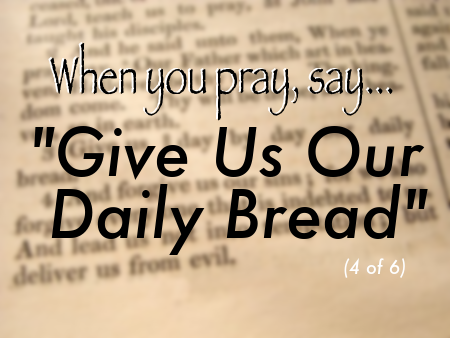
Copyright: wayoutwest / 123RF Stock Photo
In this series, I’m discussing The Lord’s Prayer, and why I believe it reflects Jesus’ most radical and challenging ideas. The prayer is meant to be descriptive of how to pray, not prescriptive on what to pray. In Part 4, we think about what it means to ask God to give us our daily bread.
(Read Part 1 here and 2 here and 3 here)
Jesus taught that our prayers should first acknowledge God as “father,” and that we should ask God to bring the Kingdom of heaven to earth through us. He then instructed the disciples to stop being so doggedly “independent.”
When you pray, say…
“Give us each day our daily bread.”
It’s a highly probable historical fact that Jesus was an itinerant sage or preacher, who sometimes lived off the generosity of others. So, it’s not unreasonable to believe that at some points in his life, Jesus didn’t know where or when he and the disciples would be eating again.
But, for most of us, here in 21st Century North America, asking God to “give us our daily bread” has no real meaning, because it is the prayer of someone who lives from hand to mouth on a day-by-day basis – if they are so fortunate.
Most of us are fortunate enough not to live that way. And, some of us even look with considerable disdain, or at least with pity, upon people who are willing or have no choice but to survive one day, one meal at a time.
For most of us, one of our deepest commitments is to achieving a level of income and a stock of assets that will ensure we will never have to depend on anybody else for our daily bread.
But, Jesus knew that when the Israelites were destitute in the Sinai desert following their deliverance from Egypt, God provided “daily bread” in the form of “manna.” The only catch was, God prohibited them from gathering more than was enough for one day, because otherwise they might lose their deep sense of dependence upon God; and that would have led to a loss of belief and trust in God’s faithfulness in meeting their needs.
Jesus knew affluence undermines opportunities for us to depend on one another. It destroys our need to depend on anyone other than ourselves. And, that severs our connectedness with one another.
The reason Jesus taught that it is hard for rich people, such as ourselves (yes, by worldly standards we are rich), to enter the Kingdom of heaven is that committing to God means being able and willing to live day by day, depending upon God, without inordinate concern for the future.
Being willing to ask God to “give us this day our daily bread.”
It doesn’t necessarily mean giving up what we have, although it might for some of us. Jesus’ point was to show us that it is tremendously more difficult to truly depend on God, to depend on our enter-connectedness, when we are all so self-reliant.
Some people have discovered the wonderful liberation of depending on the way the spirit of God, the spirit of love, connects us all. There are others of us who have not … and who don’t want to.
Because, that is a radical and very challenging way to live.
Yet, until we want to surrender our self-reliance and are willing to do so, the prayer, “Give us this day our daily bread,” is essentially meaningless.
So, in following Jesus’ radical teaching, “give us each day our daily bread,” I offer this suggestion:
When you pray say, “we commit ourselves to strive for what we really need and not for what we might need or should need or even don’t need. Remove the things in our lives that undermine our dependence on each other and on you.”
Up next: When you pray, say…
“Forgive us our sins as we forgive everyone indebted to us.”
Consider supporting Mark’s blogging. Help create a market for Progressive Christianity. Not through big publishers or big denominations, but through the grassroots. We need to encourage the growth of progressive Christian voices in the marketplace. Even a dollar will help.
Mark is a co-founder of The Christian Left. Come and join the conversation!
Previous Post

April 29, 2016
The Lord's Prayer: DEscription Not PREscription (3 of 6)
Next Post
May 3, 2016 The Lord’s Prayer: DEscription Not PREscription (5 of 6)
Browse Our Archives
Select a Category abortion Advent Afterlife agnostic America atheist Bible bourbon Brad Pitt Brokeness Christianity Christmas Church Civil Rights Confessions Congress Conservative Christianity Crucifixion Easter election Elections Equality Facebook Feminism Ferguson Fiction Following Jesus Foodie Gamers God GOP Gospels Gun Control Health Care Hell Heretic Heritic Holy Week Humanism immigration Inclusiveness Innovation Institutionalized Church Intellectualism Islam Jesus Job Justice Lectionary LGBT Life Love Matthew 11 Minister MLK Mother's Day Movie Review Movies Music Nones Obama peace Political Pope Francis Poverty Prayer Prison Progressive Christianity Prophetic Question Mark refugee Resistance sex shooting Sin Spirit Thanksgiving The 10% The Christian Left The Walking Dead Theology Trinity Trump Uncategorized unChristian Unemployment United States violence voting war Women's rights workers rights
Select a Month January 2017 July 2016 May 2016 April 2016 March 2016 February 2016 January 2016 December 2015 November 2015 October 2015 September 2015 August 2015 July 2015 June 2015 May 2015 April 2015 March 2015 February 2015 January 2015 December 2014 November 2014 October 2014 September 2014 August 2014 July 2014 June 2014 May 2014 March 2014 February 2014 January 2014 December 2013 November 2013 October 2013 September 2013 August 2013 July 2013 June 2013 February 2013 January 2013 December 2012 November 2012 October 2012 September 2012 August 2012 July 2012 June 2012 May 2012 March 2012 February 2012 January 2012 December 2011 October 2011 August 2011 July 2011 June 2011 May 2011 April 2011 March 2011 February 2011 January 2011 December 2010 November 2010 October 2010
Follow Us!
TAKE THE
Religious Wisdom Quiz
What happened to the prophet Elijah at the end of his life?
Select your answer to see how you score.
Buried by Elisha Killed by Jezebel Taken to heaven in a whirlwind Died of old age
Related posts from The God Article with Mark Sandlin

Following Jesus in the Age of Trump: Resistance...
The God Article with Mark Sandlin

On Living Wide Awake: A Prayer
The God Article with Mark Sandlin

On the Limitations of Words - A Prayer
The God Article with Mark Sandlin

A Christian Minister's Rewrite of the RNC's "Christian"...
The God Article with Mark Sandlin
TRENDING AT PATHEOS Progressive Christian

Why Christians Have a Sacred Duty to Vote:...
The Bible offers strong support for the sacred duty to vote. Here...

What Being a Modern-Day Apostle Means to Me
In my last column, I discussed the ins and outs of modern-day...

Did Ancient China Once Worship the God of...
Across human history, a common thread weaves through the origins of the...

Love Your Neighbor – Including Earth-Kin: Lev. 19,...
God’s command to love your neighbor means acting in an ethical and...

Lead a Church Study of “Jesus and Lao...
Guest writer Jack Thomas (The Irreverent Reverend) reflects on leading his church...

Principles for Understanding the Apostolic Ministry Today
Whenever people discover that my formal ministry title is "apostle," as in...
view all Progressive Christian blogs
Ad-Free & Subscriber Log-In Subscription Support
- About Us
- 2026 Calendar
- Videos
- Podcasts
- Library of World Religions
- Faith In Media Tracker
- Advertise With Us
- Write for Us
- Privacy Policy
- Terms of Service
- Do Not Sell My Data
- Contact Us
- Radiant Digital
- Manage Newsletter Subscriptions
- Unsubscribe From Notifications
- Sitemap
Copyright 2008-2026, Patheos. All rights reserved.
Subscription Support Ad-Free & Subscriber Log-In
Follow Patheos