
BuddhistCatholicContemplativeEvangelicalGeneral ChristianHinduJewishLatter-day SaintMuslimNew VisionsProgressive Christian
Beliefs
- Buddhist
- Catholic
- Contemplative
- Evangelical
- General Christian
- Hindu
- Jewish
- Latter-day Saint
- More Voices
- Muslim
- New Visions
- Pagan
- Progressive Christian
Topics
- Religion News
- Food and Religion
- Sports and Religion
- Religious Art
- Religious Music and Entertainment
- Religious Events
- History and Religion
- Style and Religion
- Politics and Religion
- Women in Religion
- Recreation Outdoors and Religion
- Business Finance and Religion
- Careers Workplace and Religion
- Education and Religion
- Family Parenting and Religion
- Health Fitness and Religion
- Home and Religion
- Relationships and Religion
- Technology and Religion
- Travel and Religion
Columnists
- Buddhist Columnists
- Business Finance and Religion Columnists
- Careers Workplace and Religion Columnists
- Catholic Columnists
- Contemplative Columnists
- Education and Religion Columnists
- Evangelists Columnists
- Family Parenting and Religion Columnists
- General Christian Columnists
- Health Fitness and Religion Columnists
- Hindu Columnists
- History and Religion Columnists
- Home and Religion Columnists
- Jewish Columnists
- More Voices Columnists
- Latter Day Columnists
- Muslim Columnists
- New Visions Columnists
- Nonreligious Columnists
- Pagan Columnists
- Politics and Religion Columnists
- Progressive Columnists
- Recreation Outdoors and Religion Columnists
- Relationships and Religion Columnists
- Religion News Columnists
- Religious Art Columnists
- Religious Events Columnists
- Religious Music and Entertainment Columnists
- Sports and Religion Columnists
- Style and Religion Columnists
- Technology and Religion Columnists
- Travel and Religion Columnists
- Women in Religion Columnists
Resource Library
- 2026 Calendar
- Library of World Religions
- The 100 Most Holy Places on Earth
- Patheos Answers
- Podcasts
- Videos
- Faith Leaders Database
- Anglican Episcopalian
- Bahai
- Baptist
- Buddhism
- Christianity
- Confucianism
- Eastern Orthodoxy
- Hinduism
- Holiness and Pentecostal
- ISKCON
- Islam
- Judaism
- Lutheran
- Methodist
- The Church of Jesus Christ of Latter-day Saints
- New Age
- Paganism
- Presbytarian and Reformed
- Protestantism
- Religion Behind the Scenes
- Roman Catholic
- Scientology
- Shia Islam
- Sikhism
- Sufism
- Sunni Islam
- Taoism
- Zen
- See all religions
Research Tools
 Ad-Free & Subscriber Log-In Subscription Support
Ad-Free & Subscriber Log-In Subscription Support
Follow Patheos 

- Trending:
- Forgiveness
- |
- Marriage
- |
- Consciousness
- |
- Death Penalty
- |
- Election
- |
- Halloween
 The God Article with Mark Sandlin
- Home
- Progressive Christian
- The Frightening Implications of Easter
The Frightening Implications of Easter
Last updated on: March 23, 2016 at 10:12 am by Mark Sandlin
The Frightening Implications of Easter 2016-03-23T10:12:01-05:00 Mark Sandlin
Patheos Explore the world's faith through different perspectives on religion and spirituality! Patheos has the views of the prevalent religions and spiritualities of the world.
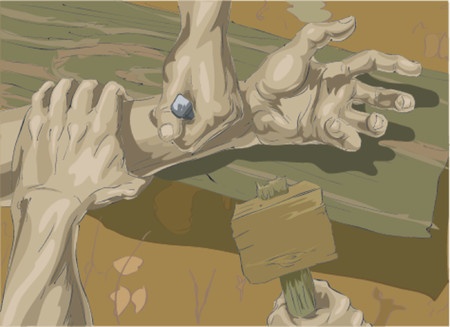
Copyright: Krisdog / 123RF Stock Photo
Even with the gruesome reality of Jesus’ suffering on “Good” Friday, our modern understanding of Holy Week and Easter has undersold the dangerous reality of the implications of the Easter story.
The Easter story should leave us all quivering in our boots.
It should also inspire us to acts of great love that might put us at great personal risk.
To truly grasp the terrifying implications of Easter in contemporary society, let’s first look at the “historical” realities of Holy Week and Easter.
Jesus’ entry into Jerusalem — humbly riding into town, bouncing around on the back of a previously unridden ass, people gathered to greet him singing and shouting, “Blessed is the King who comes in the name of the Lord,” signals to us that Easter is going to be a story about confronting The Powers That Be.
In stark contrast, the actual ruler of the region, Prefect Pontius Pilate, (basically the Governor) would have made quite a different entrance. As Rome’s official authority, he would have paraded through the front of the city’s gates on a mighty steed while surrounded by Roman soldiers.
The confrontation of The Powers at Easter begins with a quiet “announcement.”
It happens as folks are gathering in Jerusalem to observe Passover – the annual commemoration of Moses leading the Israelites out of Egypt to escape a repressive, enslaving government.
The confrontation of The Powers at Easter begins with a quiet “announcement.”
It happens in a setting that recalls the power of the people when it comes to escaping tyrannical and oppressive regimes.
As you might imagine, Rome, actually BEING a repressive government, was somewhat weary of this kind of celebration. The Romans certainly didn’t want the Hebrew people to get any ideas about another Exodus, this time from the occupying Roman government.
Given these realities, we begin to understand how Easter would have been quite dangerous.
After his humble entrance into Jerusalem, and seemingly out of character, Jesus enters into the Temple courtyard and strikes at the heart of a main source of the religious institute’s funding.
The moneychangers and traders who had set up shop in the Temple used their monopoly to take advantage of the mostly-poor travelers who came to the city to pay their taxes.
Since the religious institute and the government were closely tied, Jesus’ cleansing of the Temple was the beginning of the end. He’d gone from an annoying sideshow (along with all the other supernaturally endowed teachers of his time) to being a viable threat to the state.
The Powers That Be began to conspire to remove this thorn in their side.
From this point on, the storyline gives us a reality check as to how far The Powers were willing to go to protect their status and wealth.
It’s a story that continues to echo in the world today. We can look to the life story of Dr. Martin Luther King and remember how far American politicians and some of the people were willing to go to obstruct African Americans’ voting and civil rights.
And we can even see it today, in the 2016 Federal and State elections, where a group of folks used to lives of wealth and privilege are beginning to lash out as they feel their power slipping away.
Confronting The Powers That Be can be dangerous work. It should not be taken lightly. It can be unsettling, unnerving, and downright frightening.
The Powers That Be will not go down gently – they never do. They will use every tool available to them to maintain their status, wealth, and control.
In confronting them, we risk our good name, our freedom, and even our lives.
Yet, we are morally obligated to confront them. Yes, we are called to do so lovingly – but confront them we must, because they will not relinquish their power gently.
Or as Dr. Martin Luther King put it, “Freedom is never voluntarily given by the oppressor; it must be demanded by the oppressed.”
The Palm Sunday to Easter story is a not-so-gentle reminder of how much is required to resist powerful and oppressive forces, and it is a reminder of how far the Powers That Be Will go to protect their Power.
The Good News is that Easter’s conclusion is a reminder that it’s also the story of how far Love will go for the sake of divine justice.
In the end, while Easter is a story of confronting those who would use their power to oppress others and the real risks that go along with it.
Ultimately, though, Easter is the story of the resurrecting power of love and hope.
Consider supporting Mark’s blogging. Help create a market for Progressive Christianity. Not through big publishers or big denominations, but through the grassroots. We need to encourage the growth of progressive Christian voices in the marketplace. Even a dollar will help.
Mark is a co-founder of The Christian Left. Come and join the conversation!
Previous Post

March 23, 2016
A Hysterical Response to NC's Latest LGBT Legislative Attacks
Browse Our Archives
Select a Category abortion Advent Afterlife agnostic America atheist Bible bourbon Brad Pitt Brokeness Christianity Christmas Church Civil Rights Confessions Congress Conservative Christianity Crucifixion Easter election Elections Equality Facebook Feminism Ferguson Fiction Following Jesus Foodie Gamers God GOP Gospels Gun Control Health Care Hell Heretic Heritic Holy Week Humanism immigration Inclusiveness Innovation Institutionalized Church Intellectualism Islam Jesus Job Justice Lectionary LGBT Life Love Matthew 11 Minister MLK Mother's Day Movie Review Movies Music Nones Obama peace Political Pope Francis Poverty Prayer Prison Progressive Christianity Prophetic Question Mark refugee Resistance sex shooting Sin Spirit Thanksgiving The 10% The Christian Left The Walking Dead Theology Trinity Trump Uncategorized unChristian Unemployment United States violence voting war Women's rights workers rights
Select a Month January 2017 July 2016 May 2016 April 2016 March 2016 February 2016 January 2016 December 2015 November 2015 October 2015 September 2015 August 2015 July 2015 June 2015 May 2015 April 2015 March 2015 February 2015 January 2015 December 2014 November 2014 October 2014 September 2014 August 2014 July 2014 June 2014 May 2014 March 2014 February 2014 January 2014 December 2013 November 2013 October 2013 September 2013 August 2013 July 2013 June 2013 February 2013 January 2013 December 2012 November 2012 October 2012 September 2012 August 2012 July 2012 June 2012 May 2012 March 2012 February 2012 January 2012 December 2011 October 2011 August 2011 July 2011 June 2011 May 2011 April 2011 March 2011 February 2011 January 2011 December 2010 November 2010 October 2010
Follow Us!
TAKE THE
Religious Wisdom Quiz
Who was called by God from a burning bush to lead Israel out of Egypt?
Select your answer to see how you score.
Joseph Moses Aaron Joshua
Related posts from The God Article with Mark Sandlin

Following Jesus in the Age of Trump: Resistance...
The God Article with Mark Sandlin

On Living Wide Awake: A Prayer
The God Article with Mark Sandlin

10 Things Church Can Learn From Geeks
The God Article with Mark Sandlin

On the Limitations of Words - A Prayer
The God Article with Mark Sandlin
TRENDING AT PATHEOS Progressive Christian

What Being a Modern-Day Apostle Means to Me
In my last column, I discussed the ins and outs of modern-day...

Did Ancient China Once Worship the God of...
Across human history, a common thread weaves through the origins of the...

Love Your Neighbor – Including Earth-Kin: Lev. 19,...
God’s command to love your neighbor means acting in an ethical and...

Lead a Church Study of “Jesus and Lao...
Guest writer Jack Thomas (The Irreverent Reverend) reflects on leading his church...

Pastoral Wisdom for Responding to Sermon Pushback
Getting sermon pushback on your social justice sermon? Learn practical, Proverbs-based strategies...

Principles for Understanding the Apostolic Ministry Today
Whenever people discover that my formal ministry title is "apostle," as in...
view all Progressive Christian blogs
Ad-Free & Subscriber Log-In Subscription Support
- About Us
- 2026 Calendar
- Videos
- Podcasts
- Library of World Religions
- Faith In Media Tracker
- Advertise With Us
- Write for Us
- Privacy Policy
- Terms of Service
- Do Not Sell My Data
- Contact Us
- Radiant Digital
- Manage Newsletter Subscriptions
- Unsubscribe From Notifications
- Sitemap
Copyright 2008-2026, Patheos. All rights reserved.
Subscription Support Ad-Free & Subscriber Log-In
Follow Patheos