
BuddhistCatholicContemplativeEvangelicalGeneral ChristianHinduJewishLatter-day SaintMuslimNew VisionsProgressive Christian
Beliefs
- Buddhist
- Catholic
- Contemplative
- Evangelical
- General Christian
- Hindu
- Jewish
- Latter-day Saint
- More Voices
- Muslim
- New Visions
- Pagan
- Progressive Christian
Topics
- Religion News
- Food and Religion
- Sports and Religion
- Religious Art
- Religious Music and Entertainment
- Religious Events
- History and Religion
- Style and Religion
- Politics and Religion
- Women in Religion
- Recreation Outdoors and Religion
- Business Finance and Religion
- Careers Workplace and Religion
- Education and Religion
- Family Parenting and Religion
- Health Fitness and Religion
- Home and Religion
- Relationships and Religion
- Technology and Religion
- Travel and Religion
Columnists
- Buddhist Columnists
- Business Finance and Religion Columnists
- Careers Workplace and Religion Columnists
- Catholic Columnists
- Contemplative Columnists
- Education and Religion Columnists
- Evangelists Columnists
- Family Parenting and Religion Columnists
- General Christian Columnists
- Health Fitness and Religion Columnists
- Hindu Columnists
- History and Religion Columnists
- Home and Religion Columnists
- Jewish Columnists
- More Voices Columnists
- Latter Day Columnists
- Muslim Columnists
- New Visions Columnists
- Nonreligious Columnists
- Pagan Columnists
- Politics and Religion Columnists
- Progressive Columnists
- Recreation Outdoors and Religion Columnists
- Relationships and Religion Columnists
- Religion News Columnists
- Religious Art Columnists
- Religious Events Columnists
- Religious Music and Entertainment Columnists
- Sports and Religion Columnists
- Style and Religion Columnists
- Technology and Religion Columnists
- Travel and Religion Columnists
- Women in Religion Columnists
Resource Library
- 2026 Calendar
- Library of World Religions
- The 100 Most Holy Places on Earth
- Patheos Answers
- Podcasts
- Videos
- Faith Leaders Database
- Anglican Episcopalian
- Bahai
- Baptist
- Buddhism
- Christianity
- Confucianism
- Eastern Orthodoxy
- Hinduism
- Holiness and Pentecostal
- ISKCON
- Islam
- Judaism
- Lutheran
- Methodist
- The Church of Jesus Christ of Latter-day Saints
- New Age
- Paganism
- Presbytarian and Reformed
- Protestantism
- Religion Behind the Scenes
- Roman Catholic
- Scientology
- Shia Islam
- Sikhism
- Sufism
- Sunni Islam
- Taoism
- Zen
- See all religions
Research Tools
 Ad-Free & Subscriber Log-In Subscription Support
Ad-Free & Subscriber Log-In Subscription Support
Follow Patheos 

- Trending:
- Forgiveness
- |
- Marriage
- |
- Consciousness
- |
- Death Penalty
- |
- Election
- |
- Halloween
 The God Article with Mark Sandlin
- Home
- Progressive Christian
- The Biblical Virtues of Slow Sex
The Biblical Virtues of Slow Sex
Last updated on: June 19, 2015 at 7:32 am by Mark Sandlin
The Biblical Virtues of Slow Sex 2015-06-19T07:32:47-05:00 Mark Sandlin
Patheos Explore the world's faith through different perspectives on religion and spirituality! Patheos has the views of the prevalent religions and spiritualities of the world.
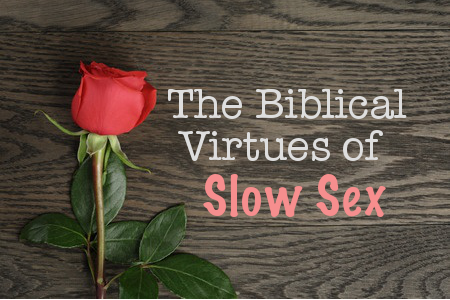
Copyright: goodween123 / 123RF Stock Photo (text added)
Let’s get something straight, right off the top: sex is good – really good.
As I’ve written before, we Christians have a lot of sexual hang-ups, and I believe it’s time for a Christian “sexual reboot.”
The Church has taught us to be more than a bit prudish about our sexuality, so we tend to beat around the bush (pardon the innuendo) when it comes to talking about sex.
But, with regard to a Christian sexual reboot, instead of talking all around the point, let me get directly to an even more significant point: SLOW sex is better – MUCH better.
Hey! What are you thinking? Get your head out of the gutter (again, pardon the innuendo). I mean slow sex as in the Slow Movement. Since beginning this article, I’ve realized that everything I write is going to have unintended sexual innuendos.
For instance, when I typed “slow movement” I couldn’t help but hear Austin Powers say, “Slow movement, yeah baby!” So, we’re just going to have to try to be grown-ups here – try.
Ok, back to the point: sex is good; but Slow Sex is really, really good.
When I say “Slow Sex,” I’m primarily talking about the act of sex being a slow process (but c’mon, having sex slowly? What’s not to like?). But, more than that, what I’m talking about is having an intimate relationship that is built, at least in part, on the fundamental concepts of the Slow Movement.
Yes, sex is a part of a romantic relationship – an important, intimate super-glue made from biological, chemical and emotional ingredients that bonds and builds a relationship like nothing else can; but it’s important to remember it’s just a part of a much bigger journey.
There are several theories from the Slow Movement, which, when applied to a relationship before anyone’s clothes come off, can greatly improve the relationship and, ultimately, greatly improve our sexual relationships themselves (and who’d be fool enough not to want even better sex?)
In a world where people can find a sexual “hookup” in a matter of minutes just by swiping right on Tinder, the ideas found in the Slow Movement couldn’t be more essential for building better intimate and loving relationships.
For Christians, there’s even better news: I’d argue Slow Sex is biblical (“Yeah baby!” – er, sorry about that).
The Slow Movement is a response to the ever-increasing pace of modern life. It advocates a slowing down of life and practicing life’s moments and processes more mindfully – with reflection, engagement and, possibly most importantly, presence.
The international Slow Movement is an outgrowth of the Slow Food movement started by Italian writer, Carlo Petrini in 1986, as a defense against McDonald’s attempts to infiltrate Italy’s famed locally and slowly produced food industry. Food and sex, who would have thought they go together?
But, Petrini’s internationally best-selling book Slow Food led to Carl Honoré’s book, In Praise of Slowness as a universal way of life in which he describes the Slow Movement:
“It is a cultural revolution against the notion that faster is always better. The Slow philosophy is not about doing everything at a snail’s pace. It’s about seeking to do everything at the right speed. Savoring the hours and minutes rather than just counting them. Doing everything as well as possible, instead of as fast as possible. It’s about quality over quantity in everything from work to food to parenting.”
Ok. Slow down. Go back and re-read that quote.
Now, think about the Slow philosophy as it can be applied to a relationship – yes, even the physical aspects of a relationship. As a matter of fact, let’s look at one of the key statements and put it in context of relationship.
“It’s about doing things at the right speed.” Far too frequently we allow our relationships to become defined by achievement and goals. We end up putting a great deal of pressure and, at times, unreasonable expectations on our partners because we begin defining our relationship by a timeline.
It’s easy to understand how we can come to feel this timeline is just normal. Much of our modern day lives are defined by and measured by how much we can do and how quickly we can achieve it.
But, imagine making a choice to throw all that scheduling and goal-oriented success out the door when it comes to the most important relationships in your life. Imagine instead focusing on the relationship itself and allowing it progress at the “right speed.”
Imagine tossing aside the external pressure and expectations of how quickly your relationship advances and achieves certain benchmarks deemed important by society and instead, truly focusing on the other person — focusing on engagement and being present in the moment.
How would that feel? How would it feel to have the person care about the most in the world step outside of the fevered pace of modern life and focus on you.
Not relationship goals – you.
Now, think of that kind of relationship and continue on the journey. Consider what physical intimacy looks like in that framework. Imagine a relationship built on reflection, engagement, presence and doing things at the right speed, moving those same building blocks of the relationship into a physically intimate setting.
Like I said, Slow Sex is good.
No doubt about it, the Slow Movement is counter cultural. It changes the pace at which society continues to push life full speed ahead. It reminds me of the “you’ve heard it said, but I say” teachings of Jesus.
When you put “Slow” in the context of an intimate relationship it becomes even more biblical.
The most important thing we have to offer the world is who we are. It is the one thing that cannot be taken from us – it has to be given.
Slow Sexuality is the ultimate in giving of ourselves to another – and no, we aren’t talking sex here (at least not yet).
Sharing the gifts of reflection, engagement and presence with someone else is the beginning of giving of yourself.
Yes, it feels a bit vulnerable. Yes, it can even feel like you are giving up power and control over the one thing you really have any real control over – yourself. But, that’s a feeling based a great deal on the brokenness of the world and the hurt that can come from it.
Within the context of a Slow Sex relationship, there is a great safety and security, a togetherness which knows the relationship is the priority because it is being developed at the right speed with full engagement and presence.
And that’s biblical.
What Jesus us tried to teach us about other people can be summed up in one word: love.
A Slow Sex relationship provides the foundation for love to be the default position, for love to be the instinct from which you react and interact. It bears all things, believes all things, hopes all things, and endures all things.
Who doesn’t want that kind of intimate relationship?
I hope you’ll agree with me:
Slow Sex is good.
(Yeah baby!)
Consider supporting Mark’s blogging. Help create a market for Progressive Christianity. Not through big publishers or big denominations, but through the grassroots. We need to encourage the growth of progressive Christian voices in the marketplace. Even a dollar will help.
Facebook continues to make it increasingly difficult for me to let you know about new blog posts like this. Please consider signing up for my mailing list where we can insure you are notified.Just click here!
Mark is a co-founder of The Christian Left. Come and join the conversation!
Previous Post

June 18, 2015
A Prayer on the Event of Hate Induced Killing
Next Post

June 26, 2015 Love Wins! Double Rainbow "All the Way" Over the White House.
Browse Our Archives
Select a Category abortion Advent Afterlife agnostic America atheist Bible bourbon Brad Pitt Brokeness Christianity Christmas Church Civil Rights Confessions Congress Conservative Christianity Crucifixion Easter election Elections Equality Facebook Feminism Ferguson Fiction Following Jesus Foodie Gamers God GOP Gospels Gun Control Health Care Hell Heretic Heritic Holy Week Humanism immigration Inclusiveness Innovation Institutionalized Church Intellectualism Islam Jesus Job Justice Lectionary LGBT Life Love Matthew 11 Minister MLK Mother's Day Movie Review Movies Music Nones Obama peace Political Pope Francis Poverty Prayer Prison Progressive Christianity Prophetic Question Mark refugee Resistance sex shooting Sin Spirit Thanksgiving The 10% The Christian Left The Walking Dead Theology Trinity Trump Uncategorized unChristian Unemployment United States violence voting war Women's rights workers rights
Select a Month January 2017 July 2016 May 2016 April 2016 March 2016 February 2016 January 2016 December 2015 November 2015 October 2015 September 2015 August 2015 July 2015 June 2015 May 2015 April 2015 March 2015 February 2015 January 2015 December 2014 November 2014 October 2014 September 2014 August 2014 July 2014 June 2014 May 2014 March 2014 February 2014 January 2014 December 2013 November 2013 October 2013 September 2013 August 2013 July 2013 June 2013 February 2013 January 2013 December 2012 November 2012 October 2012 September 2012 August 2012 July 2012 June 2012 May 2012 March 2012 February 2012 January 2012 December 2011 October 2011 August 2011 July 2011 June 2011 May 2011 April 2011 March 2011 February 2011 January 2011 December 2010 November 2010 October 2010
Follow Us!
TAKE THE
Religious Wisdom Quiz
What does the Parable of the Good Shepherd teach?
Select your answer to see how you score.
Goats are bad Shepherds are wealthy Wolves are evil Jesus cares for each of His sheep
Related posts from The God Article with Mark Sandlin

On Living Wide Awake: A Prayer
The God Article with Mark Sandlin
10 Things Church Can Learn From Geeks
The God Article with Mark Sandlin

On the Limitations of Words - A Prayer
The God Article with Mark Sandlin

A Christian Minister's Rewrite of the RNC's "Christian"...
The God Article with Mark Sandlin
TRENDING AT PATHEOS Progressive Christian

Why Christians Have a Sacred Duty to Vote:...
The Bible offers strong support for the sacred duty to vote. Here...

What Being a Modern-Day Apostle Means to Me
In my last column, I discussed the ins and outs of modern-day...

Did Ancient China Once Worship the God of...
Across human history, a common thread weaves through the origins of the...

Love Your Neighbor – Including Earth-Kin: Lev. 19,...
God’s command to love your neighbor means acting in an ethical and...

Lead a Church Study of “Jesus and Lao...
Guest writer Jack Thomas (The Irreverent Reverend) reflects on leading his church...

Principles for Understanding the Apostolic Ministry Today
Whenever people discover that my formal ministry title is "apostle," as in...
view all Progressive Christian blogs
Ad-Free & Subscriber Log-In Subscription Support
- About Us
- 2026 Calendar
- Videos
- Podcasts
- Library of World Religions
- Faith In Media Tracker
- Advertise With Us
- Write for Us
- Privacy Policy
- Terms of Service
- Do Not Sell My Data
- Contact Us
- Radiant Digital
- Manage Newsletter Subscriptions
- Unsubscribe From Notifications
- Sitemap
Copyright 2008-2026, Patheos. All rights reserved.
Subscription Support Ad-Free & Subscriber Log-In
Follow Patheos