
BuddhistCatholicContemplativeEvangelicalGeneral ChristianHinduJewishLatter-day SaintMuslimNew VisionsProgressive Christian
Beliefs
- Buddhist
- Catholic
- Contemplative
- Evangelical
- General Christian
- Hindu
- Jewish
- Latter-day Saint
- More Voices
- Muslim
- New Visions
- Pagan
- Progressive Christian
Topics
- Religion News
- Food and Religion
- Sports and Religion
- Religious Art
- Religious Music and Entertainment
- Religious Events
- History and Religion
- Style and Religion
- Politics and Religion
- Women in Religion
- Recreation Outdoors and Religion
- Business Finance and Religion
- Careers Workplace and Religion
- Education and Religion
- Family Parenting and Religion
- Health Fitness and Religion
- Home and Religion
- Relationships and Religion
- Technology and Religion
- Travel and Religion
Columnists
- Buddhist Columnists
- Business Finance and Religion Columnists
- Careers Workplace and Religion Columnists
- Catholic Columnists
- Contemplative Columnists
- Education and Religion Columnists
- Evangelists Columnists
- Family Parenting and Religion Columnists
- General Christian Columnists
- Health Fitness and Religion Columnists
- Hindu Columnists
- History and Religion Columnists
- Home and Religion Columnists
- Jewish Columnists
- More Voices Columnists
- Latter Day Columnists
- Muslim Columnists
- New Visions Columnists
- Nonreligious Columnists
- Pagan Columnists
- Politics and Religion Columnists
- Progressive Columnists
- Recreation Outdoors and Religion Columnists
- Relationships and Religion Columnists
- Religion News Columnists
- Religious Art Columnists
- Religious Events Columnists
- Religious Music and Entertainment Columnists
- Sports and Religion Columnists
- Style and Religion Columnists
- Technology and Religion Columnists
- Travel and Religion Columnists
- Women in Religion Columnists
Resource Library
- 2026 Calendar
- Library of World Religions
- The 100 Most Holy Places on Earth
- Patheos Answers
- Podcasts
- Videos
- Faith Leaders Database
- Anglican Episcopalian
- Bahai
- Baptist
- Buddhism
- Christianity
- Confucianism
- Eastern Orthodoxy
- Hinduism
- Holiness and Pentecostal
- ISKCON
- Islam
- Judaism
- Lutheran
- Methodist
- The Church of Jesus Christ of Latter-day Saints
- New Age
- Paganism
- Presbytarian and Reformed
- Protestantism
- Religion Behind the Scenes
- Roman Catholic
- Scientology
- Shia Islam
- Sikhism
- Sufism
- Sunni Islam
- Taoism
- Zen
- See all religions
Research Tools
 Ad-Free & Subscriber Log-In Subscription Support
Ad-Free & Subscriber Log-In Subscription Support
Follow Patheos 

- Trending:
- Forgiveness
- |
- Marriage
- |
- Consciousness
- |
- Death Penalty
- |
- Election
- |
- Halloween

- Home
- Catholic
- Religion News
- Mexico’s Death Trio: La Catrina, Day of Dead, Santa Muerte
Mexico’s Death Trio: La Catrina, Day of Dead, Santa Muerte
Last updated on: October 18, 2024 at 7:11 am by Andrew Chesnut
Mexico’s Death Trio: La Catrina, Day of Dead, Santa Muerte 2024-10-18T07:11:49-04:00 Andrew Chesnut
Patheos Explore the world's faith through different perspectives on religion and spirituality! Patheos has the views of the prevalent religions and spiritualities of the world.
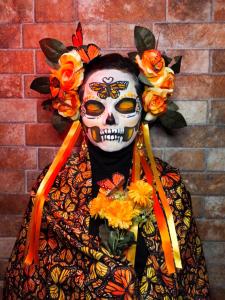
Co-authored by Professor Andrew Chesnut, Dr. Kate Kingsbury*, and Mr. David B. Metcalfe**
The season of death is in full swing. October is here impending Halloween with its cavalcade of crones, ghosts and goblins together with the Catholic holy days of All Saints and All Souls, known in Latin America as Dia de los Muertos (Day of the Dead) or Todos Santos on November 1st and 2nd. Included in these fall festivals are two familiar faces whose skeletal visages afford them special attention during the season, despite the fact that neither one is historically connected to these holidays. Santa Muerte (Saint Death or Holy Death) and la Catrina Calavera (the Skeleton Dame) engage not only millions of North and South Americans but also more and more Europeans in rituals that reconnect us with our own mortality.
With retail outlets across the US featuring more and more Mexican-themed Day of the Dead and Catrina items in their Halloween merchandise, we’ll leave aside the trick or treating and pumpkin carving of our own childhood in the United States to try to answer one of the two questions that invariably come up during our presentations on Day of the Dead and the Bone Mother (one of Santa Muerte’s main monikers). What is the relationship, if any, among the three iconic figures of Mexican death culture – Catrina Calavera, Santa Muerte, and Day of the Dead?
SANTA MUERTE
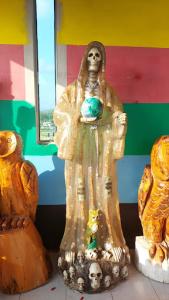
The first member of the Mexican death trinity has been in the limelight during the past decade or so, especially with her appearances in numerous TV series such as Penny Dreadful and Breaking Bad, and movies, such as Bad Boys 3, for which Chesnut and Kingsbury served as expert consultants. Unfortunately, in most media the multifaceted miracle-working saint is portrayed as solely a narco-saint, that is to say a figure appealed to by narco-traffickers for supernatural dirty deeds. But the folk saint is far more than that as Chesnut has detailed in “Devoted to Death”.
For those that have not encountered her before, Santa Muerte is a Mexican folk saint who personifies death in the form of a female skeleton. Whether as a gold medallion, or statuette, or votive candle she is typically depicted as a Grim Reapress, wielding the same scythe and wearing a shroud similar to that of the Grim Reaper, her male European forebear. Unlike canonized Catholics, folk saints are believed to be spirits of deceased Latin American women and men considered holy for their miracle working powers. What really distinguishes the Lady of the Shadows (another popular nickname), however, from other regional folk saints is that for most devotees she is the personification of death itself and not of a real woman that lived and died on Mexican soil.
In Mexico and Latin America in general, folk saints such as San La Muerte (the Argentine male cousin of Santa Muerte), Jesus Malverde, and Rey San Pascual (the Guatemalan male cousin of the Pretty Girl) have millions of devotees and are often sought out more than the thousands of Catholic saints, most of whom are Europeans who lived centuries ago. These Latin American vernacular saints are united to their devotees by nationality, culture and often class. Explaining the appeal of the Skeleton Saint, a Mexico City street vendor stated, “She understands us because she’s a badass (cabrona) like us.” In stark contrast, Mexicans would never refer to national matroness, the Virgin of Guadalupe, as a cabrona, which is also often uttered to mean “bitch.”
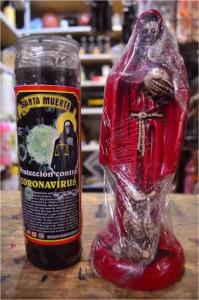
Santa Muerte is prayed to for miracles by a wide demographic of devotees. Depending on the color of her gown or the votive candle bearing her name, she offers different favours. In her ebony gown, she is known for harming enemies, and it is this color that has earned her the reputation of being a narco-saint, but the media overlooks that this colour is also used for protection, including more recently protection from COVID-19, as Kingsbury and Chesnut have documented. But what is overlooked by much of the media is that in her red mantle she aids men and especially women with love and lust, while dressed in ivory, the White Girl brings peace, well-being and spiritual cleansing. In her gold gown she bestows wealth and abundance and in her green garb she offers her aid with legal matters. In her purple cloak she brings health and healing, another color used to combat COVID-19. Her blue mantle represents aid with studies, imparting wisdom in academic and other intellectual affairs. More recently, in her gown the brown hue of graveyard dirt, she is a necromancer, constituting a conduit for communication between the realms of the living and the dead.
While some erronesouly posit the skeleton saint’s official “feast day” is August 15, there is in fact no official date, and most of the major shrines in the U.S. and Mexico celebrate on varying dates, many on the day they were founded. For example, Doña Queta’s historic shrine in the notorious Mexico City barrio of Tepito will commemorate its twenty-third anniversary on Halloween of this year. However, increasingly many shrines across Mexico, right down to Oaxaca and Chiapas, have taken Day of the Dead as Santa Muerte’s birthday/deathday and many devotees across Mexico often regale offerings typical of a Day of the Dead altar to their Santa Muerte altar, imagining the Skeleton Saint as a conduit between them and their dearly departed, known as difuntos in Mexico.
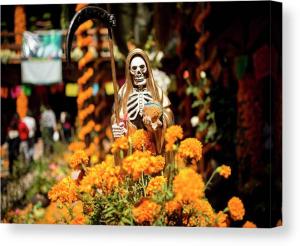
If there is a feast day in the future it will likely be November 2, for the recent decision of devotees to incorporate Holy Death into their Dia de los Muertos commemorations seems to fast be shifting from a trend to a tradition. This incorporation has become so popular that Catholic bishops and priests across Mexico, and even some in the US, routinely remind parishioners in the weeks preceding Day of the Dead that Santa Muerte stands in opposition to Christian beliefs and as such should under no circumstances be part of the remembrance of deceased family members and friends. Nevertheless, as Kingsbury experienced in Oaxaca, some even turn to their deceased relatives, beseeching them at their grave sites for permission to attend Santa Muerte celebrations.
DAY OF THE DEAD
In the US the Catholic festival of All Hallow’s Eve has taken on the darker image of Halloween, with haunted houses, horror movies, and departed souls returning for trouble rather than tradition. In Latin America and Europe, where Catholic cultural influences have remained relatively strong, the first and second of November continue to hold their ancient ties to festivals associated with honoring, celebrating and continuing interaction with the dead. In Mexico, before the Spanish conquest, the Aztecs dedicated most of the month of August to their goddess of death, Mictecacihuatl. While today’s celebrations are less extensive – Dia de Muertos (Day of the Dead,) which falls on November 1 and 2, is one of the most anticipated holidays of the year. It’s a time to reconnect with deceased family members, ancestors, and friends in a convivial spirit of remembrance and celebration.
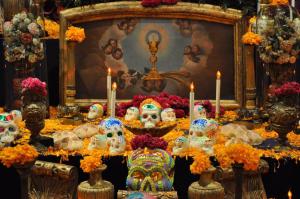
As part of the overarching suppression of Indigenous religion, the Catholic Church exorcised Mictecacihuatl and moved the date to coincide with All Saints’ Day (November 1), which is also known in Mexico as Day of the Innocents for its association with Masses focusing on deceased infants and children, and All Souls Day (November 2), where the focus is on departed adults.
Visits to the cemetery to bring offerings to the dead, such as candles, flowers -especially Cempasuchil, the distinctive yellow marigolds-, and food, are common, along with offerings left at home altars. These are erected to honor the deceased. They are symbolic expressions or representations of the departed and the love that the living still have for them.
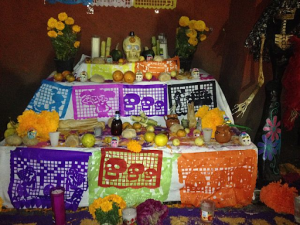
These altars consist of a photo of the deceased surrounded by their favorite objects which are given as offerings, to welcome them and show these souls that they have not been forgotten. Children typically receive toys, candy, sweet tamales, fruit, and other such treats. Adults receive libations of their favorite alcoholic beverages, such as Mezcal in Oaxaca and Charanda in Michoacan. They are also offered their favorite dishes, and sometimes cigarettes. In graveyards and on altars they are also given the striking sugar skulls, calaveras de azúcar, and pan de muerto (bread of the dead), which will be recognized by many readers outside of Mexico as familiar icons of the tradition. Adorned with the name of a deceased relative, the skulls are eaten as a reminder that death is not a bitter end, but rather a sweet continuation of the natural cycles of life. At the top of altar, which usually features multiple steps symbolizing the ascent to heaven, is often a religious icon which represents the celestial realm, usually this is the Virgin of Guadalupe, or as Kingsbury has observed in Oaxaca, the Virgin of Juquila a dark complected Marian manifestation, but a new trend among some devotees is to have Santa Muerte as the principal deity who takes on a triple role as psychopomp, a conduit to the death and a celestial figure representing the other world.
Historically commemoration of Day of the Dead has been more common among working class Mexicans. However, the combined influence of the James Bond film, Spectre, and the immensely popular animated movie, Coco, along with growing popularity in the U.S., has led many middle class Mexican urbanites to embrace traditions they used to ignore or even deride. In a surreal case of life imitating art, Mexico City held its first Day of the Dead parade in 2016, which strongly resembled the opening scenes of Spectre. In a similar vein, some of Chesnut’s Mexican relatives in Michoacan, a state famous for its colorful Day of the Dead commemorations. which incorporate the native Monarch butterfly, only began erecting home altars and posting them on social media after seeing Coco!
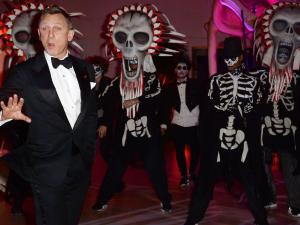
From the home hearth to the world stage the imagery of Dia de Muertos has become an able ambassador for Mexico’s cultural heritage around the globe! Nevertheless it should be noted that the middle class of Mexico City generally treat the event as an excuse for revelry and dressing up in neo-Mexi-gothic garb as opposed to the Indigenous peoples of Mexico, who don their huipil, engage in solemn processions and for whom the event is steeped in traditions that are jovial yet suffused with sadness as mariachi bands play the favorite songs of the dearly departed.
SKELETON DAME
La Catrina, the Skeleton Dame, is often confused by the unfamiliar with the Skeleton Saint, Santa Muerte, but they are very different figures. While the former originated as a satirical drawing, the latter is a figure of spiritual reverence. La Catrina was birthed in 1910, from the pen of José Guadalupe Posada who is considered the father of Mexican print-making. Posada was a contemporary of the Mexican dictator Porfirio Diaz who ruled the country for 31 years. Despite modernizing Mexico, he was notorious for his corruption, and operated a repressive oligarchical regime that oppressed the lower classes. He and his entourage maintained a lavish lifestyle forming a privileged Eurocentric elite in a country where many were literally starving to death.
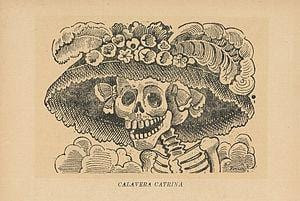
Posada employed his artistic skills as acts of rebellion, creating images that communicated his dissatisfaction with the regime. His subversive use of these allowed his ideas to be instantly understood, including by illiterate Mexicans. The satirical cartoon of la Catrina was created to mock the ruling classes. La Catrina, also known as “La Calavera Garbancera” (the Dapper Skeleton), was originally a black and white zinc etching of a skeleton attired in a large French-style floppy hat. It is said that she was drafted in the likeness of the dictator’s wife, Carmen Romero Rubio.
Posada’s popular illustrations were deeply embedded into the cultural context of the Mexican Revolution (1910-20), the planet’s first great popular revolt of the 20th century, which gradually led to a new appreciation of the Indigenous past across Latin America. The symbolism of the skeleton, which in Indigenous traditions throughout the Americas represents the continuation of life’s cyclical turn, proved to be a potent and resonant image for Mexican cultural independence from its Eurocentric elite. An ironic origin considering her contemporary role symbolizing the integration of pre-Hispanic and post-colonial ideals.
La Catrina was one of thousands of sketches of skeletons garbed in European finery that derided the vanity and opulent lifestyles of the upper classes whose extravagances came at the expense of the suffering lower classes. The message Posada was conveying was that no matter one’s wealth or status, no one escapes death and indeed the phrase “todos somos calaveras” (we are all skeletons) is often attributed to the illustrator. In this manner, la Catrina resembles Santa Muerte in that she serves as a reminder of the inevitability of death, however beyond this there are no further similarities apart from that both are female skeletons.
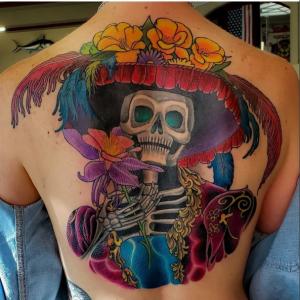
Given that the skeleton motif has deep roots in Mexico, the image of La Catrina resonated deeply with the public and with Mexican muralist Diego Rivera who altered the image of La Catrina. He morphed her into a mestizo symbol that amalgamated pre-Hispanic, colonial and postcolonial thanatological themes in his famed 1948 mural Dream of a Sunday Afternoon in Alameda Park in which he depicted himself as the son of La Catrina and Posada. Since that time innumerable iterations of the skeleton dame have been fashioned, and in keeping with Riviera’s use, La Catrina has morphed from a satirical symbol into one of national cultural identity.
In the 1980s, three-dimensional statuettes of La Catrina began to appear on sale, largely bought by tourists and affluent Mexicans. These are still popular. La Catrina has also since this time become widely used in commercialized Day of the Dead celebrations. Unlike Santa Muerte who though sometimes dressed in spangly gowns may also be depicted as austere, La Catrina is always frivolously clad, usually in a flashy frock, often clutching a purse or a parasol and always bedecked with her trademark flamboyant, floppy hat. Today, she remains an important icon of Mexicaness, and speaks to the unique and fruitful cultural dialogue which continues in Latin America.
LA MUERTE FESTIVA
Mexican culture is not alone in its remembrance of death, but it is unique in how, more often than not, these commemorations mingle the festive with the funereal in an interplay of joviality and sorrow, evincing an understanding of life and death that is more nuanced than that we often encounter in the West. Whether it is under the scythe of Santa Muerte during the festivities of Dia de los Muertos, or in the “elegant” image of Calavera Catrina, Mexicans recognize death plays a central role in their daily lives which continues much as in the pre-Hispanic past, to provide a potent image for the inevitable cycles of life, rather than, as in much of the Western world, a sense of finality and horror. Running through it all is a sense of humor and empowerment, which takes the hard lessons of death and embraces them with a fullness that is often surprising to those unfamiliar with these traditions.
Recalling pre-Columbian traditions, death remains an image of rebirth and renewal. The imagery and practices associated with these traditions keep the memory of a turbulent history alive. From a multitude of diverse Indigenous peoples in a territory that was torn limb from limb by the Spanish to line their pockets, to today, a nation with dire disparities between rich and poor and a plague of narco-violence which obliterates the lives of the innocent and the criminal every nanosecond. Nevertheless, death perdures as the great equalizer, in which everyone from incarcerated drug baron El Chapo to billionaire impresario Carlos Slim will inevitably succumb to Santa Muerte’s leveling scythe.
As they say in Mexico, “death is just and even-handed for everyone, since we will all die.” For many, this unalterable truth provides a strong reason to celebrate life while there is still time but also to bask in the knowledge that death will bring an end to us all, rich or poor, male or female, young or old.
*Dr. Kate Kingsbury obtained her doctorate in anthropology at the University of Oxford and is an honorary research associate at the University of British Columbia. Dr. Kingsbury is a staunch believer in equal rights and the power of education to ameliorate global disparities. She also works pro bono for a non profit organisation that aims to empower and educate girls in Uganda.
**Mr. David Metcalfe is a researcher, writer and multimedia specialist focusing on the interrelationship of art, culture, and consciousness. He is Editor-in-Chief for the Windbridge Research Center’s Threshold: Journal of Interdisciplinary Consciousness Studies. Follow him on Twitter.

About Andrew Chesnut
Dr. R. Andrew Chesnut earned his Ph.D degree in Latin American History from the University of California, Los Angeles in 1995 and joined the History Department faculty at the University of Houston in 1997. He quickly became an internationally recognized expert on Latin American religious history Professor Chesnut was selected as the inaugural recipient of the Bishop Walter Sullivan Chair in Catholic Studies at VCU in 2008. The chair was established as the Most Rev. Walter F. Sullivan was nearing retirement as the 11th bishop of the Catholic Diocese of Richmond to honor his nearly thirty years of service. For Professor Chesnut the chair became a unique opportunity to develop Catholic studies in a global context and at a large public university. Professor Chesnut’s early work, Born Again in Brazil: The Pentecostal Boom and the Pathogens of Poverty (Rutgers University Press, 1997), traces the meteroric rise of Pentecostalism among the popular classes in Brazil following the disestablishment of the Roman Catholic Church. His second book, Competitive Spirits: Latin America’s New Religious Economy (Oxford University Press, 2003) focuses on the three groups that have prospered most in the region’s pluralist landscape, Protestant Pentecostalism, the Catholic Charismatic Renewal, and African disasporic religions (e.g., Brazilian Candomble and Haitian Vodou). Professor Chesnut's most recent book is Devoted to Death: Santa Muerte, the Skeleton Saint (Oxford University Press, 2025). It is the first in-depth study of the Mexican folk saint in English and has received widespread media coverage. You can read more about the author here.

Browse Our Archives
Select a Category Amazon Synod andrew chesnut Brazil Catholicism Christianity death Evangelical Exorcism kate kingsbury Mexico narcocult Orixas Our Lady of Aparecida Our lady of the Bullet Pentecostal Religion Rey Pascual Santa Muerte Uncategorized vodou
Select a Month October 2026 September 2026 August 2026 July 2026 June 2026 May 2026 April 2026 March 2026 February 2026 January 2026 December 2025 October 2025 September 2025 August 2025 June 2025 May 2025 April 2025 February 2025 January 2025 November 2024 October 2024 September 2024 July 2024 May 2024 April 2024 January 2024 December 2023 October 2023 July 2023 June 2023 April 2023 March 2023 January 2023 December 2022 November 2022 October 2022 September 2022 July 2022 June 2022 January 2022 October 2021 September 2021 August 2021 May 2021 March 2021 February 2021 October 2020 August 2020 July 2020 June 2020 May 2020 April 2020 March 2020 February 2020 November 2019 October 2019 August 2019 July 2019 June 2019 May 2019 April 2019 March 2019 February 2019 January 2019 December 2018 November 2018 October 2018 September 2018 August 2018 July 2018 June 2018 May 2018 April 2018 March 2018
Follow Us!
TAKE THE
Religious Wisdom Quiz
Who prophesied destruction for Jerusalem but also promised a New Covenant?
Select your answer to see how you score.
Joel Isaiah Ezekiel Jeremiah
Related posts from The Global Catholic Review

Brazil’s Black Madonna as Political Football in Heated...

Brazil's Religious Revolution: What a Huge New Survey...

Trump's Catholic Problem Heading Into November Midterms

Did Pentecostalism Kill Brazilian Football's 'Jogo Bonito'?
TRENDING AT PATHEOS Catholic

Archdiocese Hosts Military Marriage Retreat in Germany
RASTATT, Germany — The transient military lifestyle, with its frequent deployments and...

Nearly every morning, I make the drive to Detroit with my high-school-age...

The Real AI Story Is Adoption Without Trust
Artificial intelligence has crossed a political threshold. It is no longer a...

A new article, written by Jeff Lindsay and Gale L. Pooley,...

Swimfan: Forgotten Aughts Pleasures
This is a recovery effort. In 2002, My Big Fat Greek Wedding...

Top Three Anti-Catholic Lies About Catholicism
This is my initial transcript for the video, "THE 3 WORST...
view all Catholic blogs
Ad-Free & Subscriber Log-In Subscription Support
- About Us
- 2026 Calendar
- Videos
- Podcasts
- Library of World Religions
- Faith In Media Tracker
- Advertise With Us
- Write for Us
- Privacy Policy
- Terms of Service
- Do Not Sell My Data
- Contact Us
- Radiant Digital
- Manage Newsletter Subscriptions
- Unsubscribe From Notifications
- Sitemap
Copyright 2008-2026, Patheos. All rights reserved.
Subscription Support Ad-Free & Subscriber Log-In
Follow Patheos