
BuddhistCatholicContemplativeEvangelicalGeneral ChristianHinduJewishLatter-day SaintMuslimNew VisionsProgressive Christian
Beliefs
- Buddhist
- Catholic
- Contemplative
- Evangelical
- General Christian
- Hindu
- Jewish
- Latter-day Saint
- More Voices
- Muslim
- New Visions
- Pagan
- Progressive Christian
Topics
- Religion News
- Food and Religion
- Sports and Religion
- Religious Art
- Religious Music and Entertainment
- Religious Events
- History and Religion
- Style and Religion
- Politics and Religion
- Women in Religion
- Recreation Outdoors and Religion
- Business Finance and Religion
- Careers Workplace and Religion
- Education and Religion
- Family Parenting and Religion
- Health Fitness and Religion
- Home and Religion
- Relationships and Religion
- Technology and Religion
- Travel and Religion
Columnists
- Buddhist Columnists
- Business Finance and Religion Columnists
- Careers Workplace and Religion Columnists
- Catholic Columnists
- Contemplative Columnists
- Education and Religion Columnists
- Evangelists Columnists
- Family Parenting and Religion Columnists
- General Christian Columnists
- Health Fitness and Religion Columnists
- Hindu Columnists
- History and Religion Columnists
- Home and Religion Columnists
- Jewish Columnists
- More Voices Columnists
- Latter Day Columnists
- Muslim Columnists
- New Visions Columnists
- Nonreligious Columnists
- Pagan Columnists
- Politics and Religion Columnists
- Progressive Columnists
- Recreation Outdoors and Religion Columnists
- Relationships and Religion Columnists
- Religion News Columnists
- Religious Art Columnists
- Religious Events Columnists
- Religious Music and Entertainment Columnists
- Sports and Religion Columnists
- Style and Religion Columnists
- Technology and Religion Columnists
- Travel and Religion Columnists
- Women in Religion Columnists
Resource Library
- 2026 Calendar
- Library of World Religions
- The 100 Most Holy Places on Earth
- Patheos Answers
- Podcasts
- Videos
- Faith Leaders Database
- Anglican Episcopalian
- Bahai
- Baptist
- Buddhism
- Christianity
- Confucianism
- Eastern Orthodoxy
- Hinduism
- Holiness and Pentecostal
- ISKCON
- Islam
- Judaism
- Lutheran
- Methodist
- The Church of Jesus Christ of Latter-day Saints
- New Age
- Paganism
- Presbytarian and Reformed
- Protestantism
- Religion Behind the Scenes
- Roman Catholic
- Scientology
- Shia Islam
- Sikhism
- Sufism
- Sunni Islam
- Taoism
- Zen
- See all religions
Research Tools
 Ad-Free & Subscriber Log-In Subscription Support
Ad-Free & Subscriber Log-In Subscription Support
Follow Patheos 

- Trending:
- Forgiveness
- |
- Marriage
- |
- Consciousness
- |
- Death Penalty
- |
- Election
- |
- Halloween

- Home
- Catholic
- Religion News
- Sebastian and Santa Muerte – Simpatico Saints of Holy Death and LGBTQ
Sebastian and Santa Muerte – Simpatico Saints of Holy Death and LGBTQ
Last updated on: August 12, 2021 at 4:56 am by Andrew Chesnut
Sebastian and Santa Muerte – Simpatico Saints of Holy Death and LGBTQ 2021-08-12T04:56:06-04:00 Andrew Chesnut
Patheos Explore the world's faith through different perspectives on religion and spirituality! Patheos has the views of the prevalent religions and spiritualities of the world.
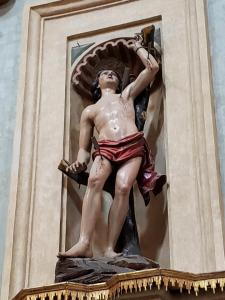
Having contemplated hundreds of Catholic saints over the past decade for my research both on Santa Muerte and Catholic death culture, I am intrigued by one in particular whom I have seen in countless churches across Europe and Latin America. Saint Sebastian was a third-century Roman martyr who during the the intense Diocletianic Persecution of Christians was ordered to face a firing squad of archers for his monotheistic faith. Though shot full of arrows, Sebastian, a Roman solider, miraculously survived, according to his hagiography. Saint Irene went to collect his body for Christian burial and discovered Sebastian still clinging to life and nursed him back to health over the course of several days. Undaunted by his near death, the brave soldier went to confront the pagan emperor Diocletian publicly on his pogrom against Christians. This time Sebastian didn’t survive the execution by clubbing that Diocletian ordered for his brazen defiance of imperial rule. Saint Lucy recovered his body from a Roman sewer where it had been dumped and had Sebastian buried in a Roman catacomb where a basilica dedicated to the martyred saint was eventually erected.
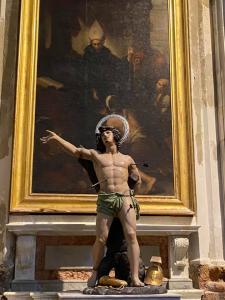
Beside being one of the saints I have seen most often at scores of churches and shrines across Latin America and Europe, the scantily clad and muscular saint interests me due to his relevance to my research on Catholic death culture and faith healing. The Roman saint is associated with both the concept of Holy Death (one of Santa Muerte’s English translations) and the Black Plague. Medieval Europeans correlated the apparent randomness with which the Plague struck to an indiscriminate rain of arrows from the sky. And since Sebastian was already associated with arrows, he, along with French saint, Roch, became one of the most popular guardian saints during the Black Death. Of course, it was also at this same time that the figure of the Grim Reaper first emerged in European art as a skeletal personification of death. Since the Reaper and Reapress (in Mediterranean countries) were harvesting European souls at unprecedented rates during the Plague, countless Christians turned to the martyred Sebastian for both protection from the insidious pandemic and for a good Catholic death in the event that the random arrows of the Black Death pierced the saint’s protective shield.
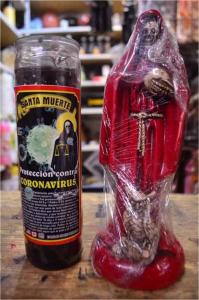
The Roman holy man’s role as both supernatural protector from the Plague and patron of Holy Death find extraordinary historical continuity in Mexican folk saint Santa Muerte’s present role as protectress and healer, not to mention granting a Good Death, for Mexican devotees battling Coronavirus in one of the hardest hit countries on the planet. That one of the English translations of her name is Holy Death (Saint Death is the other) captures the paramount importance of the Skeleton Saint’s mission of attending to those who seek a relatively peaceful and painless demise. And the contemporary parallels between Sebastian and Santa Muerte have an intriguing historical precedent.

Doña Sebastiana was a female personifcation of death, typically marked by snow-white hair, whose wooden effigy was pulled in a death cart during Holy Week processions by Penitentes in 19th-century New Mexico and Colorado. While Sebastian’s body was riddled with arrows from the firing squad, Doña Sebastiana was most often depicted pulling a bow and arrow for reaping the soul of an unsuspecting mortal. That there is no Catholic saint named Sebastiana is further evidence that the Catholic brotherhoods of isolated mountain towns in the southern Rockies who practiced a heterodox Mexican folk Catholicism associated Sebastian, the Plague saint and patron of Good Death, with la Parca, the Spanish Grim Reapress, and in a fascinating case of New World religious syncretism fused the two to create Doña Sebastiana, whom the Penitentes also referred to as Santa Muerte in their hymns and prayers.
Remarkably, the syncretism and parallels between the Roman martyr and Mexican death saint aren’t limited to protection, healing, and mortality but even extend to the realm of sexual orientation. Because of the abundant homoerotic depictions of Sebastian as a scantily clad Adonis, the patron saint also of soldiers has become a gay icon embraced by many queer men as a symbol of heroic resistance to societal oppression and discrimination. In a similar vein, Santa Muerte is the unofficial matron saint of hundreds of thousands of LGBTQ folks in Mexico and the US and beyond because she is death and death accepts all comers, no matter sexual orientation, occupation or nationality. Such is her appeal to North American LGBTQ communities that her rainbow colored votive candle, known as Santa Muerte of the 7 Powers, appears to be morphing into LGBTQ Skeleton Saint, especially since many recent devotees aren’t familiar with the color symbolism of the fastest growing new religious movement in the West.
In short, that Saint Sebastian has remained relevant across the centuries gives testament to the paramount importance of the interrelated themes of faith healing and a good death in societies of Christian heritage. It is no coincidence that the NRM of Santa Muerte has experienced meteoric growth in large measured based on the folk saint’s reputation for healing the sick and granting a good death to Mexicans plagued by so much bad death.

About Andrew Chesnut
Dr. R. Andrew Chesnut earned his Ph.D degree in Latin American History from the University of California, Los Angeles in 1995 and joined the History Department faculty at the University of Houston in 1997. He quickly became an internationally recognized expert on Latin American religious history Professor Chesnut was selected as the inaugural recipient of the Bishop Walter Sullivan Chair in Catholic Studies at VCU in 2008. The chair was established as the Most Rev. Walter F. Sullivan was nearing retirement as the 11th bishop of the Catholic Diocese of Richmond to honor his nearly thirty years of service. For Professor Chesnut the chair became a unique opportunity to develop Catholic studies in a global context and at a large public university. Professor Chesnut’s early work, Born Again in Brazil: The Pentecostal Boom and the Pathogens of Poverty (Rutgers University Press, 1997), traces the meteroric rise of Pentecostalism among the popular classes in Brazil following the disestablishment of the Roman Catholic Church. His second book, Competitive Spirits: Latin America’s New Religious Economy (Oxford University Press, 2003) focuses on the three groups that have prospered most in the region’s pluralist landscape, Protestant Pentecostalism, the Catholic Charismatic Renewal, and African disasporic religions (e.g., Brazilian Candomble and Haitian Vodou). Professor Chesnut's most recent book is Devoted to Death: Santa Muerte, the Skeleton Saint (Oxford University Press, 2025). It is the first in-depth study of the Mexican folk saint in English and has received widespread media coverage. You can read more about the author here.
Next Post

August 12, 2021 Cultuando a Criminales: los Santos Malandros de Venezuela
Browse Our Archives
Select a Category Amazon Synod andrew chesnut Brazil Catholicism Christianity death Evangelical Exorcism kate kingsbury Mexico narcocult Orixas Our Lady of Aparecida Our lady of the Bullet Pentecostal Religion Rey Pascual Santa Muerte Uncategorized vodou
Select a Month October 2026 September 2026 August 2026 July 2026 June 2026 May 2026 April 2026 March 2026 February 2026 January 2026 December 2025 October 2025 September 2025 August 2025 June 2025 May 2025 April 2025 February 2025 January 2025 November 2024 October 2024 September 2024 July 2024 May 2024 April 2024 January 2024 December 2023 October 2023 July 2023 June 2023 April 2023 March 2023 January 2023 December 2022 November 2022 October 2022 September 2022 July 2022 June 2022 January 2022 October 2021 September 2021 August 2021 May 2021 March 2021 February 2021 October 2020 August 2020 July 2020 June 2020 May 2020 April 2020 March 2020 February 2020 November 2019 October 2019 August 2019 July 2019 June 2019 May 2019 April 2019 March 2019 February 2019 January 2019 December 2018 November 2018 October 2018 September 2018 August 2018 July 2018 June 2018 May 2018 April 2018 March 2018
Follow Us!
TAKE THE
Religious Wisdom Quiz
What does "Golgotha" mean?
Select your answer to see how you score.
House of Bread Place of the Skull Mountain of God Valley of Death
Related posts from The Global Catholic Review

Brazil’s Black Madonna as Political Football in Heated...

Brazil's Religious Revolution: What a Huge New Survey...

Trump's Catholic Problem Heading Into November Midterms

Did Pentecostalism Kill Brazilian Football's 'Jogo Bonito'?
TRENDING AT PATHEOS Catholic

The Sermon on the Mount, Part I: Matthew...
The Sermon on the Mount, Part I (Matthew 4:12-5:12) St. Matthew moves...

What's up from Crossway: Reviewing some of their latest A few weeks...

Janie Learns the Way of the Cross: A...
Teaching children about Jesus' Passion can be challenging. Many parents and educators...

Looking For Good Catholic Writing - October 2026
He alone extends the heavens, and he walks upon the waves of...

In "Irreplaceable," our book on vocation and technology, Trevor Sutton and I...

I was strolling through the top floor of the brand new Parthenon...
view all Catholic blogs
Ad-Free & Subscriber Log-In Subscription Support
- About Us
- 2026 Calendar
- Videos
- Podcasts
- Library of World Religions
- Faith In Media Tracker
- Advertise With Us
- Write for Us
- Privacy Policy
- Terms of Service
- Do Not Sell My Data
- Contact Us
- Radiant Digital
- Manage Newsletter Subscriptions
- Unsubscribe From Notifications
- Sitemap
Copyright 2008-2026, Patheos. All rights reserved.
Subscription Support Ad-Free & Subscriber Log-In
Follow Patheos