
BuddhistCatholicContemplativeEvangelicalGeneral ChristianHinduJewishLatter-day SaintMuslimNew VisionsProgressive Christian
Beliefs
- Buddhist
- Catholic
- Contemplative
- Evangelical
- General Christian
- Hindu
- Jewish
- Latter-day Saint
- More Voices
- Muslim
- New Visions
- Pagan
- Progressive Christian
Topics
- Religion News
- Food and Religion
- Sports and Religion
- Religious Art
- Religious Music and Entertainment
- Religious Events
- History and Religion
- Style and Religion
- Politics and Religion
- Women in Religion
- Recreation Outdoors and Religion
- Business Finance and Religion
- Careers Workplace and Religion
- Education and Religion
- Family Parenting and Religion
- Health Fitness and Religion
- Home and Religion
- Relationships and Religion
- Technology and Religion
- Travel and Religion
Columnists
- Buddhist Columnists
- Business Finance and Religion Columnists
- Careers Workplace and Religion Columnists
- Catholic Columnists
- Contemplative Columnists
- Education and Religion Columnists
- Evangelists Columnists
- Family Parenting and Religion Columnists
- General Christian Columnists
- Health Fitness and Religion Columnists
- Hindu Columnists
- History and Religion Columnists
- Home and Religion Columnists
- Jewish Columnists
- More Voices Columnists
- Latter Day Columnists
- Muslim Columnists
- New Visions Columnists
- Nonreligious Columnists
- Pagan Columnists
- Politics and Religion Columnists
- Progressive Columnists
- Recreation Outdoors and Religion Columnists
- Relationships and Religion Columnists
- Religion News Columnists
- Religious Art Columnists
- Religious Events Columnists
- Religious Music and Entertainment Columnists
- Sports and Religion Columnists
- Style and Religion Columnists
- Technology and Religion Columnists
- Travel and Religion Columnists
- Women in Religion Columnists
Resource Library
- 2026 Calendar
- Library of World Religions
- The 100 Most Holy Places on Earth
- Patheos Answers
- Podcasts
- Videos
- Faith Leaders Database
- Anglican Episcopalian
- Bahai
- Baptist
- Buddhism
- Christianity
- Confucianism
- Eastern Orthodoxy
- Hinduism
- Holiness and Pentecostal
- ISKCON
- Islam
- Judaism
- Lutheran
- Methodist
- The Church of Jesus Christ of Latter-day Saints
- New Age
- Paganism
- Presbytarian and Reformed
- Protestantism
- Religion Behind the Scenes
- Roman Catholic
- Scientology
- Shia Islam
- Sikhism
- Sufism
- Sunni Islam
- Taoism
- Zen
- See all religions
Research Tools
 Ad-Free & Subscriber Log-In Subscription Support
Ad-Free & Subscriber Log-In Subscription Support
Follow Patheos 

- Trending:
- Forgiveness
- |
- Marriage
- |
- Consciousness
- |
- Death Penalty
- |
- Election
- |
- Halloween

- Home
- Catholic
- Religion News
- Evangelical Churches Seize Power in Latin America: ‘The Catholic Church Has Been Lax’
Evangelical Churches Seize Power in Latin America: ‘The Catholic Church Has Been Lax’
Last updated on: October 4, 2020 at 4:38 pm by Andrew Chesnut
Evangelical Churches Seize Power in Latin America: ‘The Catholic Church Has Been Lax’ 2020-10-04T16:38:00-04:00 Andrew Chesnut
Patheos Explore the world's faith through different perspectives on religion and spirituality! Patheos has the views of the prevalent religions and spiritualities of the world.
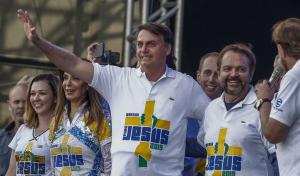
“The Bible returns to the presidential palace.” That’s what the Bolivian interim President Jeanine Áñez stated at her inauguration last November. Her turbulent administration is met with a lot of resistance from the ‘left’, but enjoys plenty of support from the Evangelical churches which are rapidly gaining ground throughout Latin America. The presidents of Mexico and Brazil were elected with explicit support from Evangelical churches. The political and
religious landscapes of Latin America are shifting rapidly.
A proud Catholic church stands on the central plaza of Yaruquí, a mountain village in Ecuador. This is not surprising – there is one on every main plaza in Latin America. The Spanish and Portuguese brought Catholicism to the New World in the sixteenth century. Since then the Roman Catholic Church practically had a monopoly on religion in Latin America.
But Google Maps locates seven evangelical churches in Yaruquí, while there is just one Catholic Church. The village is no anomaly. In many countries in Latin America the population was 95 percent Catholic well into the twentieth century. By the last count in 2014 was only 69 percent Catholic. Evangelical churchgoers now make up nineteen percent of the population, while only nine percent had been raised as such.
Church of the Masses
“Evangelical pastors are religious entrepreneurs.” In his youth, Marcelo Sergio López went to the Catholic Church. In his forties he converted to a Pentecostal church. ‘The church helps me to find peace in my daily life. My parents were both alcoholics so they couldn’t take care of me. The problems in my childhood also meant that I had difficulty with the Church.’
Marcelo never completely left the Catholic Church, but he kept attending less and less. ‘It was a neighbor who said to me,’ Come to my Pentecostal church. You will find peace here. Now I have been in that church for eight years. I can
give my children and wife the stability that I never knew as a child. ‘
According to Dr. Andrew Chesnut, Marcelo’s story fits into a broader context. He is Professor of Religious Studies at Virginia Commonwealth University in Richmond, Virginia. Chesnut has written several books on the Evangelical boom in Latin America.
Evangelical churches have mushroomed among the underclass. They are churches of the poor and for the poor, ”says Chesnut. The Catholic Church is elitist despite its attempt at Liberation Theology, which was developed in the 1960s as a Catholic movement in Latin America focused on social inequality. The movement gained some followers, also in Europe.
Chesnut: ‘Liberation theology hardly exists anymore. The movement was elitist. Because evangelical churches sprang up from the great underclass, they have been successful there. You can also see that to be a Catholic priest in
men have to study for a long time. In terms of educational levels, Catholic priests figure among the top three percent of the continent, while some Evangelical pastors only attend primary school. They are charismatic leaders and that makes a difference. ‘
Marcelo Sergio López thinks the pastor of his Pentecostal church is an admirable man. ‘The Spirit works through him. And God is the Spirit. That’s the point, not the Virgin, the religious images or all the saints. ‘ Thanks to the pastor he started to study the Bible so he always tries to improve his life. Marcelo compares different Bible translations with each other. ‘It’s good to know how other people are thinking differently about something, while they are all Christians. ‘
Bad Priests
Pastor Ábel Carvajal is a Catholic priest in Yaruquí and has another explanation for the current state of his church.
He puts his hand on his chest. The sexual abuse scandals have done us no good. It happens everywhere, but with us it makes more news. There are some bad priests, but it is reflected on the entire church. ‘
The village priest does have ideas about how to turn the tide. ‘To begin with we need to welcome people more warmly. When new people enter the church we need to greet them and say, “Thank you for being here.” That happens far too little now.
We need to be less authoritarian, an image that is strongly associated with us. ‘ Carvajal believes that his parish should be more of a community outside of mass. ‘We can offer many more activities. Before the pandemic, I took the church youth to families who could use some help to show them that you must care for others and that life is not all about having fun. Another time I took them to a diseased tree and a polluted river to get them to learn about protecting the environment. Once a year I lead a long hike with young adults to a nearby mountain top. Then I show them how beautiful God’s creation is. During retreats in Yaruquí, I point out all the litter strewn in the streets. That is one way to respect nature, but it also forges community spirit. ‘
Monopoly and Competition
Pastor Carvajal is overflowing with ideas. According to Professor Chesnut the Catholic Church has been indolent in Latin America. It had a monopoly on religions since the Spanish and Portuguese conquests. That is no longer the case. Competition has come. There is now a free market of beliefs. As in any free market you have to compete but the Catholic Church fails to do so effectively. ‘
Evangelical pastors do that a lot better, according to the professor. ‘Being religious entrepreneurs they innovate a lot.
For example, there are church services with cumbia- or merengue music. ‘ But not only is the style innovative. According to Chesnut, there is another reason for success. Some pastors receive a bonus if they recruit a certain number of believers. That can be a formula for success. ‘
The Catholic answer to the exodus of members is the Charismatic Renewal. This movement focuses on the Holy Spirit as do many Evangelical groups. Chesnut: ‘It therefore is case of the Cathlolic Church imitating the wildly successful Pentecostal competition .’ The Latin American bishops have expressed their support for the Catholic Charismatc Renewal movement in the climate of fear generated by the the current exodus of members.
The only Catholic movement that engages in evangelization is the Charismatic Renewal so the traditional Catholic Church is rapidly losing influence. Pope Francis has kept his distance from the the Charismatic Renewal. He seems to mostly ignore them.’
Evangelical churches are now not just churches for and of the poor. For about the past three decades they have also been converting more affluent people in Latin America. At the same time, Evangelical churches began to engage
politically. That is of course no coincidence. In order to exercise political influence resources are needed. Political campaigns are not cheap.
In recent years we have seen the results of that political movement. The most famous example is Brazil. President Jair Messias Bolsonaro won the 2018 elections. With the Evangelical churches as his main constituency, he is implementing a decidedly conservative policy. Latin America for the last twenty years has tilted toward the political left. In almost all countries, center-left to socialist governments were in power. Little of that is left now.
Clear Values
This change is best reflected in Bolivia. At the end of 2019, the military demanded that Socialist President Evo Morales resign because he was in violation of the constitution for a third term. Then the election had the semblance of fraud, because Morales had exactly the necessary lead in votes after the internet page on which the results appeared had been canceled and then came back online.
Morales was subsequently deposed by the army. Interim President Jeanine Áñez said at her inauguration that “the Bible returns in the presidential palace ‘. To back up her claim she raised a large leather-bound Bible high above her head. Áñez was supported by Luis Fernando Camacho, a political leader who has a huge Evangelical constituency.
He is more conservative than the Catholic Church in Bolivia, for example, when it comes to premarital sex, abortion or same-sex marriage.
Even in Mexico, where Evangelical congregations are only eight percent of the population they helped President Andrés Manuel López Obrador rise to power. This is unique, because the current president has a somewhat more left-wing bent. Andrew Chesnut explains the paradox. ‘I don’t think his values are particularly left wing. On typical
Evangelical issues such as abortion and gay marriage, he and Evangelical churches are on the same page. ‘
The professor gives a final explanation of Evangelical success. The Catholic Church is much more heterogeneous than its Evangelical counterparts. ‘ Evangelical Churches have clear, conservative values and their internal diversity is much less. This is useful for successfully conveying a political message. According to Chesnut, the Evangelical churches will greatly influence the direcition of Latin American politics over the next few years.
Pentecostal Majority
Three quarters of the Protestant churches in Latin America are made up of Pentecostal churches. Brazil is home the largest Pentecostal population on earth. The gargantuan Brazilian Assembly of God denomination has the most members, some twelve million. In relative terms, Evangelical churches are the most successful in Guatemala. There, more than 40 percent of the population attends an Evangelical church. Pentecostalism was born in the poor neighborhoods of Los Angeles at the beginning of the twentieth century. Almost immediately the dynamic new movement gained a foothold in Europe and Latin America. It has only been since the late 1980s that Evangelical churches have grown rapidly in Latin America.
Translated from the original Dutch story here.

About Andrew Chesnut
Dr. R. Andrew Chesnut earned his Ph.D degree in Latin American History from the University of California, Los Angeles in 1995 and joined the History Department faculty at the University of Houston in 1997. He quickly became an internationally recognized expert on Latin American religious history Professor Chesnut was selected as the inaugural recipient of the Bishop Walter Sullivan Chair in Catholic Studies at VCU in 2008. The chair was established as the Most Rev. Walter F. Sullivan was nearing retirement as the 11th bishop of the Catholic Diocese of Richmond to honor his nearly thirty years of service. For Professor Chesnut the chair became a unique opportunity to develop Catholic studies in a global context and at a large public university. Professor Chesnut’s early work, Born Again in Brazil: The Pentecostal Boom and the Pathogens of Poverty (Rutgers University Press, 1997), traces the meteroric rise of Pentecostalism among the popular classes in Brazil following the disestablishment of the Roman Catholic Church. His second book, Competitive Spirits: Latin America’s New Religious Economy (Oxford University Press, 2003) focuses on the three groups that have prospered most in the region’s pluralist landscape, Protestant Pentecostalism, the Catholic Charismatic Renewal, and African disasporic religions (e.g., Brazilian Candomble and Haitian Vodou). Professor Chesnut's most recent book is Devoted to Death: Santa Muerte, the Skeleton Saint (Oxford University Press, 2025). It is the first in-depth study of the Mexican folk saint in English and has received widespread media coverage. You can read more about the author here.

Browse Our Archives
Select a Category Amazon Synod andrew chesnut Brazil Catholicism Christianity death Evangelical Exorcism kate kingsbury Mexico narcocult Orixas Our Lady of Aparecida Our lady of the Bullet Pentecostal Religion Rey Pascual Santa Muerte Uncategorized vodou
Select a Month October 2026 September 2026 August 2026 July 2026 June 2026 May 2026 April 2026 March 2026 February 2026 January 2026 December 2025 October 2025 September 2025 August 2025 June 2025 May 2025 April 2025 February 2025 January 2025 November 2024 October 2024 September 2024 July 2024 May 2024 April 2024 January 2024 December 2023 October 2023 July 2023 June 2023 April 2023 March 2023 January 2023 December 2022 November 2022 October 2022 September 2022 July 2022 June 2022 January 2022 October 2021 September 2021 August 2021 May 2021 March 2021 February 2021 October 2020 August 2020 July 2020 June 2020 May 2020 April 2020 March 2020 February 2020 November 2019 October 2019 August 2019 July 2019 June 2019 May 2019 April 2019 March 2019 February 2019 January 2019 December 2018 November 2018 October 2018 September 2018 August 2018 July 2018 June 2018 May 2018 April 2018 March 2018
Follow Us!
TAKE THE
Religious Wisdom Quiz
In 3 John, what does John say he has no greater joy than?
Select your answer to see how you score.
Serving the church Preaching the gospel Hearing that his children are walking in the truth Seeing souls saved
Related posts from The Global Catholic Review

Brazil’s Black Madonna as Political Football in Heated...

Brazil's Religious Revolution: What a Huge New Survey...

Trump's Catholic Problem Heading Into November Midterms

Did Pentecostalism Kill Brazilian Football's 'Jogo Bonito'?
TRENDING AT PATHEOS Catholic

The First Eucharistic Controversy: Christ’s Real Presence
For Catholics, the Eucharist is the source and summit of the Christian...

How to Make a Decision When You Can't...
Main point: It’s much more valuable to stay close to God so...

Archdiocese Hosts Military Marriage Retreat in Germany
RASTATT, Germany — The transient military lifestyle, with its frequent deployments and...

Nearly every morning, I make the drive to Detroit with my high-school-age...

The Real AI Story Is Adoption Without Trust
Artificial intelligence has crossed a political threshold. It is no longer a...

A new article, written by Jeff Lindsay and Gale L. Pooley,...
view all Catholic blogs
Ad-Free & Subscriber Log-In Subscription Support
- About Us
- 2026 Calendar
- Videos
- Podcasts
- Library of World Religions
- Faith In Media Tracker
- Advertise With Us
- Write for Us
- Privacy Policy
- Terms of Service
- Do Not Sell My Data
- Contact Us
- Radiant Digital
- Manage Newsletter Subscriptions
- Unsubscribe From Notifications
- Sitemap
Copyright 2008-2026, Patheos. All rights reserved.
Subscription Support Ad-Free & Subscriber Log-In
Follow Patheos