
BuddhistCatholicContemplativeEvangelicalGeneral ChristianHinduJewishLatter-day SaintMuslimNew VisionsProgressive Christian
Beliefs
- Buddhist
- Catholic
- Contemplative
- Evangelical
- General Christian
- Hindu
- Jewish
- Latter-day Saint
- More Voices
- Muslim
- New Visions
- Pagan
- Progressive Christian
Topics
- Religion News
- Food and Religion
- Sports and Religion
- Religious Art
- Religious Music and Entertainment
- Religious Events
- History and Religion
- Style and Religion
- Politics and Religion
- Women in Religion
- Recreation Outdoors and Religion
- Business Finance and Religion
- Careers Workplace and Religion
- Education and Religion
- Family Parenting and Religion
- Health Fitness and Religion
- Home and Religion
- Relationships and Religion
- Technology and Religion
- Travel and Religion
Columnists
- Buddhist Columnists
- Business Finance and Religion Columnists
- Careers Workplace and Religion Columnists
- Catholic Columnists
- Contemplative Columnists
- Education and Religion Columnists
- Evangelists Columnists
- Family Parenting and Religion Columnists
- General Christian Columnists
- Health Fitness and Religion Columnists
- Hindu Columnists
- History and Religion Columnists
- Home and Religion Columnists
- Jewish Columnists
- More Voices Columnists
- Latter Day Columnists
- Muslim Columnists
- New Visions Columnists
- Nonreligious Columnists
- Pagan Columnists
- Politics and Religion Columnists
- Progressive Columnists
- Recreation Outdoors and Religion Columnists
- Relationships and Religion Columnists
- Religion News Columnists
- Religious Art Columnists
- Religious Events Columnists
- Religious Music and Entertainment Columnists
- Sports and Religion Columnists
- Style and Religion Columnists
- Technology and Religion Columnists
- Travel and Religion Columnists
- Women in Religion Columnists
Resource Library
- 2026 Calendar
- Library of World Religions
- The 100 Most Holy Places on Earth
- Patheos Answers
- Podcasts
- Videos
- Faith Leaders Database
- Anglican Episcopalian
- Bahai
- Baptist
- Buddhism
- Christianity
- Confucianism
- Eastern Orthodoxy
- Hinduism
- Holiness and Pentecostal
- ISKCON
- Islam
- Judaism
- Lutheran
- Methodist
- The Church of Jesus Christ of Latter-day Saints
- New Age
- Paganism
- Presbytarian and Reformed
- Protestantism
- Religion Behind the Scenes
- Roman Catholic
- Scientology
- Shia Islam
- Sikhism
- Sufism
- Sunni Islam
- Taoism
- Zen
- See all religions
Research Tools
 Ad-Free & Subscriber Log-In Subscription Support
Follow Patheos 

- Trending:
- Advent
- |
- Forgiveness
- |
- Thanksgiving
- |
- Election
- |
- Seasonal Holidays
- |
- Marriage

- Home
- Catholic
- Religion News
- Praying to Godmother Death – New Evidence of Santa Muerte Venerated as ‘Comadre Sebastiana’ in 19th-Century New Mexico
Praying to Godmother Death – New Evidence of Santa Muerte Venerated as ‘Comadre Sebastiana’ in 19th-Century New Mexico
Last updated on: July 25, 2020 at 4:00 pm by Andrew Chesnut
Praying to Godmother Death – New Evidence of Santa Muerte Venerated as ‘Comadre Sebastiana’ in 19th-Century New Mexico 2020-07-25T16:00:35-04:00 Andrew Chesnut
Patheos Explore the world's faith through different perspectives on religion and spirituality! Patheos has the views of the prevalent religions and spiritualities of the world.
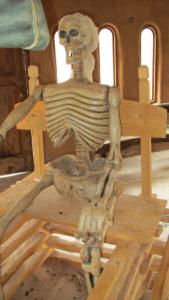
During the second half of the 19th century in the mountain towns of New Mexico and southern Colorado, Mexican-American Catholics personified death as a female skeletal figure known as both Doña Sebastiana and Comadre Sebastiana. “Comadre” has no direct English translation but is what one calls the godmother of their own child. Sebastiana, as will be examined in detail, derives from the male saint, Sebastian, the Roman martyr. Holy Week processions organized by the Penitentes, Catholic brotherhoods originating in Spain and known for their public displays of penance, included death carts with life-size wooden effigies of the skeletal Doña Sebastiana. Along with acts of self-flagellation and mock crucifixions, the Penitentes not only employed the menacing skeleton as a symbol of the agony and death suffered by Jesus Christ on the cross and the importance of a Holy Death (Santa Muerte) but they also venerated her as a supernatural personification of death, even referring to her interchangeably as Santa Muerte and Comadre Sebastiana.
In historical continuity with both her Spanish past and Mexican present, Doña Sebastiana was a new type of female personification of death originating among the Penitentes of northern New Mexico in the 1860s. Typically depicted as a skeleton with snow-white locks either seated or standing in a crude wooden cart, she threatened death to mortals with either a bow and arrow or a hatchet. In medieval Spain, the Grim Reaper was usually represented as the female Grim Reapress known as La Parca. However, it’s not only the Spanish Grim Reapress who was syncretized into the creation of Doña Sebastiana. Both her name and fact that she often stands in the death cart holding a bow and arrow suggest that Saint Sebastian fused with La Parca in the creation of Doña Sebastiana.
Saint Sebastian was a third-century Roman martyr who was shot full of arrows, but miraculously survived, according to legend. In two more extraordinary connections to Sebastiana of New Mexico and Colorado, the Roman saint is associated with both the concept of Holy Death and the Black Plague. Medieval Europeans correlated the apparent randomness with which the Plague struck victims to an indiscriminate rain of arrows from the sky, like on countless battlefields of the continent. And since Saint Sebastian was already associated with arrows, he became one of the most popular guardian saints during the Black Death. Of course, it was also at this same time in fourteenth-century Europe that the figure of the Grim Reaper first emerged. Remarkably, the syncretism would seem to endure today in that the often homo-erotic depictions of the Roman martyr resonate in his special appeal to LGBTQ devotees.
As bizarre as it might seem that a male saint who was brought over to the New World as part of Spanish Catholicism would morph into a female skeletal personification of death it isn’t without precedent. Guatemalan folk saint San Rey Pascual, the oldest of the three Latin American Skeleton Saints, is the result of the syncretism of Spanish saint Pascual Bailon, patron of cooks, and Mayan death deities. Pascual Bailon was a Franciscan friar who lived in Aragon during the latter half of the sixteenth century and was a prominent mystic and contemplative. The Church beatified him in 1618, just two decades after his death, and then canonized Bailon in 1690.
Although the Spanish saint never set foot in the New World, his apparition in Guatemala in 1650 to a terminally ill Mayan man is credited with ending a virulent epidemic. San Rey Pascual’s origin myth has Bailon appearing in the form of a tall skeleton in a luminescent cloak at the deathbed of a prominent Kaqchikel man and introducing himself as Saint Pascual, even though he wouldn’t be canonized until decades later. The skeletal saint offered his supernatural power to end the epidemic in the Kaqchikel region of present-day Ciudad Vieja, Sacatepequez, if the prominent Mayan convinced the community to adopt him as their patron saint. Since supernatural entities must often prove their powers to potential skeptics, the skeletal Bailon predicted that in nine days the prominent Kaqchikel would succumb to his high fever and that by then the epidemic would run its course. Word of the Spanish saint’s accurate prediction spread rapidly and his image became increasingly popular in the region during the colonial period. Over time the male folk saint of death became known as San Rey Pascual (Saint King Pascual) who has his own temple in Olintepeque just a stone’s throw from the Catholic church.
While San Pascual preserved his gender in morphing into the Guatemalan skeleton saint, another European male saint transformed into a female death saint, much as Saint Sebastian became Comadre Sebastiana. One of the oldest known effigies of Santa Muerte, some 200 years old, originated as a statue of the French saint, Bernard de Clairvaux. It’s likely that as the four foot wooden likeness of the saint deteriorated over time and started to look mummified, local Catholics in Tepatepec, Hidalgo, associated it with Santa Muerte, the skeletal figure of death. Interestingly the Cruz family, who owns historic effigy, celebrates the feast day of their on Santa Muerte on August 20, which is the same one for Saint Bernard.
In addition to Sebastiana fitting into a pattern of Catholic saints that morphed into Skeleton Saints, it turns out that she wasn’t a mere personification of death, such as the Grim Reapress, but a supernatural death saint who the Penitentes venerated as Santa Muerte. Given my research on Santa Muerte and my career focus on vernacular religion in the Americas, I had always suspected that for members of the Brotherhood of the Holy Blood of Christ (Hermandad de la Santa Sangre de Cristo) Sebastiana was much more than a mere artistic representation of death. If some Filipino Catholics venerate Santa Muerte who originated in the country as part of Holy Week processions in which she symbolized Christ’s victory over death, the death of death, then it certainly wouldn’t be a stretch to imagine Penitentes in the isolated mountain villages of New Mexico doing the same.
Writing in 1933 in the New Mexico Magazine local eye-witness Ely Leyba stated Brothers believed “that if any person would pray to the image of Sebastiana that their lives would be prolonged.” Moreover, Leyba described how the Penitentes of Trampas, New Mexico, would pray the rosary as they pulled the skeletal godmother in her cart during Holy Week. An extraordinary hymn or alabado not only demonstrates that the rosaries were prayed specifically for Sebastiana but also they believed her to be part of the celestial family of saints. Originating in northern New Mexico during the second half of the 19th century the hymn “Ayudad almas queridas” (Help us dear souls) imbues Sebastiana, who is interchangeably referred to as Comadre Sebastiana, Santa Muerte (Holy Death) and Physical Death, with extraordinary supernatural agency. In the following stanzas Sebastiana displays her supernatural power:
“Now Holy Death (Santa Muerte) comes dressed as a woman lawyer to defend this cause of the Lord turned into a sacrament.
My Godmother Sebastiana, crucified, lays out that pathway to God she has traveled on her knees.
Holy Death has set out, riding in her cart; with God’s orders she represents the souls.
Now Holy Death sets out to visit a sick man; commending his soul to God so that he might be freed from hell.
For forty days she was prostrate on Calvary accompanying Jesus, my Godmother Sebastiana.
Now they pray a rosary for her prostrate on Calvary; my Godmother Sebastiana gives her blessing.”
Here Sebastiana is God’s Angel of Death who represents and commends mortal souls and even bestows blessings. What’s most unusual and of course heretical is that the Catholic Brothers were praying the rosary for Sebastiana, Lady Death. Death in Christian theology is not a divinity and thus should not be prayed to or for. It’s one thing when contemporary Santa Muerte devotees pray the rosary to the Skeleton Saint but quite another when members of Catholic brotherhoods did it.
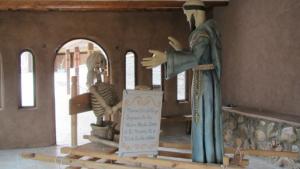
In an intriguing present-day twist on the connection between Comadre Sebastiana and Santa Muerte in Chimayo, New Mexico, a local parish priest, a native of Barcelona, commissioned a local sculptor to create a wooden likeness of Sebastiana in her death cart. It was installed in 2010 in an exhibit room attached to the Shrine of the Black Christ of Esquipulas, one of the most visited Catholic sites in the U.S. in a town famous for its massive Holy Week processions. Already well into my research on Mexican folk saint, Santa Muerte, I was astounded to see the beautiful cart, along with a statue of Saint Francis Assisi on temple grounds. The saint, for whom Pope Francis is named, described death as a “sister.”
All praise be yours, my Lord, All praise be yours, my Lord,
for our Sister Physical Death
from whose embrace no mortal can escape.
Woe to those who die in mortal sin!
Happy are those she finds doing your most holy will!
The second death can do no harm to them.
In the photo above, Sister Death holds a placard toward St. Francis’s outstretched arms, which reads:
“To die with the sacred joy of not having done harm to oneself nor to a single soul.”
These photographs are rare evidence that Sister Death, for the shortest of time, shared a sacred space with the patron saint of the poor. Just a short while after these photos were taken in March 2011, Doña Sebastiana and her cart were moved over to the nearby museum. Shrine officials feared the inevitable associations with her contemporary heiress, Santa Muerte.
*With much gratitude to my research partner, anthropologist Dr. Kate Kingsbury, for her encouragement in digging deeper into Sebastiana and proofing this article. Her forthcoming “Daughters of Death: The Female Followers of Santa Muerte” with Oxford University Press will be the next academic book on the fastest growing new religious movement in the West.


Browse Our Archives
Select a Category Amazon Synod andrew chesnut Brazil Catholicism Christianity death Evangelical Exorcism kate kingsbury Mexico narcocult Orixas Our Lady of Aparecida Our lady of the Bullet Pentecostal Religion Rey Pascual Santa Muerte Uncategorized vodou
Select a Month November 2026 October 2026 September 2026 August 2026 July 2026 June 2026 May 2026 April 2026 March 2026 February 2026 January 2026 December 2025 October 2025 September 2025 August 2025 June 2025 May 2025 April 2025 February 2025 January 2025 November 2024 October 2024 September 2024 July 2024 May 2024 April 2024 January 2024 December 2023 October 2023 July 2023 June 2023 April 2023 March 2023 January 2023 December 2022 November 2022 October 2022 September 2022 July 2022 June 2022 January 2022 October 2021 September 2021 August 2021 May 2021 March 2021 February 2021 October 2020 August 2020 July 2020 June 2020 May 2020 April 2020 March 2020 February 2020 November 2019 October 2019 August 2019 July 2019 June 2019 May 2019 April 2019 March 2019 February 2019 January 2019 December 2018 November 2018 October 2018 September 2018 August 2018 July 2018 June 2018 May 2018 April 2018 March 2018
Follow Us!
TAKE THE
Religious Wisdom Quiz
True or False: Job lost all his children, wealth, and health in a single day.
Select your answer to see how you score.
FALSE TRUE
Related posts from The Global Catholic Review
Pope Leo Tours a Latin America That is...

Rage Against The Machine? Pope Leo vs AI

Brazil’s Black Madonna as Political Football in Heated...
Brazil's Religious Revolution: What a Huge New Survey...
TRENDING AT PATHEOS Catholic

Advent Begins in the Waiting: Preparing for Jesus
The Christmas season seems to arrive earlier every year. Before Halloween decorations...

As was predicted many years ago, the Interpreter Foundation's website is...

"Why Do Churches Talk So Much About Money?"
If you were inclined to do so, you could probably find any...

Watch and Pray: On Mark 13:33-37
Jesus said to his disciples: “Be watchful! Be alert! You do not...

Debate on Purgatory & Biblical Evidences for It
This is from a combox on my video channel, Catholic Bible Highlights....

Set the table for the coming King
On Thursday we visited my sister-in-law for Thanksgiving, and throughout the entire...
view all Catholic blogs
Ad-Free & Subscriber Log-In Subscription Support
- About Us
- 2026 Calendar
- Videos
- Podcasts
- Library of World Religions
- Faith In Media Tracker
- Advertise With Us
- Write for Us
- Privacy Policy
- Terms of Service
- Do Not Sell My Data
- Contact Us
- Radiant Digital
- Manage Newsletter Subscriptions
- Unsubscribe From Notifications
- Sitemap
Copyright 2008-2026, Patheos, part of the Radiant Digital network of media brands. All rights reserved.
Subscription Support Ad-Free & Subscriber Log-In
Follow Patheos