
BuddhistCatholicContemplativeEvangelicalGeneral ChristianHinduJewishLatter-day SaintMuslimNew VisionsProgressive Christian
Beliefs
- Buddhist
- Catholic
- Contemplative
- Evangelical
- General Christian
- Hindu
- Jewish
- Latter-day Saint
- More Voices
- Muslim
- New Visions
- Pagan
- Progressive Christian
Topics
- Religion News
- Food and Religion
- Sports and Religion
- Religious Art
- Religious Music and Entertainment
- Religious Events
- History and Religion
- Style and Religion
- Politics and Religion
- Women in Religion
- Recreation Outdoors and Religion
- Business Finance and Religion
- Careers Workplace and Religion
- Education and Religion
- Family Parenting and Religion
- Health Fitness and Religion
- Home and Religion
- Relationships and Religion
- Technology and Religion
- Travel and Religion
Columnists
- Buddhist Columnists
- Business Finance and Religion Columnists
- Careers Workplace and Religion Columnists
- Catholic Columnists
- Contemplative Columnists
- Education and Religion Columnists
- Evangelists Columnists
- Family Parenting and Religion Columnists
- General Christian Columnists
- Health Fitness and Religion Columnists
- Hindu Columnists
- History and Religion Columnists
- Home and Religion Columnists
- Jewish Columnists
- More Voices Columnists
- Latter Day Columnists
- Muslim Columnists
- New Visions Columnists
- Nonreligious Columnists
- Pagan Columnists
- Politics and Religion Columnists
- Progressive Columnists
- Recreation Outdoors and Religion Columnists
- Relationships and Religion Columnists
- Religion News Columnists
- Religious Art Columnists
- Religious Events Columnists
- Religious Music and Entertainment Columnists
- Sports and Religion Columnists
- Style and Religion Columnists
- Technology and Religion Columnists
- Travel and Religion Columnists
- Women in Religion Columnists
Resource Library
- 2026 Calendar
- Library of World Religions
- The 100 Most Holy Places on Earth
- Patheos Answers
- Podcasts
- Videos
- Faith Leaders Database
- Anglican Episcopalian
- Bahai
- Baptist
- Buddhism
- Christianity
- Confucianism
- Eastern Orthodoxy
- Hinduism
- Holiness and Pentecostal
- ISKCON
- Islam
- Judaism
- Lutheran
- Methodist
- The Church of Jesus Christ of Latter-day Saints
- New Age
- Paganism
- Presbytarian and Reformed
- Protestantism
- Religion Behind the Scenes
- Roman Catholic
- Scientology
- Shia Islam
- Sikhism
- Sufism
- Sunni Islam
- Taoism
- Zen
- See all religions
Research Tools
 Ad-Free & Subscriber Log-In Subscription Support
Ad-Free & Subscriber Log-In Subscription Support
Follow Patheos 

- Trending:
- Forgiveness
- |
- Marriage
- |
- Consciousness
- |
- Death Penalty
- |
- Election
- |
- Halloween

- Home
- Catholic
- Religion News
- Mexico’s Patron of Lost Causes – A Photographic Portrait of Saint Jude on His Feast Day
Mexico’s Patron of Lost Causes – A Photographic Portrait of Saint Jude on His Feast Day
Last updated on: November 8, 2019 at 1:46 pm by Andrew Chesnut
Mexico’s Patron of Lost Causes – A Photographic Portrait of Saint Jude on His Feast Day 2019-11-08T13:46:07-05:00 Andrew Chesnut
Patheos Explore the world's faith through different perspectives on religion and spirituality! Patheos has the views of the prevalent religions and spiritualities of the world.
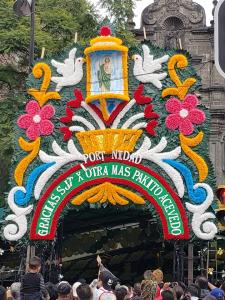
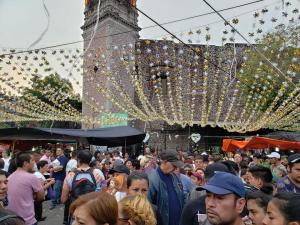
As a specialist in the Mexican religious landscape I had visited the Saint Jude shrine in Mexico City several times, but this time I was fortunate to be in town for his annual feast day on October 28. I had come to Mexico City for research on Day of the Dead, but there was no way I was going to miss the annual fiesta of Mexico’s most popular Catholic saint, the patron of lost causes, so I headed to San Hipolito Church to witness the colorful commemoration.
Practically unknown in Mexico before the 1980s, Saint Jude Thaddeus has catapulted to the top position among Catholic saints in the country with the world’s second largest Catholic population, which is about to surpass Brazil for the top spot. No other Catholic saint rivals the popularity of San Judas. Only the Virgin of Guadalupe and folk saint Santa Muerte can compete with St. Jude for Mexican souls. And over the past decade, competition between the nation’s number one Catholic saint and its top folk saint has become very intense, to the point that St. Jude in Mexico is now the only Catholic saint in the world who has a monthly feast day.
Until a decade and a half ago, the green and white cloaked saint only had an annual feast day — October 28 — exactly like his thousands of fellow Catholic counterparts around the world. However, the unexpected emergence of Santa Muerte, a new grassroots saint personifying death, changed everything. Just a few miles down the road from the famous St. Jude shrine in Mexico City at the San Hipolito Church, Santa Muerte pioneer Enriqueta Romero (affectionately known as Doña Queta) for nearly two decades now has been holding a monthly rosary service dedicated to the skeleton saint.
In fact, on Halloween of 2019 she celebrated the 18th anniversary of setting her life-size effigy of the Bony Lady out on the sidewalk in front of her home in the notorious barrio of Tepito. As related to me by the rector of shrine, it was in response to new competition from the saint of death that enterprising priests at San Hipolito Church decided to initiate St. Jude feasts celebrated on the 28th of each month.
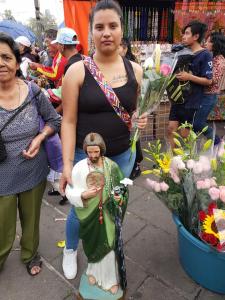
As seen in my photographs of St. Jude’s annual feast day on October 28, 2019, the celebrations of the patron of lost causes are wildly colorful affairs with devotees from all walks of Mexican life, but especially the working classes, lugging life-sized statues of the saint of last resorts, and many others dressed in his signature green and white garb, which are two of the three colors of the Mexican flag.
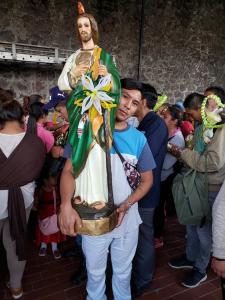
What really stands out at the annual and monthly fiestas attended by thousands is the presence of marginalized Millennials, hundreds of whom smoke marijuana and huff glue on the sidewalks that abut the temple. Ironically, the saint who is depicted with the flame of the Holy Spirit on his forehead, also has a reputation for healing drug abusers. In fact this has been an important part of the ministry at San Hipolito Church, which now promotes a line of Saint Jude mineral water.
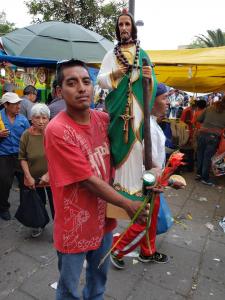
The strong contingent of marginalized youth and even criminals makes San Judas every bit as fascinating as the Bony Lady down the road. In theory, one of Santa Muerte’s strong appeals is that since she isn’t a Catholic saint, some devotees feel freer in asking her for unsavory favors. However, it turns out that even though he is a canonized saint, Jude is also often asked to perform miracles that don’t square with Christian standards of morality.
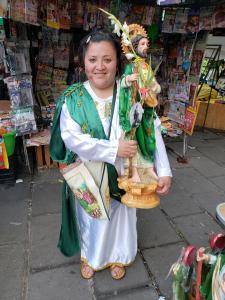
This has become such a concern to the Catholic Church that in 2008 the Archdiocese of Mexico City released a statement warning against such unorthodox practices. One such unorthodoxy is the belief by more than a few devotees that when St. Jude is represented with the iconic staff in his left hand, he is open to left-handed prayers and petitions that he would never consider with the staff at his right.
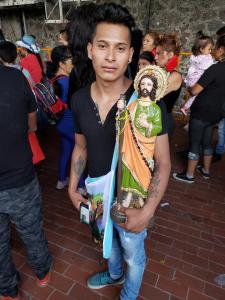
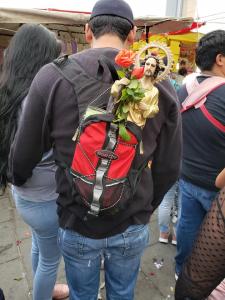
In what follows I will comment on the photos I shot during the celebration of St. Jude’s feast day in Mexico City. Riding in the backpack of a devotee, San Judas is one of the most portable Catholic saints in Mexico. Believers bring their statues to the shrine to be blessed.
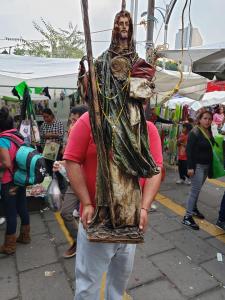
Some devotees express their devotion to the patron of lost causes by fashioning hand crafted statues, such as this one made from papier maché.
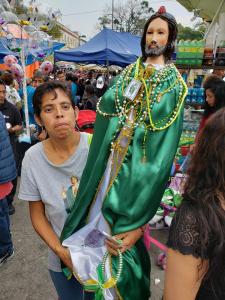
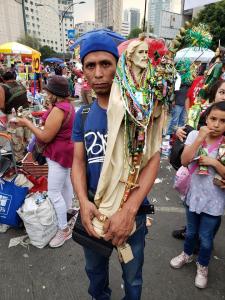
Mexican devotees are fond of adorning and dressing up their saints like this statue covered with rosary necklaces and scapulars, both of which are sold in abundance on and abutting church property.
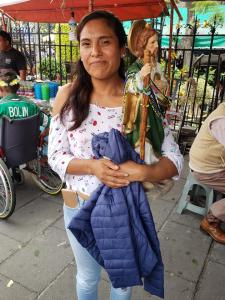
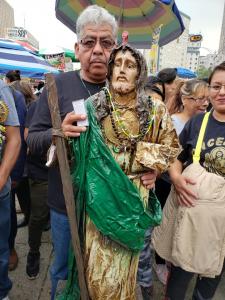
I was struck by how tenderly this middle-aged devotee held his unique statute for the photo-op.
Of the diverse demographics present young working class men in their 20s and 30s seemed to be disproportionately in attendance.
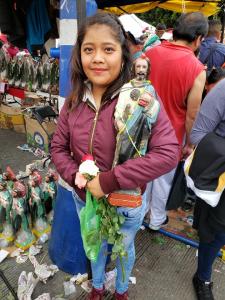
Flowers are an important part of religious celebrations in Mexico and as such this young devotee is clutching a white rose, symbol of purity.
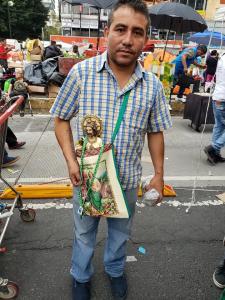
This devotees melancholic earnestness and unique St. Jude satchel caught my attention.
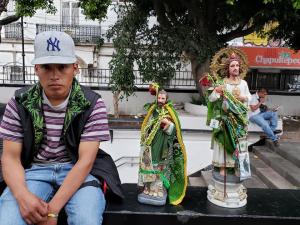
This devotee sports the classic accoutrements for young male devotees – baseball cap, backpack and heavily adorned statuette.
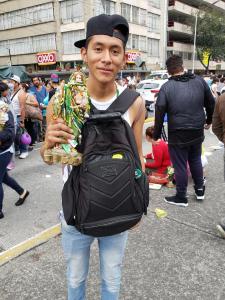
As part of the tenderness on display with which devotees care for their images of the saint many cradle him as if he were an infant.
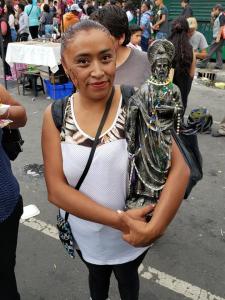
Some devotees will bring along the statuette of a friend or family member who’s unable to attend. This young man brought his mother’s, the one on the far right, to be blessed during Mass.
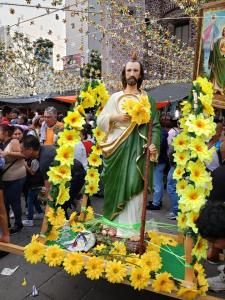
Even life-size statues are present, ones that in some cases have been brought from great distances across the largest city in the Americas.
This statuette of Santa Muerte was for sale on church grounds even though Catholic clergy in Mexico condemn her on a near-weekly basis.

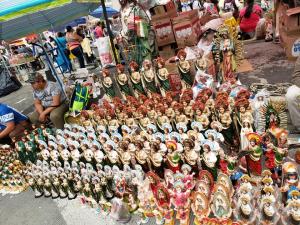
Thousands of images of the patron of lost causes are for sale both on church property and on adjacent sidewalks and street corners.
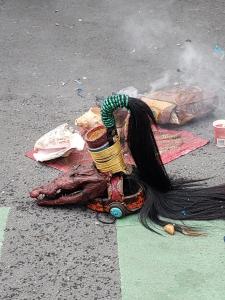
A couple blocks away from San Hipolito Church I came across a St. Jude shrine being fêted by Aztec style dancers known as “Concheros.”
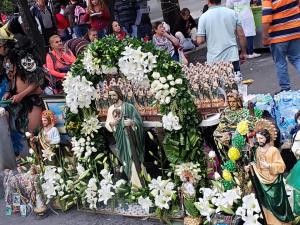
I had seen Concheros many times at both Santa Muerte events and the Basilica of the Virgin of Guadalupe, but this was the first time I saw them connected with St. Jude.
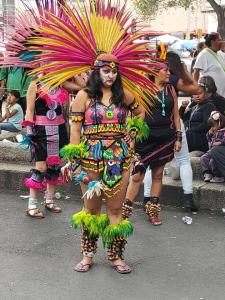
Some donned death images since Day of the Dead was just a few days away.
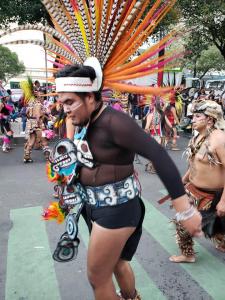
I was struck by the integration of elements of Indigenous spirituality when the cult of St. Jude is of such recent vintage in Mexico, only since the 1980s when Colombian narcos apparently imported him.
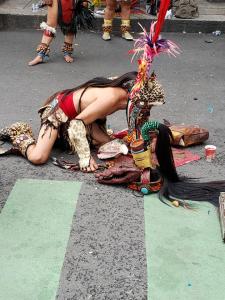
Alligator heads, jaguar pelts, and the aroma of copal and sage linked the Middle Eastern saint to an imagined Aztec past.

About Andrew Chesnut
Dr. R. Andrew Chesnut earned his Ph.D degree in Latin American History from the University of California, Los Angeles in 1995 and joined the History Department faculty at the University of Houston in 1997. He quickly became an internationally recognized expert on Latin American religious history Professor Chesnut was selected as the inaugural recipient of the Bishop Walter Sullivan Chair in Catholic Studies at VCU in 2008. The chair was established as the Most Rev. Walter F. Sullivan was nearing retirement as the 11th bishop of the Catholic Diocese of Richmond to honor his nearly thirty years of service. For Professor Chesnut the chair became a unique opportunity to develop Catholic studies in a global context and at a large public university. Professor Chesnut’s early work, Born Again in Brazil: The Pentecostal Boom and the Pathogens of Poverty (Rutgers University Press, 1997), traces the meteroric rise of Pentecostalism among the popular classes in Brazil following the disestablishment of the Roman Catholic Church. His second book, Competitive Spirits: Latin America’s New Religious Economy (Oxford University Press, 2003) focuses on the three groups that have prospered most in the region’s pluralist landscape, Protestant Pentecostalism, the Catholic Charismatic Renewal, and African disasporic religions (e.g., Brazilian Candomble and Haitian Vodou). Professor Chesnut's most recent book is Devoted to Death: Santa Muerte, the Skeleton Saint (Oxford University Press, 2025). It is the first in-depth study of the Mexican folk saint in English and has received widespread media coverage. You can read more about the author here.
Previous Post

October 22, 2019
Catholic Cartels? Ovidio Guzman and the Narco-Saints of Mexico
Next Post

November 23, 2019 Pachamama as Lightning Rod of Division over the Papacy of Pope Francis
Browse Our Archives
Select a Category Amazon Synod andrew chesnut Brazil Catholicism Christianity death Evangelical Exorcism kate kingsbury Mexico narcocult Orixas Our Lady of Aparecida Our lady of the Bullet Pentecostal Religion Rey Pascual Santa Muerte Uncategorized vodou
Select a Month October 2026 September 2026 August 2026 July 2026 June 2026 May 2026 April 2026 March 2026 February 2026 January 2026 December 2025 October 2025 September 2025 August 2025 June 2025 May 2025 April 2025 February 2025 January 2025 November 2024 October 2024 September 2024 July 2024 May 2024 April 2024 January 2024 December 2023 October 2023 July 2023 June 2023 April 2023 March 2023 January 2023 December 2022 November 2022 October 2022 September 2022 July 2022 June 2022 January 2022 October 2021 September 2021 August 2021 May 2021 March 2021 February 2021 October 2020 August 2020 July 2020 June 2020 May 2020 April 2020 March 2020 February 2020 November 2019 October 2019 August 2019 July 2019 June 2019 May 2019 April 2019 March 2019 February 2019 January 2019 December 2018 November 2018 October 2018 September 2018 August 2018 July 2018 June 2018 May 2018 April 2018 March 2018
Follow Us!
TAKE THE
Religious Wisdom Quiz
How many times did Elijah pray for rain?
Select your answer to see how you score.
5 7 3 9
Related posts from The Global Catholic Review

Brazil’s Black Madonna as Political Football in Heated...

Brazil's Religious Revolution: What a Huge New Survey...

Trump's Catholic Problem Heading Into November Midterms

Did Pentecostalism Kill Brazilian Football's 'Jogo Bonito'?
TRENDING AT PATHEOS Catholic

Nearly every morning, I make the drive to Detroit with my high-school-age...

The Real AI Story Is Adoption Without Trust
Artificial intelligence has crossed a political threshold. It is no longer a...

A new article, written by Jeff Lindsay and Gale L. Pooley,...

Swimfan: Forgotten Aughts Pleasures
This is a recovery effort. In 2002, My Big Fat Greek Wedding...

Top Three Anti-Catholic Lies About Catholicism
This is my initial transcript for the video, "THE 3 WORST...

Pope Leo Celebrates Mass for Nurses & Docs...
I don't have any idea how he did it, but Pope Leo...
view all Catholic blogs
Ad-Free & Subscriber Log-In Subscription Support
- About Us
- 2026 Calendar
- Videos
- Podcasts
- Library of World Religions
- Faith In Media Tracker
- Advertise With Us
- Write for Us
- Privacy Policy
- Terms of Service
- Do Not Sell My Data
- Contact Us
- Radiant Digital
- Manage Newsletter Subscriptions
- Unsubscribe From Notifications
- Sitemap
Copyright 2008-2026, Patheos. All rights reserved.
Subscription Support Ad-Free & Subscriber Log-In
Follow Patheos