
BuddhistCatholicContemplativeEvangelicalGeneral ChristianHinduJewishLatter-day SaintMuslimNew VisionsProgressive Christian
Beliefs
- Buddhist
- Catholic
- Contemplative
- Evangelical
- General Christian
- Hindu
- Jewish
- Latter-day Saint
- More Voices
- Muslim
- New Visions
- Pagan
- Progressive Christian
Topics
- Religion News
- Food and Religion
- Sports and Religion
- Religious Art
- Religious Music and Entertainment
- Religious Events
- History and Religion
- Style and Religion
- Politics and Religion
- Women in Religion
- Recreation Outdoors and Religion
- Business Finance and Religion
- Careers Workplace and Religion
- Education and Religion
- Family Parenting and Religion
- Health Fitness and Religion
- Home and Religion
- Relationships and Religion
- Technology and Religion
- Travel and Religion
Columnists
- Buddhist Columnists
- Business Finance and Religion Columnists
- Careers Workplace and Religion Columnists
- Catholic Columnists
- Contemplative Columnists
- Education and Religion Columnists
- Evangelists Columnists
- Family Parenting and Religion Columnists
- General Christian Columnists
- Health Fitness and Religion Columnists
- Hindu Columnists
- History and Religion Columnists
- Home and Religion Columnists
- Jewish Columnists
- More Voices Columnists
- Latter Day Columnists
- Muslim Columnists
- New Visions Columnists
- Nonreligious Columnists
- Pagan Columnists
- Politics and Religion Columnists
- Progressive Columnists
- Recreation Outdoors and Religion Columnists
- Relationships and Religion Columnists
- Religion News Columnists
- Religious Art Columnists
- Religious Events Columnists
- Religious Music and Entertainment Columnists
- Sports and Religion Columnists
- Style and Religion Columnists
- Technology and Religion Columnists
- Travel and Religion Columnists
- Women in Religion Columnists
Resource Library
- 2026 Calendar
- Library of World Religions
- The 100 Most Holy Places on Earth
- Patheos Answers
- Podcasts
- Videos
- Faith Leaders Database
- Anglican Episcopalian
- Bahai
- Baptist
- Buddhism
- Christianity
- Confucianism
- Eastern Orthodoxy
- Hinduism
- Holiness and Pentecostal
- ISKCON
- Islam
- Judaism
- Lutheran
- Methodist
- The Church of Jesus Christ of Latter-day Saints
- New Age
- Paganism
- Presbytarian and Reformed
- Protestantism
- Religion Behind the Scenes
- Roman Catholic
- Scientology
- Shia Islam
- Sikhism
- Sufism
- Sunni Islam
- Taoism
- Zen
- See all religions
Research Tools
 Ad-Free & Subscriber Log-In Subscription Support
Follow Patheos 

- Trending:
- Advent
- |
- Forgiveness
- |
- Thanksgiving
- |
- Election
- |
- Seasonal Holidays
- |
- Marriage

- Home
- Catholic
- Religion News
- Holy Child of Raffles – The Mexican Christ Child Asleep on a Skull
Holy Child of Raffles – The Mexican Christ Child Asleep on a Skull
Last updated on: August 17, 2019 at 12:30 pm by Andrew Chesnut
Holy Child of Raffles – The Mexican Christ Child Asleep on a Skull 2019-08-17T12:30:30-04:00 Andrew Chesnut
Patheos Explore the world's faith through different perspectives on religion and spirituality! Patheos has the views of the prevalent religions and spiritualities of the world.

Having researched the Mexican skeleton saint Santa Muerte for the past decade I am quite accustomed to death imagery. However, when I first came across a photo of the Holy Child of Raffles (el Santo Niño de las Suertes) I was taken aback. As a specialist in Latin American religion I am used to seeing the myriad advocations of the Christ Child. There’s el Niño Doctor wearing a doctor’s smock who as one might imagine is most often beseeched for miraculous cures. Then there’s the heretical folk saint who holds a 5 gallon gas can in one hand and a siphon in the other. Holy Child Huachicolero serves as the the spiritual patron for Mexican gasoline thieves and was recently rebuked by the Archbishop of Puebla for being “worse than Santa Muerte.”

But not even the initial shock of seeing the Holy Infant with a gas siphon in his hand prepared me for the sight of the Christ Child reclining his head on a hard human skull instead of a fluffy pillow. The childish innocence and doll-like cuteness of the Christ Child genre is retained here but unexpectedly juxtaposed with the most common memento mori – a human cranium. Catholics of course are most familiar with the death imagery of the adult Christ crucified on the Roman instrument of torture, the cross. But the Holy Infants of Prague and Atocha, among all the others, with their radiant countenance and baby fat evoke vibrant young life with no hint whatsoever of impending death and resurrection. So how to explain this unique Mexican advocation of the Christ Child in which the innocence of childhood is juxtaposed with the stark reality of death?

Let’s take a look at the origin story of the Holy Child of Raffles. In Mexico City in 1806 two priests were strolling through the district of Tlalpan when they suddenly heard the cry of a child. Disconcerted they began to look for the child and in a vacant lot discovered a small image of the Christ Child sleeping peacefully on top of a human skull. As they approached the strange image a natural spring gushed forth water and was subsequently baptized “the Eye of the Child” (el Ojo del Niño) currently located on the grounds of the Salesian seminary.

Thrilled by their discovery, the priests took the image to the archbishop who upon contemplating the Christ Child praised God for His mercy. At first the archbishop thought about giving the image to the nuns at a local monastery but after consulting with the city council he decided to hold a raffle in which God would choose the lucky recipient of the image of the Christ Child. The convent of Conceptionist Nuns of Saint Bernard won the raffle. However, cognizant that maintenance of the image could be a financial burden for the impoverished convent, the archbishop held a second raffle, which was again won by the Conceptionist sisters.

Convinced the Conceptionists couldn’t properly care for the miraculous image, the archbishop conducted a third drawing, this time without the name of the Conceptionists on a slip of paper. Not only did the lucky nuns win for a third time but had the name of their convent printed in gold, a sign from God which the archbishop could not ignore. The sisters were overwhelmed by the joy of winning such a gift from Heaven in the miraculous raffle to the extent that the Mother Superior decided to name the image el Santo Niño de las Suertes (Holy Child of Raffles). Since then the Conceptionist sisters have been the caretakers of the unique image and promoters of devotion to the Christ Child.

Since 2010 veneration of the Christ Child primarily takes place at his hangar-like shrine in the district of Xochimilco. While devotees petition the Holy Child of Raffles for miracles of all sorts, they seem to seek his divine assistance especially in three matters – health, fertility, and befitting of his origins, luck in the lottery. In fact, one of the highlights during his annual feast day celebration on the second Sunday of January is the raffling of an image of the Holy Infant to a lucky devotee.
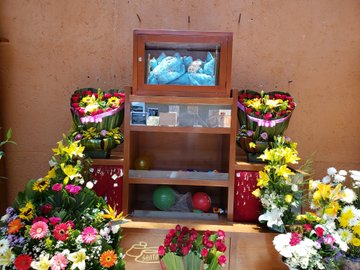
As the skull upon which the baroque image of the Holy Child rests evinces his Holy Death, this has attracted a considerable number of devotees of the Mexican death saint, Santa Muerte, which translates to English both as Holy Death and Saint Death. While some Mexican devotees prefer to regard the Skeleton Saint as the latest manifestation of Mictecacihuatl, the Aztec death goddess, the very origin of the female folk saint’s name, Santa Muerte, is the Holy Death of Christ, which in Mexico used to be reenacted at Holy Week processions with effigies of the Grim Reapress (la Parca) personifying the Holy Death of Christ. The archdiocese of Mexico City has become so concerned about the (mis)appropriation of the Holy Child of Raffles that it has issued public admonitions to parishioners in the days preceding Candlemas Day not to dress images of the Holy Infant in offensive ways, including as Santa Muerte. But of course the Holy Child of Raffles doesn’t need to wear the garb of a Skeleton Saint to remind us of the inextricable relation between life and death.
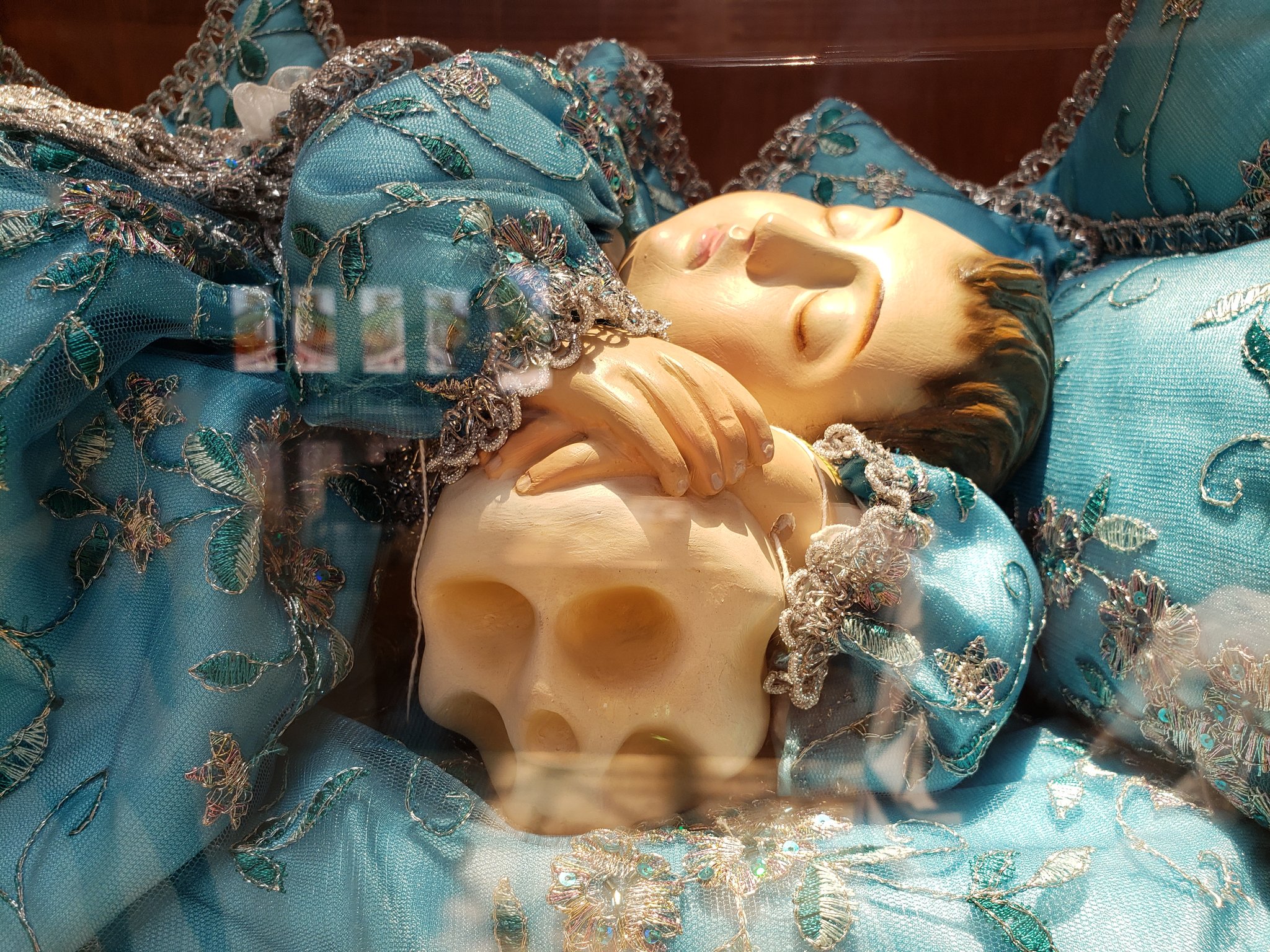
All photographs were shot by Fabiola Lopez-Chesnut and Dr. Andrew Chesnut.
Previous Post
July 9, 2019
Brazil's Black Supernatural Sister Queens: Our Lady of Aparecida and Oxum
Browse Our Archives
Select a Category Amazon Synod andrew chesnut Brazil Catholicism Christianity death Evangelical Exorcism kate kingsbury Mexico narcocult Orixas Our Lady of Aparecida Our lady of the Bullet Pentecostal Religion Rey Pascual Santa Muerte Uncategorized vodou
Select a Month November 2026 October 2026 September 2026 August 2026 July 2026 June 2026 May 2026 April 2026 March 2026 February 2026 January 2026 December 2025 October 2025 September 2025 August 2025 June 2025 May 2025 April 2025 February 2025 January 2025 November 2024 October 2024 September 2024 July 2024 May 2024 April 2024 January 2024 December 2023 October 2023 July 2023 June 2023 April 2023 March 2023 January 2023 December 2022 November 2022 October 2022 September 2022 July 2022 June 2022 January 2022 October 2021 September 2021 August 2021 May 2021 March 2021 February 2021 October 2020 August 2020 July 2020 June 2020 May 2020 April 2020 March 2020 February 2020 November 2019 October 2019 August 2019 July 2019 June 2019 May 2019 April 2019 March 2019 February 2019 January 2019 December 2018 November 2018 October 2018 September 2018 August 2018 July 2018 June 2018 May 2018 April 2018 March 2018
Follow Us!
TAKE THE
Religious Wisdom Quiz
True or False: Job lost all his children, wealth, and health in a single day.
Select your answer to see how you score.
FALSE TRUE
Related posts from The Global Catholic Review
Pope Leo Tours a Latin America That is...

Rage Against The Machine? Pope Leo vs AI

Brazil’s Black Madonna as Political Football in Heated...
Brazil's Religious Revolution: What a Huge New Survey...
TRENDING AT PATHEOS Catholic

Advent Begins in the Waiting: Preparing for Jesus
The Christmas season seems to arrive earlier every year. Before Halloween decorations...

As was predicted many years ago, the Interpreter Foundation's website is...

"Why Do Churches Talk So Much About Money?"
If you were inclined to do so, you could probably find any...

Watch and Pray: On Mark 13:33-37
Jesus said to his disciples: “Be watchful! Be alert! You do not...

Debate on Purgatory & Biblical Evidences for It
This is from a combox on my video channel, Catholic Bible Highlights....

Set the table for the coming King
On Thursday we visited my sister-in-law for Thanksgiving, and throughout the entire...
view all Catholic blogs
Ad-Free & Subscriber Log-In Subscription Support
- About Us
- 2026 Calendar
- Videos
- Podcasts
- Library of World Religions
- Faith In Media Tracker
- Advertise With Us
- Write for Us
- Privacy Policy
- Terms of Service
- Do Not Sell My Data
- Contact Us
- Radiant Digital
- Manage Newsletter Subscriptions
- Unsubscribe From Notifications
- Sitemap
Copyright 2008-2026, Patheos, part of the Radiant Digital network of media brands. All rights reserved.
Subscription Support Ad-Free & Subscriber Log-In
Follow Patheos