
BuddhistCatholicContemplativeEvangelicalGeneral ChristianHinduJewishLatter-day SaintMuslimNew VisionsProgressive Christian
Beliefs
- Buddhist
- Catholic
- Contemplative
- Evangelical
- General Christian
- Hindu
- Jewish
- Latter-day Saint
- More Voices
- Muslim
- New Visions
- Pagan
- Progressive Christian
Topics
- Religion News
- Food and Religion
- Sports and Religion
- Religious Art
- Religious Music and Entertainment
- Religious Events
- History and Religion
- Style and Religion
- Politics and Religion
- Women in Religion
- Recreation Outdoors and Religion
- Business Finance and Religion
- Careers Workplace and Religion
- Education and Religion
- Family Parenting and Religion
- Health Fitness and Religion
- Home and Religion
- Relationships and Religion
- Technology and Religion
- Travel and Religion
Columnists
- Buddhist Columnists
- Business Finance and Religion Columnists
- Careers Workplace and Religion Columnists
- Catholic Columnists
- Contemplative Columnists
- Education and Religion Columnists
- Evangelists Columnists
- Family Parenting and Religion Columnists
- General Christian Columnists
- Health Fitness and Religion Columnists
- Hindu Columnists
- History and Religion Columnists
- Home and Religion Columnists
- Jewish Columnists
- More Voices Columnists
- Latter Day Columnists
- Muslim Columnists
- New Visions Columnists
- Nonreligious Columnists
- Pagan Columnists
- Politics and Religion Columnists
- Progressive Columnists
- Recreation Outdoors and Religion Columnists
- Relationships and Religion Columnists
- Religion News Columnists
- Religious Art Columnists
- Religious Events Columnists
- Religious Music and Entertainment Columnists
- Sports and Religion Columnists
- Style and Religion Columnists
- Technology and Religion Columnists
- Travel and Religion Columnists
- Women in Religion Columnists
Resource Library
- 2026 Calendar
- Library of World Religions
- The 100 Most Holy Places on Earth
- Patheos Answers
- Podcasts
- Videos
- Faith Leaders Database
- Anglican Episcopalian
- Bahai
- Baptist
- Buddhism
- Christianity
- Confucianism
- Eastern Orthodoxy
- Hinduism
- Holiness and Pentecostal
- ISKCON
- Islam
- Judaism
- Lutheran
- Methodist
- The Church of Jesus Christ of Latter-day Saints
- New Age
- Paganism
- Presbytarian and Reformed
- Protestantism
- Religion Behind the Scenes
- Roman Catholic
- Scientology
- Shia Islam
- Sikhism
- Sufism
- Sunni Islam
- Taoism
- Zen
- See all religions
Research Tools
 Ad-Free & Subscriber Log-In Subscription Support
Ad-Free & Subscriber Log-In Subscription Support
Follow Patheos 

- Trending:
- Forgiveness
- |
- Marriage
- |
- Consciousness
- |
- Death Penalty
- |
- Election
- |
- Halloween

- Home
- Catholic
- Religion News
- President Lopez Obrador and Mexico’s New Religious Diversity
President Lopez Obrador and Mexico’s New Religious Diversity
Last updated on: January 28, 2019 at 10:35 am by Andrew Chesnut
President Lopez Obrador and Mexico’s New Religious Diversity 2019-01-28T10:35:03-05:00 Andrew Chesnut
Patheos Explore the world's faith through different perspectives on religion and spirituality! Patheos has the views of the prevalent religions and spiritualities of the world.
By Guest Columnist Ezer R. May May and translated from the original Spanish by Dr. Andrew Chesnut*
Currents of spirituality and religion have always coursed through the Latin American body politic. And now the dynamics of religious identity are having a major impact in Costa Rica, Guatemala, Nicaragua, Bolivia, Brazil, and Mexico. We saw Jair Bolsonaro win the presidential elections in Brazil with strong support from the Universal Church of the Kingdom of God (IURD) as well as the coalition between the Social Encounter Party (PES), which was founded by a NeoPentecostal preacher, and MORENA, the party of current Mexican president, Lopez Obrador.
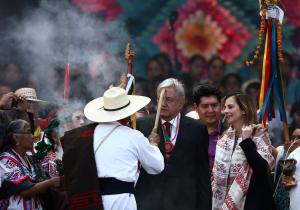
In the Mexican case another religious element comes into play, Indigenous Theology emanating from Liberation Theology and Base Christian Communities with a dose of New Age mixed in. The “Mother Earth” ritual of last December served as the dramatic symbol of the inauguration of the Mayan Train, which will transport tourists across the Yucatan. Mexican mass media is just now beginning to reflect the religious complexity and diversity that has characterized the country for some time now.
So how to forge a secular state in the context of growing religious diversity without denying that religiosity is an integral part of people’s lives? This is a thorny question but certainly both President Lopez Obrador himself as well as his staff are appealing to these diverse religious affiliations and tendencies but now through a Mayan worldview in which the traditionally secular left makes it difficult to translate it into the political arena. And for the general public it’s hard to believe that not all Evangelicals are right-wing when the reality is most are pragmatically oriented.
The alliance of the PES Party with the leftist ruling party, MORENA, of President Lopez Obrador would appear to be an ideological short circuit. But the past few months have shown this not to be the case as elected representatives from the PES voted in favor of gay marriage and the legalization of marijuana. A plausible explanation for the odd alliance is that the PES forged it in order to maintain its status as a legally recognized political party while allowing MORENA to choose the PES’s candidates for elected office. Moreover, MORENA sought to win over a significant part of the NeoPentecostal electorate among the Mexican middle classes. Of course in the end the PES didn’t have half the electoral success that MORENA had.
During the campaign season the PES was pleased with this coalition due in part to the many Evangelical allusions made by Lopez Obrador who in his speeches declared “I’m an admirer of Jesus Christ” and “From Old Testament times to our present days justice and fraternity have been front and center.” He also stated, “In the New Testament it’s clear that Jesus expressed a preference for the poor through his words and works.” This was strategic ambiguity with repeated mentions of Christ in an Evangelical bent, but he launched his presidential campaign on the 12th of December, the feast day of the Virgin of Guadalupe. During his campaign launch he remarked “we venerate the Virgin of Guadaplupe and Benito Juarez.” The scope of his vague acknowledgement of Christian diversity served to calm religious rivalries among at least some of those in attendance.
On one hand we observed the mayoral inauguration ceremonies with animated prayers delivered by NeoPentecostal pastors, while on the other Cuauhtemoc Blanco, Governor of Morelos, participated in a mass held at the governor’s mansion in honor of the Virgin of Guadalupe on her feast day. The Holy Spirit, the Trinity, the Virgin, and Mother Earth are all major religious elements in play here. So the question is how will these religious expressions be transformed in their interaction with an administration that enjoys wide political berth due to its commanding electoral triumph? These transformations will expand the present gamut as we’re talking about religious communities – Evangelical plurality, Catholic heterogeneity, regional worldviews, and Indigenous rituals connected to the earth.
Nevertheless these religious notions weren’t only integrated into political discourse, but also “secular” intellectuals employed biblical metaphors to explain the new political reality, such “tropical messiah” (Enrique Krauze), “tropical prophets” (Lorenzo Meyer), “exodus politics” (Javier Tello), “the promised land” (Bernardo Barranco), “transfiguration” (Lopez Obrador), and “crusade” and “illuminated” (Porfirio Munoz).
The Mexican and Latin American political arenas are facing post-secular societies in which the religious idiom becomes indispensable for articulating emotions, projects and political strategies in an environment chilled by rationality. It also brings with it inspiring semantic content to explain the socio-political scene. The philosopher Jurgen Habermas posited that the challenge for societies is the forging of consensus through listening to others and mutual reconsideration of both religious and secular ideas in order to extract universal values with the goal of engendering a fraternal citizenry.
We must be clear that in democratic societies one of the goals must be the elimination of second class citizens, whether immigrants, Indigenous peoples, or certain religious groups. Is this possible in Mexico? No doubt it will be an arduous journey, even more so if a wide sector of the population maintains an antiquated notion of secularization (religion and spirituality as synonymous with pre-modern). The current political climate is creating an opportunity to recognize both religious and subaltern “others” beyond the dichotomy of left and right.
*Social anthropologist trained at Universidad Autónoma de Yucatán and trained as an historian at Centro de Investigaciones y Estudios Superiores en Antropología Social-Peninsular. May’s main fields of study focus on religious minorities in Mexico, especially Protestants and Buddhists about which he has published articles in academic journals.
Previous Post

January 20, 2019
Des Catholiques Tentés par L’Évangile de la Prospérité

Browse Our Archives
Select a Category Amazon Synod andrew chesnut Brazil Catholicism Christianity death Evangelical Exorcism kate kingsbury Mexico narcocult Orixas Our Lady of Aparecida Our lady of the Bullet Pentecostal Religion Rey Pascual Santa Muerte Uncategorized vodou
Select a Month October 2026 September 2026 August 2026 July 2026 June 2026 May 2026 April 2026 March 2026 February 2026 January 2026 December 2025 October 2025 September 2025 August 2025 June 2025 May 2025 April 2025 February 2025 January 2025 November 2024 October 2024 September 2024 July 2024 May 2024 April 2024 January 2024 December 2023 October 2023 July 2023 June 2023 April 2023 March 2023 January 2023 December 2022 November 2022 October 2022 September 2022 July 2022 June 2022 January 2022 October 2021 September 2021 August 2021 May 2021 March 2021 February 2021 October 2020 August 2020 July 2020 June 2020 May 2020 April 2020 March 2020 February 2020 November 2019 October 2019 August 2019 July 2019 June 2019 May 2019 April 2019 March 2019 February 2019 January 2019 December 2018 November 2018 October 2018 September 2018 August 2018 July 2018 June 2018 May 2018 April 2018 March 2018
Follow Us!
TAKE THE
Religious Wisdom Quiz
Who was the brother of Moses and helped him confront Pharaoh?
Select your answer to see how you score.
Joseph Joshua Aaron David
Related posts from The Global Catholic Review

Brazil’s Black Madonna as Political Football in Heated...

Brazil's Religious Revolution: What a Huge New Survey...

Trump's Catholic Problem Heading Into November Midterms

Did Pentecostalism Kill Brazilian Football's 'Jogo Bonito'?
TRENDING AT PATHEOS Catholic

Emotion in Early Christianity by Andrew Crislip
Andrew Crislip’s Emotion in Early Christianity examines an often overlooked dimension of...

16 Spiritual Touchstones for a More Grounded Life
After decades of spiritual study, here are 16 principles I try...

Catholic Evangelization: Sharing Your Faith Every Day
Welcome back to the Graceful Awakening mini-series called, “From Faith to Mission.” ...

The Pillar of the Boatmen: the Ancient Monument...
The Pillar of the Boatmen is a Romano-Gaulish sculpture that dates from...

In one sense walking into Westminster Abbey is like walking down the...

'Super Scam Me' Exposes AI Jon Bon Jovi...
Leslie Pickett believed she was in a relationship with Jon Bon Jovi....
view all Catholic blogs
Ad-Free & Subscriber Log-In Subscription Support
- About Us
- 2026 Calendar
- Videos
- Podcasts
- Library of World Religions
- Faith In Media Tracker
- Advertise With Us
- Write for Us
- Privacy Policy
- Terms of Service
- Do Not Sell My Data
- Contact Us
- Radiant Digital
- Manage Newsletter Subscriptions
- Unsubscribe From Notifications
- Sitemap
Copyright 2008-2026, Patheos. All rights reserved.
Subscription Support Ad-Free & Subscriber Log-In
Follow Patheos