
BuddhistCatholicContemplativeEvangelicalGeneral ChristianHinduJewishLatter-day SaintMuslimNew VisionsProgressive Christian
Beliefs
- Buddhist
- Catholic
- Contemplative
- Evangelical
- General Christian
- Hindu
- Jewish
- Latter-day Saint
- More Voices
- Muslim
- New Visions
- Pagan
- Progressive Christian
Topics
- Religion News
- Food and Religion
- Sports and Religion
- Religious Art
- Religious Music and Entertainment
- Religious Events
- History and Religion
- Style and Religion
- Politics and Religion
- Women in Religion
- Recreation Outdoors and Religion
- Business Finance and Religion
- Careers Workplace and Religion
- Education and Religion
- Family Parenting and Religion
- Health Fitness and Religion
- Home and Religion
- Relationships and Religion
- Technology and Religion
- Travel and Religion
Columnists
- Buddhist Columnists
- Business Finance and Religion Columnists
- Careers Workplace and Religion Columnists
- Catholic Columnists
- Contemplative Columnists
- Education and Religion Columnists
- Evangelists Columnists
- Family Parenting and Religion Columnists
- General Christian Columnists
- Health Fitness and Religion Columnists
- Hindu Columnists
- History and Religion Columnists
- Home and Religion Columnists
- Jewish Columnists
- More Voices Columnists
- Latter Day Columnists
- Muslim Columnists
- New Visions Columnists
- Nonreligious Columnists
- Pagan Columnists
- Politics and Religion Columnists
- Progressive Columnists
- Recreation Outdoors and Religion Columnists
- Relationships and Religion Columnists
- Religion News Columnists
- Religious Art Columnists
- Religious Events Columnists
- Religious Music and Entertainment Columnists
- Sports and Religion Columnists
- Style and Religion Columnists
- Technology and Religion Columnists
- Travel and Religion Columnists
- Women in Religion Columnists
Resource Library
- 2026 Calendar
- Library of World Religions
- The 100 Most Holy Places on Earth
- Patheos Answers
- Podcasts
- Videos
- Faith Leaders Database
- Anglican Episcopalian
- Bahai
- Baptist
- Buddhism
- Christianity
- Confucianism
- Eastern Orthodoxy
- Hinduism
- Holiness and Pentecostal
- ISKCON
- Islam
- Judaism
- Lutheran
- Methodist
- The Church of Jesus Christ of Latter-day Saints
- New Age
- Paganism
- Presbytarian and Reformed
- Protestantism
- Religion Behind the Scenes
- Roman Catholic
- Scientology
- Shia Islam
- Sikhism
- Sufism
- Sunni Islam
- Taoism
- Zen
- See all religions
Research Tools
 Ad-Free & Subscriber Log-In Subscription Support
Ad-Free & Subscriber Log-In Subscription Support
Follow Patheos 

- Trending:
- Forgiveness
- |
- Marriage
- |
- Consciousness
- |
- Death Penalty
- |
- Election
- |
- Halloween

- Home
- Catholic
- Religion News
- Catholic Church Picks a Bone with Cameroon Skull Cult
Catholic Church Picks a Bone with Cameroon Skull Cult
Last updated on: September 25, 2018 at 6:21 pm by Andrew Chesnut
Catholic Church Picks a Bone with Cameroon Skull Cult 2018-09-25T18:21:38-04:00 Andrew Chesnut
Patheos Explore the world's faith through different perspectives on religion and spirituality! Patheos has the views of the prevalent religions and spiritualities of the world.
Authored by guest contributor Dr. Kate Kingsbury*
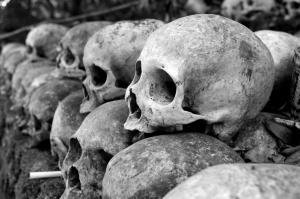
The Bamiléké of Cameroon have long believed that after the corpses of their ancestors have rotted they can be exhumed and the skulls used to communicate with the spirits of the dead, as well as their godhead, to receive spiritual guidance. Locals have named this form of ancestral worship: La Culte des Crânes, or the Skull Cult. The religious rite, which has necromancy at its fulcrum, is of ancient origin and the Bamiléké have practiced it for thousands of years. Urbanisation has impinged upon the Skull Cult as it is forbidden to move ancestral skulls, which must at all times remain in the natal village of the deceased. Nevertheless, city-dwellers who are beset by misfortune may travel to the birth places of their ancestors to honour them and perform rites to propitiate them. However, although urbanisation has adversely affected the practice, it is the Catholic Church that has most infringed upon the Skull Cult. Due to pressure from the officiants of the local Catholic Church, which has labelled the skull cult ‘barbaric’ and even ‘satanic’, the practice has faced demonisation and is thus now often conducted in secret. As I argue in this article, the Catholic Church’s vituperation of the practices is highly hypocritical, as ossuary relics also form the basis of rites at the fulcrum of their religious praxis.
Ancestor worship is widespread across Africa and comprises a key element in traditional beliefs. Amongst the Bamiléké the skull cult is a legacy that perdures from the practices of their ancestors. The latter are said to have hailed from ancient Egypt. These Egyptian ancestors preserved and mummified the bodies of the dead. But during the ninth and second half of the eleventh century a war broke out and the Bamiléké, fugitives of the conflict, fled the region eventually arriving in Cameroon. Transporting the remains of their parents, grandparents and great-grandparents in toto was impossible, nevertheless rather than leave their dearly departed behind they decided to retain only their heads in a jar and inhume the rest.
Amongst the Bamiléké ancestors have traditionally played a vital role. An ancestor is said to have meandered to the world where the dead generations who have preceded the living reside, including the Godhead known as Si who is in Bamiléké cosmogony the ultimate ancestor and originator of all life. Si is difficult to define as Si is conceived of in abstract terms but represents the energy force that impregnates all life, animating all things in the universe. Ancestors although demised retain an important place amongst the living. Upon the passing of a family member it is believed that their voyage commences with death, however this is not the grand finale, for they return, symbolically resurrected at the skull ceremony when they are exhumed from the earth.
Upon their disinterment ancestors return as active members of the family. Each skull is kept in a glass jar or box and together the dead reside in a special house called the skull hut. This is not a mausoleum but rather a dynamic space dedicated to one or more deceased family members. Although physically their skulls axiomatically evince the demise of the family member, the ancestor is said to “live” for they are given offerings of food, told about and consulted with regarding events and important family decisions. Rapports therefore are believed to be bilateral and the living nurture their relationship with the dead to receive spiritual guidance. Ancestors are said to participate with a discrete, but firm, authority in quotidian family affairs. Although their intervention may be solicited, it is also dreaded. The benevolent powers of the ancestors may provide spiritual aegis, nevertheless the wrath of an ignored or maltreated ancestor may instigate death, sickness and misfortune. Traditionally rituals were therefore followed scrupulously to avoid doh touǝ pfe, the curse of the ancestors.
Elders, despite fearing the curse of the ancestors and even referring to it to explain misfortunes have oscillated between adhering to the prescriptions of Christianity and their traditional ancestral practices. Fascinatingly, the Catholic Church has vituperated the skull cult. Whilst some Priests have attempted to establish a dialogue with elders and accommodate local practices such as the Bishop of Bafoussam, Monsignor Dieudonné Watio, who maintains that Bamileke can respect their traditions, speak to their dead, but must not consider them as mediators with God, others have vehemently denounced the skull cult. More recently Charismatic Catholic Renewal movements have labelled the Skull Cult in Cameroon as Satanic and pagan, some Priests even declaring that ancestors are the devil in disguise and affirming that only their rites of demonic deliverance can liberate those possessed. There is an outrageous irony in such denunciations.
In the religious economy of Cameroon, such statements not only smack of neocolonialism and hypocrisy but are also tainted with proselytisation propaganda. After all, the Catholic Church has long adhered to similar practices involving the bones of saints which are ritually perceived as sacred reliquaries. Indeed the process of relic acquisition is the same for both Catholics and the Skull Cult. The principle is the exhumation of the body and the recovery of the remains of the deceased. The skulls of African ancestors are preciously preserved in a special house called skull hut. The relics of the Catholic saints are caringly kept in large glass boxes called reliquaries. The glass boxes allow for the transportation of Catholic bones from one country to another, protecting them, whilst innumerable Catholic faithful visit them to imbibe the sacrality said to be imbued in these relics. Roman Catholics as well as the followers of the skull cult consider these ossuary remains as intercessors between believers and God, yet in Cameroon these practices are lambasted by the Catholic church.
Rituals also show parallels, as amongst the Bamiléké one contacts one’s ancestors to ask them to intercede with Si, God, in order to heal health ailments. Similarly, in the Catholic Church novenas to particular saints to ask them for God’s aid are advised for the resolution of diseases and sickness. St. Teresa of the infant Jesus, for example, is supplicated to cure tuberculosis. In Cameroon, Father Antoine Evouna of the Archdiocese of Yaoundé publicly testified that his broken foot was miraculously cured just by touching the reliquary of St. Teresa of the infant Jesus. Despite the Catholic Church coming head to head with Bamiléké elders as per the traditional religious practice, belief in the skull cult, although diminished, has not dwindled away entirely.
In more recent years, as a Bamiléké woman I met in Edmonton named Velila attested to me, many seek to return to such practices. ‘Although the Church is not keen on the skull cult most Cameroonians believe that as long as you are contacting your ancestors to ask for good and not to seek evil for others, you are not doing anything wrong’. Velila, although she no longer practiced ancestor worship and attended Church every Sunday, had elder relatives who still adhered to the rites. Nevertheless, it seems that although the Bamiléké seek to preserve their traditions, Catholic priests zealously denounce the idea that one can contact God through an ancestor, believing it to be pure skulduggery.
*Dr. Kate Kingsbury obtained her doctorate in anthropology at the University of Oxford, where she also did her Mphil. Dr. Kingsbury is a polyglot fluent in English, French, Spanish. She is a polymath interested in exploring the intersections between anthropology, religious studies, philosophy, sociology and critical theory. Dr. Kingsbury is Adjunct Professor at the University of Alberta, Canada. She is fascinated by religious phenomena, not only in terms of their continuity across the Holocene and into the Anthropocene but equally interested in the changes wrought to praxis and belief by humans ensuring the infinite esemplasticity that is inherent to all religions, allowing for their inception, survival, alteration, regeneration and expansion across time and space. Dr. Kingsbury is a staunch believer in equal rights and the power of education to ameliorate global disparities. She also works pro bono for a non profit organisation that aims to empower and educate girls in Uganda. Follow Dr. Kingsbury on Twitter

Browse Our Archives
Select a Category Amazon Synod andrew chesnut Brazil Catholicism Christianity death Evangelical Exorcism kate kingsbury Mexico narcocult Orixas Our Lady of Aparecida Our lady of the Bullet Pentecostal Religion Rey Pascual Santa Muerte Uncategorized vodou
Select a Month October 2026 September 2026 August 2026 July 2026 June 2026 May 2026 April 2026 March 2026 February 2026 January 2026 December 2025 October 2025 September 2025 August 2025 June 2025 May 2025 April 2025 February 2025 January 2025 November 2024 October 2024 September 2024 July 2024 May 2024 April 2024 January 2024 December 2023 October 2023 July 2023 June 2023 April 2023 March 2023 January 2023 December 2022 November 2022 October 2022 September 2022 July 2022 June 2022 January 2022 October 2021 September 2021 August 2021 May 2021 March 2021 February 2021 October 2020 August 2020 July 2020 June 2020 May 2020 April 2020 March 2020 February 2020 November 2019 October 2019 August 2019 July 2019 June 2019 May 2019 April 2019 March 2019 February 2019 January 2019 December 2018 November 2018 October 2018 September 2018 August 2018 July 2018 June 2018 May 2018 April 2018 March 2018
Follow Us!
TAKE THE
Religious Wisdom Quiz
What animal tricked Eve in the garden?
Select your answer to see how you score.
A fox A lion A wolf A serpent
Related posts from The Global Catholic Review

Brazil’s Black Madonna as Political Football in Heated...

Brazil's Religious Revolution: What a Huge New Survey...

Trump's Catholic Problem Heading Into November Midterms

Did Pentecostalism Kill Brazilian Football's 'Jogo Bonito'?
TRENDING AT PATHEOS Catholic

The Problem with False Prophets
Miller’s Station UMC| 10/18/26| Anchor Verse: Jeremiah 23: 1, 9-23 I...

Emotion in Early Christianity by Andrew Crislip
Andrew Crislip’s Emotion in Early Christianity examines an often overlooked dimension of...

16 Spiritual Touchstones for a More Grounded Life
After decades of spiritual study, here are 16 principles I try...

Catholic Evangelization: Sharing Your Faith Every Day
Welcome back to the Graceful Awakening mini-series called, “From Faith to Mission.” ...

The Pillar of the Boatmen: the Ancient Monument...
The Pillar of the Boatmen is a Romano-Gaulish sculpture that dates from...

In one sense walking into Westminster Abbey is like walking down the...
view all Catholic blogs
Ad-Free & Subscriber Log-In Subscription Support
- About Us
- 2026 Calendar
- Videos
- Podcasts
- Library of World Religions
- Faith In Media Tracker
- Advertise With Us
- Write for Us
- Privacy Policy
- Terms of Service
- Do Not Sell My Data
- Contact Us
- Radiant Digital
- Manage Newsletter Subscriptions
- Unsubscribe From Notifications
- Sitemap
Copyright 2008-2026, Patheos. All rights reserved.
Subscription Support Ad-Free & Subscriber Log-In
Follow Patheos