
BuddhistCatholicContemplativeEvangelicalGeneral ChristianHinduJewishLatter-day SaintMuslimNew VisionsProgressive Christian
Beliefs
- Buddhist
- Catholic
- Contemplative
- Evangelical
- General Christian
- Hindu
- Jewish
- Latter-day Saint
- More Voices
- Muslim
- New Visions
- Pagan
- Progressive Christian
Topics
- Religion News
- Food and Religion
- Sports and Religion
- Religious Art
- Religious Music and Entertainment
- Religious Events
- History and Religion
- Style and Religion
- Politics and Religion
- Women in Religion
- Recreation Outdoors and Religion
- Business Finance and Religion
- Careers Workplace and Religion
- Education and Religion
- Family Parenting and Religion
- Health Fitness and Religion
- Home and Religion
- Relationships and Religion
- Technology and Religion
- Travel and Religion
Columnists
- Buddhist Columnists
- Business Finance and Religion Columnists
- Careers Workplace and Religion Columnists
- Catholic Columnists
- Contemplative Columnists
- Education and Religion Columnists
- Evangelists Columnists
- Family Parenting and Religion Columnists
- General Christian Columnists
- Health Fitness and Religion Columnists
- Hindu Columnists
- History and Religion Columnists
- Home and Religion Columnists
- Jewish Columnists
- More Voices Columnists
- Latter Day Columnists
- Muslim Columnists
- New Visions Columnists
- Nonreligious Columnists
- Pagan Columnists
- Politics and Religion Columnists
- Progressive Columnists
- Recreation Outdoors and Religion Columnists
- Relationships and Religion Columnists
- Religion News Columnists
- Religious Art Columnists
- Religious Events Columnists
- Religious Music and Entertainment Columnists
- Sports and Religion Columnists
- Style and Religion Columnists
- Technology and Religion Columnists
- Travel and Religion Columnists
- Women in Religion Columnists
Resource Library
- 2026 Calendar
- Library of World Religions
- The 100 Most Holy Places on Earth
- Patheos Answers
- Podcasts
- Videos
- Faith Leaders Database
- Anglican Episcopalian
- Bahai
- Baptist
- Buddhism
- Christianity
- Confucianism
- Eastern Orthodoxy
- Hinduism
- Holiness and Pentecostal
- ISKCON
- Islam
- Judaism
- Lutheran
- Methodist
- The Church of Jesus Christ of Latter-day Saints
- New Age
- Paganism
- Presbytarian and Reformed
- Protestantism
- Religion Behind the Scenes
- Roman Catholic
- Scientology
- Shia Islam
- Sikhism
- Sufism
- Sunni Islam
- Taoism
- Zen
- See all religions
Research Tools
 Ad-Free & Subscriber Log-In Subscription Support
Ad-Free & Subscriber Log-In Subscription Support
Follow Patheos 

- Trending:
- Forgiveness
- |
- Marriage
- |
- Consciousness
- |
- Death Penalty
- |
- Election
- |
- Halloween

- Home
- Catholic
- Religion News
- An Analytical Snapshot of American Catholics
An Analytical Snapshot of American Catholics
Last updated on: September 6, 2018 at 12:01 pm by Andrew Chesnut
An Analytical Snapshot of American Catholics 2018-09-06T12:01:37-04:00 Andrew Chesnut
Patheos Explore the world's faith through different perspectives on religion and spirituality! Patheos has the views of the prevalent religions and spiritualities of the world.
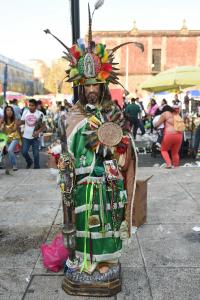
Pew Research Center, for which I have served as an academic consultant, has published seven key facts about American Catholics, which I have included here in bold type followed by my own analysis in standard type.
The Catholic Church is larger than any other single religious institution in the United States, with over 17,000 parishes that serve a large and diverse population. In spite of its size and influence, the church in recent decades has faced a number of significant challenges, from a decline in membership to a shortage of priests to continuing revelations that some Catholic clergy sexually abused minors and (in many cases) that their superiors covered up these actions.
Here are seven facts about American Catholics and their church:
1 There are roughly 51 million Catholic adults in the U.S., accounting for about one-fifth of the total U.S. adult population, according to Pew Research Center’s 2014 Religious Landscape Study. That study found that the share of Americans who are Catholic declined from 24% in 2007 to 21% in 2014.
Until now the Church in the U.S. had avoided the rapid decline in membership that has been taking place for decades in Latin America. During the first couple year of Francis’s papacy there was much talk of a “Francis effect” in which pews were supposedly filling with lapsed parishioners excited about the Argentine pontiff’s charisma and mission. However, if there is any “Francis effect” at all it’s a negative one, especially in Latin America where new polling data reveals continuing if not accelerated losses during his papacy.
2 Catholicism has experienced a greater net loss due to religious switching than has any other religious tradition in the U.S. Overall, 13% of all U.S. adults are former Catholics – people who say they were raised in the faith, but now identify as religious “nones,” as Protestants, or with another religion. By contrast, 2% of U.S. adults are converts to Catholicism – people who now identify as Catholic after having been raised in another religion (or no religion). This means that there are 6.5 former Catholics in the U.S. for every convert to the faith. No other religious group analyzed in the 2014 Religious Landscape Study has experienced anything close to this ratio of losses to gains via religious switching.
One of the main reasons for the greatest net loss due to religious switching is the lack of marketing of the faith. While the American Church has been much better than its Latin American counterparts in advertising Catholic services and goods to the public, it’s still in the stone age compared to American Evangelicals and Charismatics who masterfully market their brands on TV and social media. This is part of the reason why Pope Francis has ordered clergy to leave the comfortable confines of their offices and go out into the world to evangelize.
3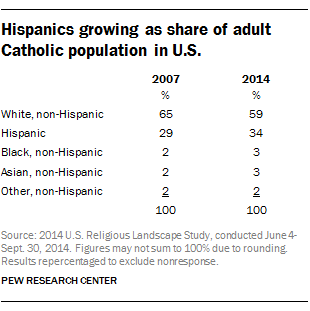 Catholics in the U.S. are racially and ethnically diverse. Roughly six-in-ten Catholic adults are white, one-third are Latino, and smaller shares identify as black, Asian American, or with other racial and ethnic groups. The data also show that the share of U.S. Catholics who are Latino has been growing, and suggest that this share is likely to continue to grow. Indeed, among Catholic Millennials, there are about as many Hispanics as whites. (For information on the demographic characteristics of U.S. Catholics, including age, education, income and more, see “America’s Changing Religious Landscape.”)
The future of the American Church is clearly a Latinx one as the percentage of Hispanic Catholics continues to rise steadily. Besides their faith-inspired commitment to lobby on behalf of Central American and Mexican immigrants, U.S. bishops are well aware of the demographic shift taking place in the pews and wisely adopt a preferential option for Latinx parishioners. With only 3% of Catholics being each Black and Asian, church membership in the U.S. is essentially Latinx and White.
4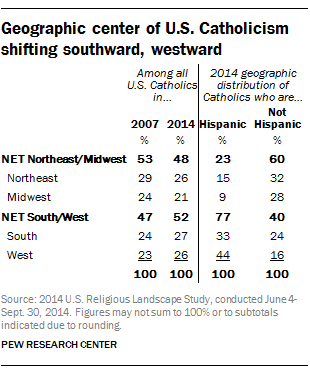 Compared with some other religious groups, Catholics are fairly evenly dispersed throughout the country: 27% live in the South, 26% in the Northeast, 26% in the West, and 21% of U.S. Catholics live in the Midwest. Since many American Hispanics are Catholic, the continuing growth of this community as a share of the U.S. population is gradually shifting the geographic center of U.S. Catholicism from the Northeast and Midwest to the South and the West. Indeed, three-quarters of Hispanic Catholics reside in the South or West, while six-in-ten non-Hispanic Catholics live in the Northeast or Midwest. Overall, the share of U.S. Catholic adults who reside in the Northeast and the Midwest declined by 5 percentage points between 2007 and 2014 (from 53% to 48%), while the share of Catholics who live in the South and West grew by an equal amount (from 47% to 52%).
The shifting geographic center of American Catholicism due to rising Latinx influence means the new urban centers of gravity of the Church are cities such as Los Angeles, Houston, Phoenix, and Dallas. The old urban bedrocks of American Catholic life, such as Boston and Baltimore, are fading in national prominence.
5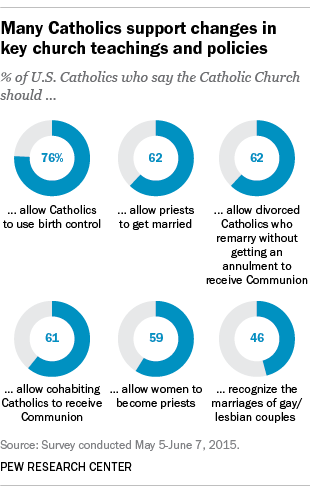 Many U.S. Catholics say they want to see the church make significant changes. For example, six-in-ten say they think the church should allow priests to marry and allow women to become priests. And nearly half of U.S. Catholics say the church should recognize the marriages of gay and lesbian couples. Support for these kinds of changes is lower – though still substantial – among Catholics who attend Mass regularly than it is among those who attend Mass less often.
The global nature of the Church makes these type of progressive changes that many American and European Catholics favor difficult. The future of Catholicism is in the Global South, especially Africa, where attitudes on sexual and social issues are significantly more conservative. Pope Francis’s relatively progressive agenda has faced well organized and relentless opposition from bishops across the globe, including American and European prelates, so the future does not bode well for those who favor married priests, female clergy, and recognition of gay marriage, among other major changes.
6 Politically, Catholic registered voters are evenly split between those who identify with or lean toward the Democratic Party (47%) and those who favor the GOP (46%). In their partisanship, U.S. Catholics are deeply divided along racial and ethnic lines. Most Hispanic Catholics identify with or lean toward the Democratic Party, while 54% of white Catholics today identify with or lean toward the GOP.
White and Latinx Catholics tend to worship not only in separate parishes but also have very different political profiles. While Latinx Catholics voted overwhelmingly for Hillary Clinton, 60% of White parishioners voted for Donald Trump. In fact, despite all the media reporting on Trump’s overwhelming support among White Evangelicals, it was White Catholics in the key swing states of Michigan, Ohio, and Pennsylvania who swung the election in his favor. 51% of White parishioners approve of Trump’s performance as president while only 17% of Latinx do!
7 Large majorities of U.S. Catholics have admired Pope Francis throughout his tenure, but there are signs of growing discontent. The latest Pew Research Center polling, conducted in January 2018 (long before the latest revelations about sex scandals in the U.S. Catholic Church), found that the share of U.S. Catholics who gave Francis “excellent” or “good” marks for his handling of the sex abuse scandal in the church was 10 points lower in 2018 than it had been in 2015 (45% vs. 55%). The January 2018 survey also found that disenchantment with Pope Francis was especially pronounced among Catholics on the political right (i.e., among those who identify with or lean toward the Republican Party).
As a pope who’s embraced left-leaning Liberation Theology it’s no surprise the Latin American pontiff is not popular among the White Catholic political right. However the graver problem is the growing disenchantment among many Catholics who have found his progressive agenda appealing. As I’ve stated on numerous occasions even before the latest scandals, the mishandling of the endemic plague of sexual abuse perpetrated by members of the clergy has been his great Achilles’ heel, which now threatens to undo his unprecedented papacy. Nothing less than a real policy of zero tolerance in which predator priests are handed over to civil authorities for prosecution and Church files are opened for public scrutiny is in order, though even these measures might be too little too late to rescue his imperiled papacy.

About Andrew Chesnut
Dr. R. Andrew Chesnut earned his Ph.D degree in Latin American History from the University of California, Los Angeles in 1995 and joined the History Department faculty at the University of Houston in 1997. He quickly became an internationally recognized expert on Latin American religious history Professor Chesnut was selected as the inaugural recipient of the Bishop Walter Sullivan Chair in Catholic Studies at VCU in 2008. The chair was established as the Most Rev. Walter F. Sullivan was nearing retirement as the 11th bishop of the Catholic Diocese of Richmond to honor his nearly thirty years of service. For Professor Chesnut the chair became a unique opportunity to develop Catholic studies in a global context and at a large public university. Professor Chesnut’s early work, Born Again in Brazil: The Pentecostal Boom and the Pathogens of Poverty (Rutgers University Press, 1997), traces the meteroric rise of Pentecostalism among the popular classes in Brazil following the disestablishment of the Roman Catholic Church. His second book, Competitive Spirits: Latin America’s New Religious Economy (Oxford University Press, 2003) focuses on the three groups that have prospered most in the region’s pluralist landscape, Protestant Pentecostalism, the Catholic Charismatic Renewal, and African disasporic religions (e.g., Brazilian Candomble and Haitian Vodou). Professor Chesnut's most recent book is Devoted to Death: Santa Muerte, the Skeleton Saint (Oxford University Press, 2025). It is the first in-depth study of the Mexican folk saint in English and has received widespread media coverage. You can read more about the author here.
Previous Post
August 30, 2018
Why is Exorcism All the Rage Across the Globe?
Browse Our Archives
Select a Category Amazon Synod andrew chesnut Brazil Catholicism Christianity death Evangelical Exorcism kate kingsbury Mexico narcocult Orixas Our Lady of Aparecida Our lady of the Bullet Pentecostal Religion Rey Pascual Santa Muerte Uncategorized vodou
Select a Month October 2026 September 2026 August 2026 July 2026 June 2026 May 2026 April 2026 March 2026 February 2026 January 2026 December 2025 October 2025 September 2025 August 2025 June 2025 May 2025 April 2025 February 2025 January 2025 November 2024 October 2024 September 2024 July 2024 May 2024 April 2024 January 2024 December 2023 October 2023 July 2023 June 2023 April 2023 March 2023 January 2023 December 2022 November 2022 October 2022 September 2022 July 2022 June 2022 January 2022 October 2021 September 2021 August 2021 May 2021 March 2021 February 2021 October 2020 August 2020 July 2020 June 2020 May 2020 April 2020 March 2020 February 2020 November 2019 October 2019 August 2019 July 2019 June 2019 May 2019 April 2019 March 2019 February 2019 January 2019 December 2018 November 2018 October 2018 September 2018 August 2018 July 2018 June 2018 May 2018 April 2018 March 2018
Follow Us!
TAKE THE
Religious Wisdom Quiz
What language was the New Testament originally written in?
Select your answer to see how you score.
Latin Hebrew Greek Aramaic
Related posts from The Global Catholic Review

Brazil’s Black Madonna as Political Football in Heated...

Brazil's Religious Revolution: What a Huge New Survey...

Trump's Catholic Problem Heading Into November Midterms

Did Pentecostalism Kill Brazilian Football's 'Jogo Bonito'?
TRENDING AT PATHEOS Catholic

Emotion in Early Christianity by Andrew Crislip
Andrew Crislip’s Emotion in Early Christianity examines an often overlooked dimension of...

16 Spiritual Touchstones for a More Grounded Life
After decades of spiritual study, here are 16 principles I try...

Catholic Evangelization: Sharing Your Faith Every Day
Welcome back to the Graceful Awakening mini-series called, “From Faith to Mission.” ...

The Pillar of the Boatmen: the Ancient Monument...
The Pillar of the Boatmen is a Romano-Gaulish sculpture that dates from...

In one sense walking into Westminster Abbey is like walking down the...

'Super Scam Me' Exposes AI Jon Bon Jovi...
Leslie Pickett believed she was in a relationship with Jon Bon Jovi....
view all Catholic blogs
Ad-Free & Subscriber Log-In Subscription Support
- About Us
- 2026 Calendar
- Videos
- Podcasts
- Library of World Religions
- Faith In Media Tracker
- Advertise With Us
- Write for Us
- Privacy Policy
- Terms of Service
- Do Not Sell My Data
- Contact Us
- Radiant Digital
- Manage Newsletter Subscriptions
- Unsubscribe From Notifications
- Sitemap
Copyright 2008-2026, Patheos. All rights reserved.
Subscription Support Ad-Free & Subscriber Log-In
Follow Patheos