
BuddhistCatholicContemplativeEvangelicalGeneral ChristianHinduJewishLatter-day SaintMuslimNew VisionsProgressive Christian
Beliefs
- Buddhist
- Catholic
- Contemplative
- Evangelical
- General Christian
- Hindu
- Jewish
- Latter-day Saint
- More Voices
- Muslim
- New Visions
- Pagan
- Progressive Christian
Topics
- Religion News
- Food and Religion
- Sports and Religion
- Religious Art
- Religious Music and Entertainment
- Religious Events
- History and Religion
- Style and Religion
- Politics and Religion
- Women in Religion
- Recreation Outdoors and Religion
- Business Finance and Religion
- Careers Workplace and Religion
- Education and Religion
- Family Parenting and Religion
- Health Fitness and Religion
- Home and Religion
- Relationships and Religion
- Technology and Religion
- Travel and Religion
Columnists
- Buddhist Columnists
- Business Finance and Religion Columnists
- Careers Workplace and Religion Columnists
- Catholic Columnists
- Contemplative Columnists
- Education and Religion Columnists
- Evangelists Columnists
- Family Parenting and Religion Columnists
- General Christian Columnists
- Health Fitness and Religion Columnists
- Hindu Columnists
- History and Religion Columnists
- Home and Religion Columnists
- Jewish Columnists
- More Voices Columnists
- Latter Day Columnists
- Muslim Columnists
- New Visions Columnists
- Nonreligious Columnists
- Pagan Columnists
- Politics and Religion Columnists
- Progressive Columnists
- Recreation Outdoors and Religion Columnists
- Relationships and Religion Columnists
- Religion News Columnists
- Religious Art Columnists
- Religious Events Columnists
- Religious Music and Entertainment Columnists
- Sports and Religion Columnists
- Style and Religion Columnists
- Technology and Religion Columnists
- Travel and Religion Columnists
- Women in Religion Columnists
Resource Library
- 2026 Calendar
- Library of World Religions
- The 100 Most Holy Places on Earth
- Patheos Answers
- Podcasts
- Videos
- Faith Leaders Database
- Anglican Episcopalian
- Bahai
- Baptist
- Buddhism
- Christianity
- Confucianism
- Eastern Orthodoxy
- Hinduism
- Holiness and Pentecostal
- ISKCON
- Islam
- Judaism
- Lutheran
- Methodist
- The Church of Jesus Christ of Latter-day Saints
- New Age
- Paganism
- Presbytarian and Reformed
- Protestantism
- Religion Behind the Scenes
- Roman Catholic
- Scientology
- Shia Islam
- Sikhism
- Sufism
- Sunni Islam
- Taoism
- Zen
- See all religions
Research Tools
 Ad-Free & Subscriber Log-In Subscription Support
Ad-Free & Subscriber Log-In Subscription Support
Follow Patheos 

- Trending:
- Forgiveness
- |
- Marriage
- |
- Consciousness
- |
- Death Penalty
- |
- Election
- |
- Halloween

- Home
- Catholic
- Religion News
- From Anonymous Bones to Memorial Skulls at an Austrian Ossuary – A Photo-Essay from Hallstatt
From Anonymous Bones to Memorial Skulls at an Austrian Ossuary – A Photo-Essay from Hallstatt
Last updated on: July 14, 2018 at 3:03 am by Andrew Chesnut
From Anonymous Bones to Memorial Skulls at an Austrian Ossuary – A Photo-Essay from Hallstatt 2018-07-14T03:03:06-04:00 Andrew Chesnut
Patheos Explore the world's faith through different perspectives on religion and spirituality! Patheos has the views of the prevalent religions and spiritualities of the world.
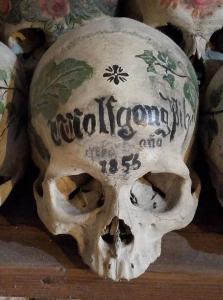
Memorial skull at Hallstatt Beinhaus. All photos by Dr. Andrew Chesnut.
Death as the ultimate equalizer is one of the compelling themes at the ossuaries of Catholic Europe. Most of the thousands of human skeletons and bones on display, whether in artistic arrangements or scattered haphazardly on the ground, bear no obvious traces of individuality. The distinctions and divisions of sex, age, type of employment, and social class, to some extent, of life in highly stratified European societies are obliterated by the leveling scythe of the Grim Reaper and Reapress, in Italy and Spain.
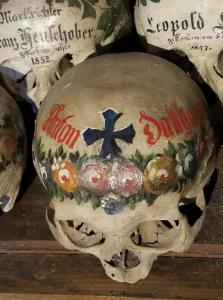
Anonymous skulls, femurs, and rib cages, among scores of other bones, serve as memento mori in no uncertain terms. No matter our station in life, we all end up as skeletons, stripped of the flesh and blood that are are an integral part of our individuality. Until a new tradition of adorning and memorializing the skulls of the deceased emerged in the Catholic Alpine region of Austria, Switzerland, and Germany, only nobility and clergy were laid to rest at charnel houses, bone chapels, and monasteries with any markers of personhood, most importantly with name tags and vestments.
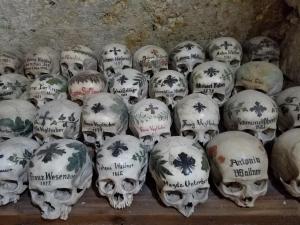
At the beginning of the eighteenth century the converging streams of Protestantism, the Enlightenment, and nascent capitalism led to a growing sense of individualism among the Western European majorities, especially the emergent bourgeoisie. Like European nobility, members of the newly formed middle classes sought to express their individuality in both life and death, and in Catholic
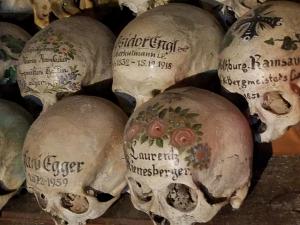
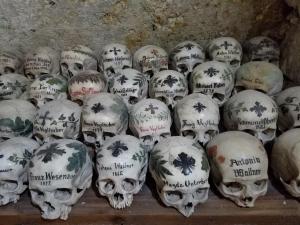
Alpine Germania one of the unique ways this maninfested was through the ornamentation and memorialization of skulls of deceased family members. And it was in the picturesque mountain village of Hallstatt where the artistic memorialization of skulls was realized most creatively and abundantly.
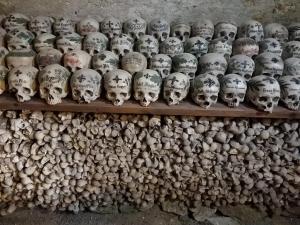
Western Europe’s high population density not only applies to the living. Many cemeteries across the continent became so overcrowded that after several years of decomposing six feet under, skeletons would be exhumed from their graves and placed in charnel houses, a term which derives from the Latin word for flesh, carnalis. In the 1700s St. Michael’s Church in Hallstattt began exhuming skeletons in the graveyard to make room for new arrivals.
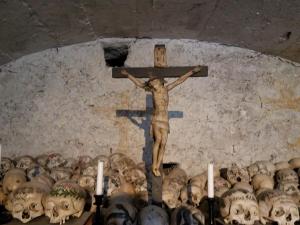
After the skeletons were bleached in the sun and transformed from a moldy yellow to a parched white, family members would stack the bones in the charnel house next to their bony kin. The new practice of memoralizing skulls with names and dates of birth and death, as well as adorning them with painted symbols took root in the 1720s. About half of the some 1,200 skulls at the Hallstatt Beinhaus are graced by symbolic flora, such as red roses for love, laurels for victory, oak for glory, among others. The majority of the 610 crania that bear dates are inscribed with years belonging to the 1800s. By the mid-20th century, the unique Catholic tradition from Alpine Germania had faded away with the last skull admitted in 1995.
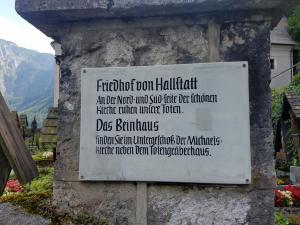
As part of the new Western fascination with death culture, especially in the U.S. and UK, the Hallstatt Beinhaus has become a trendy tourist attraction. In fact, it wasn’t easy to photograph the skulls among scores of international tourists elbowing each other in the small space. Despite the crowds, the Austrian ossuary is a poignant reminder that the now hegemonic individualism of the West, which extends beyond the grave, is of quite recent vintage, originating in singular form with the memorial skulls of Hallstatt.

About Andrew Chesnut
Dr. R. Andrew Chesnut earned his Ph.D degree in Latin American History from the University of California, Los Angeles in 1995 and joined the History Department faculty at the University of Houston in 1997. He quickly became an internationally recognized expert on Latin American religious history Professor Chesnut was selected as the inaugural recipient of the Bishop Walter Sullivan Chair in Catholic Studies at VCU in 2008. The chair was established as the Most Rev. Walter F. Sullivan was nearing retirement as the 11th bishop of the Catholic Diocese of Richmond to honor his nearly thirty years of service. For Professor Chesnut the chair became a unique opportunity to develop Catholic studies in a global context and at a large public university. Professor Chesnut’s early work, Born Again in Brazil: The Pentecostal Boom and the Pathogens of Poverty (Rutgers University Press, 1997), traces the meteroric rise of Pentecostalism among the popular classes in Brazil following the disestablishment of the Roman Catholic Church. His second book, Competitive Spirits: Latin America’s New Religious Economy (Oxford University Press, 2003) focuses on the three groups that have prospered most in the region’s pluralist landscape, Protestant Pentecostalism, the Catholic Charismatic Renewal, and African disasporic religions (e.g., Brazilian Candomble and Haitian Vodou). Professor Chesnut's most recent book is Devoted to Death: Santa Muerte, the Skeleton Saint (Oxford University Press, 2025). It is the first in-depth study of the Mexican folk saint in English and has received widespread media coverage. You can read more about the author here.
Previous Post
July 8, 2018
St. Notburga - The Skeleton Saint of Social Justice
Next Post
July 24, 2018 The Virgin of Guadalupe - Queen of Mexico and Empress of the Americas
Browse Our Archives
Select a Category Amazon Synod andrew chesnut Brazil Catholicism Christianity death Evangelical Exorcism kate kingsbury Mexico narcocult Orixas Our Lady of Aparecida Our lady of the Bullet Pentecostal Religion Rey Pascual Santa Muerte Uncategorized vodou
Select a Month October 2026 September 2026 August 2026 July 2026 June 2026 May 2026 April 2026 March 2026 February 2026 January 2026 December 2025 October 2025 September 2025 August 2025 June 2025 May 2025 April 2025 February 2025 January 2025 November 2024 October 2024 September 2024 July 2024 May 2024 April 2024 January 2024 December 2023 October 2023 July 2023 June 2023 April 2023 March 2023 January 2023 December 2022 November 2022 October 2022 September 2022 July 2022 June 2022 January 2022 October 2021 September 2021 August 2021 May 2021 March 2021 February 2021 October 2020 August 2020 July 2020 June 2020 May 2020 April 2020 March 2020 February 2020 November 2019 October 2019 August 2019 July 2019 June 2019 May 2019 April 2019 March 2019 February 2019 January 2019 December 2018 November 2018 October 2018 September 2018 August 2018 July 2018 June 2018 May 2018 April 2018 March 2018
Follow Us!
TAKE THE
Religious Wisdom Quiz
How many people did Jesus feed with five loaves and two fish?
Select your answer to see how you score.
About 100 About 7000 About 5000 men About 12
Related posts from The Global Catholic Review

Brazil’s Black Madonna as Political Football in Heated...

Brazil's Religious Revolution: What a Huge New Survey...

Trump's Catholic Problem Heading Into November Midterms

Did Pentecostalism Kill Brazilian Football's 'Jogo Bonito'?
TRENDING AT PATHEOS Catholic

The First Eucharistic Controversy: Christ’s Real Presence
For Catholics, the Eucharist is the source and summit of the Christian...

What a Stop Sign Can Teach Us About...
How to Make a Decision When You Can't Hear God Main point:...

Archdiocese Hosts Military Marriage Retreat in Germany
RASTATT, Germany — The transient military lifestyle, with its frequent deployments and...

Nearly every morning, I make the drive to Detroit with my high-school-age...

The Real AI Story Is Adoption Without Trust
Artificial intelligence has crossed a political threshold. It is no longer a...

A new article, written by Jeff Lindsay and Gale L. Pooley,...
view all Catholic blogs
Ad-Free & Subscriber Log-In Subscription Support
- About Us
- 2026 Calendar
- Videos
- Podcasts
- Library of World Religions
- Faith In Media Tracker
- Advertise With Us
- Write for Us
- Privacy Policy
- Terms of Service
- Do Not Sell My Data
- Contact Us
- Radiant Digital
- Manage Newsletter Subscriptions
- Unsubscribe From Notifications
- Sitemap
Copyright 2008-2026, Patheos. All rights reserved.
Subscription Support Ad-Free & Subscriber Log-In
Follow Patheos