
BuddhistCatholicContemplativeEvangelicalGeneral ChristianHinduJewishLatter-day SaintMuslimNew VisionsProgressive Christian
Beliefs
- Buddhist
- Catholic
- Contemplative
- Evangelical
- General Christian
- Hindu
- Jewish
- Latter-day Saint
- More Voices
- Muslim
- New Visions
- Pagan
- Progressive Christian
Topics
- Religion News
- Food and Religion
- Sports and Religion
- Religious Art
- Religious Music and Entertainment
- Religious Events
- History and Religion
- Style and Religion
- Politics and Religion
- Women in Religion
- Recreation Outdoors and Religion
- Business Finance and Religion
- Careers Workplace and Religion
- Education and Religion
- Family Parenting and Religion
- Health Fitness and Religion
- Home and Religion
- Relationships and Religion
- Technology and Religion
- Travel and Religion
Columnists
- Buddhist Columnists
- Business Finance and Religion Columnists
- Careers Workplace and Religion Columnists
- Catholic Columnists
- Contemplative Columnists
- Education and Religion Columnists
- Evangelists Columnists
- Family Parenting and Religion Columnists
- General Christian Columnists
- Health Fitness and Religion Columnists
- Hindu Columnists
- History and Religion Columnists
- Home and Religion Columnists
- Jewish Columnists
- More Voices Columnists
- Latter Day Columnists
- Muslim Columnists
- New Visions Columnists
- Nonreligious Columnists
- Pagan Columnists
- Politics and Religion Columnists
- Progressive Columnists
- Recreation Outdoors and Religion Columnists
- Relationships and Religion Columnists
- Religion News Columnists
- Religious Art Columnists
- Religious Events Columnists
- Religious Music and Entertainment Columnists
- Sports and Religion Columnists
- Style and Religion Columnists
- Technology and Religion Columnists
- Travel and Religion Columnists
- Women in Religion Columnists
Resource Library
- 2026 Calendar
- Library of World Religions
- The 100 Most Holy Places on Earth
- Patheos Answers
- Podcasts
- Videos
- Faith Leaders Database
- Anglican Episcopalian
- Bahai
- Baptist
- Buddhism
- Christianity
- Confucianism
- Eastern Orthodoxy
- Hinduism
- Holiness and Pentecostal
- ISKCON
- Islam
- Judaism
- Lutheran
- Methodist
- The Church of Jesus Christ of Latter-day Saints
- New Age
- Paganism
- Presbytarian and Reformed
- Protestantism
- Religion Behind the Scenes
- Roman Catholic
- Scientology
- Shia Islam
- Sikhism
- Sufism
- Sunni Islam
- Taoism
- Zen
- See all religions
Research Tools
 Ad-Free & Subscriber Log-In Subscription Support
Ad-Free & Subscriber Log-In Subscription Support
Follow Patheos 

- Trending:
- Forgiveness
- |
- Marriage
- |
- Consciousness
- |
- Death Penalty
- |
- Election
- |
- Halloween

- Home
- Pagan
- Book Review: So Potent Art by Emily Carding
Book Review: So Potent Art by Emily Carding
Last updated on: November 10, 2021 at 10:46 am by Ash
Book Review: So Potent Art by Emily Carding 2021-11-10T10:46:23-05:00 Ash
Patheos Explore the world's faith through different perspectives on religion and spirituality! Patheos has the views of the prevalent religions and spiritualities of the world.
In this post, I’ll be reviewing So Potent Art: the Magic of Shakespeare by Emily Carding, published in 2021 by Llewellyn Worldwide, Ltd.
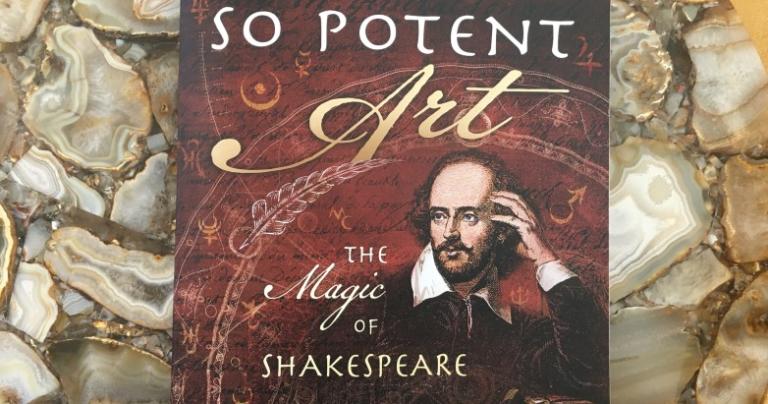
Image by Ash.
TLDR; Lovers of Shakespeare will revel in this work. So Potent Art is a thoughtfully written expose of the very real magic that influenced many of Shakespeare’s greatest plays. Readers who enjoy reading academic analyses will connect well with Carding’s writing style.
I had a lot of preconceptions about this book before I received a copy to review. My initial thought was that it would be a how-to style manual on creating ritual and invocation using Shakespearean themes. While my initial thought wasn’t incorrect, per se, this book offers much more.
The book begins with a beautifully written foreward by Caitlin Matthews, a well known author in Celtic and Western mysteries traditions and research. In fact, I own several of her books and would recommend them to readers who enjoy Celtic myths and storytelling! Matthews’ foreward sets the tone for the rest of the book, I think. Carding’s writing, while academic in style and form, is very much that of a storyteller. This isn’t surprising, as they hold a BA in Theatre Arts and an MFA in Staging Shakespeare. Of particular interest to Traditional Wiccans, Carding is an Alexandrian initiate to boot!
Places, Everyone!

Image via Pixabay.
The first few chapters set the stage, so to speak, for understanding the myriad occult beliefs and practices that influenced Shakespearean story, imagery, and prose. Chapters One and Two go into the origins of occult philosophy, including Neoplatonism, alchemy, mythic poetry (like Edmund Spenser’s Faerie Queene), hermetics, and Renaissance philosophers (Dee, Bacon, Camillo, et al). These chapters are essentially a crash course in some of the most influential occult authors and works of the time. I certainly enjoyed the refresher and learned a few new things myself.
Chapters Three and Four are dedicated to understanding how Jewish mysticism and alchemy played parts in Shakepeare’s world building skills and imagery. Carding uses numerous excerpts from Shakespeare’s plays as evidence of both hidden and overt displays of mystic and alchemical influence. It should be noted that Carding included summaries of the plays and characters they reference in this book. These summaries are peppered throughout the book and are helpful to those of us who are less knowledgeable.
Chapters Five through Seven, are each dedicated to magical and mythic beings: ghosts, fairies, and witches. Carding identifies Shakespearen examples of these beings, describes their natures, and then ends each chapter with exercises designed to connect with them. I particularly enjoyed the section on “The Rhythm of Magic: Catalectic Trochaic Tetrameter.” Carding talks about how Shakespeare breaks from his usual iambic pentameter verse rhythm to a rhythm better suited to making magic verses (catalectic trochaic tetrameter). In thinking about spells that I’ve written, I’ve definitely (and subconsciously) adopted that writing style to create invocations and incantations. Pretty rad to make that connection!
The Curtains Rise
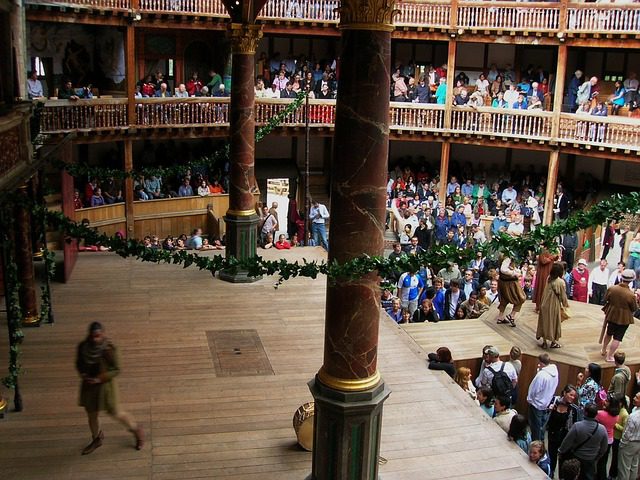
A view from within the reconstructed Globe Theatre. Image via Pixabay.
Chapter Eight documents various examples of divination used in Shakespeare’s plays, including oracular prophecy, omens, and portents. There are sections that talk about what it means to get an ill portent and what the consequences would be if they were ignored. Caesar, bro, this is about you. You were straight up given a date to mind your step (March 15) and you numbskulled yourself into getting shanked.
Chapter Nine is probably my favorite of the entire book. Carding talks about how to write prayers and invocations using beautiful examples from Shakespeare’s work. The “Prayer to Diana” (p. 209) is gorgeous and is taken from Shakepeare’s Much Ado About Nothing. Readers who are also members of initiatory traditions may find the section on “Witnessing” to be of interest. It discusses oathmaking, swears, and promises made with spirits and gods as witnesses. Blessings and Curses are also discussed, and many of us know that there are many curses thrown about in Shakespeare’s work! This chapter also discusses possession as a form of invocation (p. 234).
Chapter Ten goes into the uses of certain plants, herbs, and trees used in Shakepeare’s works. It’s not surprising that today’s plant magic looks a whole hell of a lot like what Shakespeare describes. Carding includes planetary correspondences to many of the plants that appear in Shakepeare’s works (p. 254-256), and an exercise at the end for creating your own charm bag for inspiration.
The Final Acts
Chapter Eleven explores modern figures whose research and insight have further contributed to the understanding of Shakespeare today. While it’s certainly important to see who influenced Shakespeare, it’s equally important to understand who Shakespeare has influenced. I only recognized a couple of the individuals Carding described, but theatre folks will likely have an easier time.
Chapter Twelve describes ritual theatre, its use, and how we can use Shakespeare’s ritual theatre today. I really enjoyed this chapter! Those who frequently lead group rituals may learn a few new tricks, for sure. For those who are new or less confident in leading ritual, there’s a section of this chapter called “A Step-by-Step Guide” (p. 284). Carding talks about the process of creating ritual theatre and uses their own creations and reflections as examples.
Applause
My overall impression of this book is that Carding put so much damn work into it. It read like a professional thesis, which has both good and challenging qualities. Readers with academic backgrounds and a decent exposure to Shakespeare will get the most out of this book. Those without that buy-in may find this work a bit challenging because there are quite a few areas where Carding assumes the reader has a certain level of familiarity with Shakespeare’s works.
The quality of this book is superb in the way that it’s written and researched. It couldn’t be more evident that Carding is a true Shakespeare scholar and a devotee of his work and impact.
Follow me on Instagram @thegardnerianlibrarian
Follow me on Twitter @gardlibrarian
Previous Post

September 20, 2021
A Fiction Prescription: Read Daily for Best Results
Next Post

November 30, 2021 The Horned One About My Heart
Browse Our Archives
Select a Category CRAAP Gardnerian Horsa Librarianship Pagan Book Reviews Paganism Sacred Pentagraph Uncategorized Wicca Witchcraft
Select a Month November 2025 May 2025 December 2024 September 2024 August 2024 February 2024 November 2023 May 2023 February 2023 December 2022 October 2022 August 2022 July 2022 May 2022 April 2022 February 2022 January 2022 December 2021 November 2021 September 2021 July 2021 June 2021 May 2021 March 2021 February 2021 January 2021 December 2020 November 2020
TAKE THE
Religious Wisdom Quiz
What did the Israelites eat in the wilderness?
Select your answer to see how you score.
Grapes and figs Bread and fish Honey and milk Manna
Related posts from The Gardnerian Librarian
Pagans Do Theology: Why Do We Practice by...

Books & Broomsticks: A List of Favorite Podcasts...

TRENDING AT PATHEOS Pagan

I was recently chatting with someone on Instagram. She asked me what...

While there are many people who share their results, the end of...

On July 23, I saw Christopher Nolan's The Odyssey which is Homer’s...

As I write this two big events have just finished up. One...

Restoring the Watershed of Divine Love
Perhaps cooperation is not something we manufacture through legislation, ideology, or moral...

Many UUs don’t pray because of bad experiences in a previous religion,...
view all Pagan blogs
Ad-Free & Subscriber Log-In Subscription Support
- About Us
- 2026 Calendar
- Videos
- Podcasts
- Library of World Religions
- Faith In Media Tracker
- Advertise With Us
- Write for Us
- Privacy Policy
- Terms of Service
- Do Not Sell My Data
- Contact Us
- Radiant Digital
- Manage Newsletter Subscriptions
- Unsubscribe From Notifications
- Sitemap
Copyright 2008-2026, Patheos. All rights reserved.
Subscription Support Ad-Free & Subscriber Log-In
Follow Patheos