
BuddhistCatholicContemplativeEvangelicalGeneral ChristianHinduJewishLatter-day SaintMuslimNew VisionsProgressive Christian
Beliefs
- Buddhist
- Catholic
- Contemplative
- Evangelical
- General Christian
- Hindu
- Jewish
- Latter-day Saint
- More Voices
- Muslim
- New Visions
- Pagan
- Progressive Christian
Topics
- Religion News
- Food and Religion
- Sports and Religion
- Religious Art
- Religious Music and Entertainment
- Religious Events
- History and Religion
- Style and Religion
- Politics and Religion
- Women in Religion
- Recreation Outdoors and Religion
- Business Finance and Religion
- Careers Workplace and Religion
- Education and Religion
- Family Parenting and Religion
- Health Fitness and Religion
- Home and Religion
- Relationships and Religion
- Technology and Religion
- Travel and Religion
Columnists
- Buddhist Columnists
- Business Finance and Religion Columnists
- Careers Workplace and Religion Columnists
- Catholic Columnists
- Contemplative Columnists
- Education and Religion Columnists
- Evangelists Columnists
- Family Parenting and Religion Columnists
- General Christian Columnists
- Health Fitness and Religion Columnists
- Hindu Columnists
- History and Religion Columnists
- Home and Religion Columnists
- Jewish Columnists
- More Voices Columnists
- Latter Day Columnists
- Muslim Columnists
- New Visions Columnists
- Nonreligious Columnists
- Pagan Columnists
- Politics and Religion Columnists
- Progressive Columnists
- Recreation Outdoors and Religion Columnists
- Relationships and Religion Columnists
- Religion News Columnists
- Religious Art Columnists
- Religious Events Columnists
- Religious Music and Entertainment Columnists
- Sports and Religion Columnists
- Style and Religion Columnists
- Technology and Religion Columnists
- Travel and Religion Columnists
- Women in Religion Columnists
Resource Library
- 2026 Calendar
- Library of World Religions
- The 100 Most Holy Places on Earth
- Patheos Answers
- Podcasts
- Videos
- Faith Leaders Database
- Anglican Episcopalian
- Bahai
- Baptist
- Buddhism
- Christianity
- Confucianism
- Eastern Orthodoxy
- Hinduism
- Holiness and Pentecostal
- ISKCON
- Islam
- Judaism
- Lutheran
- Methodist
- The Church of Jesus Christ of Latter-day Saints
- New Age
- Paganism
- Presbytarian and Reformed
- Protestantism
- Religion Behind the Scenes
- Roman Catholic
- Scientology
- Shia Islam
- Sikhism
- Sufism
- Sunni Islam
- Taoism
- Zen
- See all religions
Research Tools
 Ad-Free & Subscriber Log-In Subscription Support
Ad-Free & Subscriber Log-In Subscription Support
Follow Patheos 

- Trending:
- Forgiveness
- |
- Marriage
- |
- Consciousness
- |
- Death Penalty
- |
- Election
- |
- Halloween
 The Freethinker
- Home
- Nonreligious
- Op-ed: Government & Religion
Op-ed: Government & Religion
Last updated on: December 17, 2020 at 10:20 pm by Professor John Radford
Op-ed: Government & Religion 2020-12-17T22:20:55+02:00 Professor John Radford
Patheos Explore the world's faith through different perspectives on religion and spirituality! Patheos has the views of the prevalent religions and spiritualities of the world.

Image via YouTube
IN November the UK Government launched an Independent Faith Engagement Review, headed by the Director of the Conservative Christian Fellowship, Colin Bloom, above. The review into ‘how best the government should engage with faith groups in England’ concluded on December 11. The consultation prompted Professor John Radford, Emeritus Professor of Psychology at the University of East London, to pen the following piece.
It needs to be pointed out that, particularly in the last few decades, a great deal of rigorous research and informed debate has appeared on this matter. My own partial list of relevant publications runs to 2,000 words. It is not possible to attempt even a summary of this here; indeed it would be otiose, since anyone preparing a report such as this will already be familiar with it.
I am confident, however, that what I have to say is supported by appropriate work. I might add for the record that I have experience of psychological and historical research and (I may say without false modesty) a distinguished career in Higher Education, at all levels from student to senior management.
I wish to suggest that regard should be had to some principles that may be taken as fundamental to our liberal, democratic society. Perhaps the most basic is the general acceptance of the rule of law, applicable equally to all up to and including government itself, and subject to democratic control. From this it follows, inter alia, that no individual or group should be specially privileged as regards access to justice, or to participation in government, or to any services provided by the State and funded by general taxation – health, education, police and fire and so on.
Freedom of information and debate should always be the default condition, restricted by government only for genuine needs of national security. There should be no restrictions on personal beliefs, religious or not, nor on related practices provided these are within the law of the land.
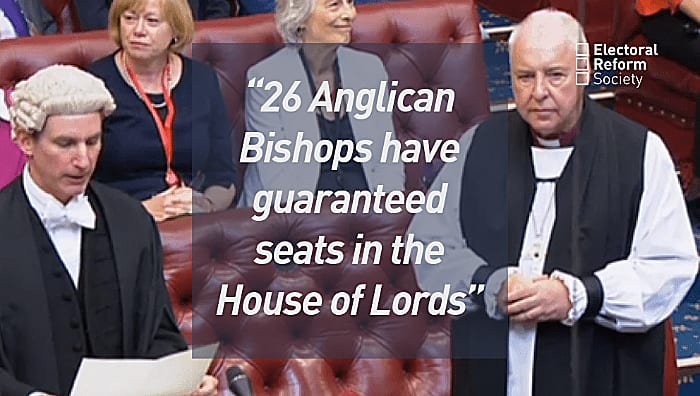
Now it is quite clear, in the present context, that various religious groups and individuals enjoy exceptions to these principles. To start at the top, as it were, twenty-six bishops of the Church of England are automatically members of the House of Lords, the upper chamber of Parliament.
As is well known, membership of the Anglican Church has been steadily declining for some time and now stands at around 15 percent of the population.
The continuance of the Bench of Bishops as part of our legislature is indefensible. It is sometimes suggested that they should be balanced by senior members of other faiths; but obviously that would only compound the problem.
A different governmental issue is that of taxation. Churches as organisations are generally granted tax exemptions as charities. It is far from clear why religious organisations, with their inevitably disputable and divisive doctrines, should necessarily be considered as of public benefit, which is a condition of being classed as a charity under the Charities Act 2006 (amended 2011).
These particular issues perhaps do not attract very much general concern. One that does is that of “faith” schools. There can be no doubt that these are undesirable, on several grounds. First, selection of children on the basis of their parents’ religion violates the basic principle of equality as above. Second, in some areas parents are obliged to send their children to a faith school, against their wishes, as no other is available.
It is obviously impossible to provide accessible schools to match all parents’ religions or lack thereof; and it is wrong to privilege one group over all the rest. Third, it is not justifiable to support discriminatory schools through taxation paid by all. Fourth, ample evidence shows that it is educationally better, from the point of view of reducing prejudice, for children to mix with others without regard to their backgrounds.
Fifth, a faith school necessarily presents its particular beliefs as superior to others (else why have it at all?). But if one is better, all the others must be worse, which is not a desirable attitude. And, not a separate point but to illustrate, surely the sorry history of Northern Ireland is sufficient warning against religious divisions in education.
This leads me to some of the ways in which religious groups and practices can be positively harmful. The shocking accumulation of cases of child abuse within various Churches is now common knowledge. Of course it is not suggested that religion was the cause; but it is clear that various Churches and senior clerics consistently sought to conceal the facts, and put the reputation of their organisation before the welfare of the children. Religions cannot be above the law.
There are other examples of such harm, indeed it might well be argued that being brought up in one of the various extremely rigid sects is itself child abuse. Certainly many survivors of such rearing regard it as that. I’ll mention just two examples. In any other context, cutting off the foreskins of under-age boys, who must by definition be unable to give informed consent, for no medical reason, but with consequent pain and potentially dangerous (occasionally fatal) sequelae, would be child abuse; and the perpetrator would no doubt face imprisonment.
But as ritual circumcision it is apparently acceptable. Another, thankfully rarer, example is the refusal of parents who are Jehovah’s Witnesses, to allow blood transfusions to save a child’s life. In these cases and others we are told “we must respect other people’s religious beliefs”. I disagree. I respect other people’s right to hold beliefs, however much I consider them absurd. I don’t respect any practices that would otherwise be illegal or inhumane. The underlying point is this: a faith or belief, however strongly and sincerely held, cannot in itself be a justification.
More generally, the question is raised as to whether religions, “faiths” and their various activities, are in general beneficial to society. First, there is no doubt that many religions are felt as beneficial by many individuals; they provide both emotional (spiritual) and practical support. In the case particularly of the Anglican Church in England, it has provided a unique treasury of historic and beautiful architecture, and this should by all means be preserved, perhaps put to other community uses as the religious demand decreases. Indeed, much of our greatest music and art have been religious in inspiration; but I know of no evidence that composers and artists would not have been just as productive in other circumstances.
For society as a whole, we can compare the more religious ones with the less so, based on stated belief and amount of attendance. We can also rate countries on numerous factors that can be counted as indicating welfare, such as low crime rate, good education, health and social services, general expression of satisfaction with life and so on. The results are clear. Countries that rate highest on positive measures, come lowest on religious factors; and vice versa. Of course this does not show that religion causes the negative factors; but it does suggest rather convincingly that it is not a very good preventative, nor is it a requisite for a good society.
It is worth pointing out, in the present context, that at least one enquiry (British Social Attitudes Survey, September 2018), found that just over half of the population stated that they belonged to no religion. With younger people, ages 18-24, this rose to 70 percent. All such surveys are snapshots, and subject to sampling error. But it does appear that undue attention by Government to faith groups runs a risk of neglecting, perhaps alienating, around half the general population; and that this proportion seems likely to increase.
Questions about human behaviour very seldom have a simple yes/no answer. However, based on what is well established, my personal firm conclusion is that matters of faith should as far as possible be left to individuals. Government should neither support nor restrict any faith or religion, or lack thereof. It should, however, act to ensure that all citizens, and groups and organisations, should behave in accordance with the law, and be neither favoured nor penalised unequally compared to others.
Independent Faith Engagement Review
Previous Post

December 17, 2020
Pastor, charged over child porn, called Sunday booze sales 'immoral'
Next Post

December 18, 2020 Priests behaving badly: a Friday round-up
Browse Our Archives
Select a Category Archive My Atheism News Opinion Reviews Uncategorized
Select a Month December 2021 November 2021 October 2021 September 2021 August 2021 July 2021 June 2021 May 2021 April 2021 March 2021 February 2021 January 2021 December 2020 November 2020 October 2020 September 2020 August 2020 July 2020 June 2020 May 2020 April 2020 March 2020 February 2020 January 2020 December 2019 November 2019 October 2019 September 2019 August 2019 July 2019 June 2019 May 2019 April 2019 March 2019 February 2019 January 2019 December 2018 November 2018 October 2018 September 2018 August 2018 July 2018 June 2018 May 2018 April 2018 March 2018 February 2018 January 2018 December 2017 November 2017 October 2017 September 2017 August 2017 July 2017 June 2017 May 2017 April 2017 March 2017 February 2017 January 2017 December 2016 November 2016 October 2016 September 2016 August 2016 July 2016 June 2016 May 2016 April 2016 March 2016 February 2016 January 2016 April 2012 March 2012 February 2012 January 2012 December 2011 November 2011 October 2011 September 2011 August 2011 July 2011 June 2011 May 2011 April 2011 March 2011 February 2011 January 2011 December 2010 November 2010 October 2010 September 2010 August 2010 July 2010 June 2010 May 2010 April 2010 March 2010 February 2010 January 2010 December 2009 November 2009 October 2009 September 2009 August 2009 July 2009 June 2009 May 2009 April 2009 March 2009 February 2009 January 2009 December 2008 November 2008 October 2008 September 2008 August 2008 July 2008 June 2008 May 2008 April 2008 March 2008 February 2008 January 2008 December 2007 November 2007 October 2007 September 2007 August 2007 July 2007 March 2007 April 2006 February 2006
Follow Us!
TAKE THE
Religious Wisdom Quiz
What does "Satan" mean in Hebrew?
Select your answer to see how you score.
Murderer Destroyer Deceiver Adversary
Books by This Author Books by The Freethinker
Related posts from The Freethinker

Gothic novelist Anne Rice, who quit being a...
Survey shows that US atheists are overwhelmingly pro-vax

Plumber gets $20,000 for finding money stashed in...
Virginia library's festive holiday display sparks a devil...
TRENDING AT PATHEOS Nonreligious

Dethroning Jesus and Enthroning Yourself
Jesus Never Asked to Be Worshipped. He Asked to Be Understood. Christianity...

Why Most Christians are Really Paulians and Jobians
I Don't Care, But It Matters Let's get this out of the...

Essential Tips to Successfully Navigate the Selling Process
Selling a house can feel overwhelming, but it doesn’t have to be....

To Make Remote Work Effective, Think About Others
The COVID-19 pandemic forced many companies to rapidly transition to remote work....

Flexibility Is Key to Solving Problems of Tomorrow
The world of work is undergoing a dramatic transformation. The COVID-19 pandemic...
view all Nonreligious blogs
Ad-Free & Subscriber Log-In Subscription Support
- About Us
- 2026 Calendar
- Videos
- Podcasts
- Library of World Religions
- Faith In Media Tracker
- Advertise With Us
- Write for Us
- Privacy Policy
- Terms of Service
- Do Not Sell My Data
- Contact Us
- Radiant Digital
- Manage Newsletter Subscriptions
- Unsubscribe From Notifications
- Sitemap
Copyright 2008-2026, Patheos. All rights reserved.
Subscription Support Ad-Free & Subscriber Log-In
Follow Patheos