
BuddhistCatholicContemplativeEvangelicalGeneral ChristianHinduJewishLatter-day SaintMuslimNew VisionsProgressive Christian
Beliefs
- Buddhist
- Catholic
- Contemplative
- Evangelical
- General Christian
- Hindu
- Jewish
- Latter-day Saint
- More Voices
- Muslim
- New Visions
- Pagan
- Progressive Christian
Topics
- Religion News
- Food and Religion
- Sports and Religion
- Religious Art
- Religious Music and Entertainment
- Religious Events
- History and Religion
- Style and Religion
- Politics and Religion
- Women in Religion
- Recreation Outdoors and Religion
- Business Finance and Religion
- Careers Workplace and Religion
- Education and Religion
- Family Parenting and Religion
- Health Fitness and Religion
- Home and Religion
- Relationships and Religion
- Technology and Religion
- Travel and Religion
Columnists
- Buddhist Columnists
- Business Finance and Religion Columnists
- Careers Workplace and Religion Columnists
- Catholic Columnists
- Contemplative Columnists
- Education and Religion Columnists
- Evangelists Columnists
- Family Parenting and Religion Columnists
- General Christian Columnists
- Health Fitness and Religion Columnists
- Hindu Columnists
- History and Religion Columnists
- Home and Religion Columnists
- Jewish Columnists
- More Voices Columnists
- Latter Day Columnists
- Muslim Columnists
- New Visions Columnists
- Nonreligious Columnists
- Pagan Columnists
- Politics and Religion Columnists
- Progressive Columnists
- Recreation Outdoors and Religion Columnists
- Relationships and Religion Columnists
- Religion News Columnists
- Religious Art Columnists
- Religious Events Columnists
- Religious Music and Entertainment Columnists
- Sports and Religion Columnists
- Style and Religion Columnists
- Technology and Religion Columnists
- Travel and Religion Columnists
- Women in Religion Columnists
Resource Library
- 2026 Calendar
- Library of World Religions
- The 100 Most Holy Places on Earth
- Patheos Answers
- Podcasts
- Videos
- Faith Leaders Database
- Anglican Episcopalian
- Bahai
- Baptist
- Buddhism
- Christianity
- Confucianism
- Eastern Orthodoxy
- Hinduism
- Holiness and Pentecostal
- ISKCON
- Islam
- Judaism
- Lutheran
- Methodist
- The Church of Jesus Christ of Latter-day Saints
- New Age
- Paganism
- Presbytarian and Reformed
- Protestantism
- Religion Behind the Scenes
- Roman Catholic
- Scientology
- Shia Islam
- Sikhism
- Sufism
- Sunni Islam
- Taoism
- Zen
- See all religions
Research Tools
 Ad-Free & Subscriber Log-In Subscription Support
Ad-Free & Subscriber Log-In Subscription Support
Follow Patheos 

- Trending:
- Forgiveness
- |
- Marriage
- |
- Consciousness
- |
- Death Penalty
- |
- Election
- |
- Halloween
 The Freethinker
- Home
- Nonreligious
- First ever cult Supreme Court Justice nominated by Trump
First ever cult Supreme Court Justice nominated by Trump
Last updated on: September 27, 2020 at 8:31 pm by Ophelia Benson
First ever cult Supreme Court Justice nominated by Trump 2020-09-27T20:31:30+02:00 Ophelia Benson
Patheos Explore the world's faith through different perspectives on religion and spirituality! Patheos has the views of the prevalent religions and spiritualities of the world.
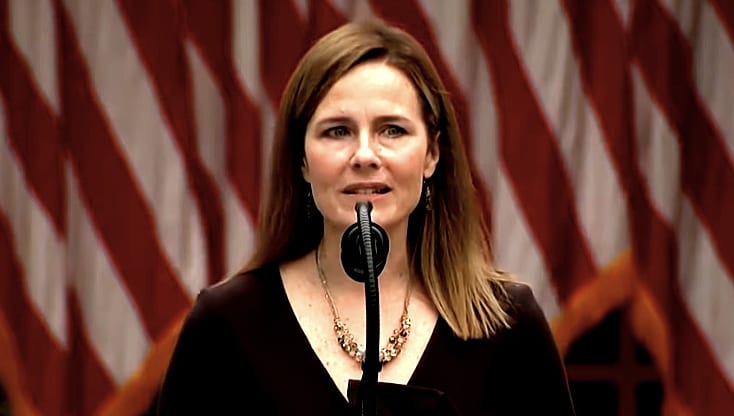
Image via YouTube
TRUMP chose to nominate a fanatical Catholic – Amy Coney Barrett, above – to replace Ruth Bader Ginsburg on the US Supreme Court. Of course he did, despite being perhaps the least religious president we’d ever had. Before you get excited about Donald Trump the freethinker, remember that he thinks of himself as a god.
Arguments from both political factions have been publicly rehearsed: will Barrett’s religious convictions affect her performance as a supreme court justice, or should they have nothing to do with determining her fitness for such an important role?
This is the absurdity we argue over, or watch pundits arguing over, with every nomination to the court. How can a person’s convictions not affect her performance as a supreme court justice? Or at least how can we safely assume and trust that they won’t?
Nominees all dutifully say that their religious views are in a completely different mental box from their legal reasoning, but then once they’re on the court how very often they decide cases just the way their religious views and affiliations would have predicted. It’s not as if religious bodies refrain from announcing their opinions on various subjects that are relevant to laws and legal interpretations, is it.
It’s permissible to grill court nominees about their other opinions, their mere secular and political and reason-based opinions. It’s only the special magical baseless ones, handed down from on high so long ago that no one knows the source, that are treated as off limits when it comes to really important decisions. Asking about that would be a Religious Test, you see, and that’s forbidden. It’s Article 6 of the Constitution: “no religious Test shall ever be required as a Qualification to any Office or public Trust under the United States.”
At the time it was a religious freedom move, but now it’s working to shield theocratic views on the law from questioning.
The National Constitution Center gives some background:
This prohibition, commonly known as the No Religious Test Clause, banned a longstanding form of religious discrimination practiced both in England and in the United States. In doing so, it provided a limited but enduring textual constitutional commitment to religious liberty and equality that has influenced the way Americans have understood the relationship between government and religion over the last two centuries.
In England, religious tests were used to “establish” the Church of England as an official national church. The Test Acts, in force from the 1660s until the 1820s, required all government officials to take an oath disclaiming the Catholic doctrine of transubstantiation and affirming the Church of England’s teachings about receiving the sacrament. These laws effectively excluded Catholics and members of dissenting Protestant sects from exercising political power. Religious tests were needed, William Blackstone explained, to protect the established church and the government “against perils from non-conformists of all denominations, infidels, turks, jews, heretics, papists, and sectaries.”
So the men (they were all men of course) who worked up the US Constitution said just don’t talk about it at all. The result is there are a lot of religious zealots on the Court and there will soon be another.
So now I want to know more about this People of Praise group (or cult) that Amy Coney Bryant belongs to. Stephanie Kirchgaessner at the Guardian has some basics:
Interviews with experts who have studied charismatic Christian groups such as People of Praise, and with former members of the group, plus a review of the group’s own literature, reveal an organization that appears to dominate some members’ everyday lives, in which so-called “heads” – or spiritual advisers – make big life decisions, and in which members are expected to financially support one another. Married women – such as Barrett – count their husbands as their “heads” and all members are expected to donate 5% of their income to the organization.
In other words the cult (or group) conceptualizes women as officially, universally subordinate to men, which means it sees them as in some way inferior. That’s not a great attribute in a justice on the top court, and it’s downright insulting as a replacement for Ruth Bader Ginsburg.
The group emerged out of the Catholic charismatic movement of the late 1960s, which blended Catholicism and Protestant Pentecostalism – Catholics and Protestants are both members – and adopted practices like speaking in tongues.
Well, I guess it could be worse, they could be snake-handlers.
People of Praise is headed by an all-male board of governors described as its “highest authority”.
Meaning that “highest authority” has to be male … yet here is ACB, up for a job with the highest legal authority the US has. How does that work? Doesn’t she believe that “highest authority” has to be male? Because if she doesn’t, what the hell is she doing in an organization that imposes that belief on her?
None of it makes any sense. It’s like going for a top job at the Center for Disease Control while believing in Christian Science.
Writing for Politico, Massimo Faggioli, a historian and theologian at Villanova University, said there were “tensions” between serving as a supreme court justice, one of the final interpreters of the US constitution, and swearing an oath to an organization he said “lacks transparency and visible structures of authority that are accountable to their members, to the Roman Catholic church, and to the wider public”.
How do we know the People of Praise won’t be telling ACB how to rule?
Previous Post

September 27, 2020
Wacko in Waco backpedals over Ginsburg death prayer

Browse Our Archives
Select a Category Archive My Atheism News Opinion Reviews Uncategorized
Select a Month December 2021 November 2021 October 2021 September 2021 August 2021 July 2021 June 2021 May 2021 April 2021 March 2021 February 2021 January 2021 December 2020 November 2020 October 2020 September 2020 August 2020 July 2020 June 2020 May 2020 April 2020 March 2020 February 2020 January 2020 December 2019 November 2019 October 2019 September 2019 August 2019 July 2019 June 2019 May 2019 April 2019 March 2019 February 2019 January 2019 December 2018 November 2018 October 2018 September 2018 August 2018 July 2018 June 2018 May 2018 April 2018 March 2018 February 2018 January 2018 December 2017 November 2017 October 2017 September 2017 August 2017 July 2017 June 2017 May 2017 April 2017 March 2017 February 2017 January 2017 December 2016 November 2016 October 2016 September 2016 August 2016 July 2016 June 2016 May 2016 April 2016 March 2016 February 2016 January 2016 April 2012 March 2012 February 2012 January 2012 December 2011 November 2011 October 2011 September 2011 August 2011 July 2011 June 2011 May 2011 April 2011 March 2011 February 2011 January 2011 December 2010 November 2010 October 2010 September 2010 August 2010 July 2010 June 2010 May 2010 April 2010 March 2010 February 2010 January 2010 December 2009 November 2009 October 2009 September 2009 August 2009 July 2009 June 2009 May 2009 April 2009 March 2009 February 2009 January 2009 December 2008 November 2008 October 2008 September 2008 August 2008 July 2008 June 2008 May 2008 April 2008 March 2008 February 2008 January 2008 December 2007 November 2007 October 2007 September 2007 August 2007 July 2007 March 2007 April 2006 February 2006
Follow Us!
TAKE THE
Religious Wisdom Quiz
In this Gospel, Jesus' first miracle is not recorded, and the narrative begins with a voice crying in the wilderness. Which Gospel starts with John the Baptist's ministry?
Select your answer to see how you score.
John Mark Matthew Luke
Books by This Author Books by The Freethinker
Related posts from The Freethinker

Gothic novelist Anne Rice, who quit being a...
Survey shows that US atheists are overwhelmingly pro-vax

Plumber gets $20,000 for finding money stashed in...
Virginia library's festive holiday display sparks a devil...
TRENDING AT PATHEOS Nonreligious

Dethroning Jesus and Enthroning Yourself
Jesus Never Asked to Be Worshipped. He Asked to Be Understood. Christianity...

Why Most Christians are Really Paulians and Jobians
I Don't Care, But It Matters Let's get this out of the...

Essential Tips to Successfully Navigate the Selling Process
Selling a house can feel overwhelming, but it doesn’t have to be....

To Make Remote Work Effective, Think About Others
The COVID-19 pandemic forced many companies to rapidly transition to remote work....

Flexibility Is Key to Solving Problems of Tomorrow
The world of work is undergoing a dramatic transformation. The COVID-19 pandemic...
view all Nonreligious blogs
Ad-Free & Subscriber Log-In Subscription Support
- About Us
- 2026 Calendar
- Videos
- Podcasts
- Library of World Religions
- Faith In Media Tracker
- Advertise With Us
- Write for Us
- Privacy Policy
- Terms of Service
- Do Not Sell My Data
- Contact Us
- Radiant Digital
- Manage Newsletter Subscriptions
- Unsubscribe From Notifications
- Sitemap
Copyright 2008-2026, Patheos. All rights reserved.
Subscription Support Ad-Free & Subscriber Log-In
Follow Patheos