
BuddhistCatholicContemplativeEvangelicalGeneral ChristianHinduJewishLatter-day SaintMuslimNew VisionsProgressive Christian
Beliefs
- Buddhist
- Catholic
- Contemplative
- Evangelical
- General Christian
- Hindu
- Jewish
- Latter-day Saint
- More Voices
- Muslim
- New Visions
- Pagan
- Progressive Christian
Topics
- Religion News
- Food and Religion
- Sports and Religion
- Religious Art
- Religious Music and Entertainment
- Religious Events
- History and Religion
- Style and Religion
- Politics and Religion
- Women in Religion
- Recreation Outdoors and Religion
- Business Finance and Religion
- Careers Workplace and Religion
- Education and Religion
- Family Parenting and Religion
- Health Fitness and Religion
- Home and Religion
- Relationships and Religion
- Technology and Religion
- Travel and Religion
Columnists
- Buddhist Columnists
- Business Finance and Religion Columnists
- Careers Workplace and Religion Columnists
- Catholic Columnists
- Contemplative Columnists
- Education and Religion Columnists
- Evangelists Columnists
- Family Parenting and Religion Columnists
- General Christian Columnists
- Health Fitness and Religion Columnists
- Hindu Columnists
- History and Religion Columnists
- Home and Religion Columnists
- Jewish Columnists
- More Voices Columnists
- Latter Day Columnists
- Muslim Columnists
- New Visions Columnists
- Nonreligious Columnists
- Pagan Columnists
- Politics and Religion Columnists
- Progressive Columnists
- Recreation Outdoors and Religion Columnists
- Relationships and Religion Columnists
- Religion News Columnists
- Religious Art Columnists
- Religious Events Columnists
- Religious Music and Entertainment Columnists
- Sports and Religion Columnists
- Style and Religion Columnists
- Technology and Religion Columnists
- Travel and Religion Columnists
- Women in Religion Columnists
Resource Library
- 2026 Calendar
- Library of World Religions
- The 100 Most Holy Places on Earth
- Patheos Answers
- Podcasts
- Videos
- Faith Leaders Database
- Anglican Episcopalian
- Bahai
- Baptist
- Buddhism
- Christianity
- Confucianism
- Eastern Orthodoxy
- Hinduism
- Holiness and Pentecostal
- ISKCON
- Islam
- Judaism
- Lutheran
- Methodist
- The Church of Jesus Christ of Latter-day Saints
- New Age
- Paganism
- Presbytarian and Reformed
- Protestantism
- Religion Behind the Scenes
- Roman Catholic
- Scientology
- Shia Islam
- Sikhism
- Sufism
- Sunni Islam
- Taoism
- Zen
- See all religions
Research Tools
 Ad-Free & Subscriber Log-In Subscription Support
Ad-Free & Subscriber Log-In Subscription Support
Follow Patheos 

- Trending:
- Forgiveness
- |
- Marriage
- |
- Consciousness
- |
- Death Penalty
- |
- Election
- |
- Halloween

- Home
- Catholic
- Thoughts on Christmas: Providence and Grace
Thoughts on Christmas: Providence and Grace
Last updated on: December 22, 2020 at 9:37 pm by guest writer
Thoughts on Christmas: Providence and Grace 2020-12-22T21:37:29-05:00 guest writer
Patheos Explore the world's faith through different perspectives on religion and spirituality! Patheos has the views of the prevalent religions and spiritualities of the world.
by guest writer Gavril Andreicut, Ph.D.
According to Paul, Jesus was born at the proper time, “when the fulness of time had come,” when everything was prepared to receive Jesus. (Galatians 4:4) Paul Tillich, in his A History of Christian Thought, argues that the birth of Jesus happened “when everything was ready for it to happen.” The Gospel of Luke places the birth of Jesus in a historical context, trying to make his gospel appealing and reliable. In addition, most (if not all) church histories spend time trying to convince their readers that the world at the birth of Jesus was prepared to embrace his message. However, I do agree that the cosmopolitan and polytheistic Mediterranean world at that time needed a more consistent and certain religious truth and authority.
However, the birth of Jesus challenges us to ask ourselves, “Was the world prepared to receive Jesus”? In fact, those who praised God at the birth of Jesus were just a few shepherds. The others—an angel and a multitude of the heavenly host—were heavenly figures. Otherwise, the story tells us quite clearly that the world was not just unprepared to receive Jesus but also hostile to him.
Jesus was born in a manger, in a very humble place. Those who received the good news of the birth of Jesus were a few shepherds, people who were marginalized and without any credit in society, not people of a respectable social status. Interestingly, besides Mary and Joseph, they were the first people who saw Jesus. Soon after his birth, King Herod the Great, afraid of potential rivals, wanted to kill Jesus.
And this trend continued throughout Jesus’s life. People of his own village were offended by his teachings. “Is not this [Jesus] the carpenter’s son,” people asked? (Mark 6:3) Jesus was opposed by religious and political leaders who considered Jesus a threat to their own authority. Captured by authorities, even his own disciples left him, and he died deserted by all. It certainly does not seem that the world and people were ready to embrace Jesus’s teachings.
The question remains: how was the world prepared for Jesus? How do we reconcile God’s providence, of which Paul talks, with the birth narratives? Be it as it may, two observations seem pertinent.
First, while the birth of Jesus is about change, people do not accept change easily and want to control it according to their desires and goals. The birth of Jesus could be generally defined as “the greatest change of history,” when God’s Son entered human history and asked people to change. The message of Christmas is first and foremost a message of grace. As Jesus is God’s gift for us, we must be channels of grace to others, rays of light, helping hands, “letters” written by God to others and the world. But this is precisely why people refuse to change and to accept Jesus. An act of grace is an act of sacrifice, which means that we are willing to sacrifice something which is dear to us, perhaps our ego and immediate desires, and allow God to speak to people through us. But in light of history, it is not something which happens ordinarily; however, I am not saying that there are no faithful and godly Christians. As Christians, we approximate God’s teachings according to our desires. So, our Christianity is a combination of God’s teachings and our desires, which give substance and taste to our Christianity. According to Augustine, it is pride which prevents us from being channels of grace to others, faithful followers of God.
“And what is pride but a craving for a perverse elevation, perverse in that it deserts him [God] to whom the soul ought to cleave as its source of life, so as to make itself as it were its own source? This happens when the soul loves itself too much.” (City of God)
According to Bernard of Clairvaux, since our energy is divided, especially by the “attention to the body,” it is impossible to follow God faithfully. (On the Love of God) However, although history tells that change is not a realistic hope because it implies humility and the control of our ego, Scripture and Jesus are not equivocal regarding the topic.
Second, Jesus (i.e., Christianity) did not receive an official recognition for his teachings until he was willing to function within the social and political structures of secular society, which meant compromise. The point is that Jesus is not allowed to act independently of the political power. He is conditioned and constrained by certain social and political rules. So, what we have is a Jesus processed through the norms of society. Of course, Jesus (Christianity) tried to distance himself from the secular world, but it was a futile attempt. Indeed, it seems that what we have today is a combination of Jesus and tradition—i.e., Jesus and religious traditions (Catholics, Orthodox, Baptists, Lutherans, Reformed, Methodists, etc.), Jesus and politics, Jesus and business, Jesus and school, and Jesus and our own desires—which gives substance and taste to our Christianity.
The question is, do we receive Jesus at Christmas? Based on what I said above, we accept Jesus conditionally. At a personal level, we claim the first place for ourselves, whereas we assign him the second or the third. While we do not renounce to our ego and desires, we remind him again and again about his humble birth and life. At a social level, we remind him not to get involved in our affairs and that there is a clear separation between our religious life and our social and political life, between Sunday and the rest of the week. In other words, in our personal and social life, we remind him, especially through our actions, to submit to our priorities. Considering that Jesus has not been ordinarily embraced by people without conditions and for his own sake, Paul’s “when the fulness of time had come” must be understood in light of his desire to convince his readers that, with the coming of Jesus, the rules of salvation have changed – people are saved by grace through faith. Indeed, the message of Christmas is one of grace and teaches us to give ourselves to others, which means that Christmas is about relationship, about our relationship with Jesus and people.
20 December 2020, Chicago, IL
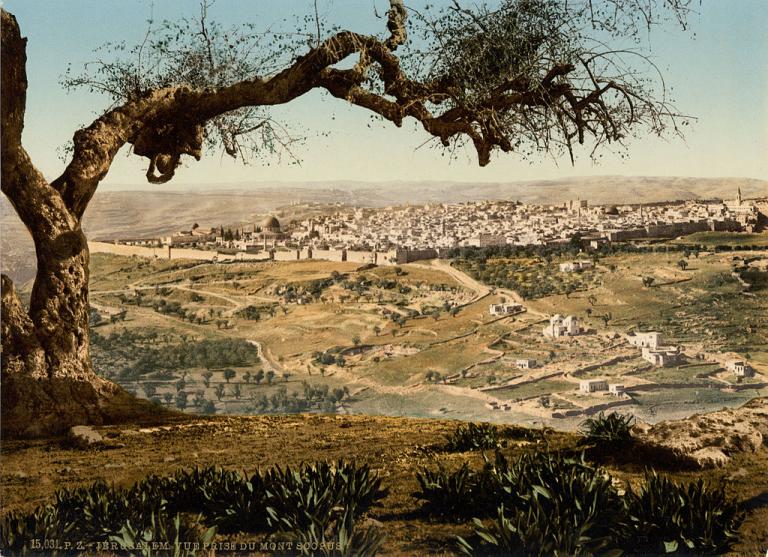
image credit: Jerusalem from Mount Scopus, Holy Land, ca. 1895) [CC BY 2.0 (http://creativecommons.org/licenses/by/2.0)], via Wikimedia Commons.
Previous Post

December 17, 2020
The Birth of Jesus and the Pattern of Christian Life
Next Post
January 2, 2021 Christianity, a Divine Religion or Just a Religious Historical Tradition?
Browse Our Archives
Select a Category abortion abuse art and culture Books Catholic and Gay Catholic identity Catholic Laity Catholic Vocations Catholic Youth Catholicity Cinema clergy scandal Community of Sant’Egidio Culture of Life Editorial Faith Family Father Robert Barron Guest Post In Defense of Christians Marriage Mary Middle East New Evangelization Parenthood Patheos Catholic Poetry politics Pope Poverty Prayer Priesthood Race in America Sacred Art Saints Series sexuality Shaw Synod Uncategorized
Select a Month August 2023 February 2022 January 2022 December 2021 October 2021 September 2021 August 2021 February 2021 January 2021 December 2020 October 2020 August 2020 June 2020 May 2020 April 2020 November 2019 June 2019 May 2019 March 2019 December 2018 October 2018 September 2018 August 2017 July 2017 October 2016 August 2016 July 2016 June 2016 December 2015 September 2015 August 2015 July 2015 June 2015 May 2015 April 2015 March 2015 February 2015 January 2015 December 2014 November 2014 October 2014 September 2014
TAKE THE
Religious Wisdom Quiz
Who was Jesus’ mother?
Select your answer to see how you score.
Mary Esther Ruth Sarah
Related posts from The Font

The Sacrament of Matrimony Needs Urgent Pastoral Attention
Pastoral Zeal as Priestly Identity

Making a Difference: Let Us Venture Together from...
Christianity, an Image of the Social and Political...
TRENDING AT PATHEOS Catholic

Rejecting Doom: Christian Hope And Human Action
Christianity is a religion of hope. We are to have hope and...

It’s What Comes From Within Which Matters
One of the most difficult things for us to understand is why...

Why I Choose the Eucharist Over the Sermon
Choose the Eucharist, Not the Sermon What are we supposed to get...

5 Design Elements Found in Spiritually Rooted Homes
Putting Spirituality Into Home Decor Our homes are more than our living...

Credo: A Story of God Told with the...
About 10 years ago, I began to imagine a personal "Credo" that...

The Anatomy of Divine Revelation in Catholic Thought
The claim that God has made Himself known to human beings is...
view all Catholic blogs
Ad-Free & Subscriber Log-In Subscription Support
- About Us
- 2026 Calendar
- Videos
- Podcasts
- Library of World Religions
- Faith In Media Tracker
- Advertise With Us
- Write for Us
- Privacy Policy
- Terms of Service
- Do Not Sell My Data
- Contact Us
- Radiant Digital
- Manage Newsletter Subscriptions
- Unsubscribe From Notifications
- Sitemap
Copyright 2008-2026, Patheos. All rights reserved.
Subscription Support Ad-Free & Subscriber Log-In
Follow Patheos