
BuddhistCatholicContemplativeEvangelicalGeneral ChristianHinduJewishLatter-day SaintMuslimNew VisionsProgressive Christian
Beliefs
- Buddhist
- Catholic
- Contemplative
- Evangelical
- General Christian
- Hindu
- Jewish
- Latter-day Saint
- More Voices
- Muslim
- New Visions
- Pagan
- Progressive Christian
Topics
- Religion News
- Food and Religion
- Sports and Religion
- Religious Art
- Religious Music and Entertainment
- Religious Events
- History and Religion
- Style and Religion
- Politics and Religion
- Women in Religion
- Recreation Outdoors and Religion
- Business Finance and Religion
- Careers Workplace and Religion
- Education and Religion
- Family Parenting and Religion
- Health Fitness and Religion
- Home and Religion
- Relationships and Religion
- Technology and Religion
- Travel and Religion
Columnists
- Buddhist Columnists
- Business Finance and Religion Columnists
- Careers Workplace and Religion Columnists
- Catholic Columnists
- Contemplative Columnists
- Education and Religion Columnists
- Evangelists Columnists
- Family Parenting and Religion Columnists
- General Christian Columnists
- Health Fitness and Religion Columnists
- Hindu Columnists
- History and Religion Columnists
- Home and Religion Columnists
- Jewish Columnists
- More Voices Columnists
- Latter Day Columnists
- Muslim Columnists
- New Visions Columnists
- Nonreligious Columnists
- Pagan Columnists
- Politics and Religion Columnists
- Progressive Columnists
- Recreation Outdoors and Religion Columnists
- Relationships and Religion Columnists
- Religion News Columnists
- Religious Art Columnists
- Religious Events Columnists
- Religious Music and Entertainment Columnists
- Sports and Religion Columnists
- Style and Religion Columnists
- Technology and Religion Columnists
- Travel and Religion Columnists
- Women in Religion Columnists
Resource Library
- 2026 Calendar
- Library of World Religions
- The 100 Most Holy Places on Earth
- Patheos Answers
- Podcasts
- Videos
- Faith Leaders Database
- Anglican Episcopalian
- Bahai
- Baptist
- Buddhism
- Christianity
- Confucianism
- Eastern Orthodoxy
- Hinduism
- Holiness and Pentecostal
- ISKCON
- Islam
- Judaism
- Lutheran
- Methodist
- The Church of Jesus Christ of Latter-day Saints
- New Age
- Paganism
- Presbytarian and Reformed
- Protestantism
- Religion Behind the Scenes
- Roman Catholic
- Scientology
- Shia Islam
- Sikhism
- Sufism
- Sunni Islam
- Taoism
- Zen
- See all religions
Research Tools
 Ad-Free & Subscriber Log-In Subscription Support
Ad-Free & Subscriber Log-In Subscription Support
Follow Patheos 

- Trending:
- Forgiveness
- |
- Marriage
- |
- Consciousness
- |
- Death Penalty
- |
- Election
- |
- Halloween

- Home
- Catholic
- Gaudete et Exsulate, Pope Francis, and the Abortion Question in U.S. Politics
Gaudete et Exsulate, Pope Francis, and the Abortion Question in U.S. Politics
Last updated on: October 8, 2020 at 9:19 pm by guest writer
Gaudete et Exsulate, Pope Francis, and the Abortion Question in U.S. Politics 2020-10-08T21:19:24-05:00 guest writer
Patheos Explore the world's faith through different perspectives on religion and spirituality! Patheos has the views of the prevalent religions and spiritualities of the world.
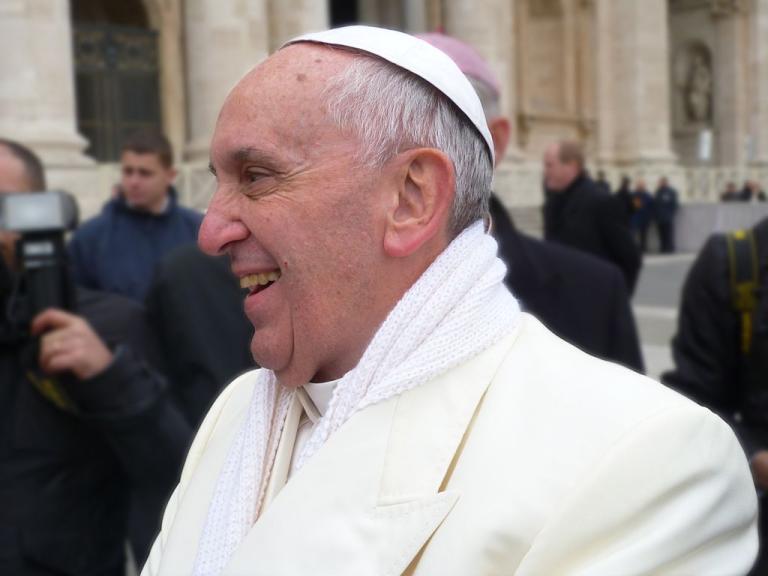
By Gabriel Sozzi (Own work) [CC BY-SA 3.0 (http://creativecommons.org/licenses/by-sa/3.0)], via Wikimedia Commons.
by guest writer Jared D. Carl
Once again, Catholics have emerged as a crucial constituency in presidential politics. Both President Trump and former Vice President Biden are courting Catholics, each one laying out why they’re the true pro-life candidate. Catholic writers and advocacy groups have also joined the fray, arguing for this or that candidate, with some actually trivializing the issue of abortion. Perhaps surprisingly, the apostolic exhortation Gaudete et Exsulate has become a key component of this strategy. But what does the Church really say about weighing the issue of abortion against other important issues this November?
In his apostolic exhortation Gaudete et Exsulate, Pope Francis writes that the lives of the already born, including the poor, destitute, and abandoned, are “equally sacred” to those of the unborn. Somehow, this incontrovertible statement about the equal dignity of all human life is at the center of the aggressive and coordinated effort to trivialize abortion and encourage Catholic support for pro-abortion politicians. Groups like NETWORK Advocates for Catholic Social Justice and activists like Michael Sean Winters exploit Gaudete et Exsulate and argue that abortion isn’t the only issue that matters; that there are many “equally sacred priorities.”
It’s vital that when we bring the Church’s social teaching to bear on U.S. politics, and when we apply Pope Francis’ pastoral counsel to issues at stake in the upcoming election, that we consider the full depth and breadth of the Church’s social doctrine. While a host of issues are important, it must be understood that they are not all equally sacred priorities, and that the protection and defense of innocent life from direct and intentional killing remains paramount for U.S. Catholics.
It’s precisely because abortion is the direct and intentional killing of an innocent human being, an intrinsically evil act contrary to the dignity, divine image, and right to life of a child, that it possesses – and imposes – a moral weight greater than that of other economic, social, and political concerns. The USCCB also notes that the “enormous number of human lives destroyed by abortion” is another factor elevating its importance. It’s also distinct not only because it’s legal, but because many politicians – and an entire political party – are working actively to advance and expand pro-abortion legislation at the state and federal levels. Biden, for example, said if elected he would pass legislation to make Roe the “law of the land” in the event Roe were to be overturned by the Supreme Court. For these reasons, it’s abundantly clear that the moral obligation to oppose abortion has a special claim on the conscience and actions of Catholics.
Indeed, in Gaudete et Exsulate, far from trivializing abortion, Pope Francis proclaims the sanctity of all life and reminds his readers that Catholics have an unmistakable moral duty to defend the lives of unborn children. He writes that our defense of the innocent unborn must be “clear, firm and passionate.” Human dignity demands that we recognize the sacredness of every life, “regardless of his or her stage of development.”
There can be no doubt where Pope Francis stands on the equal sacredness of life in the womb to that of life outside the womb. For attached to the “equally sacred” sentence in Gaudete et Exsulate is a footnote that emphasizes the Church’s constant teaching that human life is always sacred, from conception to natural death, and that life must be safeguarded starting at conception. Pope Francis also approved a letter, recently promulgated by the CDF, that states a child’s life, from the moment of conception, is “sacred, unique, unrepeatable, and inviolable, exactly like that of every adult person” (emphasis added).
In light of this clear and constant teaching, U.S. Catholics must ask themselves if the lives of the innocent unborn are being treated as equally sacred to those of the already born. The obvious answer is that they are not. Innocent, unborn children are being slaughtered on a horrific scale.
Ending abortion must therefore be the “preeminent priority” for U.S. Catholics. In fact, it’s our preeminent obligation, according to the USCCB. This guidance by the bishops is fully in line with Pope Francis, who called abortion the “preeminent” social and political issue of our time, referring to ending abortion as a human rights issue.
How, then, is Gaudete et Exsulate being used to trivialize abortion? Winters, for his part, creates artificial tension between abortion being “preeminent” and all lives being “equally sacred.” He purposefully confuses the equal sacredness of lives with the equal sacredness of issues. The NETWORK runs with this logic, arguing that Biden is the pro-life candidate (despite his stance on expanding abortion rights and access) because he “opposes expanding the U.S.-Mexico border wall.”
This maneuver is based on Pope Francis’ critique of those who consider the situation of migrants to be a “lesser issue.” In Gaudete et Exsulate, he writes that some may consider the situation of migrants a “secondary issue compared to the ‘grave’ bioethical questions.” This, he tells us, is unacceptable for a Catholic, “for whom the only proper attitude is to stand in the shoes of those brothers and sisters of ours who risk their lives to offer a future to their children.” He pleads for Catholics to take to heart our Lord’s words in Mt. 25:31-46.
But this in no way should lead Catholics to downplay the direct and intentional killing of innocent children or elevate issues like “immigration reform” to its status. Abortion isn’t a mere ethical question in the United States; it’s a billion-dollar industry – funded in part by Catholics who pay taxes – that ends the lives of hundreds of thousands of children every year. It’s authorized violence against children, perpetrated by their mothers and propagated as a “right.” Yes, the lives of migrants are equally sacred to the lives of the unborn. We must practice empathy and demand that our country treat migrants fairly and humanely. But, ultimately, abortion is an intrinsic evil that undermines society at its very foundation, while how a nation deals with immigration is a regulatory matter.
The Compendium of the Social Doctrine of the Church states that immigration ought to be regulated according to criteria of “equity and balance.” Regulating immigration by those standards is a matter of justice, prudence, and statesmanship. Abortion, on the other hand, is a “horrendous crime.” It’s a “particularly serious moral disorder” and a “dangerous threat to just and democratic social existence.” The Church denies its status as a “right.”
The moral law and common sense also tell us that it’s worse to intentionally kill an innocent child than it is for a sovereign nation to prevent someone from crossing its border. While voters could, in theory, have grave and proportionate reasons for supporting a pro-abortion candidate, it’s a serious error to trivialize abortion or raise other issues to equal or greater prominence. A well-formed conscience recognizes that not all issues carry the same moral weight, and that the sanctioned murder of over 2,000 children every day far outweighs the experience of migrants at our borders.
In their attempt to justify and encourage Catholic support for Biden and other pro-abortion politicians, NETWORK, Winters, and others abuse Gaudete et Exsulate and distort the Church’s social doctrine. They strike at the very foundation of society. They do terrible harm to the dignity and rights of the unborn and already-born alike. While their political judgement may lead them to vote for a pro-abortion candidate, let the rest of us be clear that abortion is not merely one of many equally sacred issues. To Catholics voting this November, the Church is clear: the right to life is fundamental and inviolable; opposition to abortion, our preeminent priority and obligation.
Previous Post

August 25, 2020
Navigating Abortion Politics as a Catholic and an American

Browse Our Archives
Select a Category abortion abuse art and culture Books Catholic and Gay Catholic identity Catholic Laity Catholic Vocations Catholic Youth Catholicity Cinema clergy scandal Community of Sant’Egidio Culture of Life Editorial Faith Family Father Robert Barron Guest Post In Defense of Christians Marriage Mary Middle East New Evangelization Parenthood Patheos Catholic Poetry politics Pope Poverty Prayer Priesthood Race in America Sacred Art Saints Series sexuality Shaw Synod Uncategorized
Select a Month August 2023 February 2022 January 2022 December 2021 October 2021 September 2021 August 2021 February 2021 January 2021 December 2020 October 2020 August 2020 June 2020 May 2020 April 2020 November 2019 June 2019 May 2019 March 2019 December 2018 October 2018 September 2018 August 2017 July 2017 October 2016 August 2016 July 2016 June 2016 December 2015 September 2015 August 2015 July 2015 June 2015 May 2015 April 2015 March 2015 February 2015 January 2015 December 2014 November 2014 October 2014 September 2014
TAKE THE
Religious Wisdom Quiz
Who prophesied the fall of Babylon?
Select your answer to see how you score.
Ezekiel Isaiah Daniel Jeremiah
Related posts from The Font

Prioritizing the Interior Life with Dorothy Day
Pastoral Zeal as Priestly Identity

Making a Difference: Let Us Venture Together from...
Christianity, an Image of the Social and Political...
TRENDING AT PATHEOS Catholic

Rejecting Doom: Christian Hope And Human Action
Christianity is a religion of hope. We are to have hope and...

It’s What Comes From Within Which Matters
One of the most difficult things for us to understand is why...

Why I Choose the Eucharist Over the Sermon
Choose the Eucharist, Not the Sermon What are we supposed to get...

5 Design Elements Found in Spiritually Rooted Homes
Putting Spirituality Into Home Decor Our homes are more than our living...

Credo: A Story of God Told with the...
About 10 years ago, I began to imagine a personal "Credo" that...

The Anatomy of Divine Revelation in Catholic Thought
The claim that God has made Himself known to human beings is...
view all Catholic blogs
Ad-Free & Subscriber Log-In Subscription Support
- About Us
- 2026 Calendar
- Videos
- Podcasts
- Library of World Religions
- Faith In Media Tracker
- Advertise With Us
- Write for Us
- Privacy Policy
- Terms of Service
- Do Not Sell My Data
- Contact Us
- Radiant Digital
- Manage Newsletter Subscriptions
- Unsubscribe From Notifications
- Sitemap
Copyright 2008-2026, Patheos. All rights reserved.
Subscription Support Ad-Free & Subscriber Log-In
Follow Patheos