
BuddhistCatholicContemplativeEvangelicalGeneral ChristianHinduJewishLatter-day SaintMuslimNew VisionsProgressive Christian
Beliefs
- Buddhist
- Catholic
- Contemplative
- Evangelical
- General Christian
- Hindu
- Jewish
- Latter-day Saint
- More Voices
- Muslim
- New Visions
- Pagan
- Progressive Christian
Topics
- Religion News
- Food and Religion
- Sports and Religion
- Religious Art
- Religious Music and Entertainment
- Religious Events
- History and Religion
- Style and Religion
- Politics and Religion
- Women in Religion
- Recreation Outdoors and Religion
- Business Finance and Religion
- Careers Workplace and Religion
- Education and Religion
- Family Parenting and Religion
- Health Fitness and Religion
- Home and Religion
- Relationships and Religion
- Technology and Religion
- Travel and Religion
Columnists
- Buddhist Columnists
- Business Finance and Religion Columnists
- Careers Workplace and Religion Columnists
- Catholic Columnists
- Contemplative Columnists
- Education and Religion Columnists
- Evangelists Columnists
- Family Parenting and Religion Columnists
- General Christian Columnists
- Health Fitness and Religion Columnists
- Hindu Columnists
- History and Religion Columnists
- Home and Religion Columnists
- Jewish Columnists
- More Voices Columnists
- Latter Day Columnists
- Muslim Columnists
- New Visions Columnists
- Nonreligious Columnists
- Pagan Columnists
- Politics and Religion Columnists
- Progressive Columnists
- Recreation Outdoors and Religion Columnists
- Relationships and Religion Columnists
- Religion News Columnists
- Religious Art Columnists
- Religious Events Columnists
- Religious Music and Entertainment Columnists
- Sports and Religion Columnists
- Style and Religion Columnists
- Technology and Religion Columnists
- Travel and Religion Columnists
- Women in Religion Columnists
Resource Library
- 2026 Calendar
- Library of World Religions
- The 100 Most Holy Places on Earth
- Patheos Answers
- Podcasts
- Videos
- Faith Leaders Database
- Anglican Episcopalian
- Bahai
- Baptist
- Buddhism
- Christianity
- Confucianism
- Eastern Orthodoxy
- Hinduism
- Holiness and Pentecostal
- ISKCON
- Islam
- Judaism
- Lutheran
- Methodist
- The Church of Jesus Christ of Latter-day Saints
- New Age
- Paganism
- Presbytarian and Reformed
- Protestantism
- Religion Behind the Scenes
- Roman Catholic
- Scientology
- Shia Islam
- Sikhism
- Sufism
- Sunni Islam
- Taoism
- Zen
- See all religions
Research Tools
 Ad-Free & Subscriber Log-In Subscription Support
Ad-Free & Subscriber Log-In Subscription Support
Follow Patheos 

- Trending:
- Forgiveness
- |
- Marriage
- |
- Consciousness
- |
- Death Penalty
- |
- Election
- |
- Halloween

- Home
- Catholic
- Bread: Mystery and Gift
Bread: Mystery and Gift
Last updated on: April 19, 2020 at 10:40 pm by guest writer
Bread: Mystery and Gift 2020-04-19T22:40:48-05:00 guest writer
Patheos Explore the world's faith through different perspectives on religion and spirituality! Patheos has the views of the prevalent religions and spiritualities of the world.
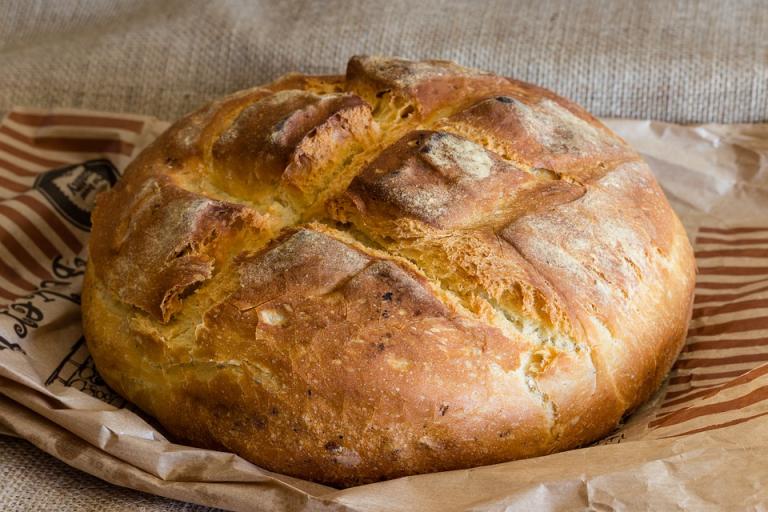
by guest writer Judy Bratten
One of my favorite gifts last Christmas came from our friend Paul in Kansas. Only four years earlier, I had given him a one-day, rapid rise course in whole grain breadmaking. Now he bakes his own breads from his own grain, organically grown on golden Kansas fields. The gift was a loaf of dark, moist bread and an article on bread making, the old-fashioned way, including instructions on producing homegrown yeast.
As I studied the article, I realized how far we have come from the days of scythes and flails and millstones. In my own twenty-five years of baking bread, I have particularly enjoyed the multisensory experience that baking provides, as well as the sense of being part of an age-old tradition. Yet my baking procedure is still a modern version of the ancient skill, dependent on machinery, electricity, and pre-packaged yeast. To produce three loaves of bread takes me about three hours.
But in the days before such technology, making bread required a daily commitment of time and energy. The wheaten lump which was to become the yeast had to be buried in a sack of freshly milled, organically grown flour; it had to be nurtured and cared for with motherly diligence. To ensure a regular supply of yeast, the process followed a repetitive cycle, a baker’s version of singing rounds. One had to stay with it; taking a few days off would prove fatal for the yeast and to those who depended on the bread as the “staff of life.” Just to provide this one ingredient of breadbaking required one to remain at home and live a simple, disciplined life.
What a contrast this rich, deliberate method is to modern breadmaking, especially the most recent invention: a breadmaking machine. This new “labor-saving device” mixes, kneads, raises and bakes the bread while the owner pursues other interests. The mysterious and sensual aspects of breadmaking have been replaced by convenience and speed, and I can’t help wondering if this same deterioration is taking place in the Church.
Christ came in mystery and in flesh, confounding the wise and scandalizing the practical, and bread has been a major symbol of this paradox. In the parable of the yeast, Jesus compares faith to a lump of leaven which mysteriously changes dough into bread. When Jesus was moved by the hungry crowd, he took five common loaves and mysteriously multiplied them to feed five thousand, and then did it again with seven loaves to feed four thousand. Finally, Jesus performs the greatest mystery in the awesome and incomprehensible gift of the Eucharist: “Take and eat, this is my Body.”
The sense of mystery which is part of ancient breadbaking and even of my more modern methods is totally absent in the machine, just as the sense of mystery is gradually being lost in regard to Jesus in the Eucharist, or even Jesus as “God.” With the Protestant disavowal of the presence of Christ in the Eucharist has come an accompanying disregard for the mysterious power of God in the world, as expressed in the Renaissance, the “Age of Reason” and the modern machine age. The ways of God have become knowable; the mystical elements of everyday life have become simply “laws of Nature,” laws to be comprehended and codified. The technological age is the obvious descendant of such ancestry.
But trivialization of the holy is not limited to our separated brethren. How often do we see lack of reverence shown to the Tabernacle in a Catholic Church? How often do we notice communicants pop the host into their mouths as if it were a potato chip? And how often do we see adoration of the Blessed Sacrament in the local parish?
In addition to removing the sense of mystery, the breadmaking machine encourages one to think of productivity rather than process. The ancient act of baking bread required physical contact with the earth and the fruit of the earth. It required getting one’s hands into the dough, being sensitive to the change from stickiness to firmness. The flour on one’s hands, the smell of the yeasty batter, the heat of the oven, all became an integral part of each loaf of bread. This is all lost if one allows a machine to the do the work. Spiritually, we can see that the ancient disciplines which encouraged the development of holiness have been at best ignored, if not forgotten. Where is the fasting, the mortification that should be part of Lent? What happened to frequent confession and daily Communion? How many homilies encourage us to live holy lives by dealing with our vices and developing our virtues? Most of the time we are patted on the back and reassured that God is merciful, that Jesus is “a good Friend.” The process of sanctification has been replaced by a twelve-step-program.
There is yet a more subtle loss that comes with the demystification of breadmaking: the understanding of bread as “gift.” I realized this recently when a dear friend of mine told me she had received a breadmaking machine as a present. Since my friend is financially well-off and can buy anything she wants, the only gifts I had been able to give her over the years were my fresh loaves of homemade bread. The machine had diminished the value of those gifts and left us both poorer. It also makes unnecessary the breadbaking lessons I gave to Paul and others. The opportunity to pass on wisdom, to share insights and to create something beautiful together is lost, as is the opportunity for the unexpected, for the serendipitous moment.
When I lived in a small town in North Carolina, I had become close friends with the wife of the local Baptist minister. Elaine was blond and lovely and gracious, yet insecure in her abilities and her role as a pastor’s wife. I admired her soft, southern drawl and she admired my ability to bake bread.
“It’s not hard,” I told her. “I’ll teach you.”
As so we arranged a day when I could give her an official breadmaking lesson. She had all the ingredients ready when I arrived; the bowls and measuring cups were on the counter. She was as excited as a little girl going on her first carnival ride. As we followed the age-old process of blending water, yeast, flour, oil, sugar, and salt, we exchanged Biblical references to bread, stories about our baking failures and lessons we had learned from the daily routines of motherhood. By the time I left, she had two lovely loaves to put into the oven and had renewed her confidence in herself. Later that evening she called to tell me how her family had praised the work of her hands. Her voice sparkled as she thanked me for the lesson.
Not long after, Elaine’s husband took a new pastorate in another part of the state. She was heart-broken about leaving and anxious about making new friends in a strange town.
“What will I do?” she worried.
“You will be fine,” I reassured her. “The Lord will show you what to do.” I prayed that my words would be fulfilled.
A few weeks later, she called from her new home to tell me that she was baking bread and giving it to neighbors and members of their congregation.
“And I’m teaching others how to bake bread, just as you taught me,” she laughed. “I’ve been able to make many wonderful friends.”
The gift had become a gift to pass on, to bring warmth and love into lives I would never otherwise touch. Like the Bread of Life, we are meant to be broken and shared with others. We are called to see every human being as a gift and to become more like the great Gift of God Himself, Jesus Christ.
For me, bread has become a symbol of simplicity in my physical and spiritual life. Just as I am able to take the everyday elements of water, flour and yeast to produce an aromatic and nourishing food, I pray that God may take my ordinary traits and talents to produce a sweet and fitting offering to Him. Just as a good loaf of bread requires patience and skill, I pray that the Lord will grant me the grace and virtues I need to raise a faithful and happy family.
I am planning to start a lump of leaven the old-fashioned way. I am looking forward to watching the slow, mysterious process which will enable me to bake bread as my ancestors did. The cookstove will be chocked with dusty, chunky blocks of wood, the faint smoky odor blending with the sweet, nutty aroma of baking bread. No machine can duplicate that experience.
Be gentle
when you touch bread.
Let it not be uncared for, unwanted.
So often bread
is taken for granted.
There is so much beauty in bread –
Beauty of sun and soil,
Beauty of ancient toil.
Winds and rains have caressed it,
Christ often blessed it.
Be gentle
when you touch bread.
— Author unknown
(This piece was first published in Caelum et Terra, Summer 1995. It is republished here with the author’s permission, at a time when suddenly everyone finds themselves baking bread, or trying to do so)
image credit: https://pixabay.com/photos/bread-bake-baked-bakery-food-4857068/

Next Post

May 5, 2020 Religion and Morality in Verdi's 'Otello'
Browse Our Archives
Select a Category abortion abuse art and culture Books Catholic and Gay Catholic identity Catholic Laity Catholic Vocations Catholic Youth Catholicity Cinema clergy scandal Community of Sant’Egidio Culture of Life Editorial Faith Family Father Robert Barron Guest Post In Defense of Christians Marriage Mary Middle East New Evangelization Parenthood Patheos Catholic Poetry politics Pope Poverty Prayer Priesthood Race in America Sacred Art Saints Series sexuality Shaw Synod Uncategorized
Select a Month August 2023 February 2022 January 2022 December 2021 October 2021 September 2021 August 2021 February 2021 January 2021 December 2020 October 2020 August 2020 June 2020 May 2020 April 2020 November 2019 June 2019 May 2019 March 2019 December 2018 October 2018 September 2018 August 2017 July 2017 October 2016 August 2016 July 2016 June 2016 December 2015 September 2015 August 2015 July 2015 June 2015 May 2015 April 2015 March 2015 February 2015 January 2015 December 2014 November 2014 October 2014 September 2014
TAKE THE
Religious Wisdom Quiz
In Revelation, how many elders sit on thrones around God's throne?
Select your answer to see how you score.
Twelve Twenty-four Seventy Seven
Related posts from The Font

Making a Difference: Let Us Venture Together from...
Christianity, an Image of the Social and Political...
Is Jesus the Essence and Center of Christianity?

Making a Difference - President Biden: ‘Build Back...
TRENDING AT PATHEOS Catholic

Rejecting Doom: Christian Hope And Human Action
Christianity is a religion of hope. We are to have hope and...

It’s What Comes From Within Which Matters
One of the most difficult things for us to understand is why...

Why I Choose the Eucharist Over the Sermon
Choose the Eucharist, Not the Sermon What are we supposed to get...

5 Design Elements Found in Spiritually Rooted Homes
Putting Spirituality Into Home Decor Our homes are more than our living...

Credo: A Story of God Told with the...
About 10 years ago, I began to imagine a personal "Credo" that...

The Anatomy of Divine Revelation in Catholic Thought
The claim that God has made Himself known to human beings is...
view all Catholic blogs
Ad-Free & Subscriber Log-In Subscription Support
- About Us
- 2026 Calendar
- Videos
- Podcasts
- Library of World Religions
- Faith In Media Tracker
- Advertise With Us
- Write for Us
- Privacy Policy
- Terms of Service
- Do Not Sell My Data
- Contact Us
- Radiant Digital
- Manage Newsletter Subscriptions
- Unsubscribe From Notifications
- Sitemap
Copyright 2008-2026, Patheos. All rights reserved.
Subscription Support Ad-Free & Subscriber Log-In
Follow Patheos