
BuddhistCatholicContemplativeEvangelicalGeneral ChristianHinduJewishLatter-day SaintMuslimNew VisionsProgressive Christian
Beliefs
- Buddhist
- Catholic
- Contemplative
- Evangelical
- General Christian
- Hindu
- Jewish
- Latter-day Saint
- More Voices
- Muslim
- New Visions
- Pagan
- Progressive Christian
Topics
- Religion News
- Food and Religion
- Sports and Religion
- Religious Art
- Religious Music and Entertainment
- Religious Events
- History and Religion
- Style and Religion
- Politics and Religion
- Women in Religion
- Recreation Outdoors and Religion
- Business Finance and Religion
- Careers Workplace and Religion
- Education and Religion
- Family Parenting and Religion
- Health Fitness and Religion
- Home and Religion
- Relationships and Religion
- Technology and Religion
- Travel and Religion
Columnists
- Buddhist Columnists
- Business Finance and Religion Columnists
- Careers Workplace and Religion Columnists
- Catholic Columnists
- Contemplative Columnists
- Education and Religion Columnists
- Evangelists Columnists
- Family Parenting and Religion Columnists
- General Christian Columnists
- Health Fitness and Religion Columnists
- Hindu Columnists
- History and Religion Columnists
- Home and Religion Columnists
- Jewish Columnists
- More Voices Columnists
- Latter Day Columnists
- Muslim Columnists
- New Visions Columnists
- Nonreligious Columnists
- Pagan Columnists
- Politics and Religion Columnists
- Progressive Columnists
- Recreation Outdoors and Religion Columnists
- Relationships and Religion Columnists
- Religion News Columnists
- Religious Art Columnists
- Religious Events Columnists
- Religious Music and Entertainment Columnists
- Sports and Religion Columnists
- Style and Religion Columnists
- Technology and Religion Columnists
- Travel and Religion Columnists
- Women in Religion Columnists
Resource Library
- 2026 Calendar
- Library of World Religions
- The 100 Most Holy Places on Earth
- Patheos Answers
- Podcasts
- Videos
- Faith Leaders Database
- Anglican Episcopalian
- Bahai
- Baptist
- Buddhism
- Christianity
- Confucianism
- Eastern Orthodoxy
- Hinduism
- Holiness and Pentecostal
- ISKCON
- Islam
- Judaism
- Lutheran
- Methodist
- The Church of Jesus Christ of Latter-day Saints
- New Age
- Paganism
- Presbytarian and Reformed
- Protestantism
- Religion Behind the Scenes
- Roman Catholic
- Scientology
- Shia Islam
- Sikhism
- Sufism
- Sunni Islam
- Taoism
- Zen
- See all religions
Research Tools
 Ad-Free & Subscriber Log-In Subscription Support
Ad-Free & Subscriber Log-In Subscription Support
Follow Patheos 

- Trending:
- Forgiveness
- |
- Marriage
- |
- Consciousness
- |
- Death Penalty
- |
- Election
- |
- Halloween

- Home
- Catholic
- How Stories Unlock The Truth
How Stories Unlock The Truth
Last updated on: October 13, 2016 at 3:07 pm by Guest Contributor
How Stories Unlock The Truth 2016-10-13T15:07:14-05:00 Guest Contributor
Patheos Explore the world's faith through different perspectives on religion and spirituality! Patheos has the views of the prevalent religions and spiritualities of the world.
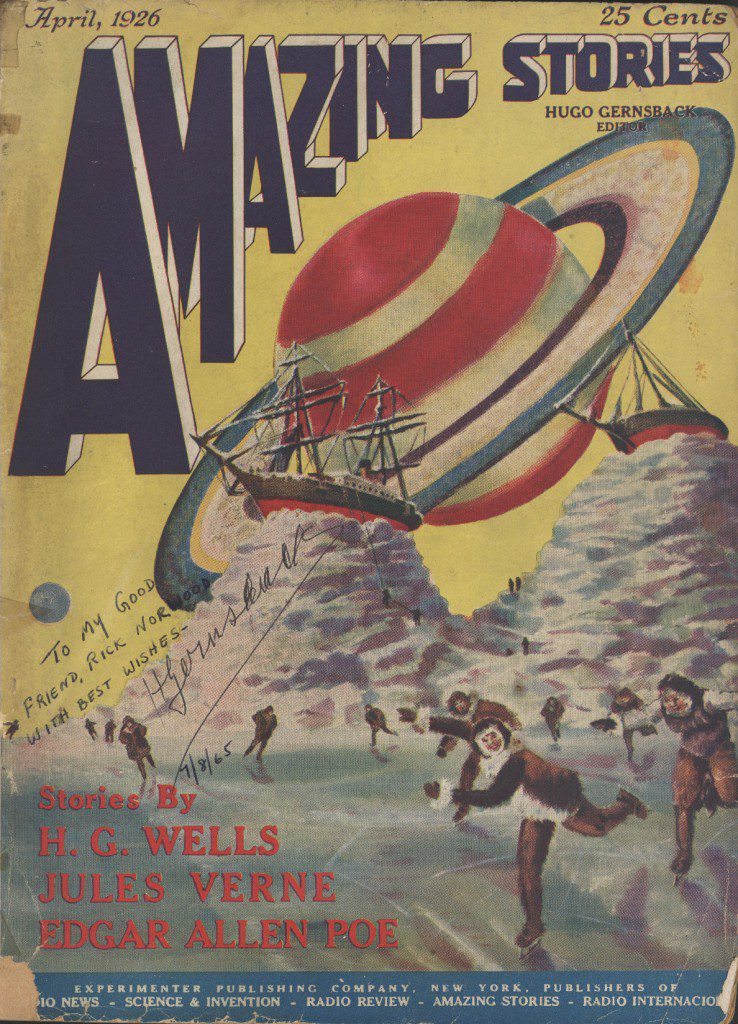
Amazing Stories, April 1926. Volume 1, Number 1 (Public Domain, Source: Wikimedia)
The world’s being squeezed by a vise. On one side is materialism, determinism, no Creator, or a god that’s indistinguishable from creation. Thus, it’s up to man to take control—Serling’s “The Obsolete Man”, Orwell’s “1984”, Bradbury’s “Fahrenheit 451”. On the other side, the God of rules. Obey and go to heaven, disobey and go to hell. Thus, man’s role is to propitiate a capricious lord and master—Zeus, Tolkien’s Sauron, the god of ISIS and some fundamentalist Christians.
Mercy and justice, unfathomable and one of us, omnipotent and nailed to a cross, the natural world and the transcendent, are hard to grasp, apparent contradictions. But what if we’re not enslaved by the laws of nature or a rigid lawgiver? What if we have the freedom to make choices that have temporal and eternal consequences?
A fantastic story we hear, a novel we’ll never forget, a bolt from the blue while we’re walking, helping us to unlock truth. Storytelling can pry this vise open. Stories that depict radical mercy, servant leadership, what friendship entails, the persistent and often painful call to “conversion”, hope that surpasses mere optimism or disposition, the insidiousness and ravages of evil. Showing us—not telling us through the lips of sock puppet characters—how these things vitalize or destroy human lives.
The “Rise And Fall of The Third Reich” by William L. Shirer is hardly a story. I occasionally read ten or twenty or fifty pages, always shaken by the pathological lying, killing, and self-delusion. On the back page of the book I felt compelled to write: THIS IS WHAT A WORLD WITHOUT THE TRUE GOD LOOKS LIKE. In “The Lord of The Rings”, Gollum depicts the pathetic narrowness of cramped lives that succumb to evil, though we absorb this truth differently in stories than we do by reading historical accounts.
In F. Scott Fitzgerald’s Jay Gatsby, we have both vise clamps in one man, the unconstrained schemer with a disordered image of the “divine” Daisy, a schizophrenic perspective that’s commonplace in our world.
In Graham Greene’s raw and troubling “The Quiet American”, his atheistic journalist who caused the death of another man (Pyle) says, “I thought of the first day and Pyle sitting beside me at the Continental…Everything had gone right with me since he had died, but how I wished there existed someone to whom I could say that I was sorry.” Where does one go to confess and receive forgiveness when there is no God?
In Richard Adams’ “Watership Down”, the leader of a band of itinerant rabbits is a character similar to the apostle Peter, not especially good at anything, though someone the other rabbits—the strongest, fastest, smartest, most imaginative—desire to follow, and he leads them somewhere none of the others could lead them.
Atticus Finch stands against the lynchers that are determined to murder Tom Robinson. He doesn’t flinch. But when Bob Ewell spits in his face, he doesn’t respond. What can such seemingly contradictory behavior teach us?
In “The Man”, Ray Bradbury’s spaceship Captain Hart is obsessed with following and finding a Christ he’s convinced is going from planet to planet. Hart’s ever so close, getting closer and closer, missing the Man by a week, a day, a few hours. After Hart dashes off in his spaceship, one who remains behind is told, “And he (Hart) will go on and on, thinking to find that very thing which he left behind here, on this planet…Come along now. We mustn’t keep him waiting.”
Why does Thornton Wilder’s commercial salesman and honest, virtuous, indefatigable proselytizer George Brush fail to convert those he evangelizes in “Heaven’s My Destination”? Could it be that his God is too small, a belief that everything depends on him?
The good angels in Tolkien’s mythology—Gandalf and many of the Valar and Maiar, practice forbearance and restraint when it comes to impeding human and elven freedom, while there’s no restraint when it comes to the fallen angels—Melkor, Sauron, Saruman—who will do anything they can to re-make the world according to their desires.
Rod Serling’s “Twilight Zone” episodes are ripe with provocative ideas, from “The Obsolete Man” where books are forbidden and human beings are nothing more than cogs in the state’s machine, to “A Pitch For The Angels”, where a call to heroic generosity is made and answered, to “The Monsters on Maple Street” that challenges the “tribalism” that resides in all of us.
In Dostoevsky’s “Crime And Punishment”, a man feels compelled to commit a heinous crime, and is then haunted by the evil he’s done. How many of us have faced similar crises in our lives, albeit in smaller matters. How could I have done that? Where can I go to find peace?
In my novel “Iota”, an unspoken question is asked: who are you when you’re stripped naked, and everything is laid bare? And who can handle this nakedness alone and unaided?
Jesus, the Christ, the man on the cross, is so familiar we don’t see or hear him anymore. His name evokes boredom, blank stares, impatience, condescension, “another time perhaps”. He’s like the invisible man in G. K. Chesterton’s story, “The Invisible Man”, invisible because he’s so familiar. Sean Wright’s poem, “When Jesus Came To Birmingham” tells a similar story, one of apathy, with Wright’s Jesus as anguished as at Calvary.
Can anything good come from the Order of the Seekers for Truth and Penitence (the Torturers Guild)? Gene Wolfe’s “The Book of The New Sun” challenges us to answer this question when the apprentice torturer Severian is banished for showing mercy by allowing a prisoner who’s been sentenced to an excruciating death to take her own life. In bizarre and startling ways, Wolfe explores the demarcation between individual and community, the expansive effect of mercy, time as a meandering, backtracking stream rather than a straight steady-flowing canal.
Raymond Chandler’s private eye, Phillip Marlowe, was called a “slumming angel”, because for all his flaws he has an inerrant sense of justice, and an inclination to mercy, but the best the God-less Marlowe can do is pull the temple down around him, as Samson did; respite from the darkness, not freedom from it.
Flannery O’Connor depicts twisted religion in “Wise Blood” and “The Violent Bear It Away” so we can see the devastation of false religion, so we can see that our yearning for something outside ourselves doesn’t always lead to light and life, so we can see that human freedom must grapple with the mysterium iniquitatis, the mystery of evil.
Am I my brother’s keeper? Who is my brother? When she should be using her few remaining days for her natural mission, E. B. White’s Charlotte takes on a super-natural mission to save Wilbur the pig, a creature belonging to an “alien race”. Moreover, Wilbur is just one unspectacular pig, and all Charlotte’s labors will do nothing to change the practice of hog farming.
Well-written, rousing, meaningful stories help us to envision a space between those enslaving vise clamps. Some of these stories are hard work, some are troubling, some shake us to the core. Seeking and finding a space for authentic freedom and enlightenment is worth it.
T. M. Doran is the author of “Toward the Gleam”, “Terrapin”, and “Iota”. His website is at tmdoran.com
Previous Post

August 29, 2016
Talking to My Daughters About Hilary Clinton
Next Post
October 25, 2016 If Pope Francis “Failed,” What Does That Say about Benedict?
Browse Our Archives
Select a Category abortion abuse art and culture Books Catholic and Gay Catholic identity Catholic Laity Catholic Vocations Catholic Youth Catholicity Cinema clergy scandal Community of Sant’Egidio Culture of Life Editorial Faith Family Father Robert Barron Guest Post In Defense of Christians Marriage Mary Middle East New Evangelization Parenthood Patheos Catholic Poetry politics Pope Poverty Prayer Priesthood Race in America Sacred Art Saints Series sexuality Shaw Synod Uncategorized
Select a Month August 2023 February 2022 January 2022 December 2021 October 2021 September 2021 August 2021 February 2021 January 2021 December 2020 October 2020 August 2020 June 2020 May 2020 April 2020 November 2019 June 2019 May 2019 March 2019 December 2018 October 2018 September 2018 August 2017 July 2017 October 2016 August 2016 July 2016 June 2016 December 2015 September 2015 August 2015 July 2015 June 2015 May 2015 April 2015 March 2015 February 2015 January 2015 December 2014 November 2014 October 2014 September 2014
TAKE THE
Religious Wisdom Quiz
In Revelation, how many elders sit on thrones around God's throne?
Select your answer to see how you score.
Twelve Twenty-four Seventy Seven
Related posts from The Font
Tweeting With God: Essential Text for RCIA and...

Yes, the Devil is Real. Be Armed.

Confession, The Hidden Sacrament Indeed

What "Gifts" are Found in the Visitation of...
TRENDING AT PATHEOS Catholic

Rejecting Doom: Christian Hope And Human Action
Christianity is a religion of hope. We are to have hope and...

It’s What Comes From Within Which Matters
One of the most difficult things for us to understand is why...

Why I Choose the Eucharist Over the Sermon
Choose the Eucharist, Not the Sermon What are we supposed to get...

5 Design Elements Found in Spiritually Rooted Homes
Putting Spirituality Into Home Decor Our homes are more than our living...

Credo: A Story of God Told with the...
About 10 years ago, I began to imagine a personal "Credo" that...

The Anatomy of Divine Revelation in Catholic Thought
The claim that God has made Himself known to human beings is...
view all Catholic blogs
Ad-Free & Subscriber Log-In Subscription Support
- About Us
- 2026 Calendar
- Videos
- Podcasts
- Library of World Religions
- Faith In Media Tracker
- Advertise With Us
- Write for Us
- Privacy Policy
- Terms of Service
- Do Not Sell My Data
- Contact Us
- Radiant Digital
- Manage Newsletter Subscriptions
- Unsubscribe From Notifications
- Sitemap
Copyright 2008-2026, Patheos. All rights reserved.
Subscription Support Ad-Free & Subscriber Log-In
Follow Patheos