
BuddhistCatholicContemplativeEvangelicalGeneral ChristianHinduJewishLatter-day SaintMuslimNew VisionsProgressive Christian
Beliefs
- Buddhist
- Catholic
- Contemplative
- Evangelical
- General Christian
- Hindu
- Jewish
- Latter-day Saint
- More Voices
- Muslim
- New Visions
- Pagan
- Progressive Christian
Topics
- Religion News
- Food and Religion
- Sports and Religion
- Religious Art
- Religious Music and Entertainment
- Religious Events
- History and Religion
- Style and Religion
- Politics and Religion
- Women in Religion
- Recreation Outdoors and Religion
- Business Finance and Religion
- Careers Workplace and Religion
- Education and Religion
- Family Parenting and Religion
- Health Fitness and Religion
- Home and Religion
- Relationships and Religion
- Technology and Religion
- Travel and Religion
Columnists
- Buddhist Columnists
- Business Finance and Religion Columnists
- Careers Workplace and Religion Columnists
- Catholic Columnists
- Contemplative Columnists
- Education and Religion Columnists
- Evangelists Columnists
- Family Parenting and Religion Columnists
- General Christian Columnists
- Health Fitness and Religion Columnists
- Hindu Columnists
- History and Religion Columnists
- Home and Religion Columnists
- Jewish Columnists
- More Voices Columnists
- Latter Day Columnists
- Muslim Columnists
- New Visions Columnists
- Nonreligious Columnists
- Pagan Columnists
- Politics and Religion Columnists
- Progressive Columnists
- Recreation Outdoors and Religion Columnists
- Relationships and Religion Columnists
- Religion News Columnists
- Religious Art Columnists
- Religious Events Columnists
- Religious Music and Entertainment Columnists
- Sports and Religion Columnists
- Style and Religion Columnists
- Technology and Religion Columnists
- Travel and Religion Columnists
- Women in Religion Columnists
Resource Library
- 2026 Calendar
- Library of World Religions
- The 100 Most Holy Places on Earth
- Patheos Answers
- Podcasts
- Videos
- Faith Leaders Database
- Anglican Episcopalian
- Bahai
- Baptist
- Buddhism
- Christianity
- Confucianism
- Eastern Orthodoxy
- Hinduism
- Holiness and Pentecostal
- ISKCON
- Islam
- Judaism
- Lutheran
- Methodist
- The Church of Jesus Christ of Latter-day Saints
- New Age
- Paganism
- Presbytarian and Reformed
- Protestantism
- Religion Behind the Scenes
- Roman Catholic
- Scientology
- Shia Islam
- Sikhism
- Sufism
- Sunni Islam
- Taoism
- Zen
- See all religions
Research Tools
 Ad-Free & Subscriber Log-In Subscription Support
Ad-Free & Subscriber Log-In Subscription Support
Follow Patheos 

- Trending:
- Forgiveness
- |
- Marriage
- |
- Consciousness
- |
- Death Penalty
- |
- Election
- |
- Halloween

- Home
- Catholic
- “The Avengers” and Friedrich Nietzsche
“The Avengers” and Friedrich Nietzsche
Last updated on: May 5, 2015 at 11:08 am by Elizabeth Scalia
“The Avengers” and Friedrich Nietzsche 2015-05-05T11:08:24-05:00 Elizabeth Scalia
Patheos Explore the world's faith through different perspectives on religion and spirituality! Patheos has the views of the prevalent religions and spiritualities of the world.
By Very Rev. Robert Barron
C.S. Lewis, J.R.R. Tolkien, and their colleagues in the Inklings wanted to write fiction that would effectively “evangelize the imagination,” accustoming the minds, especially of young people, to the hearing of the Christian Gospel. Accordingly, Tolkien’s Gandalf is a figure of Jesus the prophet and Lewis’s Aslan a representation of Christ as both sacrificial victim and victorious king. Happily, the film versions of both The Lord of the Rings and The Chronicles of Narnia have proven to be wildly popular all over the world.
Not so happily, Joss Whedon’s “Avenger” films, the second of which has just appeared, work as a sort of antidote to Tolkien and Lewis, shaping the imaginations of young people so as to receive a distinctly different message. It is certainly relevant to my purpose here to note that Whedon, the auteur behind Buffy the Vampire Slayer, Firefly, and many other well-received films and television programs, is a self-avowed atheist and has, on many occasions, signaled his particular dissatisfaction with the Catholic Church.
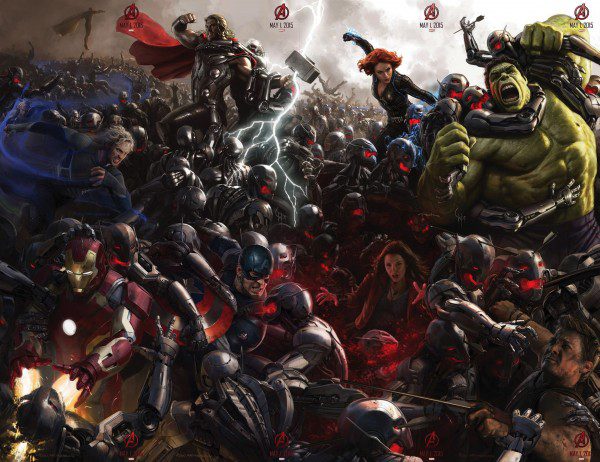
I won’t rehearse in too much detail the plot of Avengers: Age of Ultron. Suffice it to say that the world is threatened by an artificial intelligence, by the name of Ultron, who has run amok and incarnated himself in a particularly nasty robotic body. Ultron wants to destroy the human race and has produced an army of robots as his posse. Enter the Avengers –Tony Stark (Iron Man), the Hulk, Black Widow, Captain America, Hawkeye, and Thor — to do battle with the dark forces. There is an awful lot of CGI bumping and banging and blowing things up, but when the rubble settles, we see that the real struggle is over a perfect body — a synthesis of machine and flesh — that Ultron, with the help of brainwashed scientists, is designing for himself.
After pursuing the bad guys on a wild ride through the streets of Seoul, the Avengers recover the body, and Thor, using one of the fundamental building blocks of the universe or lightning or something, brings it to life.
Exuding light, intelligence, and calmness of spirit, this newly created robot/human/god floats above the ground and announces that his name is “I am.” Just before his climactic battle with Ultron, “I am” declares that order and chaos are two sides of the same coin and that wickedness is never eliminated but keeps coming around in an endless cycle.
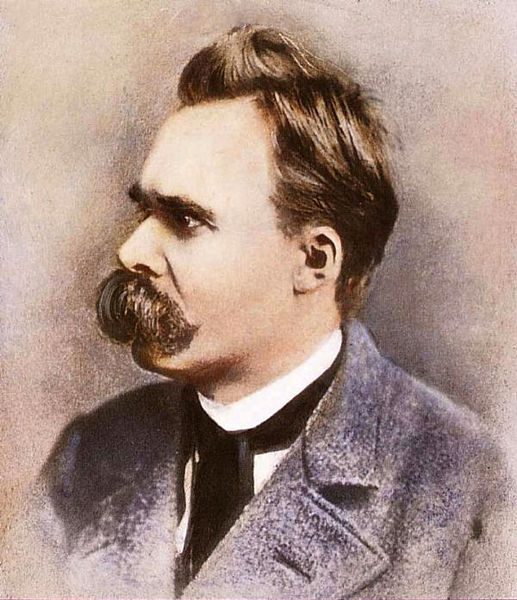
Image Public Domain via WikimediaCommons

Although some have seen Biblical themes at work in all of this, I see pretty much the opposite, namely, an affirmation of a Nietzschean view of life. Whedon, who was a philosophy student at university, delights in dropping references to the great thinkers in his work, and one of the most cited in “Ultron” is none other than the man I take to be the most influential of the 19th century philosophers, Friedrich Nietzsche.
At a key moment in the film, Ultron in fact utters Nietzsche’s most famous one-liner: “what does not kill me makes me stronger,” and the observation made by the newly-created “I am” is a neat expression of Nietzsche’s doctrine of the eternal return of the same. At the heart of the German philosopher’s work is the declaration of the death of God, which signals that all values are relative, that we live in a space “beyond good and evil.” Into that space, Nietzsche contends, the Ubermensch, the superman, should confidently stride. This is a human being who has thrown off the shackles of religion and conventional morality and is able to exercise fully his Wille zur Macht (Will to Power). Asserting this will, the superman defines himself completely on his own terms, effectively becoming a god. Here we see the significant influence of Nietzsche on Sartre and the other existentialists of the twentieth century.
The Avengers is chock-a-block with Ubermenschen, powerful, willful people who assert themselves through technology and the hyper-violence that that technology makes possible. And the most remarkable instance of this technologically informed self-assertion is the creation of the savior figure, who self-identifies with the very words of Yahweh in the book of Exodus. But he is not the Word become flesh; instead, he is the coming together of flesh and robotics, produced by the flexing of the all too human will to power.
I find it fascinating that this pseudo-savior was brought about by players on both sides of the divide, by both Iron Man and Ultron. Like Nietzsche’s superman, he is indeed beyond good and evil — which is precisely why he cannot definitively solve the problems that bedevil the human race, and can only glumly predict the eternal return of trouble.
If you have any doubts about the Nietzschean intention of Joss Whedon, take a good look at the image that plays as The Avengers comes to a close. It is a neo-classical sculpture of all of the major figures in the film locked in struggle, straining against one another. It is in complete conformity with the aesthetic favored by Albert Speer, Leni Riefenstahl, and the other artists of the Nazi period.
What the Christian evangelist can seize upon in this film is the frank assertion that the will to power — even backed up by stunningly sophisticated technology –never finally solves our difficulties, that it, in point of fact, makes things worse. See the Tower of Babel narrative for the details.
And this admission teases the mind to consider the possibility that the human predicament can be addressed finally only through the invasion of grace. Once that door is opened, the Gospel can be proclaimed.
 Father Robert Barron is the founder of the global ministry, Word on Fire, and the Rector/President of Mundelein Seminary. He is the creator of the award winning documentary series, “Catholicism” and “Catholicism:The New Evangelization.” Learn more at www.WordonFire.org
Related:
Amid Criticism of Film, Whedon Quits Twitter
Previous Post

April 24, 2015
Finding Galilee, and Prophecy, on the Periphery with the Poor
Next Post

May 14, 2015 Reactive Political Expediency Before a Papal Encyclical
Recent Comments
Browse Our Archives
Select a Category abortion abuse art and culture Books Catholic and Gay Catholic identity Catholic Laity Catholic Vocations Catholic Youth Catholicity Cinema clergy scandal Community of Sant’Egidio Culture of Life Editorial Faith Family Father Robert Barron Guest Post In Defense of Christians Marriage Mary Middle East New Evangelization Parenthood Patheos Catholic Poetry politics Pope Poverty Prayer Priesthood Race in America Sacred Art Saints Series sexuality Shaw Synod Uncategorized
Select a Month August 2023 February 2022 January 2022 December 2021 October 2021 September 2021 August 2021 February 2021 January 2021 December 2020 October 2020 August 2020 June 2020 May 2020 April 2020 November 2019 June 2019 May 2019 March 2019 December 2018 October 2018 September 2018 August 2017 July 2017 October 2016 August 2016 July 2016 June 2016 December 2015 September 2015 August 2015 July 2015 June 2015 May 2015 April 2015 March 2015 February 2015 January 2015 December 2014 November 2014 October 2014 September 2014
TAKE THE
Religious Wisdom Quiz
What does "Jabez" mean in Hebrew?
Select your answer to see how you score.
Sorrow The Lord Saves Victory Strength
Related posts from The Font

Jenner's Gnosticism, the “Shadow Council,” and St. Irenaeus
A Lion of the American Church: Thoughts on...
A Message in Blood: ISIS and the Meaning...
Stephen Fry's Cruel God, Job, and the Cross...
TRENDING AT PATHEOS Catholic

Rejecting Doom: Christian Hope And Human Action
Christianity is a religion of hope. We are to have hope and...

It’s What Comes From Within Which Matters
One of the most difficult things for us to understand is why...

Why I Choose the Eucharist Over the Sermon
Choose the Eucharist, Not the Sermon What are we supposed to get...

5 Design Elements Found in Spiritually Rooted Homes
Putting Spirituality Into Home Decor Our homes are more than our living...

Credo: A Story of God Told with the...
About 10 years ago, I began to imagine a personal "Credo" that...

The Anatomy of Divine Revelation in Catholic Thought
The claim that God has made Himself known to human beings is...
view all Catholic blogs
Ad-Free & Subscriber Log-In Subscription Support
- About Us
- 2026 Calendar
- Videos
- Podcasts
- Library of World Religions
- Faith In Media Tracker
- Advertise With Us
- Write for Us
- Privacy Policy
- Terms of Service
- Do Not Sell My Data
- Contact Us
- Radiant Digital
- Manage Newsletter Subscriptions
- Unsubscribe From Notifications
- Sitemap
Copyright 2008-2026, Patheos. All rights reserved.
Subscription Support Ad-Free & Subscriber Log-In
Follow Patheos