
BuddhistCatholicContemplativeEvangelicalGeneral ChristianHinduJewishLatter-day SaintMuslimNew VisionsProgressive Christian
Beliefs
- Buddhist
- Catholic
- Contemplative
- Evangelical
- General Christian
- Hindu
- Jewish
- Latter-day Saint
- More Voices
- Muslim
- New Visions
- Pagan
- Progressive Christian
Topics
- Religion News
- Food and Religion
- Sports and Religion
- Religious Art
- Religious Music and Entertainment
- Religious Events
- History and Religion
- Style and Religion
- Politics and Religion
- Women in Religion
- Recreation Outdoors and Religion
- Business Finance and Religion
- Careers Workplace and Religion
- Education and Religion
- Family Parenting and Religion
- Health Fitness and Religion
- Home and Religion
- Relationships and Religion
- Technology and Religion
- Travel and Religion
Columnists
- Buddhist Columnists
- Business Finance and Religion Columnists
- Careers Workplace and Religion Columnists
- Catholic Columnists
- Contemplative Columnists
- Education and Religion Columnists
- Evangelists Columnists
- Family Parenting and Religion Columnists
- General Christian Columnists
- Health Fitness and Religion Columnists
- Hindu Columnists
- History and Religion Columnists
- Home and Religion Columnists
- Jewish Columnists
- More Voices Columnists
- Latter Day Columnists
- Muslim Columnists
- New Visions Columnists
- Nonreligious Columnists
- Pagan Columnists
- Politics and Religion Columnists
- Progressive Columnists
- Recreation Outdoors and Religion Columnists
- Relationships and Religion Columnists
- Religion News Columnists
- Religious Art Columnists
- Religious Events Columnists
- Religious Music and Entertainment Columnists
- Sports and Religion Columnists
- Style and Religion Columnists
- Technology and Religion Columnists
- Travel and Religion Columnists
- Women in Religion Columnists
Resource Library
- 2026 Calendar
- Library of World Religions
- The 100 Most Holy Places on Earth
- Patheos Answers
- Podcasts
- Videos
- Faith Leaders Database
- Anglican Episcopalian
- Bahai
- Baptist
- Buddhism
- Christianity
- Confucianism
- Eastern Orthodoxy
- Hinduism
- Holiness and Pentecostal
- ISKCON
- Islam
- Judaism
- Lutheran
- Methodist
- The Church of Jesus Christ of Latter-day Saints
- New Age
- Paganism
- Presbytarian and Reformed
- Protestantism
- Religion Behind the Scenes
- Roman Catholic
- Scientology
- Shia Islam
- Sikhism
- Sufism
- Sunni Islam
- Taoism
- Zen
- See all religions
Research Tools
 Ad-Free & Subscriber Log-In Subscription Support
Ad-Free & Subscriber Log-In Subscription Support
Follow Patheos 

- Trending:
- Forgiveness
- |
- Marriage
- |
- Consciousness
- |
- Death Penalty
- |
- Election
- |
- Halloween

- Home
- Catholic
- The Poor on the Periphery, the Treasure of the Church
The Poor on the Periphery, the Treasure of the Church
Last updated on: March 9, 2015 at 4:33 pm by Zeger Polhuijs
The Poor on the Periphery, the Treasure of the Church 2015-03-09T16:33:12-05:00 Zeger Polhuijs
Patheos Explore the world's faith through different perspectives on religion and spirituality! Patheos has the views of the prevalent religions and spiritualities of the world.
Visiting the Community of Sant’Egidio in Rome for a full week in February was the experience of a lifetime. Spiritually and socially it was a profound experience in what turned out to be a pilgrimage of charity and peace. Intellectually speaking, it raised challenging questions on the state of the Church and the Catholic faith in Europe, the pontificate of Pope Francis, and the ways in which his teaching and example might be put into practice.
My visit happened to take place at a significant moment: the day before I travelled to Rome, the Vatican released a statement on the beatification of Archbishop Oscar Romero of El Salvador. He was now officially recognized as a martyr and would definitely be beatified. Remembering Archbishop Romero, who was murdered while celebrating mass on March 25 1980, has been very important for the Community of Sant’Egidio for many years because of his efforts for peace and for the poor. On the evening I arrived in Rome I attended a thanksgiving prayer of the community for the occasion of this joyful news, which was held in the basilica of Santa Maria in the Trastevere neighbourhood.
The next day I visited San Bartolomeo church on the island in the Tiber river. In this church, dedicated to the 20th and 21st century martyrs, I saw the very missal Romero had been using on the day he was martyred. This suddenly brought an already familiar story very close to my heart.
Over the course of the week, I participated in the community’s service to the poor, especially by visiting the homeless on the streets and in a train station, and serving meals in the community’s restaurant for the homeless. At the same time a group of bishops from various continents visited the Community of Sant’Egidio in Rome. They were received by Pope Francis during an audience, during which he repeated the challenge of what could be called his ‘missionary ecclesiology of the periphery’: “Look at the peripheries and the last”. Within a few days he would put his money where his mouth was, himself, by making a surprise visit to a shantytown in a parish in the Pietralata suburb.
In the first two years of his pontificate, Pope Francis has spoken a lot about ‘center’ and ‘periphery’. He spoke about it frequently in homilies and speeches, and reflected on it in Evangelii Gaudium. As I traced the origins of the Community of Sant’Egidio in various neighbourhoods of Rome during my visit, I learned about the way in which this lay movement has put these missionary concepts into practice during its history (which is of course one of the many possible ways it can be done).
To whit: On February 7 1968 a number of Italian students gathered in the Chiesa Nuova (‘new church’) of St. Philip Neri to discuss what to do about the loneliness in their city. They decided to start visiting the poor inhabitants of the ‘borgate’, the peripheral shantytowns, focusing on improving the lives of its children. In 1973 the community moved into a dilapidated former Carmelite convent in the central Trastevere neighbourhood, which included a small church dedicated to Saint Egidio (this would later lend its name to the community). The motivation to establish a presence in a central neighbourhood of the city was this: to be able to establish a more universal presence in the city’s peripheries. In this small church the growing community could gather to pray as its service to the poor found its way to more and more of the outer neighbourhoods. The center not as a goal in itself but as a means to the goal of a presence in the periphery.
How does this work out nowadays? Two things are clear: the community is still developing its extensive outreach with the various kinds of poor people in the many peripheries, and the church of Sant’Egidio has ceased to be able to accommodate the growing number of community members.
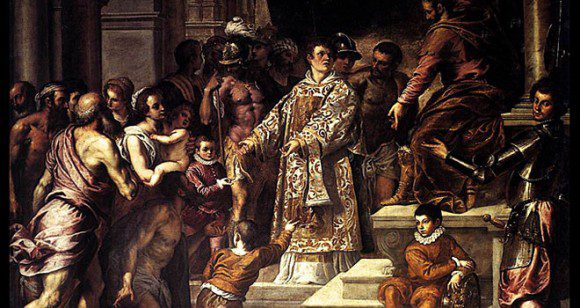
On the 47th anniversary of the community, which was during the week of my visit, a festive mass was celebrated in the massive basilica of Saint John Lateran. Not only bishops, politicians, and diplomats attended, but also the community’s many peripheral friends: the elderly, the disabled, the homeless, and the children. It felt like being confronted with a contemporary and living icon of the story of Saint Lawrence of Rome presenting the poor to Emperor Valerian as the treasures of the church.
That is what I think I saw that evening: a living icon of the presence of Christ in the periphery, being put together in the center of the universal Church.
Meanwhile, the state of the Church in Europe is still worrisome, and the situation of the decreasing number of Catholic faithful, especially in the Netherlands, seems to be more discouraging every year. What is to become of the Catholic community as a minority in a Europe with increasing ethnic, cultural and religious tensions? What is going to happen to parish life with so much churches closing and so little callings to the priesthood? Are the movements, the Community of Sant’Egidio being one of them, going to save the day like the cavalry in a Western movie which always arrived late but in time to save the besieged protagonists?
And what about the poor, and the refugees on their rafts in the Mediterranean? During the next month, I will try to reflect on these questions as I will work on my thesis on the Community of Sant’Egidio as a case study to understand the role of the ecclesial lay movements in contemporary Catholicism. Let’s hope it will not only bring knowledge, but also some wisdom.
 Zeger Polhuijs is a Dutch student and Catholic blogger, and involved with the Community of Sant’Egidio in Amsterdam. Over the next months he will conduct fieldwork in the Sant’Egidio Communities in Rome, Antwerp and Amsterdam for his thesis research.
Image: Saint Lawrence with poor by Jacopo d’Antonio Negretti/Public Domain
Previous Post

March 5, 2015
That Human Decency Stubbornly Persists is Hopeful
Next Post
March 15, 2015 What "Gifts" are Found in the Visitation of Mary to Elizabeth?
Browse Our Archives
Select a Category abortion abuse art and culture Books Catholic and Gay Catholic identity Catholic Laity Catholic Vocations Catholic Youth Catholicity Cinema clergy scandal Community of Sant’Egidio Culture of Life Editorial Faith Family Father Robert Barron Guest Post In Defense of Christians Marriage Mary Middle East New Evangelization Parenthood Patheos Catholic Poetry politics Pope Poverty Prayer Priesthood Race in America Sacred Art Saints Series sexuality Shaw Synod Uncategorized
Select a Month August 2023 February 2022 January 2022 December 2021 October 2021 September 2021 August 2021 February 2021 January 2021 December 2020 October 2020 August 2020 June 2020 May 2020 April 2020 November 2019 June 2019 May 2019 March 2019 December 2018 October 2018 September 2018 August 2017 July 2017 October 2016 August 2016 July 2016 June 2016 December 2015 September 2015 August 2015 July 2015 June 2015 May 2015 April 2015 March 2015 February 2015 January 2015 December 2014 November 2014 October 2014 September 2014
TAKE THE
Religious Wisdom Quiz
Who said, "Naked I came from my mother’s womb, and naked I shall return"?
Select your answer to see how you score.
Solomon Job Elijah David
Related posts from The Font
Finding Galilee, and Prophecy, on the Periphery with...

A Community of Buoyant Friendship Amid Gathering Clouds
Restoring Christian Culture Brick by Brick
Our Lady of the Heights: Commemorating the Tulsa...
TRENDING AT PATHEOS Catholic

Creation, Preservation, and Teleology in Catholic Theology
As I write this, it is very early Monday morning. Like millions...

The Parable Of The Sower And The Word...
One of Christ’s most famous parables is that of the sower who...

Rejecting Doom: Christian Hope And Human Action
Christianity is a religion of hope. We are to have hope and...

Why I Choose the Eucharist Over the Sermon
Choose the Eucharist, Not the Sermon What are we supposed to get...

5 Design Elements Found in Spiritually Rooted Homes
Putting Spirituality Into Home Decor Our homes are more than our living...

Credo: A Story of God Told with the...
About 10 years ago, I began to imagine a personal "Credo" that...
view all Catholic blogs
Ad-Free & Subscriber Log-In Subscription Support
- About Us
- 2026 Calendar
- Videos
- Podcasts
- Library of World Religions
- Faith In Media Tracker
- Advertise With Us
- Write for Us
- Privacy Policy
- Terms of Service
- Do Not Sell My Data
- Contact Us
- Radiant Digital
- Manage Newsletter Subscriptions
- Unsubscribe From Notifications
- Sitemap
Copyright 2008-2026, Patheos. All rights reserved.
Subscription Support Ad-Free & Subscriber Log-In
Follow Patheos