
BuddhistCatholicContemplativeEvangelicalGeneral ChristianHinduJewishLatter-day SaintMuslimNew VisionsProgressive Christian
Beliefs
- Buddhist
- Catholic
- Contemplative
- Evangelical
- General Christian
- Hindu
- Jewish
- Latter-day Saint
- More Voices
- Muslim
- New Visions
- Pagan
- Progressive Christian
Topics
- Religion News
- Food and Religion
- Sports and Religion
- Religious Art
- Religious Music and Entertainment
- Religious Events
- History and Religion
- Style and Religion
- Politics and Religion
- Women in Religion
- Recreation Outdoors and Religion
- Business Finance and Religion
- Careers Workplace and Religion
- Education and Religion
- Family Parenting and Religion
- Health Fitness and Religion
- Home and Religion
- Relationships and Religion
- Technology and Religion
- Travel and Religion
Columnists
- Buddhist Columnists
- Business Finance and Religion Columnists
- Careers Workplace and Religion Columnists
- Catholic Columnists
- Contemplative Columnists
- Education and Religion Columnists
- Evangelists Columnists
- Family Parenting and Religion Columnists
- General Christian Columnists
- Health Fitness and Religion Columnists
- Hindu Columnists
- History and Religion Columnists
- Home and Religion Columnists
- Jewish Columnists
- More Voices Columnists
- Latter Day Columnists
- Muslim Columnists
- New Visions Columnists
- Nonreligious Columnists
- Pagan Columnists
- Politics and Religion Columnists
- Progressive Columnists
- Recreation Outdoors and Religion Columnists
- Relationships and Religion Columnists
- Religion News Columnists
- Religious Art Columnists
- Religious Events Columnists
- Religious Music and Entertainment Columnists
- Sports and Religion Columnists
- Style and Religion Columnists
- Technology and Religion Columnists
- Travel and Religion Columnists
- Women in Religion Columnists
Resource Library
- 2026 Calendar
- Library of World Religions
- The 100 Most Holy Places on Earth
- Patheos Answers
- Podcasts
- Videos
- Faith Leaders Database
- Anglican Episcopalian
- Bahai
- Baptist
- Buddhism
- Christianity
- Confucianism
- Eastern Orthodoxy
- Hinduism
- Holiness and Pentecostal
- ISKCON
- Islam
- Judaism
- Lutheran
- Methodist
- The Church of Jesus Christ of Latter-day Saints
- New Age
- Paganism
- Presbytarian and Reformed
- Protestantism
- Religion Behind the Scenes
- Roman Catholic
- Scientology
- Shia Islam
- Sikhism
- Sufism
- Sunni Islam
- Taoism
- Zen
- See all religions
Research Tools
 Ad-Free & Subscriber Log-In Subscription Support
Ad-Free & Subscriber Log-In Subscription Support
Follow Patheos 

- Trending:
- Forgiveness
- |
- Marriage
- |
- Consciousness
- |
- Death Penalty
- |
- Election
- |
- Halloween

- Home
- Catholic
- Fathers and Sons and the Father and the Son: A reflection on presence.
Fathers and Sons and the Father and the Son: A reflection on presence.
Last updated on: March 20, 2015 at 3:01 pm by Guest Contributor
Fathers and Sons and the Father and the Son: A reflection on presence. 2015-03-20T15:01:07-05:00 Guest Contributor
Patheos Explore the world's faith through different perspectives on religion and spirituality! Patheos has the views of the prevalent religions and spiritualities of the world.
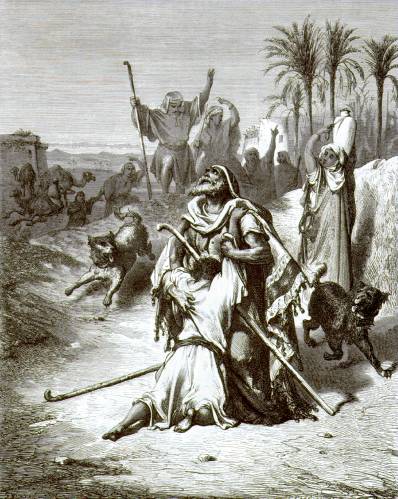
Return of the Prodigal by Gustave Dore, Public Domain, Wikimedia Commons.

by Fabio Hurtado
We live, in fact, in a world starved for solitude, silence, and privacy, and therefore starved for meditation and true friendship.
— C.S. Lewis
It was almost a year ago when during a meeting – I use that term loosely to describe four friends gathering at a local pub to drink draft beer and talk through theology and life – that we faced this question: If God is a loving father why would he abandon his children and not show himself to those he claims to love?
The logic behind this question is that a loving father is around to share in the lives of his children. If he is a father then the most important thing a father can do is to be present. In a sense, presence is the defining role of fatherhood. By all apparent standards, and since he does not appear to us early each morning, God is at best an absent, aloof, distant, and cold father. It seems he lacks the essence of fatherhood: presence.
It has taken me some time to pray through this question. What I am about to offer is not a theological treatise; this is, I hope, a response to a question posed by a friend, albeit one who does not share my faith.
A year is a long time to take to offer a response, but I have taken time, during Mass and at other times of prayer, to ask God to reveal a response, to reveal His response. I have knocked annoyingly on his door, trusting that persistence is the greater part of holiness.
Please understand, I desperately wanted God’s answer to this question for myself, as a father, and as a son. I offer this reflection to you in the spirit of communication and friendship, not in the desire to proselytize nor to convert.
We are, after all, among friends.
Woe to you, teachers of the law and Pharisees, you hypocrites! You give a tenth of your spices — mint, dill and cumin. But you have neglected the more important matters of the law — justice, mercy, and faithfulness. You should have practiced the latter, without neglecting the former. — Matthew 23:23
I love this verse from Mathew’s gospel, where we find the both/and mentality of Jesus. He was not an either/or person. He is asking here for both the practicing of complex abstract ideas like justice and mercy in our daily life, while still following the concrete letter of the law. Any prophet can choose the life-giving spirit over the just letter of the law. The Son of God wants both: mercy and justice. You take care of the tenth of mint and you practice mercy and faithfulness. So much like a true father: you feed and clothe your kids and you also teach them the higher ideals in life: love, justice, kindness. Without both, your child starves – one way or another.
God’s response to the question about being absent is both simple and complex: Jesus.
God loves a paradox. In a paradox he can have us hold the tension of two seemingly contradictory statements. When finite beings try to deal in God (infinite) language there will always be inherent contradictions, so God needs to have us live in the paradox.
Here is the deal: before I knew Jesus, I would have agreed completely with the statement that God is absent from the world.
I mean, it’s obviously true. I don’t see the dude the way I see you. But after I met Jesus – that sounds weird, right? – I realized that God had been with me all along. In Jesus, God silences all the noise about him being an absent father.
So two questions: how does he do that, and how can I ever realize it before meeting Jesus?
If you asked a believer to summarize the good news I think most folks would go right to John 3:16. Because God loved the world — because he wanted to be present in the lives of his children — he sent Jesus. And then Jesus died on the Cross and blah, blah, blah. I mean, you have heard this already and it does not move you. Right?
Because, still, where is he?
I’ll let Tolkien answer that, since he is a crowd favorite in our group. This piece is from one of Tolkien’s letters to his son:
Out of the darkness of my life, so much frustrated, I put before you the one great thing to love on earth: the Blessed Sacrament…There you will find
romance, glory, honour, fidelity, and the true way of all your loves on earth.
The Blessed Sacrament, the Eucharist, is Christ literally present today, this moment, on planet Earth. God is literally present in every tabernacle in every church under the appearance of piece of flat bread wafer. And yet all we see is a wafer — he is apparently not there.
The Eucharist is Jesus fulfilling his promise to be with us until the end of time. Yet, it is God respecting our freedom to accept Him without overwhelming us with his appearance.
It is God doing what a father must do: being fully present. Yesterday. Today. Eternally.
That is why Tolkien is so excited about the Eucharist. It is why he shares this with his son. A father sharing the Son with his son! That’s true presence. Fatherhood.
Any cheap conjurer can make things appear when they are not truly there (a penny, a card trick) or make them disappear (the Statue of Liberty) when they are there. The God of the universe wants both: to both be present and appear not to be present at the same time.
So, second question: How can I realize God’s presence before meeting Jesus?
Speaking for myself, I cannot imagine it.
It would be like asking to feel like a son, without actually accepting that you are one.
It’s like wanting to feel loved by a father you don’t recognize as one.
When the prodigal son leaves the father and walks away, he does not have sonship. As soon as he begins to walk back, the father returns his sonship. He meets him on the way back and mercy begins, and the pain of not being a son stops.
A son who does not need a father is a tough son to father.
When does a son need a father? When he is playing in his first ball game; when he needs to learn how to treat a woman; when he stays out past midnight to get drunk and high.
A son needs a father, even to be recognized as a son. In fact, the word son would not have meaning without the word father.
When the son admits a need, the father enters the son’s world, and begins to fill it. The son is hurt and the father is healer and then right there they collide — the needful and hurt one and the Healer collide. I like that Mercy Me chooses, in this song, the word collide because of the inevitability that a collision implies.
When the child feels the need to finally seek the father, he calls out; the Father says, “Come Home.” God is fully present; he is there. It is for the son to move toward him; the son has all the power to claim him the father, or to continue to remain fatherless.
The Son has all the power within the paradox. When we hand our lives over to the Son we become sons of the always-present Father.
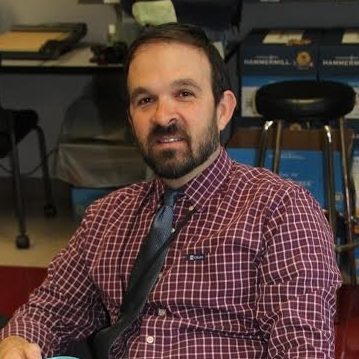 Fabio Alberto Hurtado was born in Havana, Cuba. He is currently the Dean of Academics and English teacher at Cannon School in Concord, NC where he lives with his wife, children, dog Boo, six hens, and a bantam black rooster. Fabio is currently working of a memoir of growing up as a Cuban-American boy. He holds an M.A. in Theology from Holy Apostles College & Seminary.
Previous Post
March 19, 2015
Embracing Death: When we Can't Face Life but Won't Take the Cross
Next Post

March 23, 2015 Confession, The Hidden Sacrament Indeed
Browse Our Archives
Select a Category abortion abuse art and culture Books Catholic and Gay Catholic identity Catholic Laity Catholic Vocations Catholic Youth Catholicity Cinema clergy scandal Community of Sant’Egidio Culture of Life Editorial Faith Family Father Robert Barron Guest Post In Defense of Christians Marriage Mary Middle East New Evangelization Parenthood Patheos Catholic Poetry politics Pope Poverty Prayer Priesthood Race in America Sacred Art Saints Series sexuality Shaw Synod Uncategorized
Select a Month August 2023 February 2022 January 2022 December 2021 October 2021 September 2021 August 2021 February 2021 January 2021 December 2020 October 2020 August 2020 June 2020 May 2020 April 2020 November 2019 June 2019 May 2019 March 2019 December 2018 October 2018 September 2018 August 2017 July 2017 October 2016 August 2016 July 2016 June 2016 December 2015 September 2015 August 2015 July 2015 June 2015 May 2015 April 2015 March 2015 February 2015 January 2015 December 2014 November 2014 October 2014 September 2014
TAKE THE
Religious Wisdom Quiz
Who found Moses' basket in the Nile?
Select your answer to see how you score.
Pharaoh's daughter Jochebed Miriam Zipporah
Related posts from The Font
Pastoral Zeal as Priestly Identity
Christianity, an Image of the Social and Political...
Is Jesus the Essence and Center of Christianity?

TRENDING AT PATHEOS Catholic

Creation, Preservation, and Teleology in Catholic Theology
As I write this, it is very early Monday morning. Like millions...

The Parable Of The Sower And The Word...
One of Christ’s most famous parables is that of the sower who...

Rejecting Doom: Christian Hope And Human Action
Christianity is a religion of hope. We are to have hope and...

Why I Choose the Eucharist Over the Sermon
Choose the Eucharist, Not the Sermon What are we supposed to get...

5 Design Elements Found in Spiritually Rooted Homes
Putting Spirituality Into Home Decor Our homes are more than our living...

Credo: A Story of God Told with the...
About 10 years ago, I began to imagine a personal "Credo" that...
view all Catholic blogs
Ad-Free & Subscriber Log-In Subscription Support
- About Us
- 2026 Calendar
- Videos
- Podcasts
- Library of World Religions
- Faith In Media Tracker
- Advertise With Us
- Write for Us
- Privacy Policy
- Terms of Service
- Do Not Sell My Data
- Contact Us
- Radiant Digital
- Manage Newsletter Subscriptions
- Unsubscribe From Notifications
- Sitemap
Copyright 2008-2026, Patheos. All rights reserved.
Subscription Support Ad-Free & Subscriber Log-In
Follow Patheos