
BuddhistCatholicContemplativeEvangelicalGeneral ChristianHinduJewishLatter-day SaintMuslimNew VisionsProgressive Christian
Beliefs
- Buddhist
- Catholic
- Contemplative
- Evangelical
- General Christian
- Hindu
- Jewish
- Latter-day Saint
- More Voices
- Muslim
- New Visions
- Pagan
- Progressive Christian
Topics
- Religion News
- Food and Religion
- Sports and Religion
- Religious Art
- Religious Music and Entertainment
- Religious Events
- History and Religion
- Style and Religion
- Politics and Religion
- Women in Religion
- Recreation Outdoors and Religion
- Business Finance and Religion
- Careers Workplace and Religion
- Education and Religion
- Family Parenting and Religion
- Health Fitness and Religion
- Home and Religion
- Relationships and Religion
- Technology and Religion
- Travel and Religion
Columnists
- Buddhist Columnists
- Business Finance and Religion Columnists
- Careers Workplace and Religion Columnists
- Catholic Columnists
- Contemplative Columnists
- Education and Religion Columnists
- Evangelists Columnists
- Family Parenting and Religion Columnists
- General Christian Columnists
- Health Fitness and Religion Columnists
- Hindu Columnists
- History and Religion Columnists
- Home and Religion Columnists
- Jewish Columnists
- More Voices Columnists
- Latter Day Columnists
- Muslim Columnists
- New Visions Columnists
- Nonreligious Columnists
- Pagan Columnists
- Politics and Religion Columnists
- Progressive Columnists
- Recreation Outdoors and Religion Columnists
- Relationships and Religion Columnists
- Religion News Columnists
- Religious Art Columnists
- Religious Events Columnists
- Religious Music and Entertainment Columnists
- Sports and Religion Columnists
- Style and Religion Columnists
- Technology and Religion Columnists
- Travel and Religion Columnists
- Women in Religion Columnists
Resource Library
- 2026 Calendar
- Library of World Religions
- The 100 Most Holy Places on Earth
- Patheos Answers
- Podcasts
- Videos
- Faith Leaders Database
- Anglican Episcopalian
- Bahai
- Baptist
- Buddhism
- Christianity
- Confucianism
- Eastern Orthodoxy
- Hinduism
- Holiness and Pentecostal
- ISKCON
- Islam
- Judaism
- Lutheran
- Methodist
- The Church of Jesus Christ of Latter-day Saints
- New Age
- Paganism
- Presbytarian and Reformed
- Protestantism
- Religion Behind the Scenes
- Roman Catholic
- Scientology
- Shia Islam
- Sikhism
- Sufism
- Sunni Islam
- Taoism
- Zen
- See all religions
Research Tools
 Ad-Free & Subscriber Log-In Subscription Support
Ad-Free & Subscriber Log-In Subscription Support
Follow Patheos 

- Trending:
- Forgiveness
- |
- Marriage
- |
- Consciousness
- |
- Death Penalty
- |
- Election
- |
- Halloween

- Home
- Catholic
- Stephen Fry’s Cruel God, Job, and the Cross of Jesus
Stephen Fry’s Cruel God, Job, and the Cross of Jesus
Last updated on: February 23, 2015 at 1:19 pm by Elizabeth Scalia
Stephen Fry’s Cruel God, Job, and the Cross of Jesus 2015-02-23T13:19:01-05:00 Elizabeth Scalia
Patheos Explore the world's faith through different perspectives on religion and spirituality! Patheos has the views of the prevalent religions and spiritualities of the world.
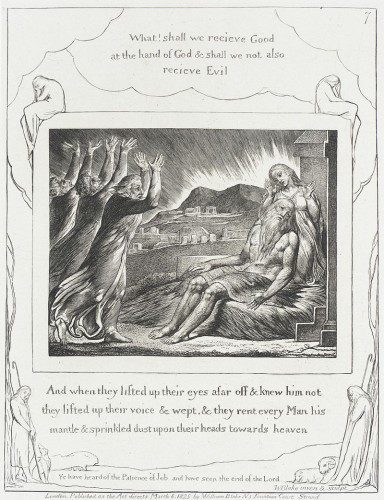
Public Domain via WikimediaCommons

By Very Rev. Robert Barron
The British writer, actor, and comedian Stephen Fry is featured in a YouTube video which has gone viral: over 5 million views as of this moment. As you may know, Fry is, like his British counterparts Christopher Hitchens and Richard Dawkins, a fairly ferocious atheist, who has made a name for himself in recent years as a very public debunker of all things religious. In the video in question, he articulates precisely what he would say to God if, upon arriving at the pearly gates, he discovered that he was mistaken in his atheism. Fry says that he would ask God why he made a universe in which children get bone cancer, a universe in which human beings suffer horrifically and without justification. If such a monstrous, self-absorbed, and stupid God exists, Fry insists, he would decidedly not want to spend eternity with him. Now there is much more to Fry’s rant—it goes on for several minutes—but you get the drift.
To those who feel that Stephen Fry has delivered a devastating blow to religious belief, let me say simply this: this objection is nothing new to Christians. St. Paul, Origen, Augustine, C.S. Lewis, G.K. Chesterton and many, many other Christian theologians up and down the centuries have dealt with it. In fact, one of the pithiest expressions of the problem was formulated by St. Thomas Aquinas in the thirteenth century. The great Catholic philosopher argued that if one of two contraries be infinite, the other would be altogether destroyed. Yet God is called infinitely good. Therefore, if God exists, there should be no evil. But there is evil. Thus it certainly seems to follow that God does not exist. Thomas thereby conveys all of the power of Fry’s observations without the histrionics. And of course, all of this subtle theological wrestling with the problem of suffering is grounded, finally, in the most devastating rant ever uttered against God, a rant found not in an essay of some disgruntled atheist philosopher but rather in the pages of the Bible. I’m talking about the book of Job.
According to the familiar story, Job is an innocent man, but he is nevertheless compelled to endure every type of suffering. In one fell swoop, he loses his wealth, his livelihood, his family, and his health. A group of friends console him and then attempt to offer theological explanations for his pain. But Job dismisses them all and, with all the fury of Stephen Fry, calls out God, summoning him, as it were, into the dock to explain himself. Out of the desert whirlwind God then speaks—and it is the longest speech by God in the Scriptures: “Where were you when I laid the foundations of the earth? Tell me, if you know… . Who shut within doors the sea…when I made the clouds its garment and thick darkness its swaddling bands? Have you ever in your lifetime commanded the morning and shown the dawn its place” (Job 38: 4, 8-10)? God goes on, taking Job on a lengthy tour of the mysteries, conundrums, and wonders of the universe, introducing him to ever wider contexts, situating his suffering within frameworks of meaning that he had never before considered. In light of God’s speech, I would first suggest to Stephen Fry that the true God is the providential Lord of all of space and all of time.
Secondly, I would observe that none of us can see more than a tiny swatch of that immense canvas on which God works. And therefore I would urge him to reconsider his confident assertion that the suffering of the world—even the most horrific and seemingly unjustified—is necessarily without meaning. Imagine that one page of Tolkien’s Lord of the Rings was torn away and allowed to drift on the wind. Imagine further that that page became, in the course of several months, further ripped and tattered so that only one paragraph of it remained legible. And finally imagine that someone who had never heard of Tolkien’s rich and multi-layered story came, by chance, upon that single paragraph. Would it not be the height of arrogance and presumption for that person to declare that those words made not a lick of sense? Would it not be akin to someone, utterly ignorant of higher mathematics, declaring that a complex algebraic formula, coherent in itself but opaque to him, is nothing but gibberish? Given our impossibly narrow point of view, how could any of us ever presume to pronounce on the “meaninglessness” of what happens in the world?
A third basic observation I would make to Mr. Fry is this: once we grant that God exists, we hold to the very real possibility of a life beyond this one. But this implies that no evil in this world, even death itself, is of final significance. Is it terrible that innocent children die of wasting diseases? Well of course. But is it finally and irreversibly terrible? Is it nothing but terrible? By no means! It might in fact be construed as an avenue to something unsurpassably good.
In the last analysis, the best rejoinder to Fry’s objection is a distinctively Christian one, for Christians refer to the day on which Jesus was unjustly condemned, abandoned by his friends, brutally scourged, paraded like an animal through the streets, nailed to an instrument of torture and left to die as “Good Friday.” To understand that is to have the ultimate answer to Job—and to Stephen Fry.
 Father Robert Barron is the founder of the global ministry, Word on Fire, and the Rector/President of Mundelein Seminary. He is the creator of the award winning documentary series, “Catholicism” and “Catholicism:The New Evangelization.” Learn more at www.WordonFire.org
Previous Post

February 19, 2015
Same Sex Marriage Inevitable; Churches Must Seek Legal Protections
Next Post
February 25, 2015 A Medievalist Considers Inculturation in the Sacred Art
Browse Our Archives
Select a Category abortion abuse art and culture Books Catholic and Gay Catholic identity Catholic Laity Catholic Vocations Catholic Youth Catholicity Cinema clergy scandal Community of Sant’Egidio Culture of Life Editorial Faith Family Father Robert Barron Guest Post In Defense of Christians Marriage Mary Middle East New Evangelization Parenthood Patheos Catholic Poetry politics Pope Poverty Prayer Priesthood Race in America Sacred Art Saints Series sexuality Shaw Synod Uncategorized
Select a Month August 2023 February 2022 January 2022 December 2021 October 2021 September 2021 August 2021 February 2021 January 2021 December 2020 October 2020 August 2020 June 2020 May 2020 April 2020 November 2019 June 2019 May 2019 March 2019 December 2018 October 2018 September 2018 August 2017 July 2017 October 2016 August 2016 July 2016 June 2016 December 2015 September 2015 August 2015 July 2015 June 2015 May 2015 April 2015 March 2015 February 2015 January 2015 December 2014 November 2014 October 2014 September 2014
TAKE THE
Religious Wisdom Quiz
Who is known for his wisdom and built a temple?
Select your answer to see how you score.
Solomon Paul Moses David
Related posts from The Font

Jenner's Gnosticism, the “Shadow Council,” and St. Irenaeus
"The Avengers" and Friedrich Nietzsche
A Lion of the American Church: Thoughts on...
Yes, the Devil is Real. Be Armed.
TRENDING AT PATHEOS Catholic

Rejecting Doom: Christian Hope And Human Action
Christianity is a religion of hope. We are to have hope and...

It’s What Comes From Within Which Matters
One of the most difficult things for us to understand is why...

Why I Choose the Eucharist Over the Sermon
Choose the Eucharist, Not the Sermon What are we supposed to get...

5 Design Elements Found in Spiritually Rooted Homes
Putting Spirituality Into Home Decor Our homes are more than our living...

Credo: A Story of God Told with the...
About 10 years ago, I began to imagine a personal "Credo" that...

The Anatomy of Divine Revelation in Catholic Thought
The claim that God has made Himself known to human beings is...
view all Catholic blogs
Ad-Free & Subscriber Log-In Subscription Support
- About Us
- 2026 Calendar
- Videos
- Podcasts
- Library of World Religions
- Faith In Media Tracker
- Advertise With Us
- Write for Us
- Privacy Policy
- Terms of Service
- Do Not Sell My Data
- Contact Us
- Radiant Digital
- Manage Newsletter Subscriptions
- Unsubscribe From Notifications
- Sitemap
Copyright 2008-2026, Patheos. All rights reserved.
Subscription Support Ad-Free & Subscriber Log-In
Follow Patheos