
BuddhistCatholicContemplativeEvangelicalGeneral ChristianHinduJewishLatter-day SaintMuslimNew VisionsProgressive Christian
Beliefs
- Buddhist
- Catholic
- Contemplative
- Evangelical
- General Christian
- Hindu
- Jewish
- Latter-day Saint
- More Voices
- Muslim
- New Visions
- Pagan
- Progressive Christian
Topics
- Religion News
- Food and Religion
- Sports and Religion
- Religious Art
- Religious Music and Entertainment
- Religious Events
- History and Religion
- Style and Religion
- Politics and Religion
- Women in Religion
- Recreation Outdoors and Religion
- Business Finance and Religion
- Careers Workplace and Religion
- Education and Religion
- Family Parenting and Religion
- Health Fitness and Religion
- Home and Religion
- Relationships and Religion
- Technology and Religion
- Travel and Religion
Columnists
- Buddhist Columnists
- Business Finance and Religion Columnists
- Careers Workplace and Religion Columnists
- Catholic Columnists
- Contemplative Columnists
- Education and Religion Columnists
- Evangelists Columnists
- Family Parenting and Religion Columnists
- General Christian Columnists
- Health Fitness and Religion Columnists
- Hindu Columnists
- History and Religion Columnists
- Home and Religion Columnists
- Jewish Columnists
- More Voices Columnists
- Latter Day Columnists
- Muslim Columnists
- New Visions Columnists
- Nonreligious Columnists
- Pagan Columnists
- Politics and Religion Columnists
- Progressive Columnists
- Recreation Outdoors and Religion Columnists
- Relationships and Religion Columnists
- Religion News Columnists
- Religious Art Columnists
- Religious Events Columnists
- Religious Music and Entertainment Columnists
- Sports and Religion Columnists
- Style and Religion Columnists
- Technology and Religion Columnists
- Travel and Religion Columnists
- Women in Religion Columnists
Resource Library
- 2026 Calendar
- Library of World Religions
- The 100 Most Holy Places on Earth
- Patheos Answers
- Podcasts
- Videos
- Faith Leaders Database
- Anglican Episcopalian
- Bahai
- Baptist
- Buddhism
- Christianity
- Confucianism
- Eastern Orthodoxy
- Hinduism
- Holiness and Pentecostal
- ISKCON
- Islam
- Judaism
- Lutheran
- Methodist
- The Church of Jesus Christ of Latter-day Saints
- New Age
- Paganism
- Presbytarian and Reformed
- Protestantism
- Religion Behind the Scenes
- Roman Catholic
- Scientology
- Shia Islam
- Sikhism
- Sufism
- Sunni Islam
- Taoism
- Zen
- See all religions
Research Tools
 Ad-Free & Subscriber Log-In Subscription Support
Ad-Free & Subscriber Log-In Subscription Support
Follow Patheos 

- Trending:
- Forgiveness
- |
- Marriage
- |
- Consciousness
- |
- Death Penalty
- |
- Election
- |
- Halloween

- Home
- Catholic
- On Thomas Merton, a Gratitude Both Priestly and Intellectual
On Thomas Merton, a Gratitude Both Priestly and Intellectual
Last updated on: February 19, 2015 at 3:46 pm by Fr. Robert Barron
On Thomas Merton, a Gratitude Both Priestly and Intellectual 2015-02-19T15:46:07-05:00 Fr. Robert Barron
Patheos Explore the world's faith through different perspectives on religion and spirituality! Patheos has the views of the prevalent religions and spiritualities of the world.
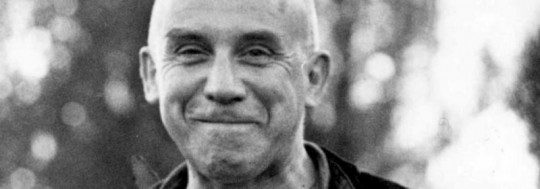
By Very Rev. Robert Barron
I write these words on the one hundredth anniversary of the birth of Thomas Merton, one of the greatest spiritual writers of the 20th century and a man who had a decisive influence on me and my vocation to the priesthood. I first encountered Merton’s writing in a peculiar way. My brother and I were both working at a bookstore in the Chicago suburbs. One afternoon, he tossed to me a tattered paperback with a torn cover that the manager had decided to discard. My brother said, “You might like this; it’s written by a Trappist monk.” I replied, with the blithe confidence of a sixteen year old, “I don’t want to read a book by some Buddhist.” With exquisite sensitivity, he responded, “Trappists are Catholics, you idiot.”
The book in question was The Seven Storey Mountain, Thomas Merton’s passionate, articulate, smart, and deeply moving account of his journey from worldling to Trappist monk. Though much of the philosophy and theology was, at that time, over my head, I became completely caught up in the drama and romance of Merton’s story, which is essentially the tale of how a man fell in love with God. The book is extraordinarily well written, funny, adventurous, and spiritually wise. In one of the blurbs written for the first edition, Fulton Sheen referred to it as a contemporary version of St. Augustine’s Confessions, and it was fulsomely praised by both Evelyn Waugh and Graham Greene. Moreover, it contributed massively to the startling influx of young men into monasteries and religious communities across the United States in the postwar era.
I was so thrilled by my first encounter with Merton that I dove headlong into his body of writing. The Sign of Jonas, a journal that Merton kept in the years leading up to his priestly ordination, became a particular favorite. That work concludes with an essay called “Firewatch: July 4, 1952,” which Jacques Maritain referred to as the greatest piece of spiritual writing in the twentieth century. In this powerful meditation, Merton uses the mundane monastic task of walking through the monastery checking for fires as a metaphor for a Dantesque examination of the soul. The Sign of Jonas is marked by Merton’s playful and ironic sense of humor, but it also gives evidence of the enormous range of his reading and intellectual interests. To devour that book as a nineteen year old, as I did, was to receive an unparalleled cultural education. For many people of my generation, Merton opened the door to the wealth of the Catholic spiritual tradition: I first learned about John of the Cross, Meister Eckhart, Teresa of Avila, Bernard of Clairvaux, Odo of Cluny, the Victorines, Origen, Thérèse of Lisieux, and Hans Urs von Balthasar from him.
Perhaps the central theme of all of Merton’s writings is contemplation. What he stressed over and again in regard to this crucial practice is that it is not the exclusive preserve of spiritual athletes, but rather something that belongs to all the baptized and that stands at the heart of Christian life. For contemplation is, in his language, “to find the place in you where you are here and now being created by God.” It is consciously to discover a new center in God and hence at the same time to discover the point of connection to everyone and everything else in the cosmos. Following the French spiritual masters, Merton called this le point vierge, the virginal point, or to put it in the language of the fourth Gospel, “water bubbling up in you to eternal life.” In his famous epiphanic experience at the corner of 4th and Walnut in downtown Louisville, Merton felt, through le point vierge, a connection to the ordinary passersby so powerful it compelled him to exclaim, “There is no way of telling people that they are all walking around shining like the sun.”
Sadly, for many younger Catholics today, Merton, if he is known at all, is viewed with a certain suspicion, and this for two reasons. First, when he was a man of fifty-one, he fell in love with a young nurse who cared for him after back surgery. Though it is almost certain that this was exclusively an affair of the heart, it was certainly, to say the very least, unseemly for a middle-aged monk and priest to have been so infatuated with a much younger woman. At the same time, Merton worked through this confusing period and returned to his vowed monastic life. And the journal that he kept during that year is so spiritually alert and illuminating that I often recommend it to brother priests who are wrestling with the promise of celibacy. To dismiss Merton out of hand because of this admittedly inappropriate relationship strikes me as disproportionate.
The second reason that some younger Catholics are wary of Merton is his interest, in the last roughly ten years of his life, in Eastern religions, especially Buddhism. They see this as an indication of a religious relativism or a vague syncretism. Nothing could be further from the truth. Merton was indeed fascinated by the Eastern religions and felt that Christians could benefit from a greater understanding of their theory and practice, but he never for a moment felt that all the religions were the same or that Christians should move to some space “beyond” Christianity. In order to verify this, all one has to do is read the prefaces to his major books on Zen and Buddhism. About ten years ago, I had the privilege of giving a retreat to the monks at Merton’s monastery of Gethsemani in Kentucky. Just after the retreat ended, Merton’s secretary, Br. Patrick Hart, took me in a jeep out to see the hermitage that Merton occupied the last few years of his life. While we were sitting on the front porch of the small house, he looked at me intently and said, “Could you tell anyone that’s interested that Thomas Merton died a monk of Gethsemani Abbey and a priest of the Catholic Church?” He was as bothered as I am by the silly suggestion that Merton, at the end of his life, was on the verge of leaving the priesthood or abandoning the Catholic faith.
Thomas Merton was not perfect, and he might not have been a saint. But he was indeed a master of the spiritual life, and his life and work had a profound effect on me and an army of others around the world. I offer this birthday tribute as a small token of gratitude.
 Father Robert Barron is the founder of the global ministry, Word on Fire, and the Rector/President of Mundelein Seminary. He is the creator of the award winning documentary series, “Catholicism” and “Catholicism:The New Evangelization.” Learn more at www.WordonFire.org
(Merton Image via Bing.com “free to use/share”)
Previous Post

January 30, 2015
Why Having a Heart of Gold is Not What Christianity is About
Next Post

February 4, 2015 A Community of Buoyant Friendship Amid Gathering Clouds
Browse Our Archives
Select a Category abortion abuse art and culture Books Catholic and Gay Catholic identity Catholic Laity Catholic Vocations Catholic Youth Catholicity Cinema clergy scandal Community of Sant’Egidio Culture of Life Editorial Faith Family Father Robert Barron Guest Post In Defense of Christians Marriage Mary Middle East New Evangelization Parenthood Patheos Catholic Poetry politics Pope Poverty Prayer Priesthood Race in America Sacred Art Saints Series sexuality Shaw Synod Uncategorized
Select a Month August 2023 February 2022 January 2022 December 2021 October 2021 September 2021 August 2021 February 2021 January 2021 December 2020 October 2020 August 2020 June 2020 May 2020 April 2020 November 2019 June 2019 May 2019 March 2019 December 2018 October 2018 September 2018 August 2017 July 2017 October 2016 August 2016 July 2016 June 2016 December 2015 September 2015 August 2015 July 2015 June 2015 May 2015 April 2015 March 2015 February 2015 January 2015 December 2014 November 2014 October 2014 September 2014
TAKE THE
Religious Wisdom Quiz
What will happen to Satan at the end of time, according to Revelation 20:10?
Select your answer to see how you score.
He will repent and be forgiven He will be thrown into the lake of fire He will roam the earth forever He will be cast out of heaven again
Related posts from The Font

Jenner's Gnosticism, the “Shadow Council,” and St. Irenaeus
"The Avengers" and Friedrich Nietzsche
A Lion of the American Church: Thoughts on...
A Message in Blood: ISIS and the Meaning...
TRENDING AT PATHEOS Catholic

Creation, Preservation, and Teleology in Catholic Theology
As I write this, it is very early Monday morning. Like millions...

The Parable Of The Sower And The Word...
One of Christ’s most famous parables is that of the sower who...

Rejecting Doom: Christian Hope And Human Action
Christianity is a religion of hope. We are to have hope and...

Why I Choose the Eucharist Over the Sermon
Choose the Eucharist, Not the Sermon What are we supposed to get...

5 Design Elements Found in Spiritually Rooted Homes
Putting Spirituality Into Home Decor Our homes are more than our living...

Credo: A Story of God Told with the...
About 10 years ago, I began to imagine a personal "Credo" that...
view all Catholic blogs
Ad-Free & Subscriber Log-In Subscription Support
- About Us
- 2026 Calendar
- Videos
- Podcasts
- Library of World Religions
- Faith In Media Tracker
- Advertise With Us
- Write for Us
- Privacy Policy
- Terms of Service
- Do Not Sell My Data
- Contact Us
- Radiant Digital
- Manage Newsletter Subscriptions
- Unsubscribe From Notifications
- Sitemap
Copyright 2008-2026, Patheos. All rights reserved.
Subscription Support Ad-Free & Subscriber Log-In
Follow Patheos