
BuddhistCatholicContemplativeEvangelicalGeneral ChristianHinduJewishLatter-day SaintMuslimNew VisionsProgressive Christian
Beliefs
- Buddhist
- Catholic
- Contemplative
- Evangelical
- General Christian
- Hindu
- Jewish
- Latter-day Saint
- More Voices
- Muslim
- New Visions
- Pagan
- Progressive Christian
Topics
- Religion News
- Food and Religion
- Sports and Religion
- Religious Art
- Religious Music and Entertainment
- Religious Events
- History and Religion
- Style and Religion
- Politics and Religion
- Women in Religion
- Recreation Outdoors and Religion
- Business Finance and Religion
- Careers Workplace and Religion
- Education and Religion
- Family Parenting and Religion
- Health Fitness and Religion
- Home and Religion
- Relationships and Religion
- Technology and Religion
- Travel and Religion
Columnists
- Buddhist Columnists
- Business Finance and Religion Columnists
- Careers Workplace and Religion Columnists
- Catholic Columnists
- Contemplative Columnists
- Education and Religion Columnists
- Evangelists Columnists
- Family Parenting and Religion Columnists
- General Christian Columnists
- Health Fitness and Religion Columnists
- Hindu Columnists
- History and Religion Columnists
- Home and Religion Columnists
- Jewish Columnists
- More Voices Columnists
- Latter Day Columnists
- Muslim Columnists
- New Visions Columnists
- Nonreligious Columnists
- Pagan Columnists
- Politics and Religion Columnists
- Progressive Columnists
- Recreation Outdoors and Religion Columnists
- Relationships and Religion Columnists
- Religion News Columnists
- Religious Art Columnists
- Religious Events Columnists
- Religious Music and Entertainment Columnists
- Sports and Religion Columnists
- Style and Religion Columnists
- Technology and Religion Columnists
- Travel and Religion Columnists
- Women in Religion Columnists
Resource Library
- 2026 Calendar
- Library of World Religions
- The 100 Most Holy Places on Earth
- Patheos Answers
- Podcasts
- Videos
- Faith Leaders Database
- Anglican Episcopalian
- Bahai
- Baptist
- Buddhism
- Christianity
- Confucianism
- Eastern Orthodoxy
- Hinduism
- Holiness and Pentecostal
- ISKCON
- Islam
- Judaism
- Lutheran
- Methodist
- The Church of Jesus Christ of Latter-day Saints
- New Age
- Paganism
- Presbytarian and Reformed
- Protestantism
- Religion Behind the Scenes
- Roman Catholic
- Scientology
- Shia Islam
- Sikhism
- Sufism
- Sunni Islam
- Taoism
- Zen
- See all religions
Research Tools
 Ad-Free & Subscriber Log-In Subscription Support
Ad-Free & Subscriber Log-In Subscription Support
Follow Patheos 

- Trending:
- Forgiveness
- |
- Marriage
- |
- Consciousness
- |
- Death Penalty
- |
- Election
- |
- Halloween

- Home
- Catholic
- Indifferent Relativism Helps Totalitarianism to Grow
Indifferent Relativism Helps Totalitarianism to Grow
Last updated on: February 19, 2015 at 3:48 pm by Fr. Robert Barron
Indifferent Relativism Helps Totalitarianism to Grow 2015-02-19T15:48:23-05:00 Fr. Robert Barron
Patheos Explore the world's faith through different perspectives on religion and spirituality! Patheos has the views of the prevalent religions and spiritualities of the world.
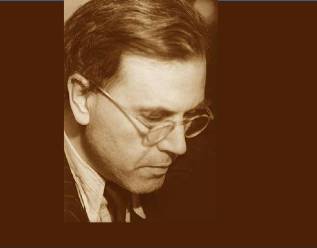
Dietrich von Hildebrand and Our Relativistic Age
By Very Rev. Robert Barron
Postmodern relativism and deconstruction have produced, at the popular level, what I have termed the “Meh culture,” that is to say, a culture dominated by the “whatever” attitude, a bland, detached indifferentism to the good and the true. How often have you heard someone say, “that’s perhaps true for you but not for me,” or “who are you to be imposing your values on me?” or in the immortal words of the Dude in “The Big Lebowski,” “well, that’s just like your opinion, man.” Is it not a commonplace today that the only moral absolute that remains is the obligation to tolerate all points of view? What this subjectivism has conduced toward is a society lacking in energy and focus, one that cannot rouse itself to corporate action on behalf of some universal good. John Henry Newman said that well-defined banks are precisely what give verve and direction to a river. Once those banks are knocked down, the river will spread out, in short order, into a large, lazy lake. Applying the analogy, he argued that objective truths, clearly understood, are what give energy to a culture and that when those truths are compromised in the name of freedom or toleration, said culture rapidly loses its purpose and cohesiveness. It is as though people today are floating on individual air-mattresses on Newman’s lazy lake, disconnected from one another, each locked in the isolation of his or her subjective judgments.
The great twentieth century philosopher Dietrich von Hildebrand was one of the most articulate and incisive critics of the kind of relativism that has come to hold sway in our time. Following the prompts of both Plato and St. Augustine, Hildebrand delighted in showing the self-defeating incoherence of the position: if he is to be consistent, the relativist must hold that the claim of universal relativism is itself relative and hence not binding on anyone beside himself. Hildebrand taught that the philosophy of relativism flowed from the failure to honor the fundamental distinction between the arena of the merely subjectively satisfying and the arena of real values. There are many things and experiences that we seek because they please us or satisfy some basic need. One might find a cigarette appealing or a slice of pizza tasty or a political party useful, but in all these cases, one is bending the thing in question to his subjectivity. But there are other goods (Hildebrand’s “values”) that by their splendor, excellence, and intrinsic worth, draw the person out of himself, bending his subjectivity to them, drawing him toward self-transcendence.
In the presence of Beethoven’s Ninth Symphony or Chartres Cathedral or Plato’s Republic or the daily work of the Missionaries of Charity in Calcutta, one is compelled to acknowledge the preciousness of a reality that goes beyond the needs or expectation of one’s ego. To characterize such things as merely subjectively satisfying, as though appreciating them is simply a matter of individual taste, would be simply ludicrous. The whole point of the moral life for Hildebrand is to cultivate the appropriate response to these objective values, to channel one’s energies according to their demands. A crucial consequence of cultivating the proper response to values is that real community increases and intensifies. Whereas the merely subjectively satisfying correlates to the individual and his particular preferences, the objectively valuable correlates to the entire society of those drawn out of themselves and into a shared devotion.
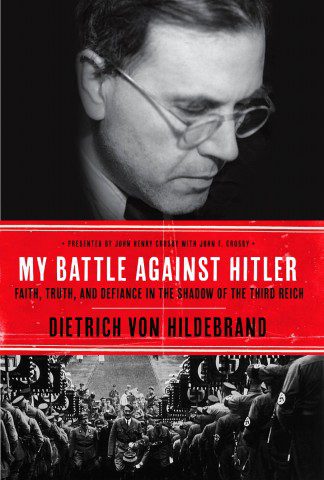 One might be tempted to think, “so far so abstract.” But a new book titled My Battle Against Hitler, edited by two of the most devoted Hildebrandians on the scene today, John Crosby and his son John Henry Crosby, vividly demonstrates how Hildebrand himself lived out the principles of his moral philosophy in the face of the most vicious ideology of the last century. In the 1920’s, as the National Socialist movement was gaining ground, Hildebrand, a professor of moral philosophy at the University of Munich, commenced to speak out against Hitler and his cronies. He saw Nazism—marked by anti-Semitism, crude nationalism, cruelty, and indifference to human dignity—as a repudiation of an entire range of objective values. Though it put his career and eventually his very life at risk, Hildebrand became, accordingly, an impassioned opponent of this political movement which had begun to attract the support even of leading intellectuals. When Hitler came to power in 1933, Hildebrand was compelled to leave his beloved Munich and take up residence in Vienna. From 1933 to 1938, he continued vocally to oppose Hitler, founding and editing an anti-Nazi journal that so infuriated Hitler that the Fuhrer referred to Hildebrand as his “number one enemy.” When the German annexation of Austria took place, Hildebrand was aggressively sought by the Gestapo and narrowly escaped with his life, eventually settling in New York, where he became professor of philosophy at Fordham University.
A key concomitant of the assertion of objective value is the claim that objective disvalues exist as well. And just as we should cultivate a response of love and appreciation to value, we should cultivate a response of hatred and opposition to wickedness. Hildebrand saw that indifference to evil is as destructive as indifference to good. In our relativistic age, when we are confronted with a whole range of disvalues in our society, Hildebrand’s is a voice we need to heed.
 Father Robert Barron is the founder of the global ministry, Word on Fire, and the Rector/President of Mundelein Seminary. He is the creator of the award winning documentary series, “Catholicism” and “Catholicism:The New Evangelization.” Learn more at www.WordonFire.org
Previous Post

November 27, 2014
"The most vicious animals!" Von Hildebrand & Nazism
Next Post

December 2, 2014 Wanted from Pope Francis: More Company Manners
Browse Our Archives
Select a Category abortion abuse art and culture Books Catholic and Gay Catholic identity Catholic Laity Catholic Vocations Catholic Youth Catholicity Cinema clergy scandal Community of Sant’Egidio Culture of Life Editorial Faith Family Father Robert Barron Guest Post In Defense of Christians Marriage Mary Middle East New Evangelization Parenthood Patheos Catholic Poetry politics Pope Poverty Prayer Priesthood Race in America Sacred Art Saints Series sexuality Shaw Synod Uncategorized
Select a Month August 2023 February 2022 January 2022 December 2021 October 2021 September 2021 August 2021 February 2021 January 2021 December 2020 October 2020 August 2020 June 2020 May 2020 April 2020 November 2019 June 2019 May 2019 March 2019 December 2018 October 2018 September 2018 August 2017 July 2017 October 2016 August 2016 July 2016 June 2016 December 2015 September 2015 August 2015 July 2015 June 2015 May 2015 April 2015 March 2015 February 2015 January 2015 December 2014 November 2014 October 2014 September 2014
TAKE THE
Religious Wisdom Quiz
What body part did Peter cut off a servant during Jesus’ arrest?
Select your answer to see how you score.
Ear Nose Hand Finger
Related posts from The Font

Tweeting With God: Essential Text for RCIA and...

Jenner's Gnosticism, the “Shadow Council,” and St. Irenaeus

"The Avengers" and Friedrich Nietzsche
TRENDING AT PATHEOS Catholic

Rejecting Doom: Christian Hope And Human Action
Christianity is a religion of hope. We are to have hope and...

It’s What Comes From Within Which Matters
One of the most difficult things for us to understand is why...

Why I Choose the Eucharist Over the Sermon
Choose the Eucharist, Not the Sermon What are we supposed to get...

5 Design Elements Found in Spiritually Rooted Homes
Putting Spirituality Into Home Decor Our homes are more than our living...

Credo: A Story of God Told with the...
About 10 years ago, I began to imagine a personal "Credo" that...

The Anatomy of Divine Revelation in Catholic Thought
The claim that God has made Himself known to human beings is...
view all Catholic blogs
Ad-Free & Subscriber Log-In Subscription Support
- About Us
- 2026 Calendar
- Videos
- Podcasts
- Library of World Religions
- Faith In Media Tracker
- Advertise With Us
- Write for Us
- Privacy Policy
- Terms of Service
- Do Not Sell My Data
- Contact Us
- Radiant Digital
- Manage Newsletter Subscriptions
- Unsubscribe From Notifications
- Sitemap
Copyright 2008-2026, Patheos. All rights reserved.
Subscription Support Ad-Free & Subscriber Log-In
Follow Patheos